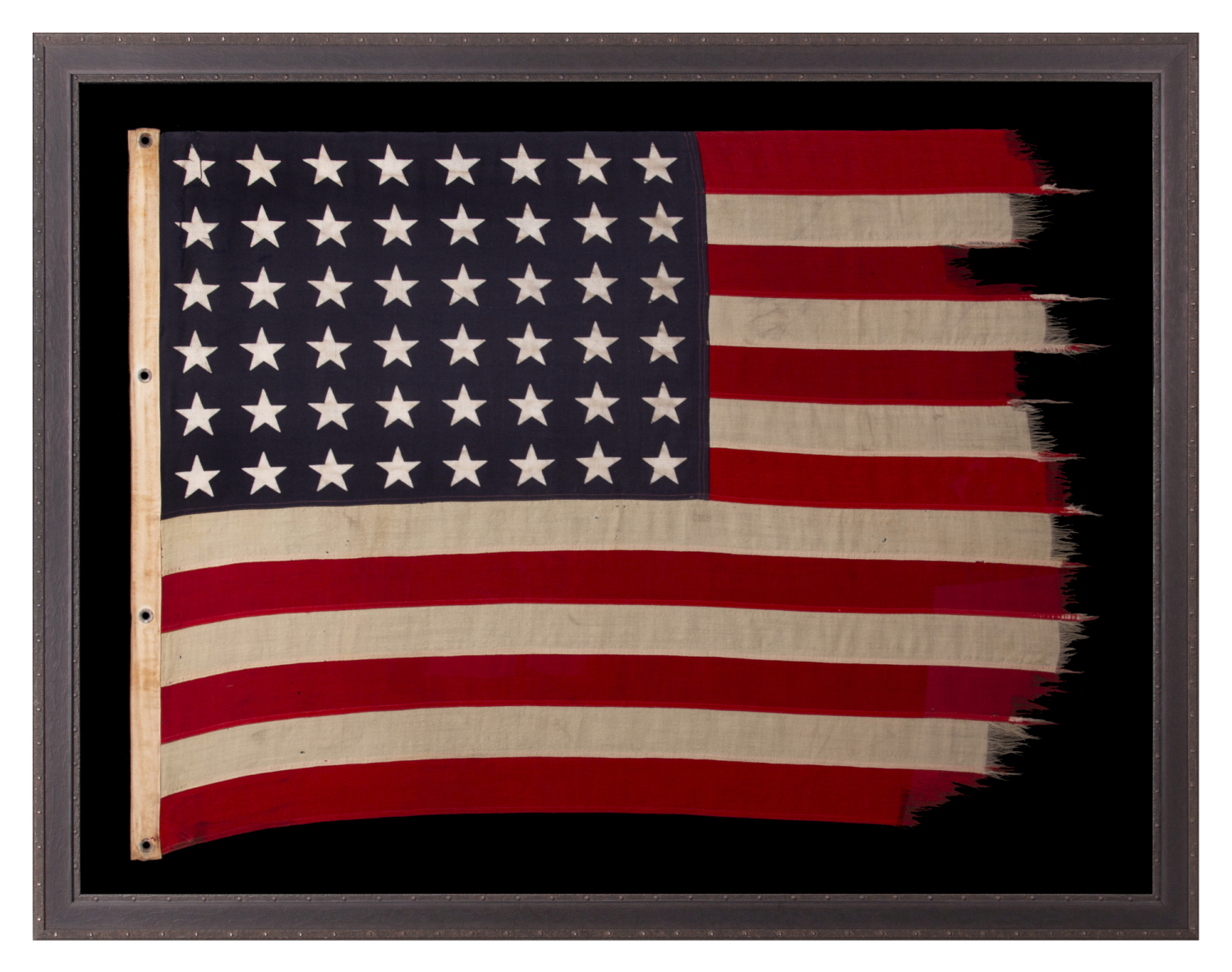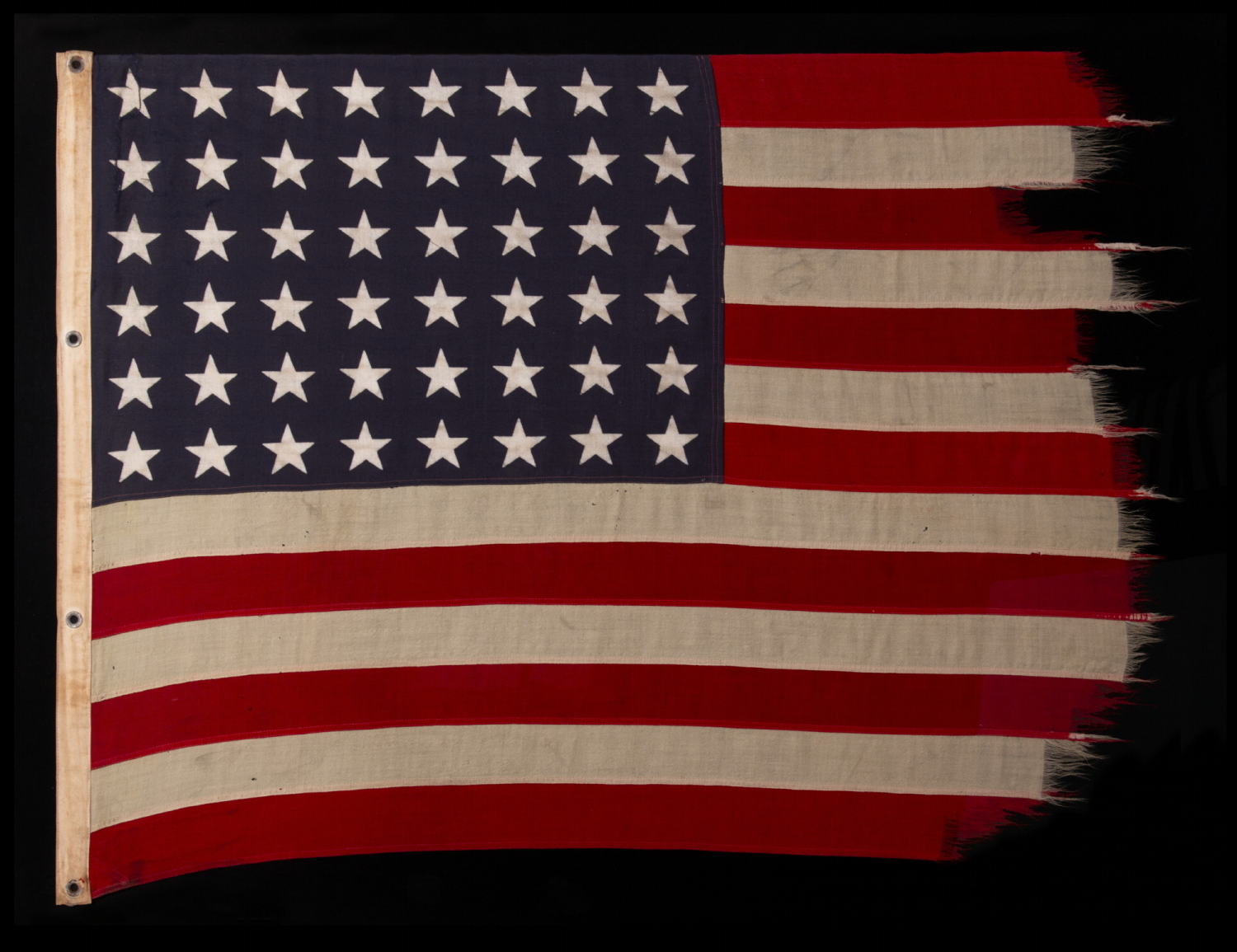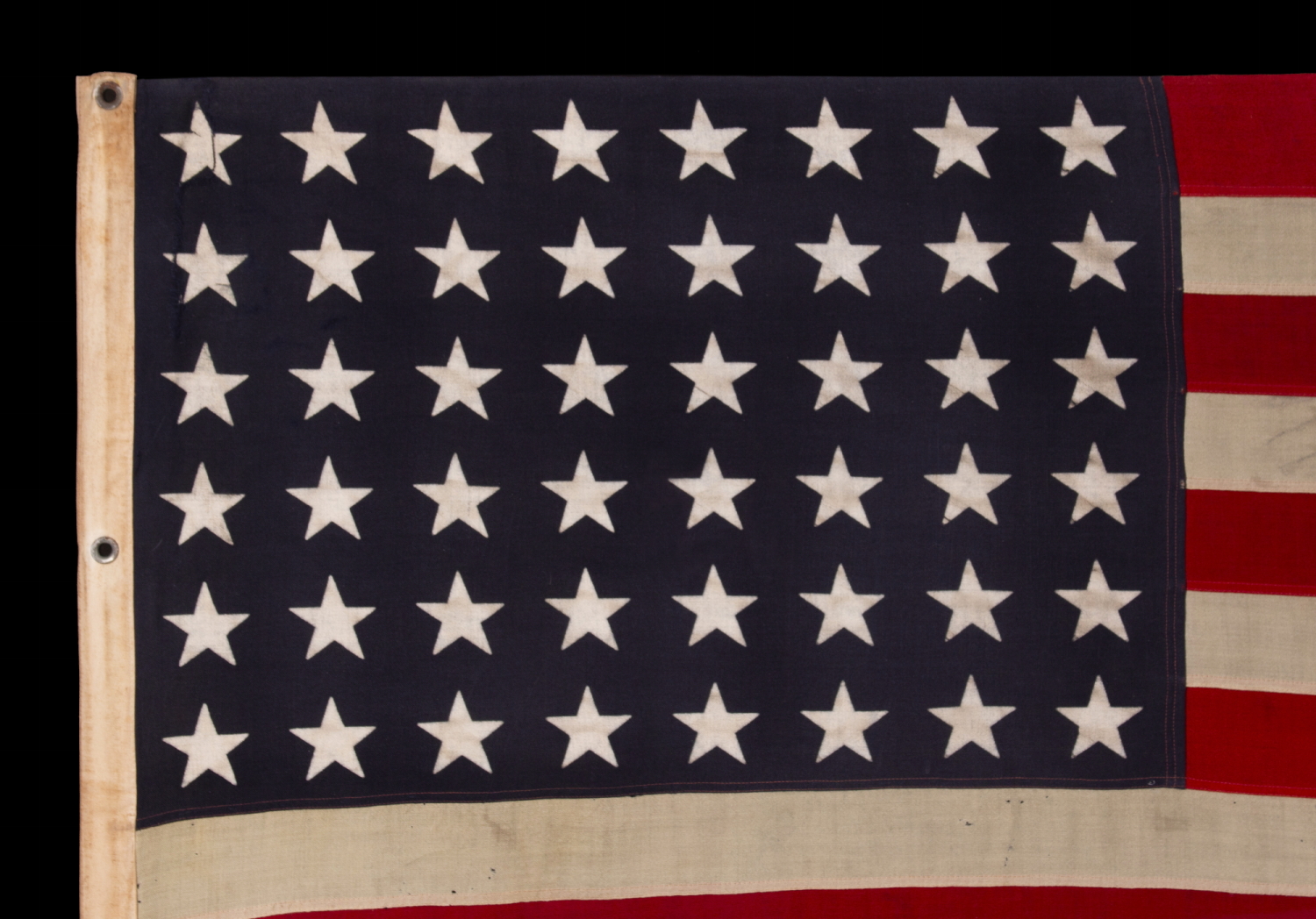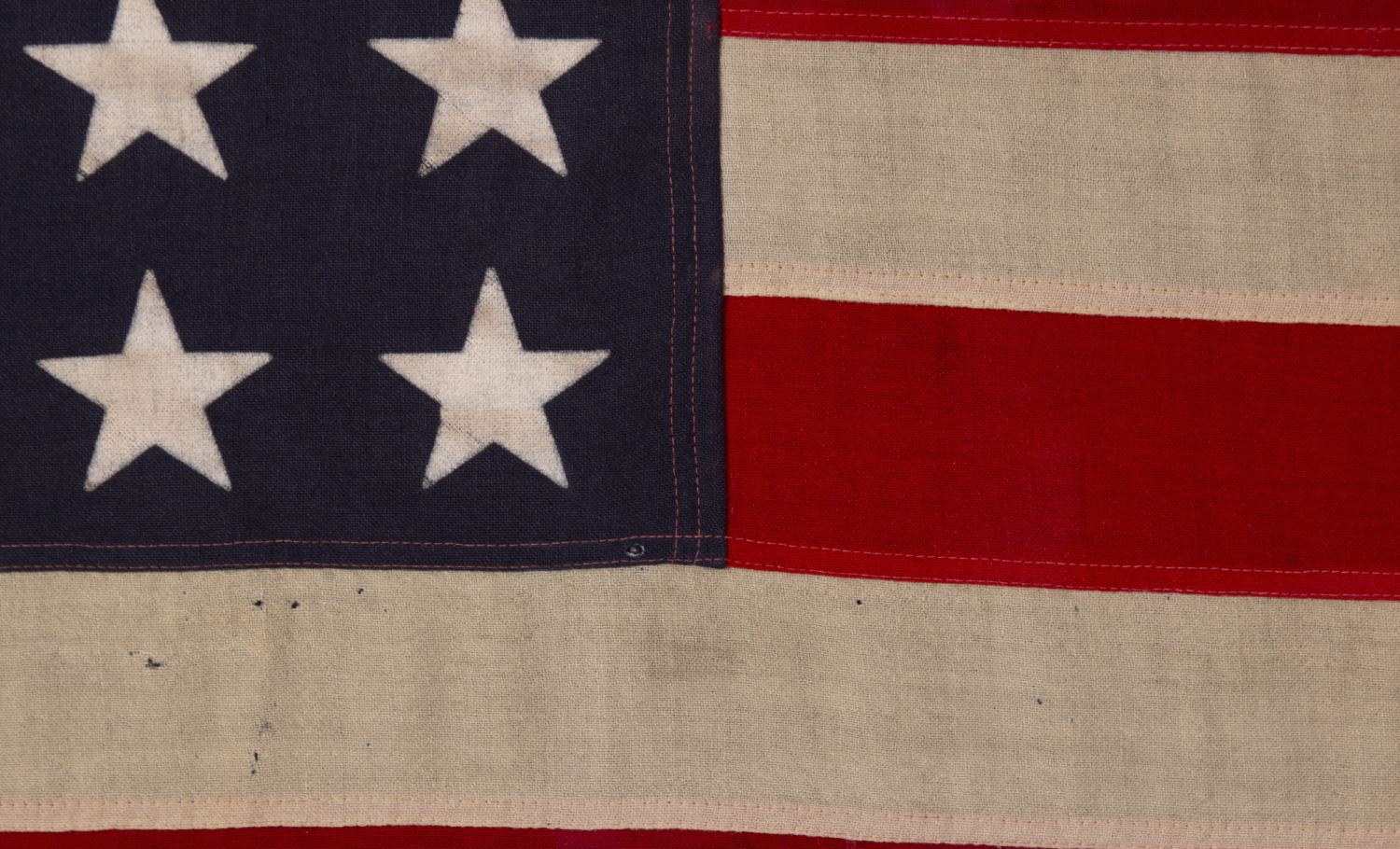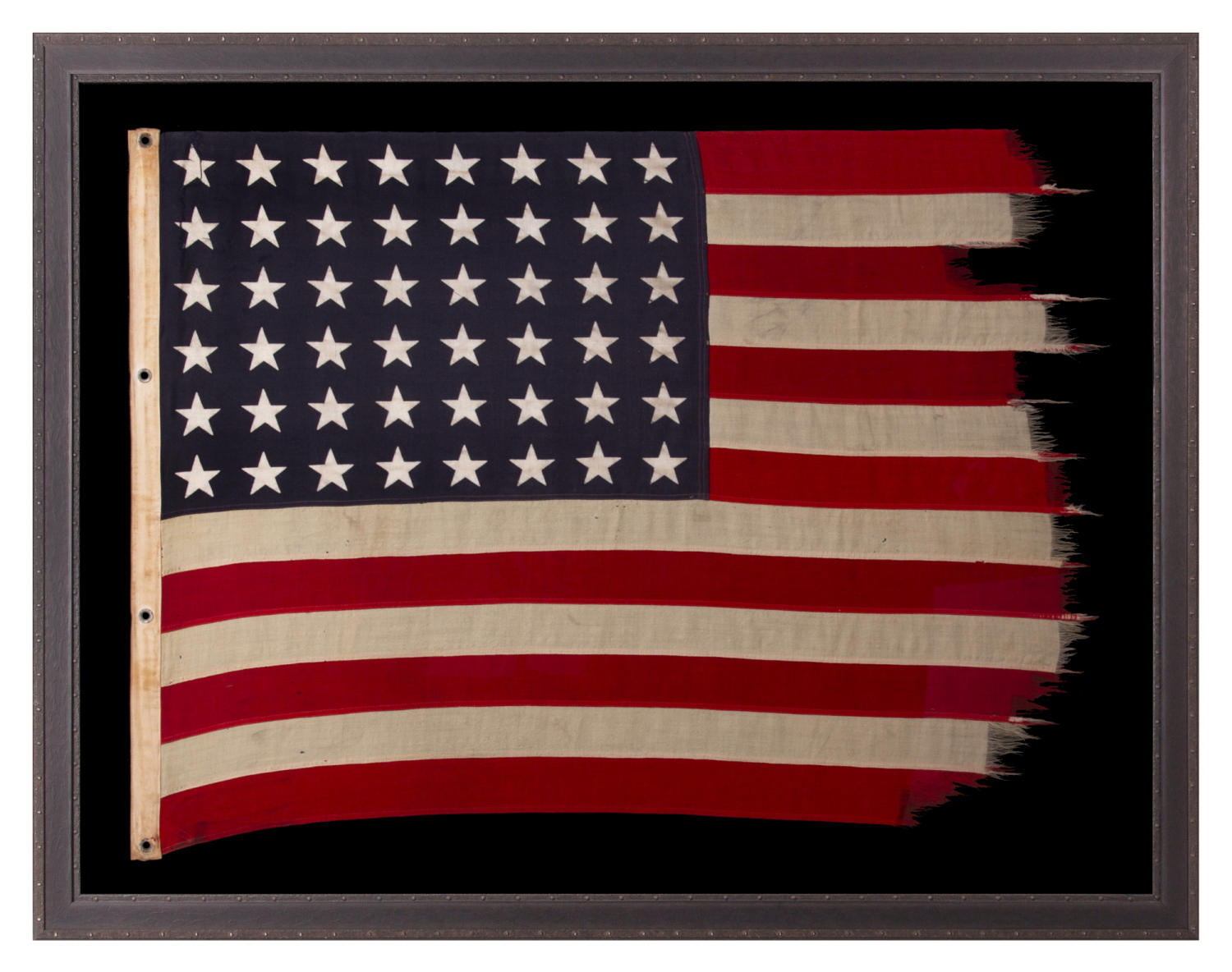
| ANTIQUE AMERICAN FLAG WITH 48 STARS, A U.S. NAVY SMALL BOAT ENSIGN, MADE IN JANUARY OF 1944, DURING WWII (U.S. INVOLVEMENT 1941-45), AT MARE ISLAND, CALIFORNIA, FORMER HEADQUARTERS OF THE PACIFIC FLEET, WITH ENDEARING WEAR FROM LONG-TERM USE |
|
| Web ID: | 48j-1090 |
| Available: | In Stock |
| Frame Size (H x L): | 53.5" x 69.75" |
| Flag Size (H x L): | 41.25" x 59.25" |
| Description: | |
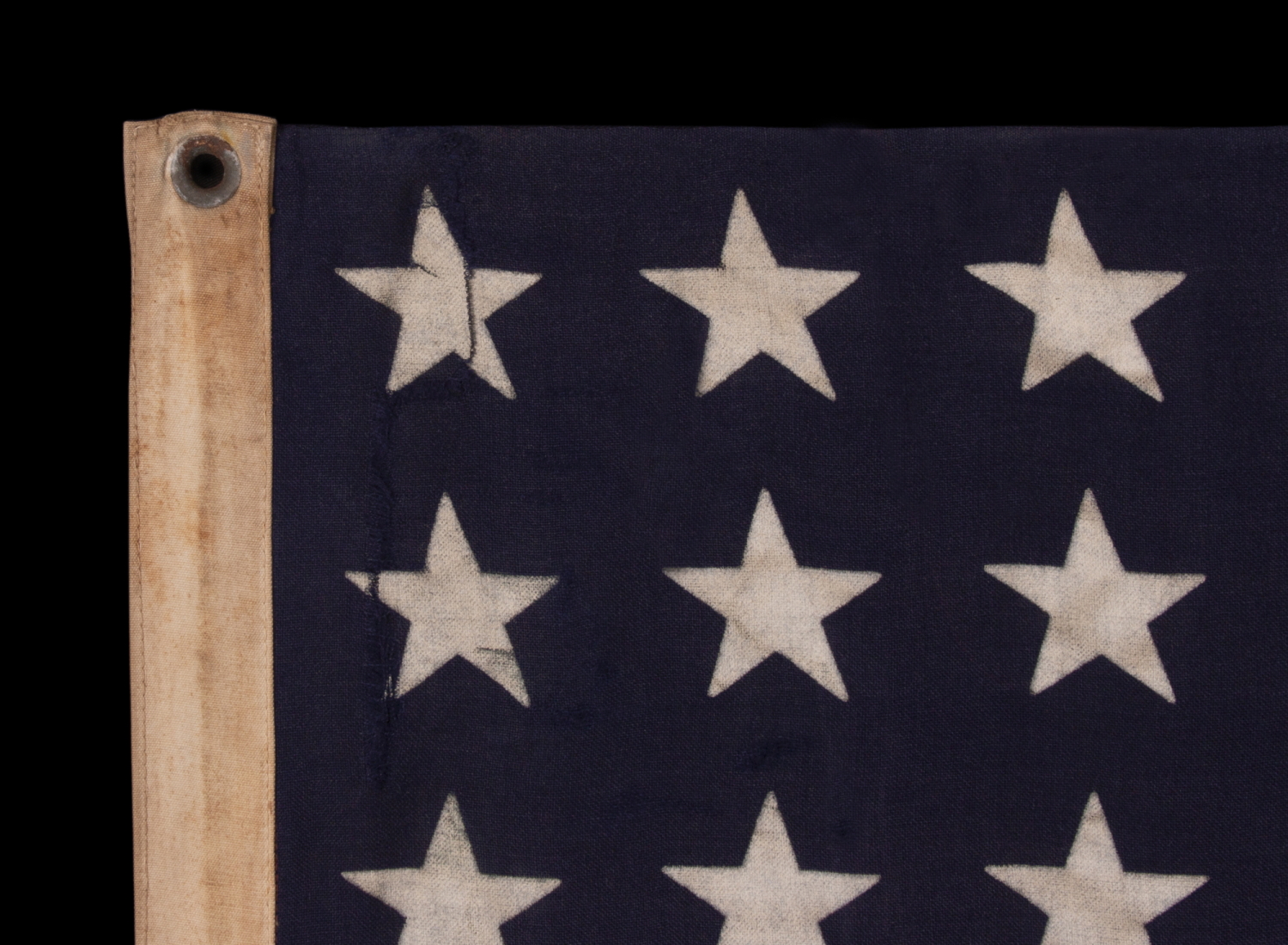
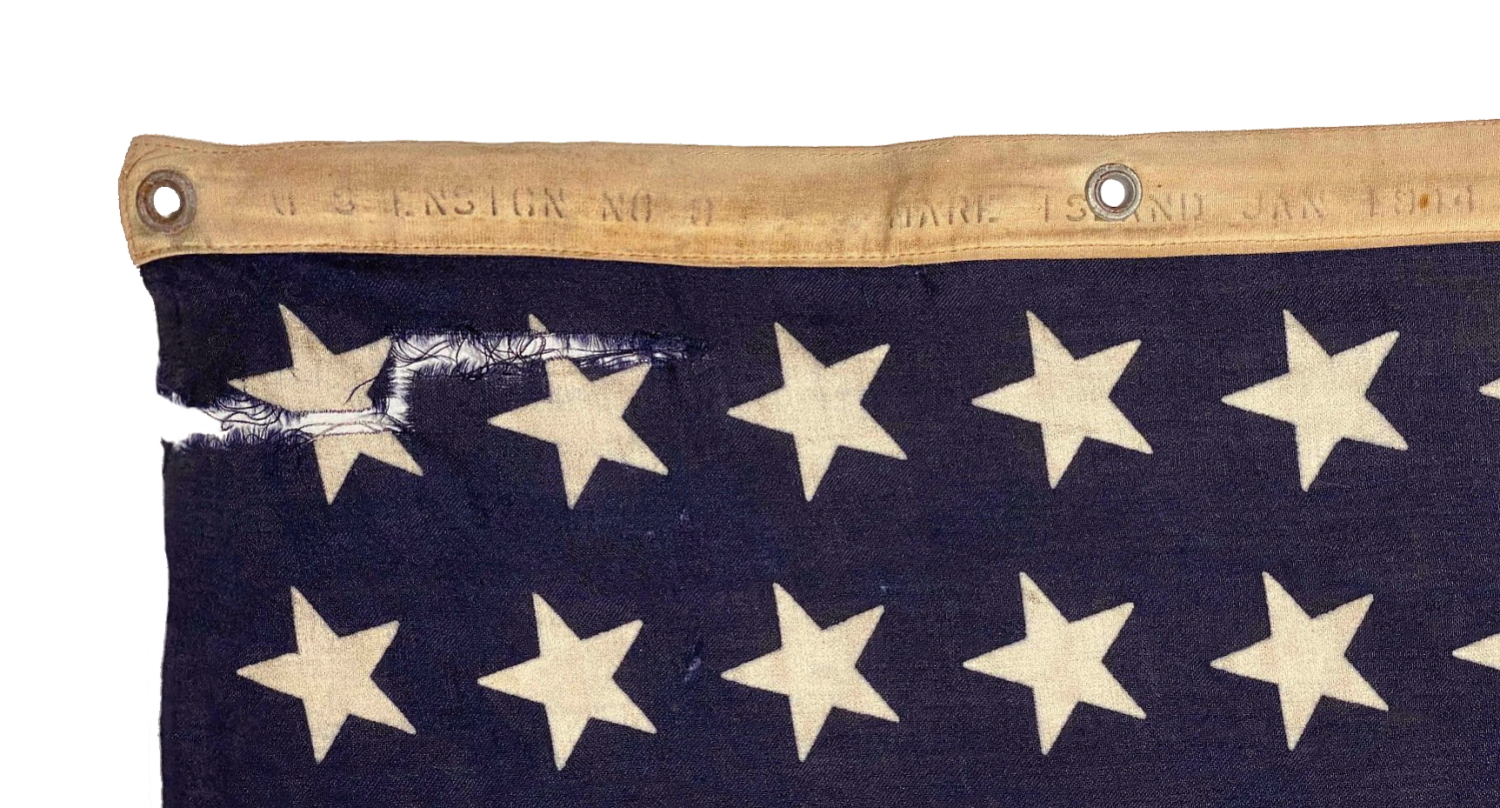
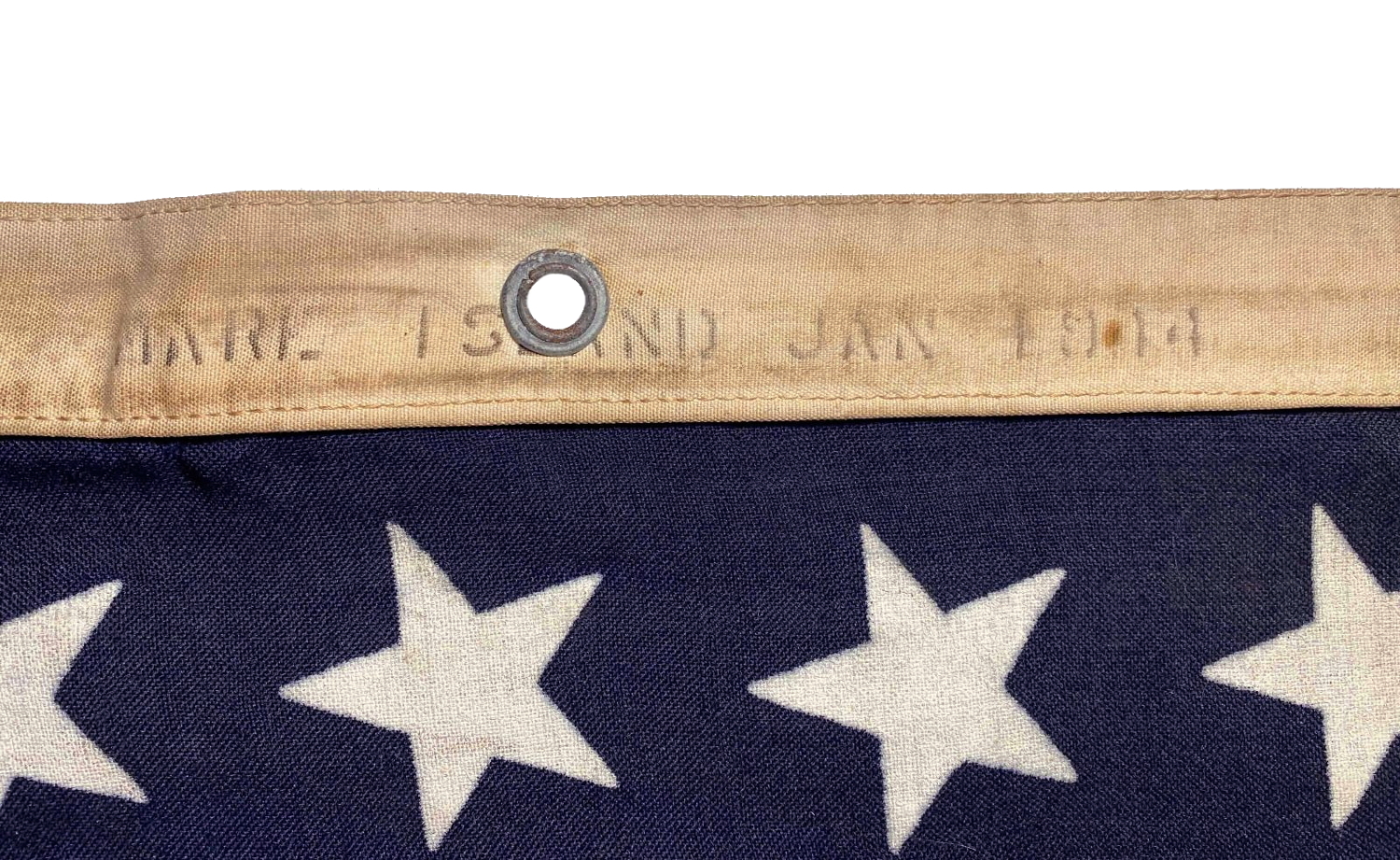
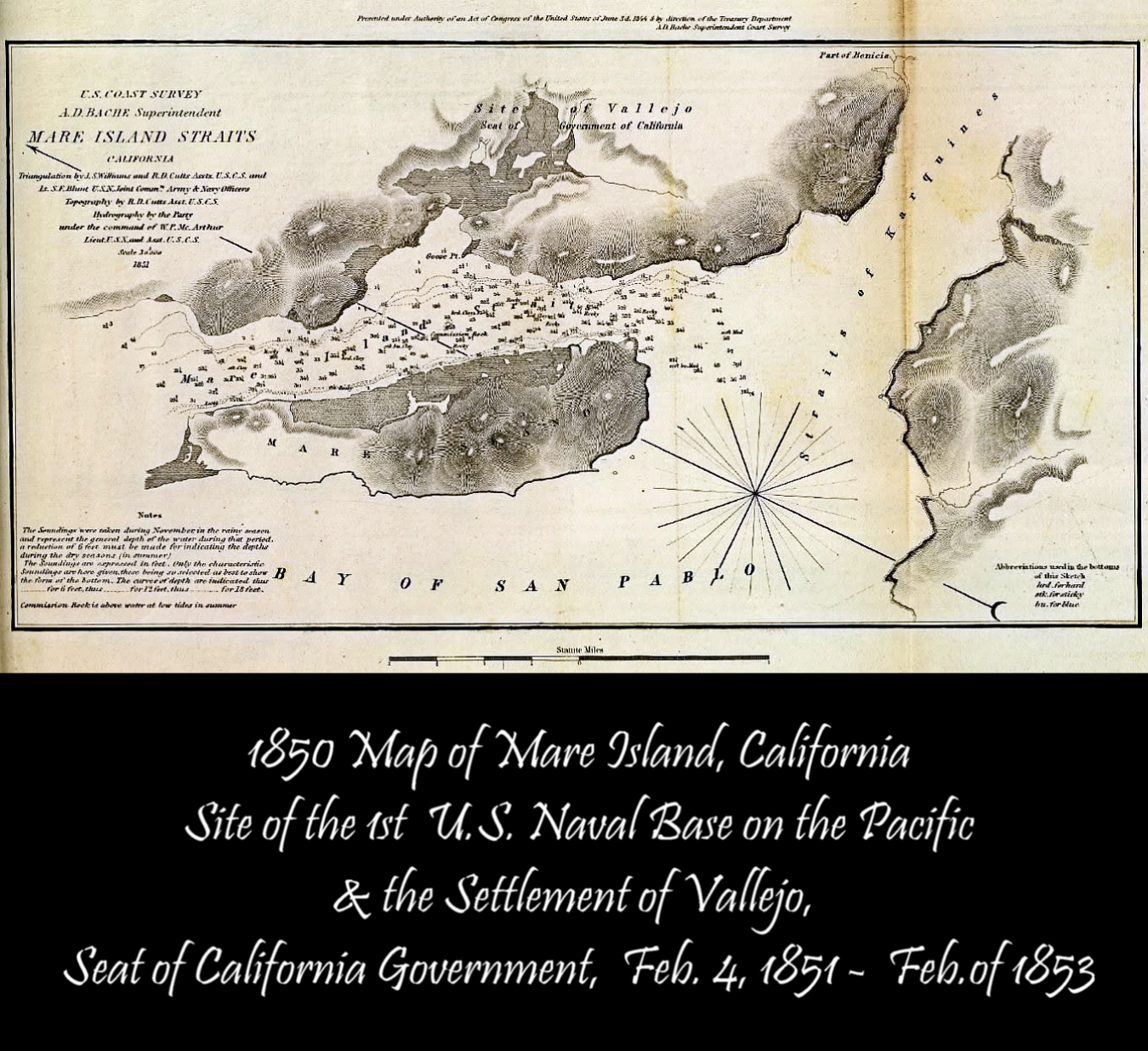
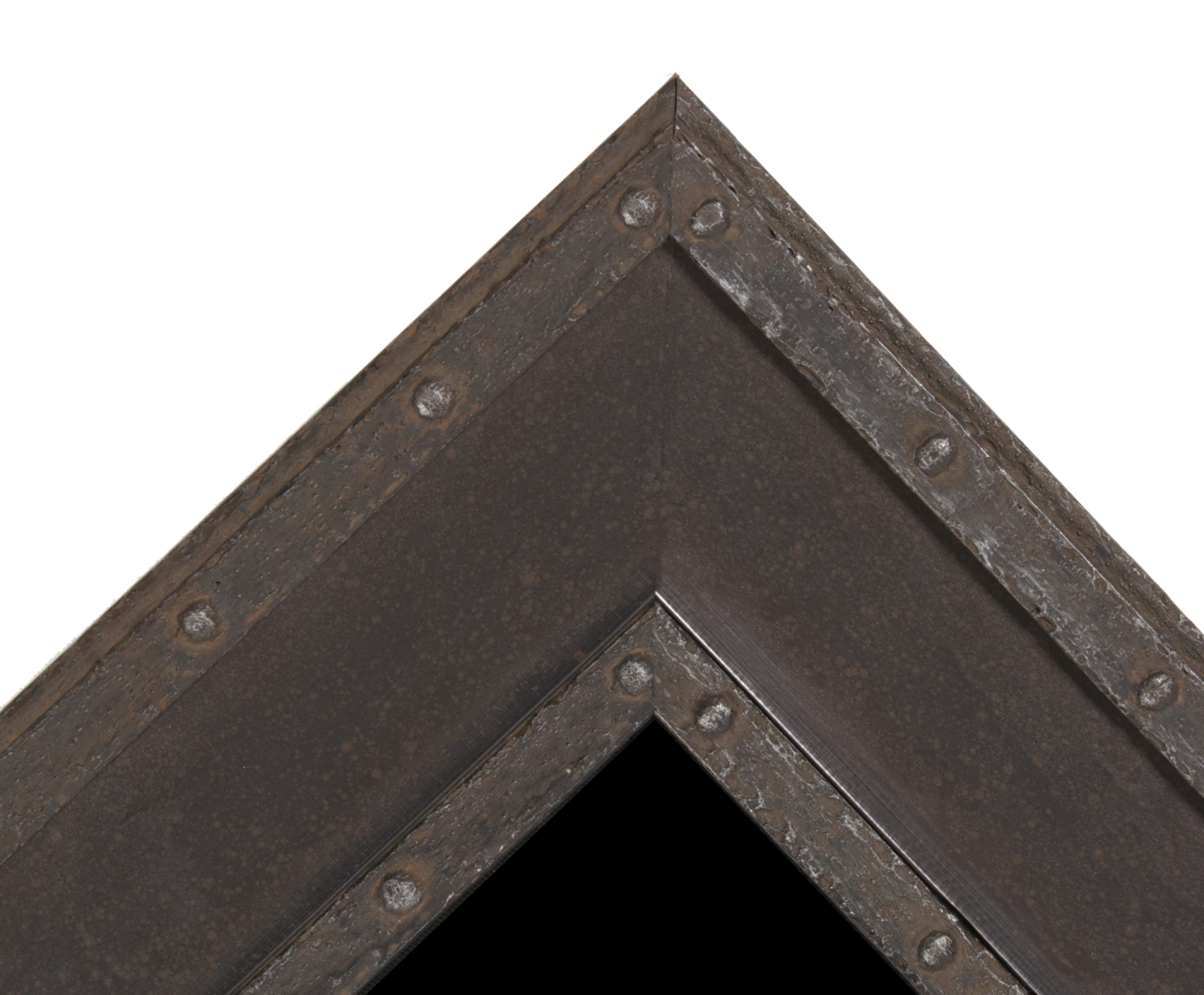
| 48 star, U.S. Navy small boat ensign, made in January of 1944, during the WWII, at Mare Island, California, Headquarters of the Pacific Fleet. A black stencil along the hoist on the reverse side reads as follows: "US Ensign No 9 Mare Island Jan 1944.” While U.S. involvement in the Second World War (1941-45) necessitated the acquisition of flags from many sources, the Navy had long made their own flags at several locations, of which this was one. “Ensign” is simply a term for the primary flag flown on a ship. "No. 9" is a size designation for a small boat flag that, per U.S. Navy Regulations of 1914, was to measure 3.52 x 6.69 feet. The canton and stripes of the flag are made of wool bunting, of an unusually heavy weight, typical of Mare Island-produced flags. The individual elements have been pieced and hemmed by machine stitching. The stars are block-printed or stenciled in thick, white pigment, expertly applied. This is a known technique, in use at Mare Island at this time, present on other known examples from this location. Use of this method provides sound evidence of ingenuity and perseverance, in the face of wartime shortages, as well as our nation’s great need for efficiency, with so many Americans engaged in various aspects of the fight, far from home, so many of whom would never return. There is a sailcloth canvas binding along the hoist, with four white metal grommets, the latter of which demonstrate the shortage of available brass, critical in the manufacture of shell cartridges. The general manner in which the flag is made, with higher grade fabrics and uncommonly stout construction, is indicative of U.S. Navy flags of the WWI-WWII era. Although the specific history of this flag has been lost to time, the fact that it displays proper evidence of having been flown for an extended period is uncommon among surviving examples. Most flags of this nature, brought home by sailors, were ships stores and never saw wartime service. Endearing wear from legitimate wartime is, in this instance, both historically attractive and visually striking. The 48 star flag became official in 1912 following the addition of New Mexico and Arizona. It remained so throughout WWI (U.S. involvement 1917-18), WWII (U.S. involvement 1941-45), and the Korean War (1950-53), until Alaska gained statehood in 1959, and the 49th star was added. Located about 23 miles northeast of San Francisco, Mare Island (actually a peninsula) became a seat of U.S. Navy defense in 1852, in the wake of California’s admission as the 31st state (1850). The site was proposed by Commodore John Drake Sloat, a prominent U.S. Navy officer who, in 1848, had embarked at Monterey and claimed the former Mexican ‘Alta California’ Territory for the United States, with the support of explorer and former U.S. Army Engineer, John Fremont, who arrived on the same day, in the employment of one America’s most powerful senators, Railroad Thomas Hart Benton of Missouri. Two years later, Sloat received orders to lead a survey party in search of a logical site for the nation's first Pacific naval installation. The result was his recommendation that it be situated on the ‘island’ that lay beyond the Napa River, on the western edge of the settlement of Vallejo, which at that time served as the state’s principle seat of government. Sloat selected the location, being "free from ocean gales and from floods and freshets." On November 6th 1852, two years after California gained statehood, President Fillmore reserved Mare Island for government use by Executive Order. Acting favorably on Sloat’s report, U.S. Navy purchased Mare Island, in July of 1853, for the sum of $83,410, for use as a naval shipyard.* Two years later, on September 16th of 1854, it became the first permanent U.S. naval installation on the West Coast, with Commodore David G. Farragut serving as its first commander. The base became home to what was known as the Pacific Fleet, and remained so until the threat of Japanese expansionism caused the shift to a more advanced position at Pearl Harbor. Very active in WWII, Korea, and Vietnam, it closed in 1993, following congressional approval of recommendations contained in the Base Realignment and Closure Report. All-in-all, an exceptional U.S. Navy-produced relic of WWII, clearly dated and with identified origin, exhibiting both characteristics of wartime shortage, and compellingly attractive wear from wartime use. * When the Navy bought Mare Island, it belonged to one of its own, Lieutenant Commander William Pope McArthur, a U.S. Navy hydrographer, who had previously surveyed the island, and, in 1850, bought it from its Mexican owner, with a consortium of private investors. Per the 1848 Treaty of Guadalupe Hidalgo, that ended the Mexican War, legal owners of private land, in areas seized by or otherwise transferred to the United States, retained their original ownership. Mounting: The flag was mounted and framed within our own textile conservation department, led by expert staff. We take great care in the mounting and preservation of flags and have framed thousands of examples. The 3-part frame is made of wood, yet has a distressed metallic finish that presents like old gunmetal and rusted iron. The glazing is U.V. protective acrylic (Plexiglas). Condition: In addition to extensive losses at the fly end, there is moderate to significant soiling along the canvas hoist and in some of the stars. There is a significant tear in the upper, hoist end corner of the canton, extending downward from the top edge, into the two stars below, with minor, associated pigment loss. There is extremely minor pigment loss in the stars from creasing, and a limited number of tiny holes in the striped field, accompanied by a few minor to modest areas of soiling in the same. Many of my clients prefer early flags to show their age and history of use, especially when they present well, as-is the case here. |
|
| Video: | |
| Collector Level: | Intermediate-Level Collectors and Special Gifts |
| Flag Type: | Sewn flag |
| Star Count: | 48 |
| Earliest Date of Origin: | 1944 |
| Latest Date of Origin: | 1944 |
| State/Affiliation: | California |
| War Association: | WW 2 |
| Price: | Please call (717) 676-0545 or (717) 502-1281 |
| E-mail: | info@jeffbridgman.com |
 |
|