| |
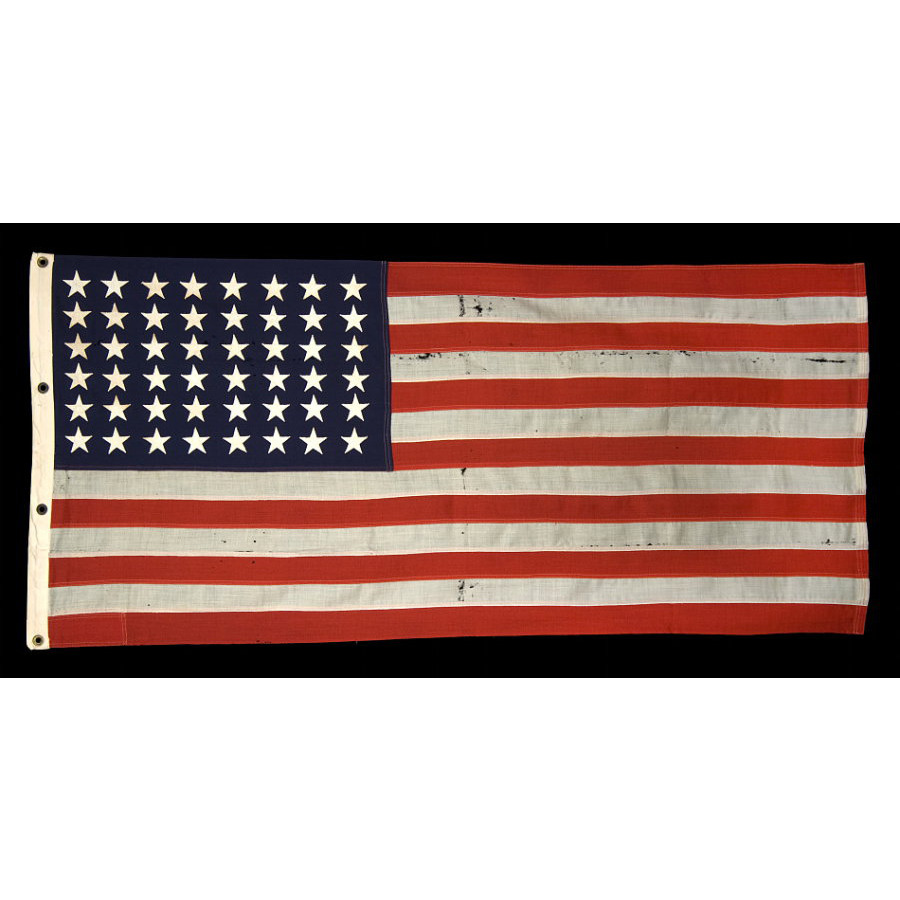
48 STAR, U.S. NAVY SMALL BOAT ENSIGN, MADE AT MARE ISLAND, CALIFORNIA DURING WWII, SIGNED & DATED MARCH, 1941 |
|
| Available: |
Sold |
| Frame Size (H x L): |
|
| Flag Size (H x L): |
30.75" x 69" |
|
| Description....: |
|
48 star American national flag, made during World War II and signed along the reverse side of the hoist with a black stencil that reads: "U S ENSIGN NO 10 MARE ISLAND MAR 1941." This was the month that Japanese spy Takeo Yoshikawa arrived in Honolulu to begin his study of the United States fleet at Pearl Harbor. It was also at this time that F.D.R. signed the Lend Lease Act, which allowed Britain, China, and other Allies to buy U.S. military goods and defer payment until after the war. While the U.S. would not formally declare war until Japan attacked on December 8th, American volunteers, especially pilots ("Gun-Jumpers") had joined the Canadian and British forces and the American military was posturing in anticipation of the inevitable. WWII is generally said to have begun on September 1st, 1939, when Hitler invaded Poland and war was subsequently declared on Germany by France and the United Kingdom.
Located about 23 miles northeast of San Francisco, Mare Island (actually a peninsula) became a seat of U.S. Navy defense in 1852, in the wake of California’s admission as the 31st state (1850). The site was proposed by Commodore John Drake Sloat, a prominent U.S. Navy officer who, in 1848, had embarked at Monterey and claimed the former Mexican ‘Alta California’ Territory for the United States, with the support of explorer and former U.S. Army Engineer, John Fremont, who arrived on the same day, in the employment of one America’s most powerful senators, Railroad Thomas Hart Benton of Missouri. Two years later, Sloat received orders to lead a survey party in search of a logical site for the nation's first Pacific naval installation. The result was his recommendation that it be situated on the ‘island’ that lay beyond the Napa River, on the western edge of the settlement of Vallejo, which at that time served as the state’s principle seat of government. Sloat selected the location, being "free from ocean gales and from floods and freshets." On November 6th 1852, two years after California gained statehood, President Fillmore reserved Mare Island for government use by Executive Order. Acting favorably on Sloat’s report, U.S. Navy purchased Mare Island, in July of 1853, for the sum of $83,410, for use as a naval shipyard.* Two years later, on September 16th of 1854, it became the first permanent U.S. naval installation on the West Coast, with Commodore David G. Farragut serving as its first commander. The base became home to what was known as the Pacific Fleet, and remained so until the threat of Japanese expansionism caused the shift to a more advanced position at Pearl Harbor. Very active in WWII, Korea, and Vietnam, it closed in 1993, following congressional approval of recommendations contained in the Base Realignment and Closure Report.
Arizona joined the Union as the 48th state in 1912. The 48 star flag was official that year until 1959.
Construction: The canton and stripes of the flag are made of wool bunting, pieced with machine stitching. The stars are made of cotton and are double-appliqued (applied to both sides) with a zigzag machine stitch. There is a heavy canvas binding with four especially heavy gauge brass grommets for hoisting, each stamped with a number "2". The weight of the wool and the stalwart construction is typical of what the Navy preferred for its flags in this period. The fabric is heavier grade than what was typically employed in commercially-made flags and the fly end was bound with rows of stitching instead of the usual two. There is a large gusset (a patch of extra fabric added for support in areas that received the most wear) in the lower, hoist-end corner.
* When the Navy bought Mare Island, it belonged to one of its own, Lieutenant Commander William Pope McArthur, a U.S. Navy hydrographer, who had previously surveyed the island, and, in 1850, bought it from its Mexican owner, with a consortium of private investors. Per the 1848 Treaty of Guadalupe Hidalgo, that ended the Mexican War, legal owners of private land, in areas seized by or otherwise transferred to the United States, retained their original ownership.
Mounting: The flag has not yet been mounted. It must be mounted in the proper vertical format, with the canton in the upper left, in order to view the stencil, which is on the reverse side of the hoist binding. Fabric of similar coloration can be placed behind the flag during the mounting process, if so desired, to ghost out the minor losses.
Condition: There is minor mothing throughout, which is common in vintage wool flags. There is only the most minor amount of staining, almost not worthy of mention. The colors are strong and the flag presents beautifully. Many of my clients prefer early flags to show their age gracefully. |
|
|
|
| Collector Level: |
Beginners and Holiday Gift Giving |
|
| Flag Type: |
Sewn flag |
|
| Star Count: |
13 |
|
| Earliest Date of Origin: |
1941 |
|
| Latest Date of Origin: |
1941 |
|
| State/Affiliation: |
California |
|
| War Association: |
WW 2 |
|
| Price: |
SOLD |
|
| |
Views: 6963 |
|
|
|





