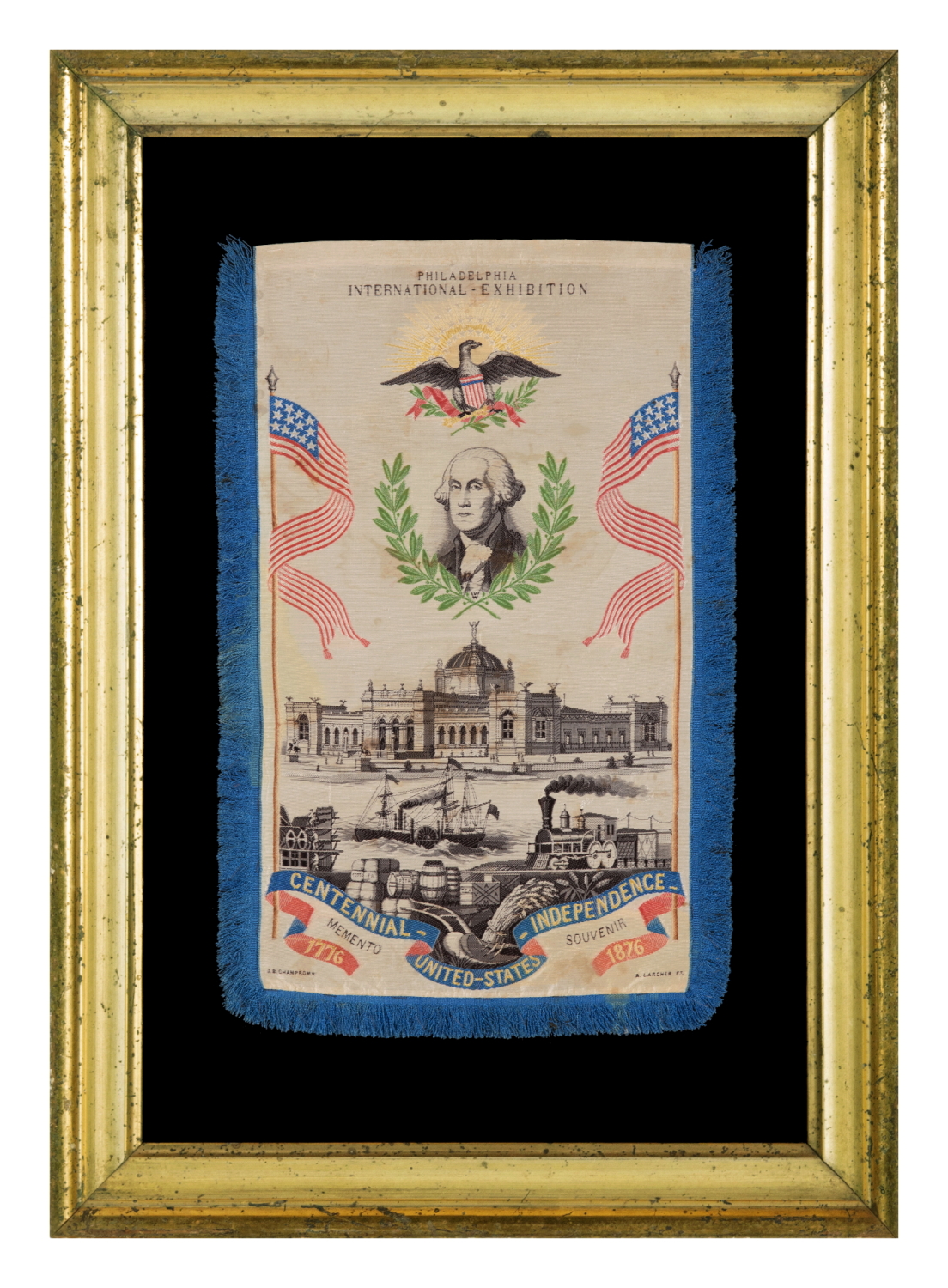
| LARGE SCALE SOUVENIR STEVENSGRAPH, MADE TO CELEBRATE 100 YEARS OF AMERICAN INDEPENDENCE, BY JEAN-BAPTISTE CHAMPROMY & A. LARCHER, IN SAINT-ÉTIENNE, FRANCE, FOR PHILADELPHIA’S 1876 CENTENNIAL INTERNATIONAL EXPOSITION |
|
| Web ID: | pat-720 |
| Available: | Sold |
| Frame Size (H x L): | 16.75" x 11.75" |
| Flag Size (H x L): | 11" x 7.25" |
| Description: | |
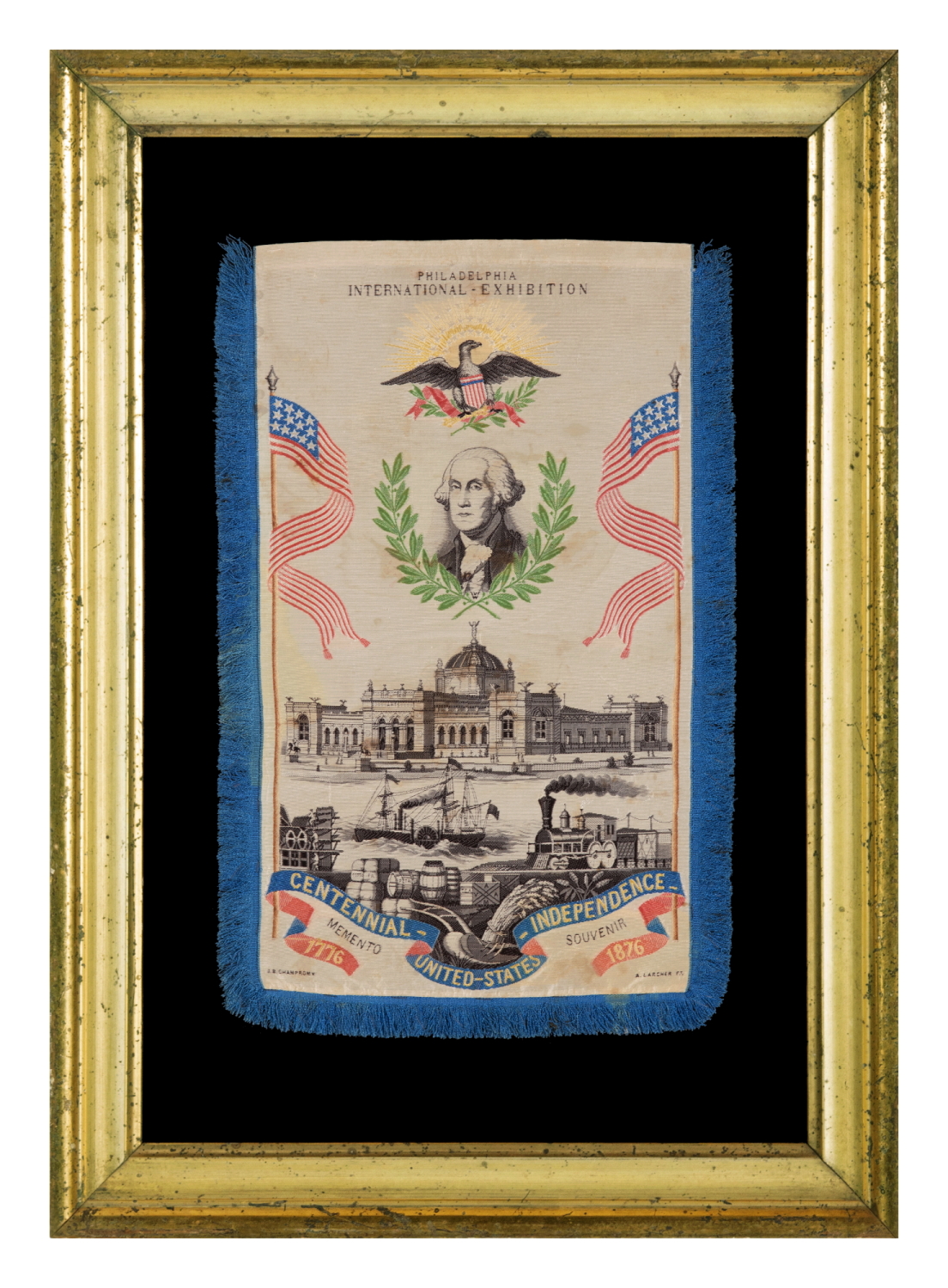
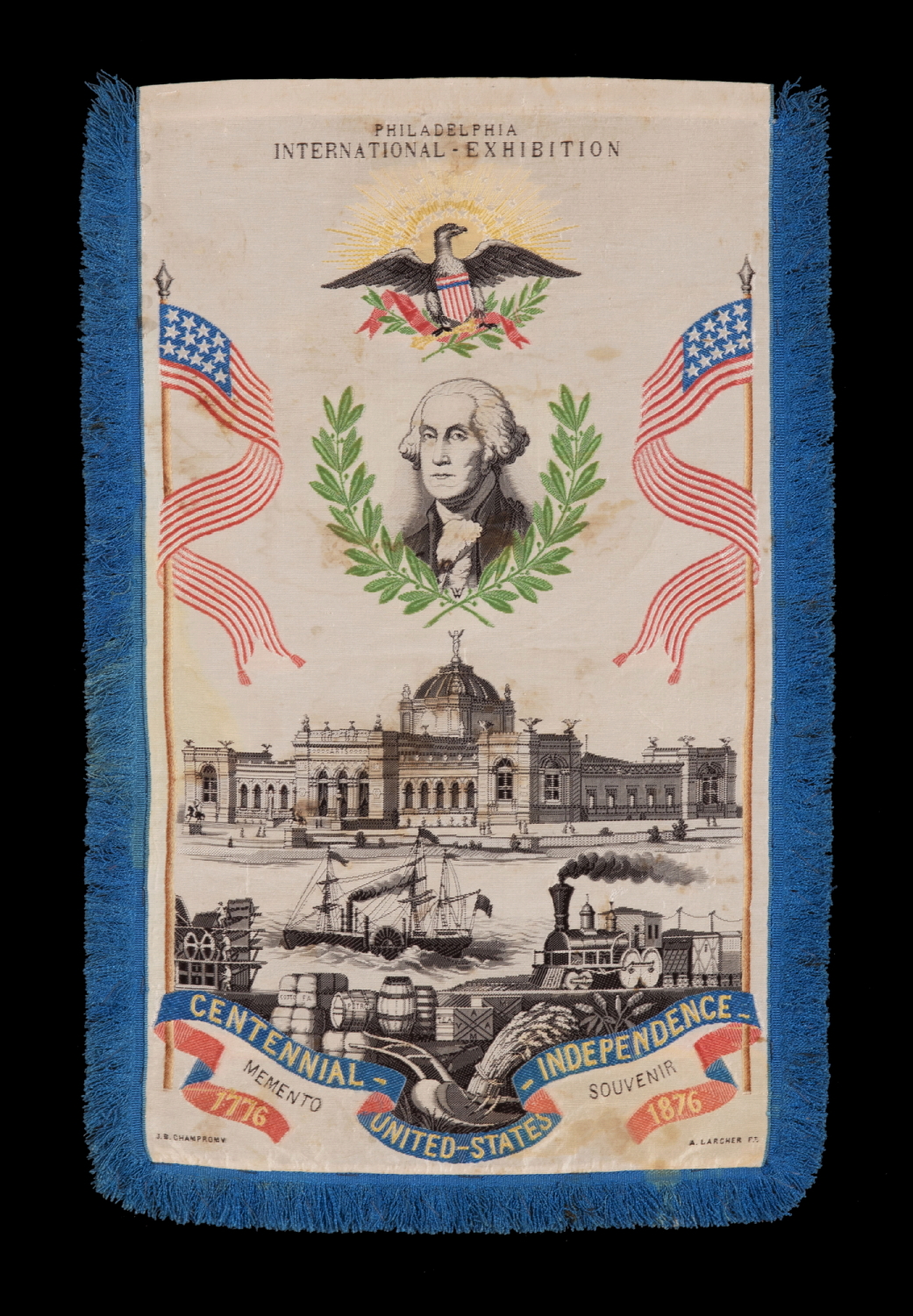
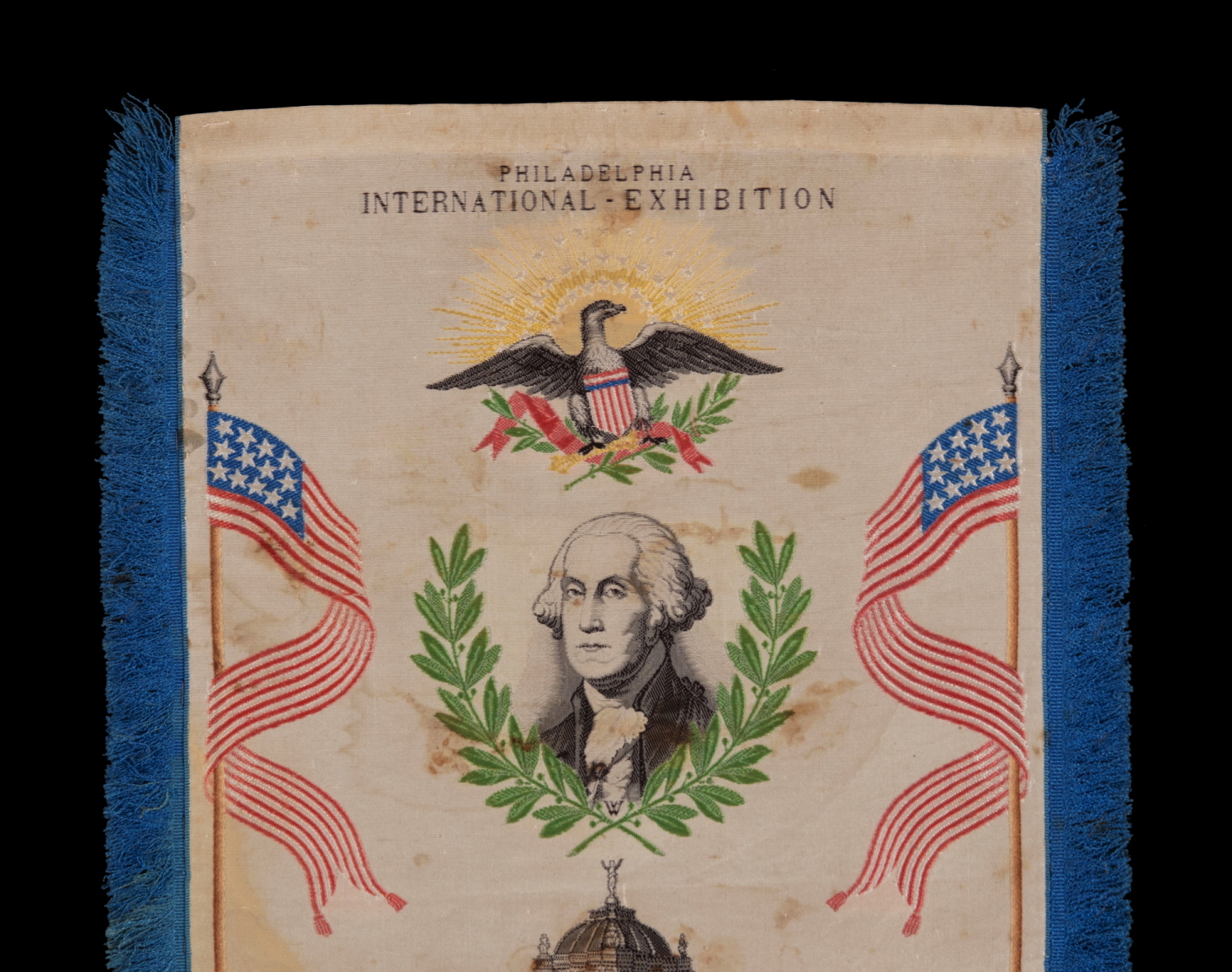
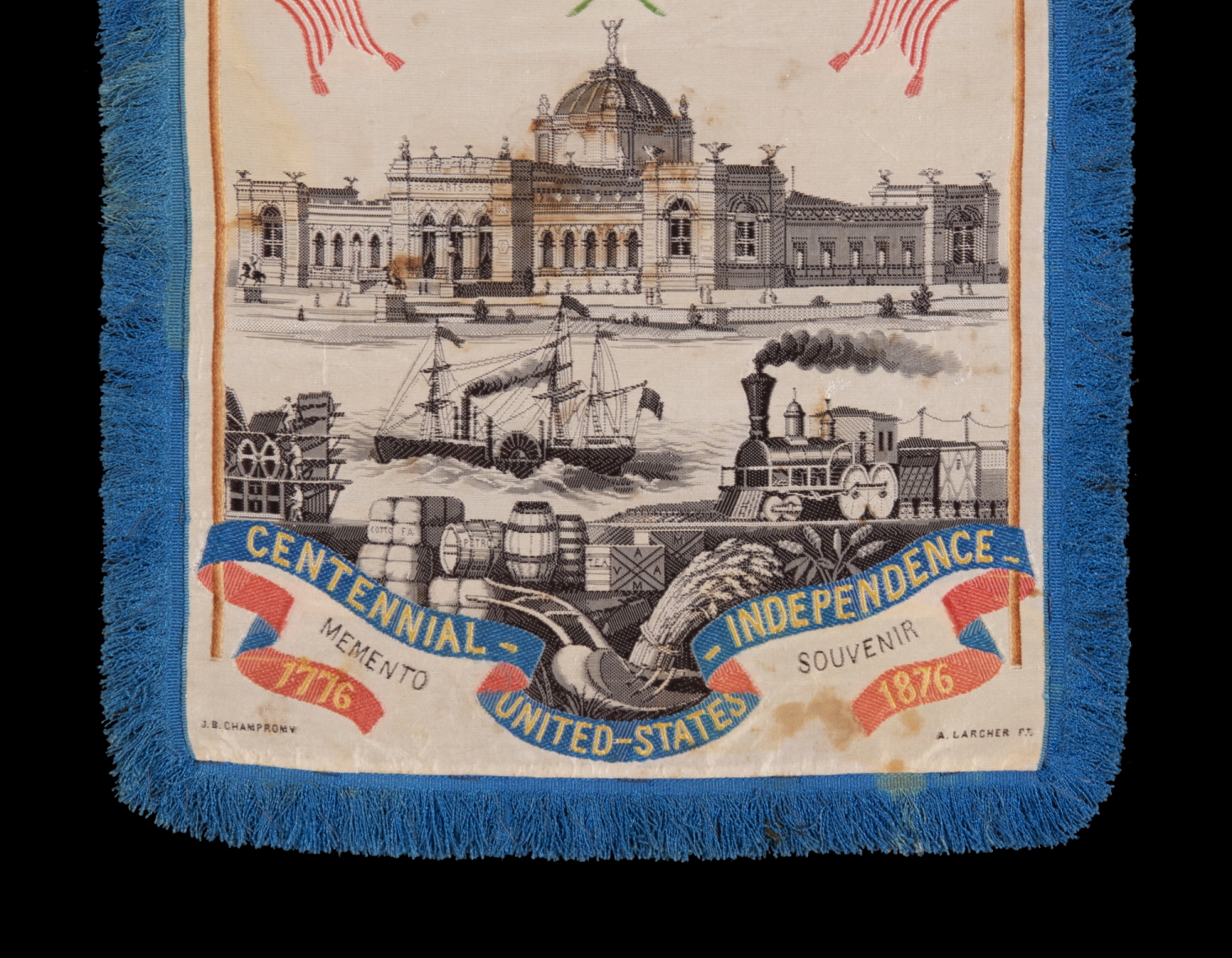
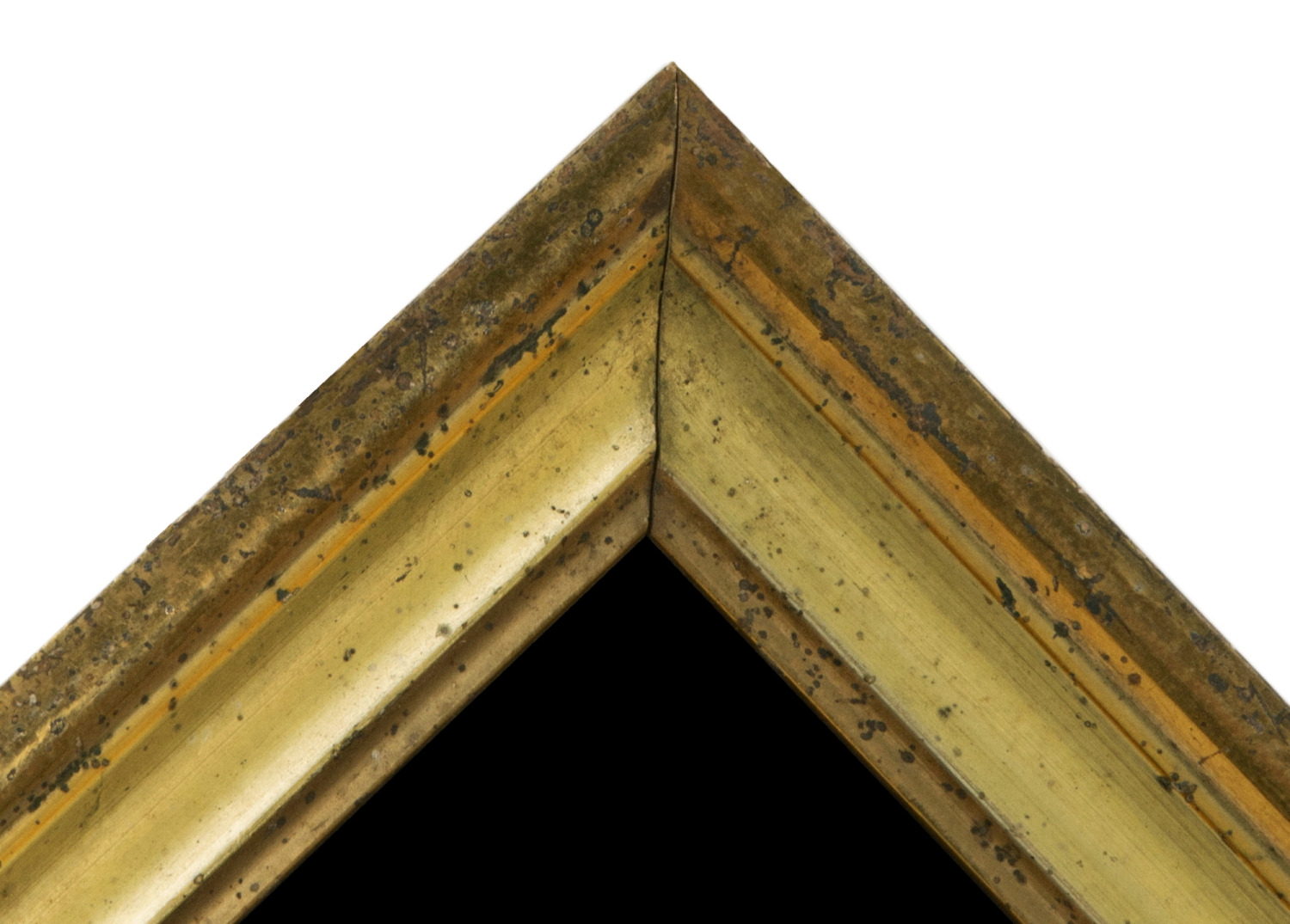
| This souvenir Stevensgraph (woven silk picture) was made for the 1876 Centennial International Exposition in Philadelphia, Pennsylvania, America’s first World’s Fair event, held in conjunction with our nation’s 100-year anniversary of independence. One of the key figures who pioneered the technology to produce this manner of textile was Thomas Stevens, a weaver in Coventry, England, who adapted a Jacquard loom to weave colorful pictures from silk. Stevens sold his first in 1862. At that time he was producing four different designs, though by the late 1880's, that number had grown to approximately 900. Though Stevens was the foremost marketer, successful in equating his name with these extraordinarily fine textiles, French, Swiss, and German competitors all acquired the technology to produce them at approximately the same time, in or around 1860. Most Stevensgraphs were bookmarks, but there were greeting cards, postcards, and other formats, of which this is a standout. Approximately three times the width of a large bookmark, this giant format, Stevensgraph-type textile—rare in scale among its counterparts—was produced in Saint-Étienne, France. The name of its designer and marketer, “J. B. (Jean-Baptiste) Champromy,” appears in the lower, left corner, while that of the printer, “A. Larcher,” appears to the right. Saint-Étienne served as the global epicenter for silk ribbon production during the 19th century, at one point employing as many as 30,000. Though Champromy does not appear to have been a major exhibitor, with a physical presence at the fair, he is listed twice in the official catalogue, and is categorized among its archives as a manufacturer of ‘Political Americana’ and ‘Costume/Textiles.’ The graphics of the ribbon center on a familiar portrait of George Washington, in the style made famous by painter Gilbert Stuart, set within an open wreath of green laurel. Note the uncommon presence of a fanciful “W” beneath. Washington’s image flanked by two 13-star flags with billowing, stylized, elongated profiles that terminate in “V”-shaped swallowtails, tipped with tassels. Note the 4-4-5 star patterns, which are extremely unusual. Above Washington is a spread-winged, federal eagle, with a shield upon its breast, gripping arrows and olive branches. The rays of a rising sun extend above this, with an array of 37 stars to denote the number of states (prior to Colorado’s addition on August 1st, 1876). Along the upper register are the words “Philadelphia International Exposition”. The Fairmount Park Art Gallery, a.k.a. ‘Memorial Hall,’ illustrated just below center, is one of just two Centennial Expo buildings that still stand today on the original site.* Though immense in scale and opulent as a rule, almost all of the 200-plus structures erected for the event were only temporary. The largest of these, known simply as the Main Building, at 21 acres on the interior, was the largest building in the world at the time. Below the art gallery are industrial images that relate to Pennsylvania. The ship, the sheaf of wheat, and the plow are all part of Pennsylvania’s state seal (though in different format). There are also images of a steam engine, a manufacturing plant, and commodities such as petroleum (America’s first oil was discovered in Pennsylvania), tea, and cotton bails, the latter of which reflects Philadelphia’s booming textile industry. Below is a banner that celebrates the Expo. One of the most unusual attributes of this particular Stevensgraph is the delicate, blue, silk fringe applied to three sides. This was the most elaborately adorned version of the ribbon, also known to have been produced with fringe along the lower border only, as well as with no fringe at all. All-in-all, an exceptional example of what I consider to be the very best of all varieties of Stevensgraph-type ribbons known from the 1876 Centennial International Exhibition, in its most desirable form. * Two, small, brick outbuildings also remain on the site. Mounting: The flag was mounted and framed within our own conservation department, led by expert staff. We take great care in the mounting and preservation of flags and other early textiles, and have framed thousands of examples. The gilded, American, gilt molding dates to the period between 1820 and 1850, and displays beautifully saturated, lemon-green undertones that work extremely well with the colors of the textile. The background is 100% cotton twill, black in color, that has been washed and treated for colorfastness. The glazing is Optimum Museum Acrylic (Plexiglas), U.V. protective, anti-reflective (crystal clear), and scratch-resistant. Condition: There is a small amount of bleaching in the fringe, near the lower, right-hand corner. There is minor to modest soling in limited areas, accompanied by small instances of modest to moderate of the same. This is an extraordinarily difficult example to acquire with the 3-sided fringe and without significant fading, such that it presents beautifully. |
|
| Video: | |
| Collector Level: | Intermediate-Level Collectors and Special Gifts |
| Flag Type: | |
| Star Count: | 37 |
| Earliest Date of Origin: | 1876 |
| Latest Date of Origin: | 1876 |
| State/Affiliation: | Pennsylvania |
| War Association: | |
| Price: | SOLD |
| E-mail: | info@jeffbridgman.com |
 |
|