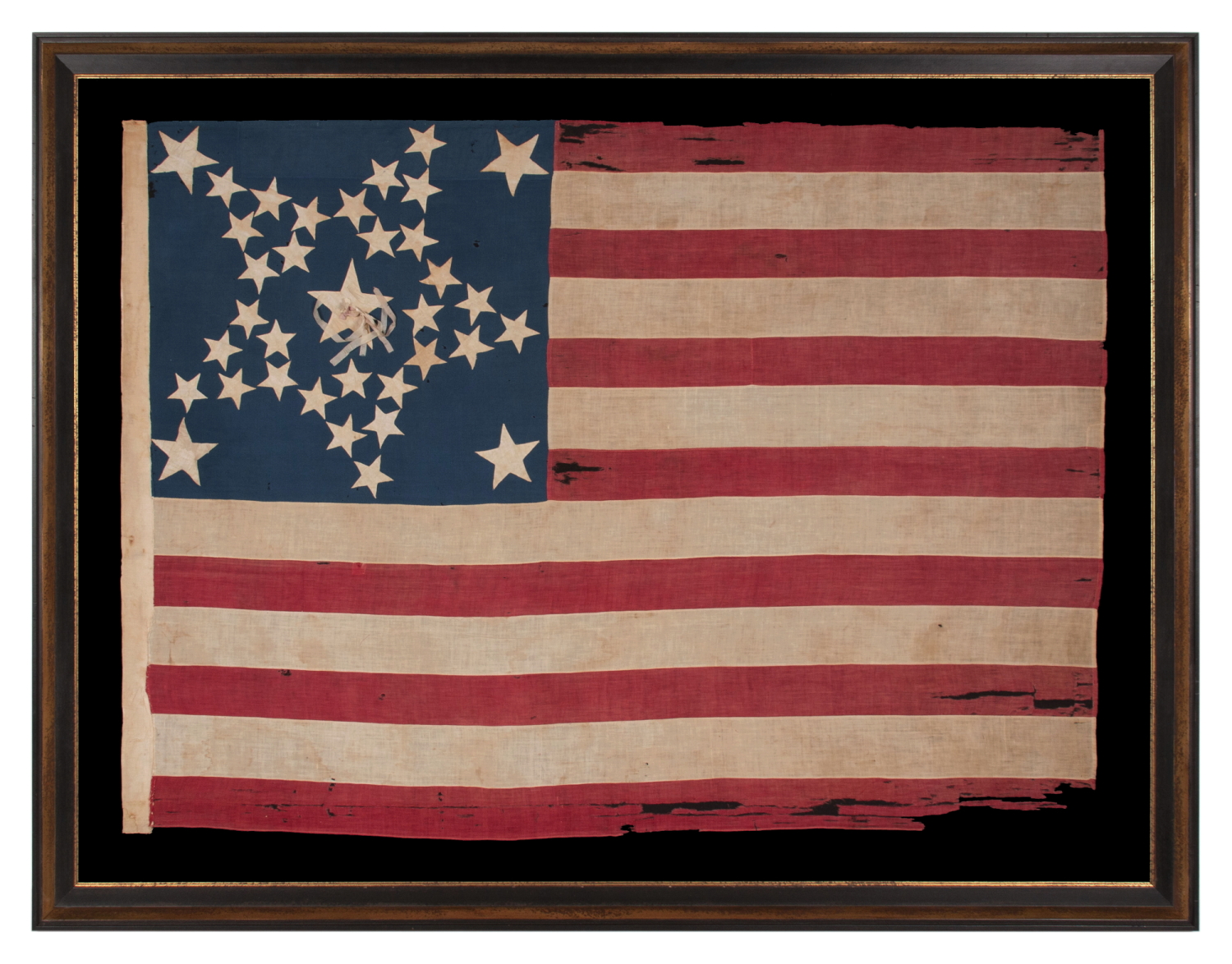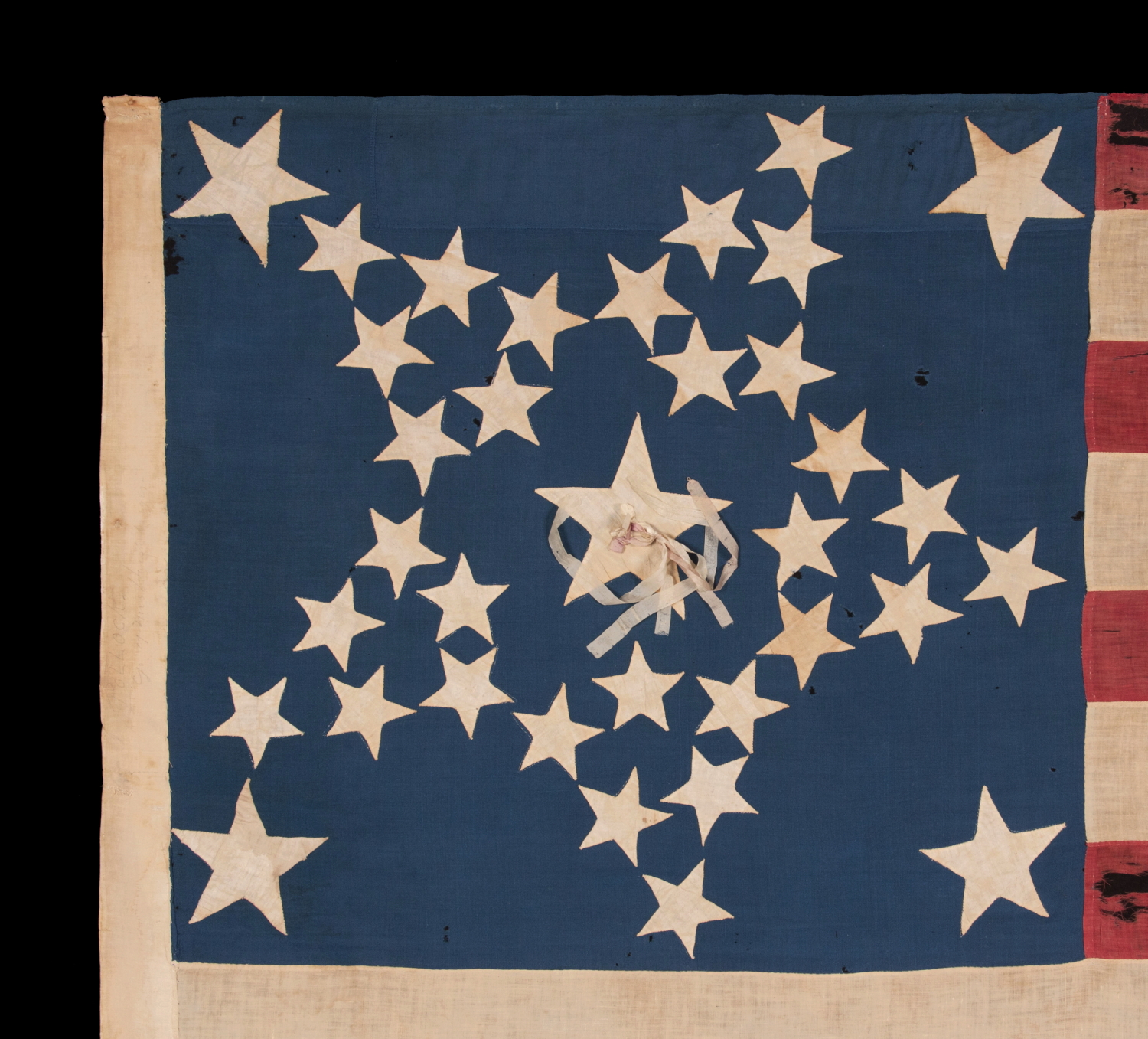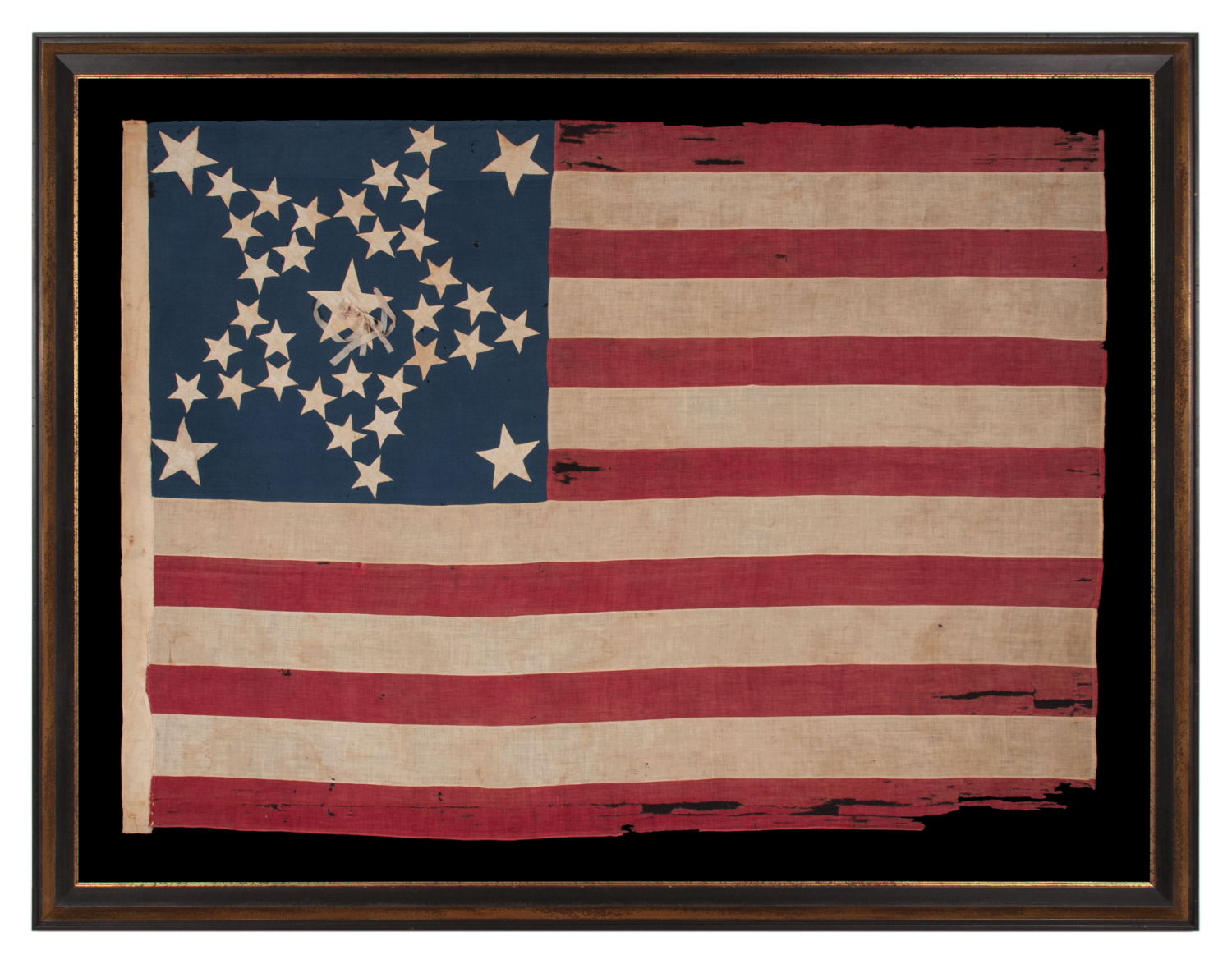
| 35 STARS IN A DYNAMIC “GREAT STAR” PATTERN, WITH A HUGE CENTER STAR THAT HAS AN UNUSUAL RIBBON ROSETTE, AND LARGE STARS FLANKING IN EACH CORNER, ON A CIVIL WAR PERIOD FLAG, HANDED DOWN THROUGH THE FAMILY OF LT. JOHN POLLOCK (KILLED AT THE BATTLE OF FAIR OAKS, VIRGINIA), SAID TO HAVE BEEN CARRIED BY COMPANY “A” OF THE 61ST PENNSYLVANIA VOLUNTEERS; THIS REGIMENT LOST MORE OFFICERS THAN ANY OTHER IN FEDERAL SERVICE |
|
| Web ID: | 35j-899 |
| Available: | In Stock |
| Frame Size (H x L): | 62.5" x 82.5" |
| Flag Size (H x L): | 51" x 70.75" |
| Description: | |
| This spectacular antique American flag, with 35 stars arranged in what is known as the “Great Star” pattern (a star made out of stars,) is one of the most dynamic of the form that a collector could ever hope to acquire. Great Star patterns come in many forms. The most notable features on this particular example include large stars that flank the basic pattern in each corner, and a huge center star, the latter of which has a very unusual characteristic that consists of a rosette, made of bunched, silk ribbon, hand-stitched in the very center. A penciled inscription along the binding, in block style capital letters, reads: “Pollock.” Beneath this, in script, is what appears to be “c/o of [repeated] Mrs. Hershberger.” According to information that accompanied the flag, it was given to “a collector of Civil War items” by a great grandson of Lieutenant John Pollock, a member of “A” Company of the 61st Pennsylvania Volunteers, killed at the Battle of Fair Oaks, Virginia, dying on June 13th, 1862, of wounds received there. Also known as the Battle of Seven Pines, the engagement took place between May 31st – June 1st, of that year. Presuming that the story is accurate, the manner in which the flag ended up in the possession of the Pollocks is a bit of a mystery. West Virginia broke off from Virginia to become the 35th state on June 20th, 1863, about a year after Pollock’s death. During the second half of the 19th century, it became common to add stars to the American flag, before the territories that those stars represented had actually gained statehood. This was done with a hopeful eye toward western expansion and to show approval for the forthcoming state(s) and, theoretically, its residents, the land itself, the political advantages of the forthcoming votes of their senators and congressmen, electoral votes, etc. Although the practice of displaying “anticipatory star counts” seems to have occurred with some frequency in 36 star flags made prior to October 31st, 1864, when Nevada joined the Union as the 36th state, it is rare prior to this time. That said, I have encountered it in the 34 star count more than once. I have owned examples with 34, 35, and 37 stars, made for presidential campaigns in 1860, when there were just 33 states. These would presumably honor the hopeful addition of Kansas, Nebraska, Nevada, and/or Utah, all of which were thought to be on the way. So it is certainly feasible that a 35 star flag was made in either the 33 or 34 star period, though this is not something typically encountered or expected. In this instance, there is a reasonable possibility that West Virginia’s addition was anticipated. With the uppermost portion of Virginia in such close proximity to the flag’s likely place of origin, a fear of being so close to the border of a seceded, Confederate state was likely to have been of serious concern to its maker and other local residents that might hear about or see it, and be made aware of the reason for its anticipatory count. The flag is an ideal size to have been carried by a company, and was probably presented to the unit at some point, maybe when it mustered in at Pittsburgh on September 27th, 1861. Such events were usually accompanied by much fanfare, including parades, political speeches, and patriotic rallies. It is very likely that the ribbon rosette—once red, white, and blue, now faded to the present state—was worn by the maker of the flag, or the presenter, who decorated herself for the festivities. John Pollock mustered in at the rank of Lieutenant and would have led Company A. The most likely maker of a company presentation flag such as this, would be the wife of the commanding officer. Just how the name of Hershberger ties in with that of Lieutenant Pollock remains unknown. Because he was buried in Virginia, I do not think it likely that the flag was made by a relative of his for any sort of memorial function, which would, at any rate, have been an uncommon reason for the creation of such an elaborate flag as this. Flags that draped on coffins were generally much larger, and this flag shows evidence of being extensively flown. Presuming that it was carried by Company A for that purpose as a battle flag, it stands to reason that it may have been returned to the maker at some point in the future, following Pollock’s demise, which would explain the trail of possession to his descendent. What can be said is that that the flag is absolutely of the size that I would expect for a civil war presentation colors, and exhibits the exact sort of wear that I would expect from long term use of being hand-carried. Whatever the case may be, the 61st Pennsylvania would go on to participate in many of the war’s most significant engagements, including Antietam, Fredericksburg, Chancellorsville, Gettysburg, Rappahannock Station, Cold Harbor, Spotsylvania, and Petersburg, among others. In doing so, the unit managed to earn the incredible distinction of having lost more officers during the course of the war than any other Federal regiment. The flag is entirely hand-sewn throughout. Because 60% or more of Civil War period examples have at least some treadle stitching, this is a nice feature. The canton is made of fine merino wool. A full width of the fabric was employed in the lower portion of the canton, with two smaller segments of the same material joined together side-by-side, above this, to achieve what was needed to complete the necessary height. The stars of the flag are made of plain weave cotton and are double-appliquéd (applied to both sides). The stripes are made of plain weave cotton. There is a plain weave cotton binding along the hoist, in the form of an open sleeve, the fabric of which is of a different weave than that employed in the white cotton stripes. Great Star patterns come in many forms. Graphically speaking, this example is as good as it gets. This, plus the relatively manageable scale of the flag—significantly smaller than military issue, regulation battle flags, which measured 6 x 6.5 feet—plus the fact that it is of the Civil War period, with some specific history to an important unit and an officer killed in action, and the remarkable history of the regiment he served, all combine to make this a truly remarkable flag among anything one can hope to acquire in a 19th century example. It survives as an absolute standout among the most wonderful flags I have had the great privilege to own. Mounting: The flag was mounted and framed within our own conservation department, which is led by expert staff. We take great care in the mounting and preservation of flags and have framed thousands of examples. The black-painted, hand-gilded and distressed molding is Italian. The background is 100% cotton twill, black in color, that has been washed and treated for colorfastness. Spacers keep the textile away from the glazing, which is U.V. protective acrylic (Plexiglas). Condition: Report forthcoming. Please inquire. |
|
| Video: | |
| Collector Level: | Flags for the truest Patriots. My best offerings |
| Flag Type: | Sewn flag |
| Star Count: | 35 |
| Earliest Date of Origin: | 1863 |
| Latest Date of Origin: | 1865 |
| State/Affiliation: | Pennsylvania |
| War Association: | 1861-1865 Civil War |
| Price: | Please call (717) 676-0545 or (717) 502-1281 |
| E-mail: | info@jeffbridgman.com |
 |
|