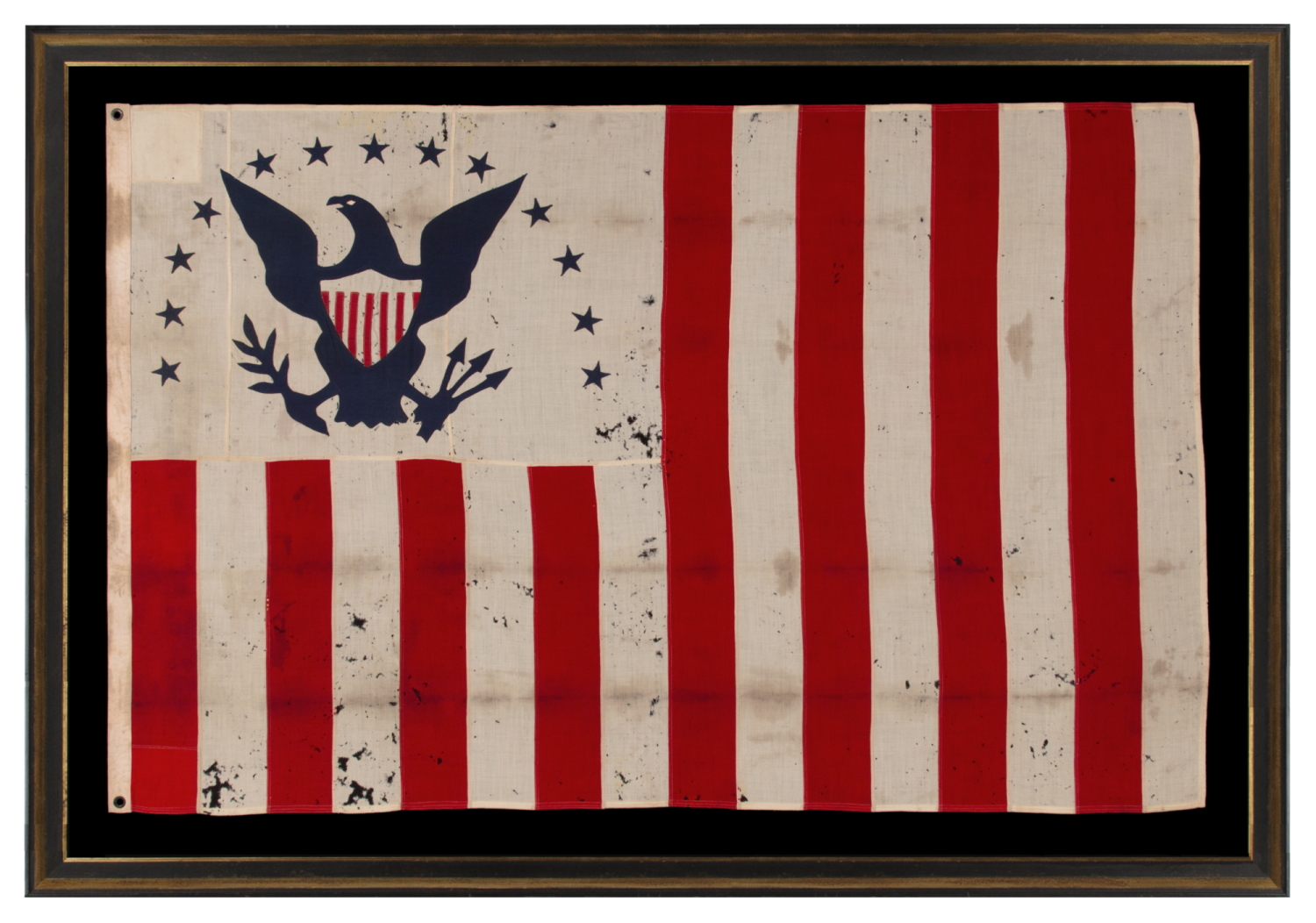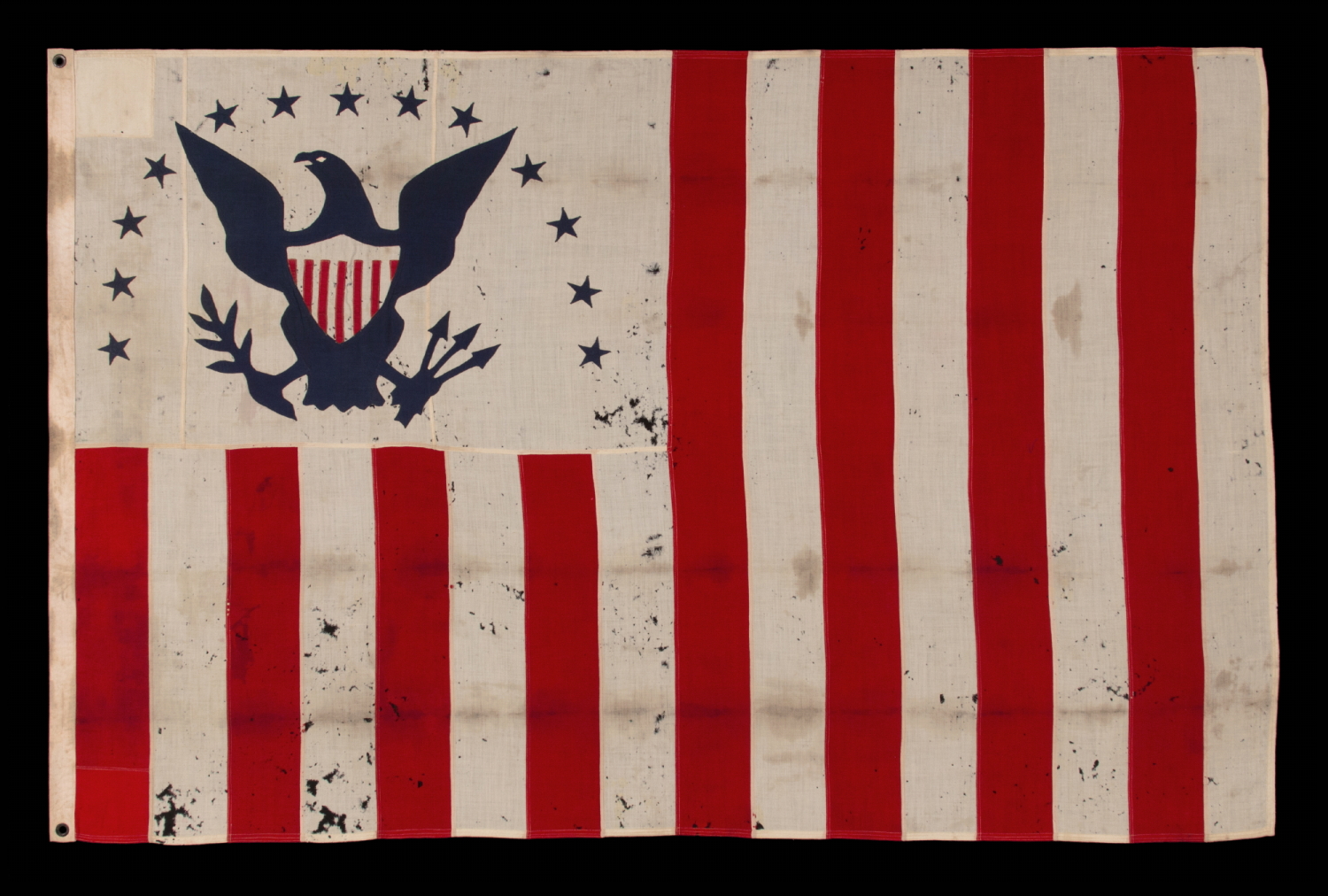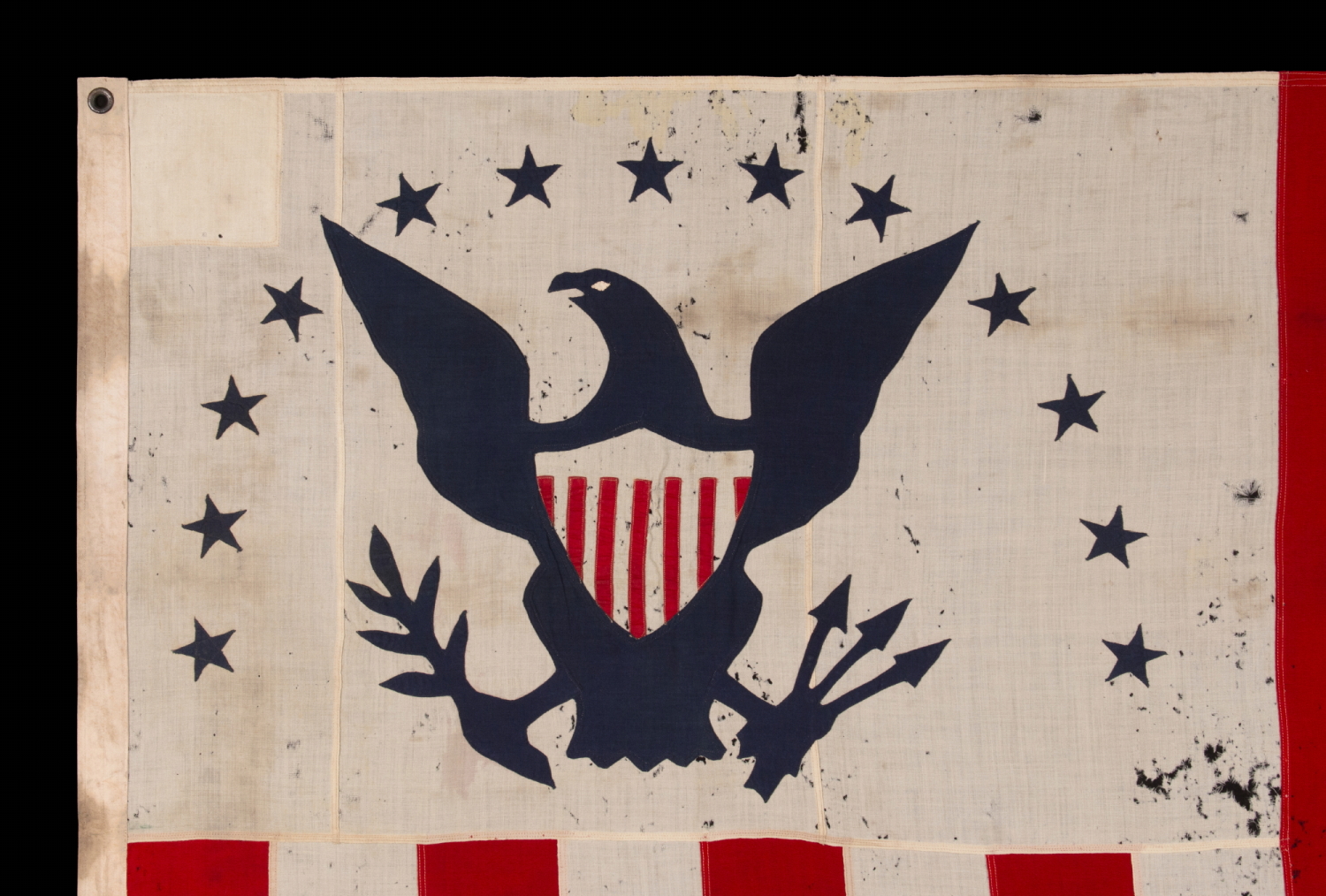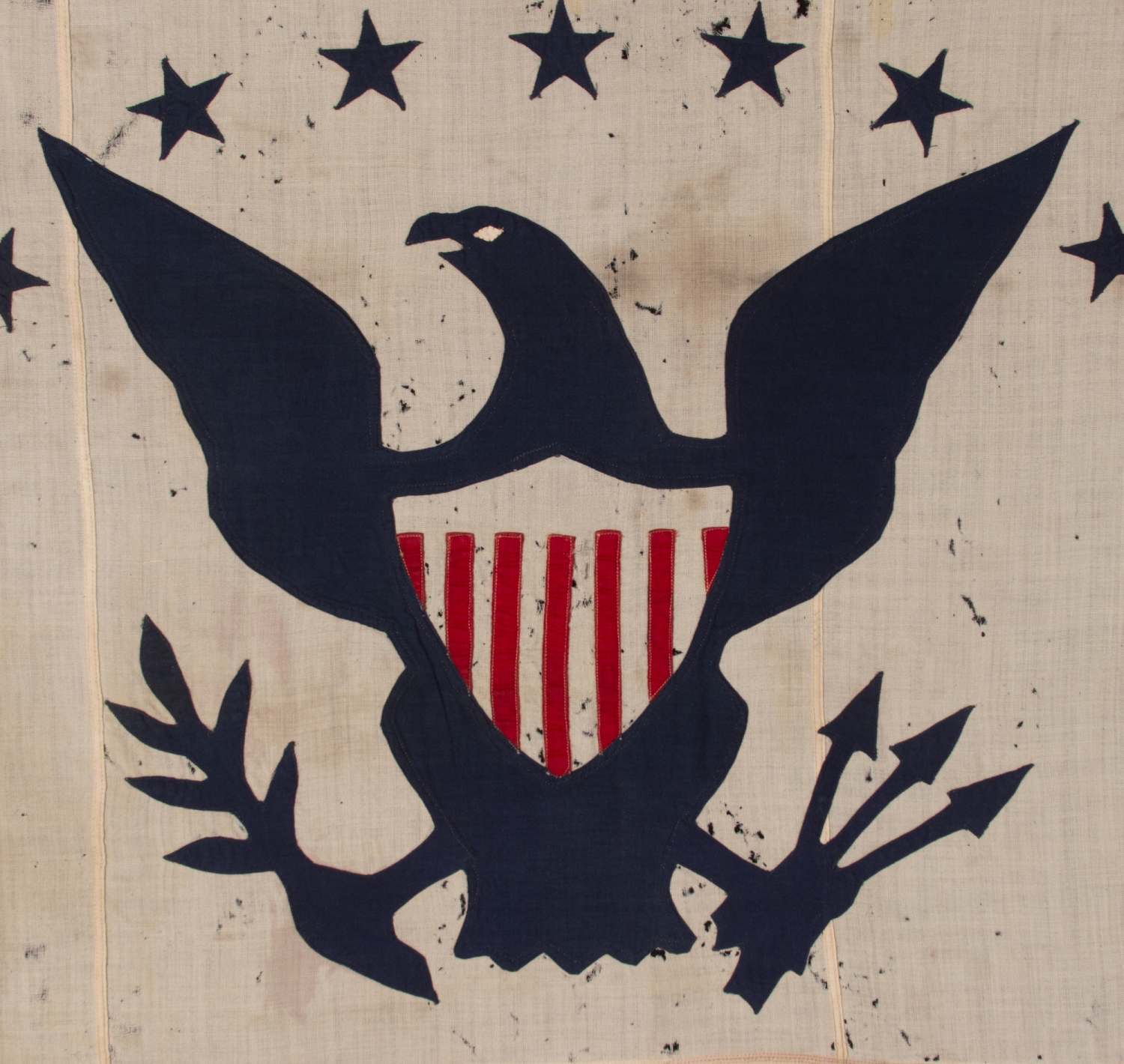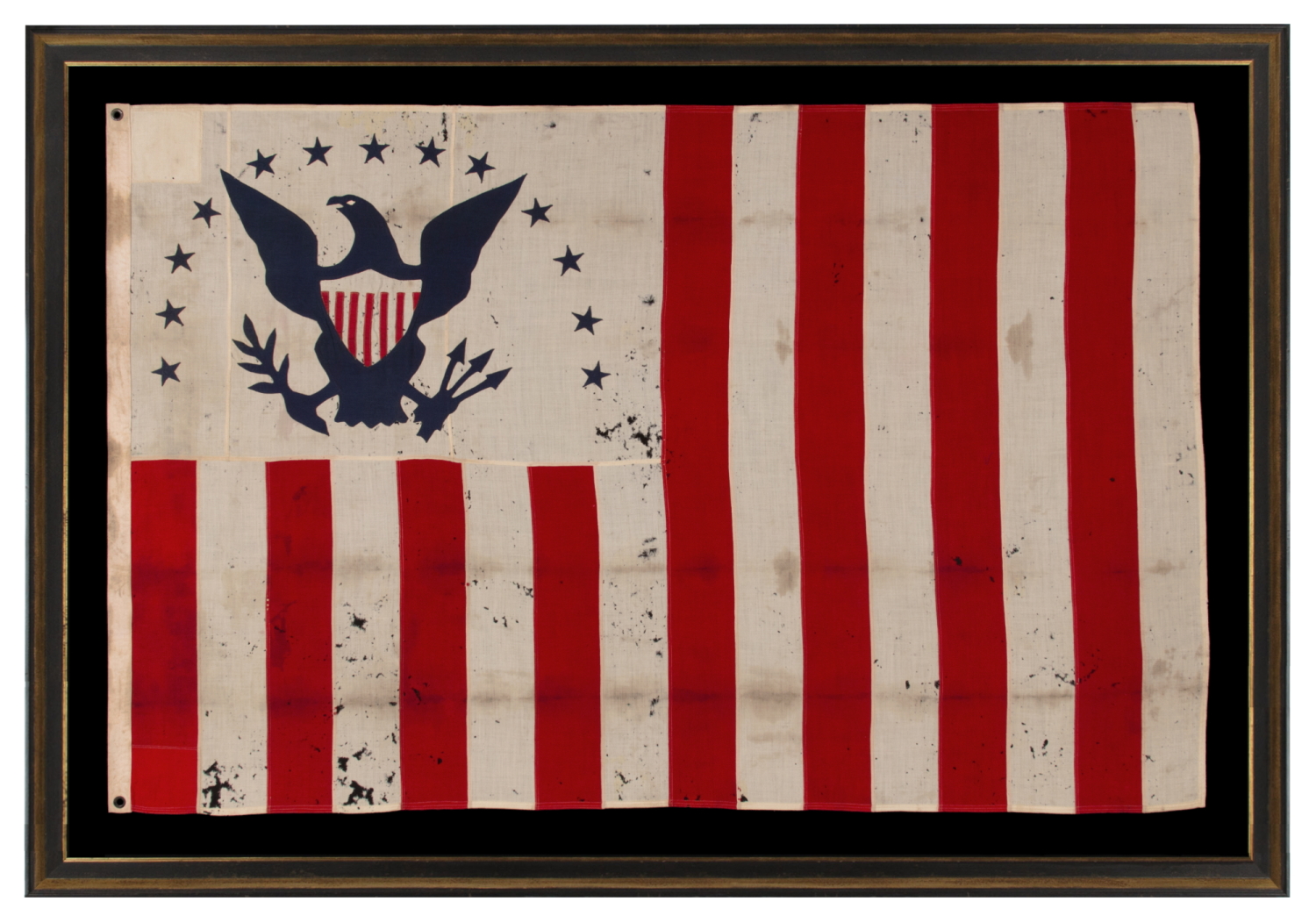
| LATE 19th CENTURY FLAG OF THE REVENUE MARINE (a.k.a., REVENUE CUTTER SERVICE), WITH A BLUE EAGLE AMID AN ARCH OF 13 BLUE STARS, ON A WHITE CANTON, AND 16 RED & WHITE, VERTICAL STRIPES, MADE circa 1885-1895 |
|
| Web ID: | ofj-961 |
| Available: | In Stock |
| Frame Size (H x L): | Approx. 70" x 102.5" |
| Flag Size (H x L): | 58.25" x 90.5" |
| Description: | |
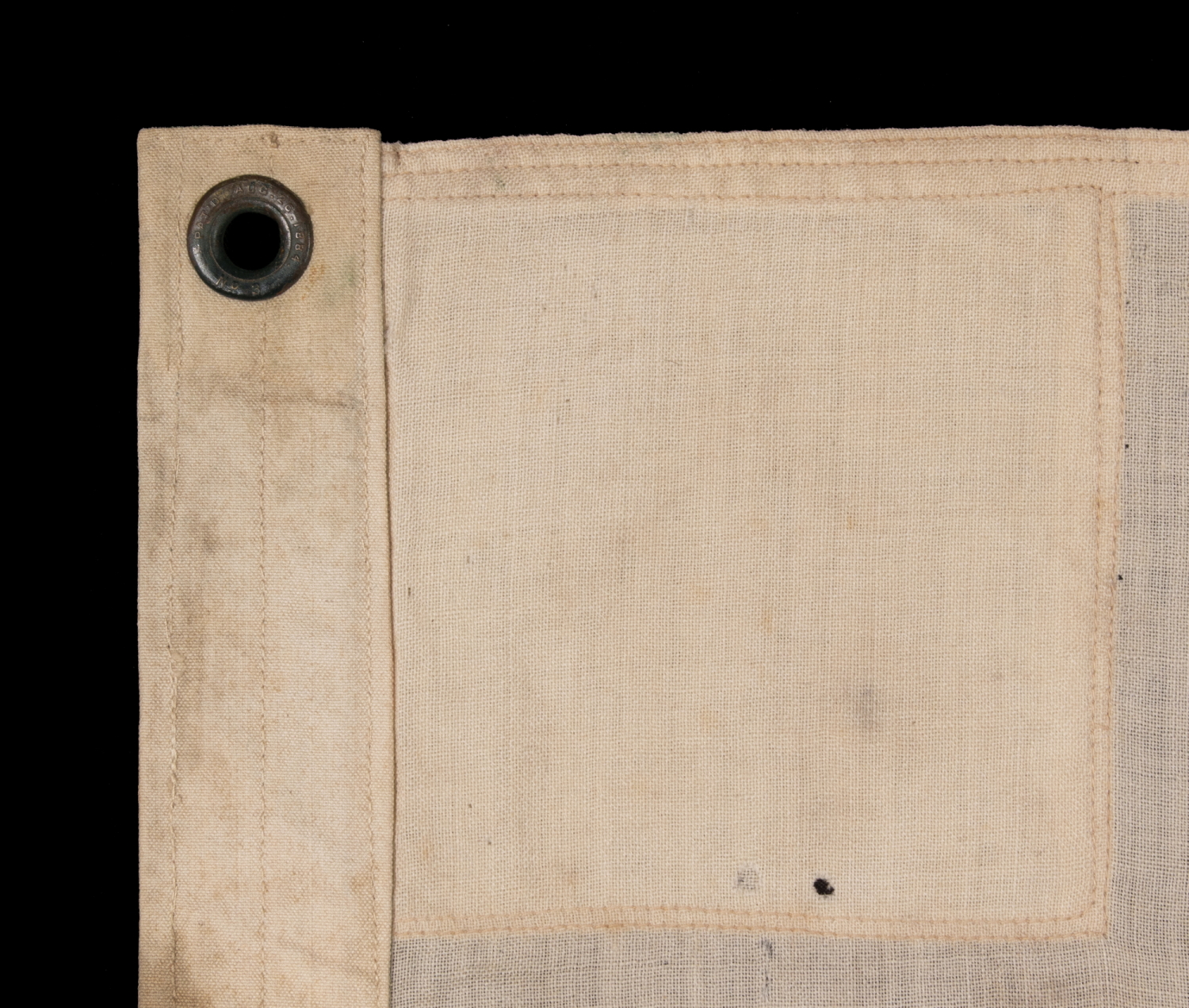
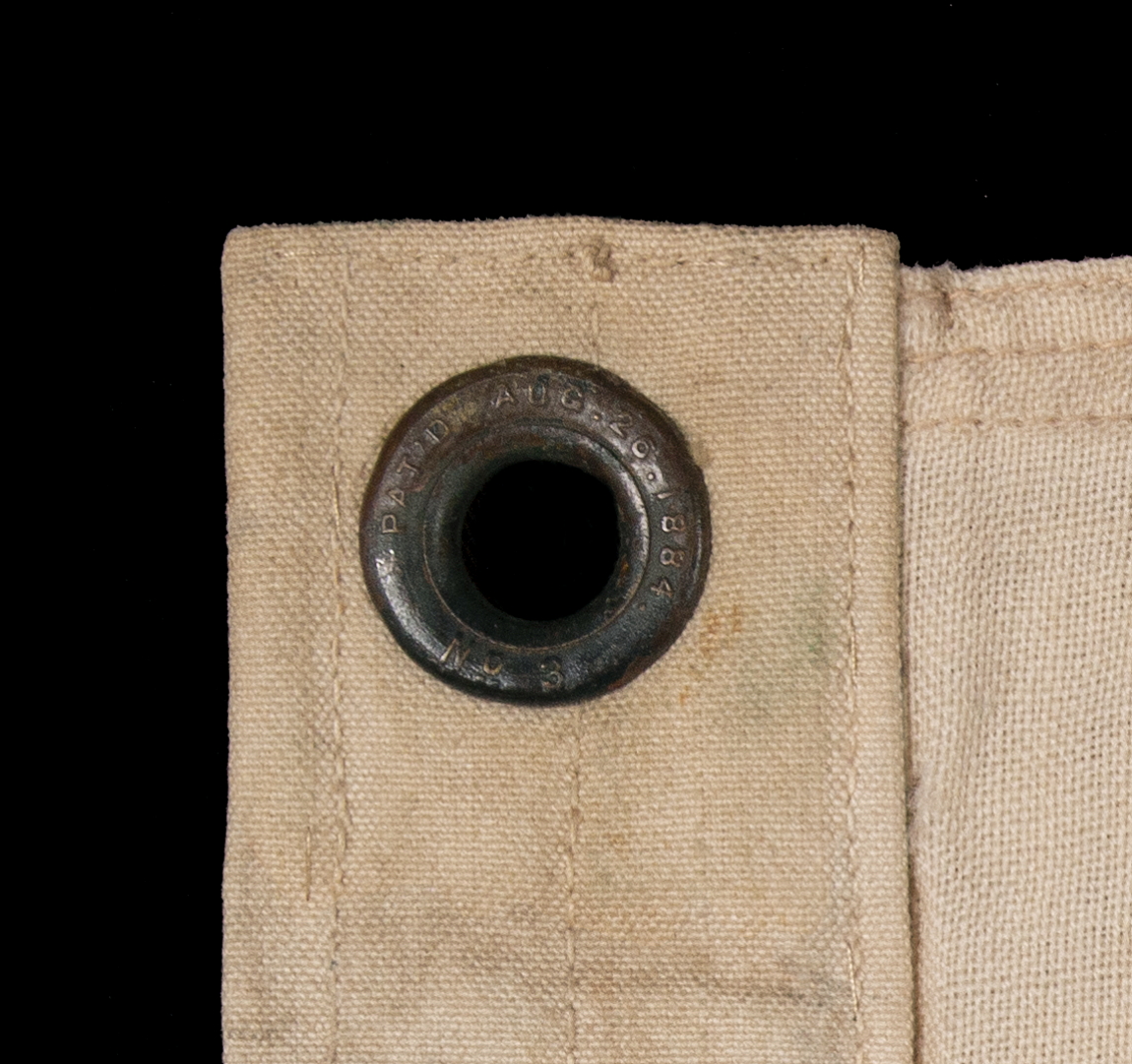
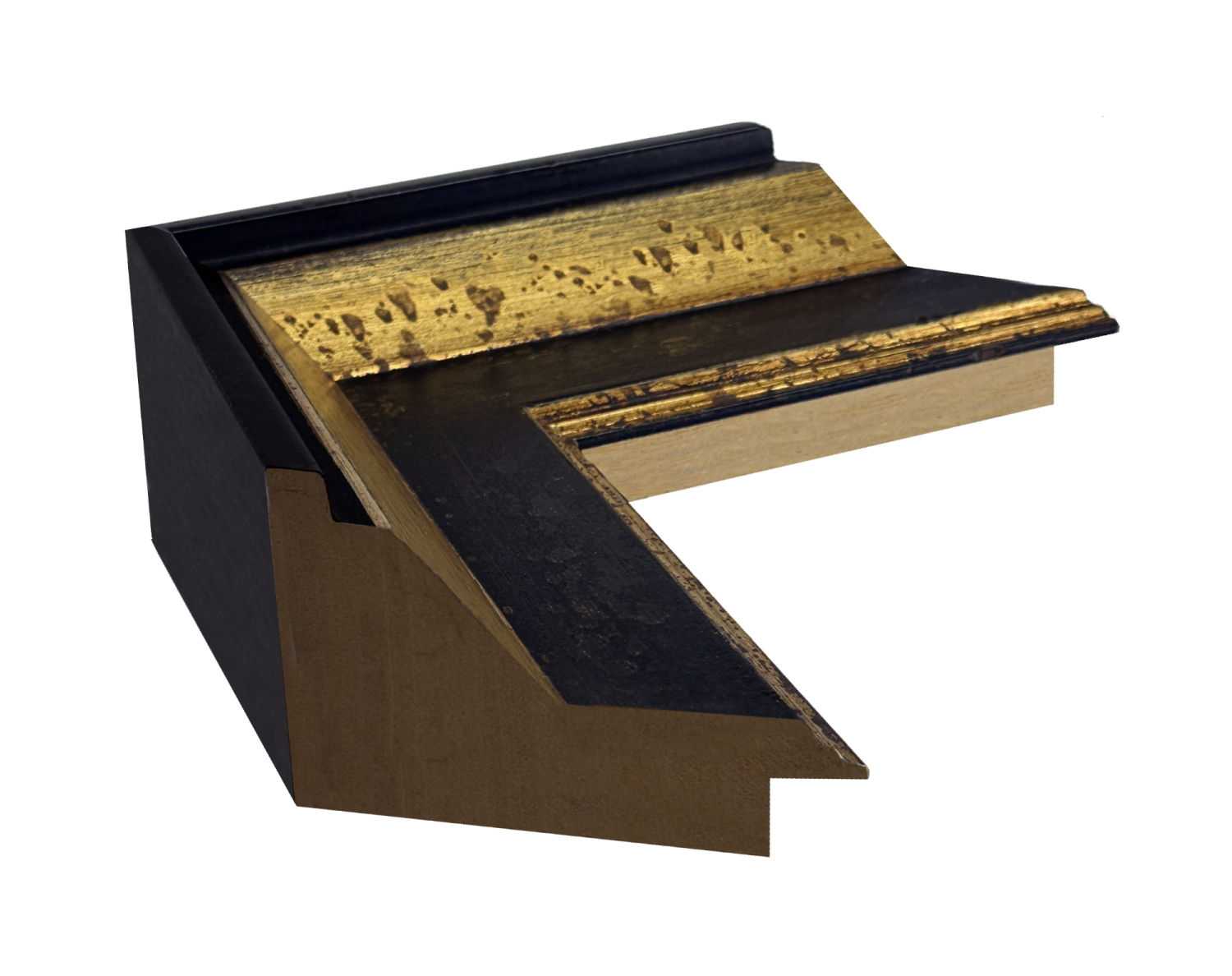
| The Revenue Marine was founded by U.S. Treasury Secretary Alexander Hamilton, through an act of the United States Congress passed August 4th, 1790. Tasked with the protection of merchant ships in and around major ports, its duty was to ensure the safe transport of goods, to deter looting and piracy, and to oversee that proper tariffs and customs fees were collected. Because there was as of yet no income tax, this was our nation’s most significant revenue stream and extremely important to the U.S. Treasury. Protection on the open waters was not only financially critical, but fundamental to the safety of the new nation. Most Americans don’t realize that for a period of time following the Revolutionary War, the navy was disbanded and there were no ships. Vast debt, incurred to fund the Revolution, was partly repaid through the sale of all remaining warships to France. In the formation of the Revenue Marine, Hamilton ordered 10 ships, that were distributed across various ports. Washington suggested to Hamilton that each captain selected for service oversee the building of his own ship. While the U.S. Treasury held the overall umbrella for this military-like force, each ship was directly responsible to the customs collector in whichever port it sailed from. Captains had wide-ranging authority to do what they saw fit to keep order, and could board and search any vessel whether docked or at sea. From 1790 until the U.S. Navy reformed in 1798, Revenue Cutters were the only armed American ships in government service. The Revenue Marine thereafter fought alongside the U.S. Navy and have since participated in every major U.S. seafaring conflict. Reorganized a couple of times during the 19th century, the scope of its mission began to grow. First by default, then by a change in general orders, one of its functions became the rescue of ships in distress. In 1894, the name was formally changed to the Revenue Cutter Service (RCS). This would become the most widely coined title by historians and collectors of related artifacts. The basic format of the flag is question here was actually adopted by an act of Congress in 1799, for use by the Customs office on ships of the Revenue Marine. Designed by Oliver Wolcott, there were to be 16 stripes, and probably as many stars. Wolcott, who replaced Alexander Hamilton as Secretary of the Treasury in 1795, selected the count of 16 in accordance with the logic employed in the Flag Act of the same year, passed by Congress, that added 2 stripes and 2 stars to the previous counts of 13 stars and 13 stripes, in order to reflect the 1791 addition of Vermont, and the 1792 addition of Kentucky, as the 14th and 15th states. Since Tennessee had entered the Union on June 1st, 1796, the 1799 customs flag legislation occurred at a time when there were a total of 16 states. Because the original records in regard to this matter were destroyed when the British burned Washington, in 1814, specifics regarding the star count on Revenue Marine flags remain unknown. One early illustration depicts a flag with 15 stars and 16 stripes, curiously excluding Tennessee in the star count, yet including it in the stripes. Likewise curious is the fact that while 16 stripes were specified on the flag of the Revenue Marine, 16 was never an official star count for the Stars & Stripes. It wasn’t until 1818, when 4 more states, in addition to Tennessee, had joined the Union, that congress decided to once again change the national flag, updating the number of stars from 15 to 20. At this time, the stripe count was permanently returned to 13. The fear, of course, was that they would grow to become pinstripes, if they continued to mirror the number of states. Among the tiny number of surviving examples that date to the 19th century (there are no 1799 examples), all have 13 stars and 16 stripes, except one, that displays 13 stars and 13 stripes. Inconsistency was actually more of a rule than an exception in early America, when an enormous amount of artist’s liberty was taken in the replication of flags, state and federal seals, and all manner of the related components thereof. Made sometime between roughly 1885 – 1895, this particular flag of the Revenue Cutter Service flag displays 13 stars and 16 stripes. Note how the eagle, tall and narrow, with wings raised (some display them down), bears an ample degree of folk quality, that impacts its overall presentation. Since eagles are both very desirable, and rare, on early American flags of all kinds, and because flags of the RCS are so graphically different, and visually arresting, rare, 19th century examples, such as this one, make a great addition to any collection. The canton and stripes of the flag are made of wool bunting that has been pieced and hemmed by treadle stitching. The square patches in the upper and lower corners at the hoist end are called gussets. These were included where the flag received the most stress when flown and are original to its construction. The stars are made of cotton and are double-appliquéd (applied to both sides), also with a lineal, treadle stitch, as are the 7 red, vertical stripes (called pales), that, together with the white wool bunting onto which they were sewn, form a federal shield a count of a total of 13. The blue cotton fabric was single-appliquéd to the white field, to form the eagle. This means that a cutout was made on the reverse, and the blue fabric was under-hemmed, with treadle stitching, in this instance, so that its profile is viewable both sides. The diamond-shaped eye of the eagle, made of white satin or polished cotton, is hand-sewn and double-appliquéd. There is a heavy, sailcloth canvas binding along the hoist, with 2 brass grommets, each of which is stamped: “Pat’d Aug.26.1884,” followed by “No 3.” The presence of these marks can be seen on the grommets of flags produced by the U.S. Navy between the 1880’s and around 1915. The navy generally made its own flags at several locations, namely the Brooklyn Navy Yard, in NYC, and at Mare Island, California, headquarters of the Pacific Fleet. In spite of their having been administered by two different branches of the federal government at the time of the flag’s manufacture, it seems likely that this example was actually made by the Navy at one of these two locations. Because the grommets on other types of flags are never so specifically marked, this is a very nice feature. This is the only example of a Revenue Cutter ensign that I have ever encountered with 1884, patent-dated, U.S. Navy grommets. In 1915, the RCS merged with the U.S. Lifesaving Service to form the U.S. Coast Guard. As of this date it was no longer responsible to the U.S. Treasury, but instead became a branch of the U.S. Armed Forces, responsible to the president. Today it falls under the Department of Homeland Security in times of peace, but at times of war its direction can be transferred to the Navy by the President, as Commander-in-Chief. Mounting: For 25 years we have maintained a specialized department for this purpose. We take great care in the mounting and preservation of flags and related textiles and have preserved thousands of examples. The flag has been hand-sewn to 100% silk organza throughout for support. It was then hand-stitched to 100% cotton, black in color, that was washed & treated for colorfastness. The mount was in a black-painted, hand-gilded and distressed Italian molding. The glazing is U.V. protective acrylic (Plexiglas). Condition: There is minor to modest mothing throughout, accompanied by areas of moderate loss in the lower, fly-end corner of the canton, as well as in the first two pales. There are areas of moderate soiling along the binding, accompanied by four horizontal regions with instances of the same. There is minor soiling elsewhere throughout. Many of my clients prefer early flags to show their age and history of use. |
|
| Video: | |
| Collector Level: | Flags for the truest Patriots. My best offerings |
| Flag Type: | Sewn flag |
| Star Count: | 13 |
| Earliest Date of Origin: | 1885 |
| Latest Date of Origin: | 1895 |
| State/Affiliation: | |
| War Association: | |
| Price: | Please call (717) 676-0545 or (717) 502-1281 |
| E-mail: | info@jeffbridgman.com |
 |
|