| |
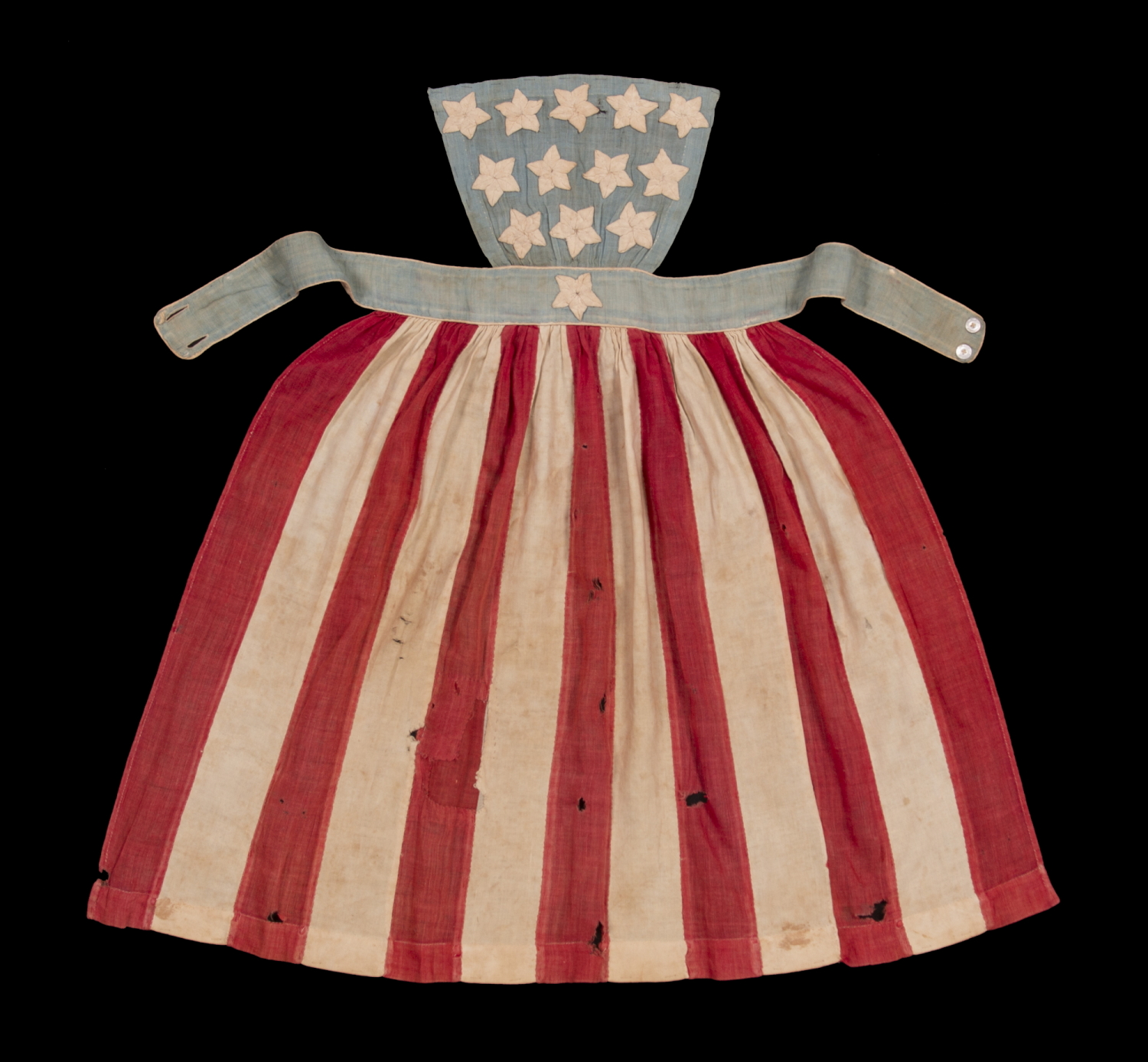
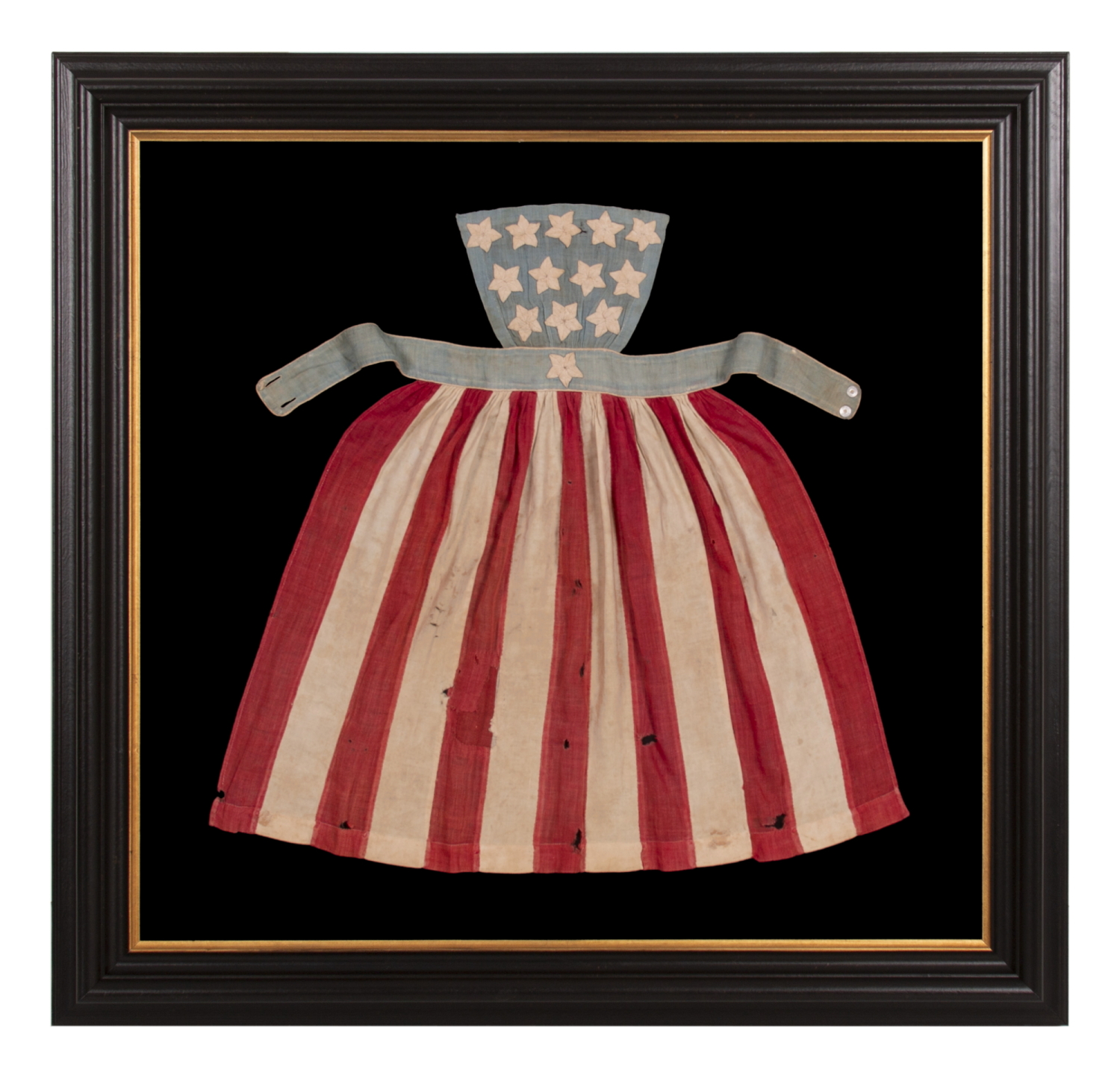
ENTIRELY HAND-SEWN, CIVIL WAR PERIOD APRON WITH 13 HAND-EMBROIDERED STARS & 13 STRIPES, OF A TYPE WORN BY YOUNG WOMEN AT BENEFITS FOR THE UNITED STATES SANITARY COMMISSION, WHICH STAFFED, FUNDED, & MODERNIZED CIVIL WAR HOSPITALS, PREDECESSOR TO THE RED CROSS, 1861-1865 |
| |
|
| Dimensions (inches): |
Frame - 34.25" t x 35.75 w; Apron - 22.75" t x 24" w |
| Description: |
|
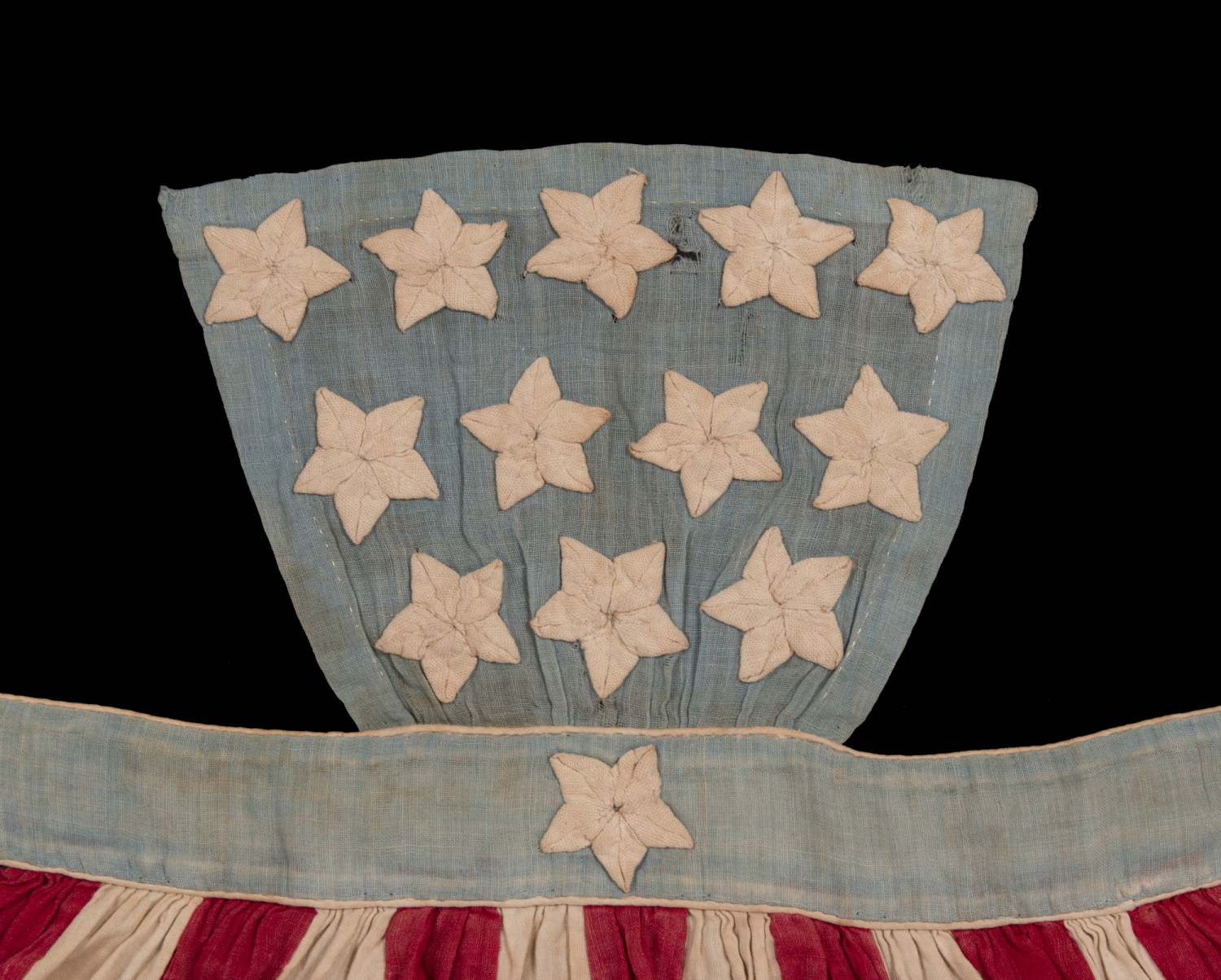
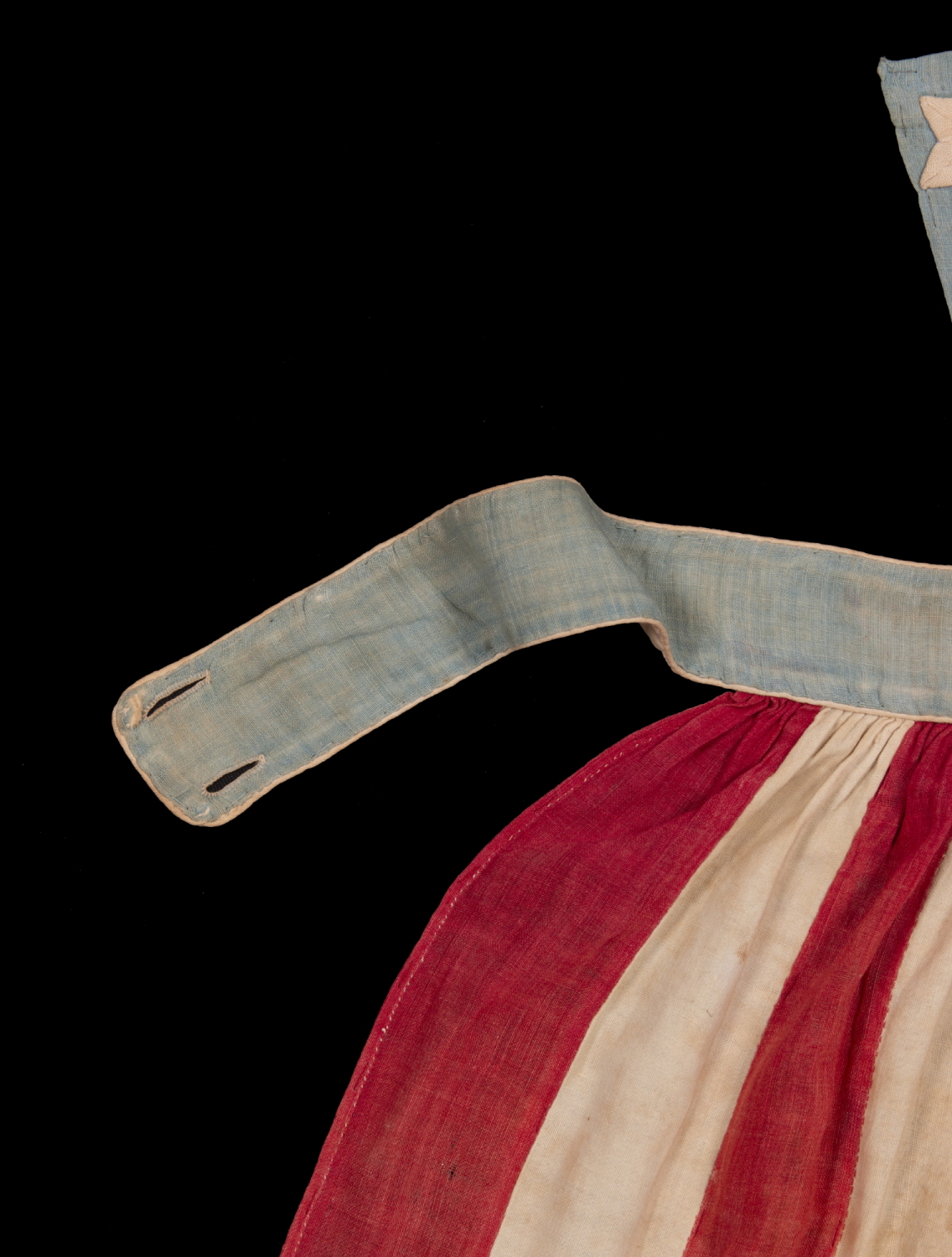
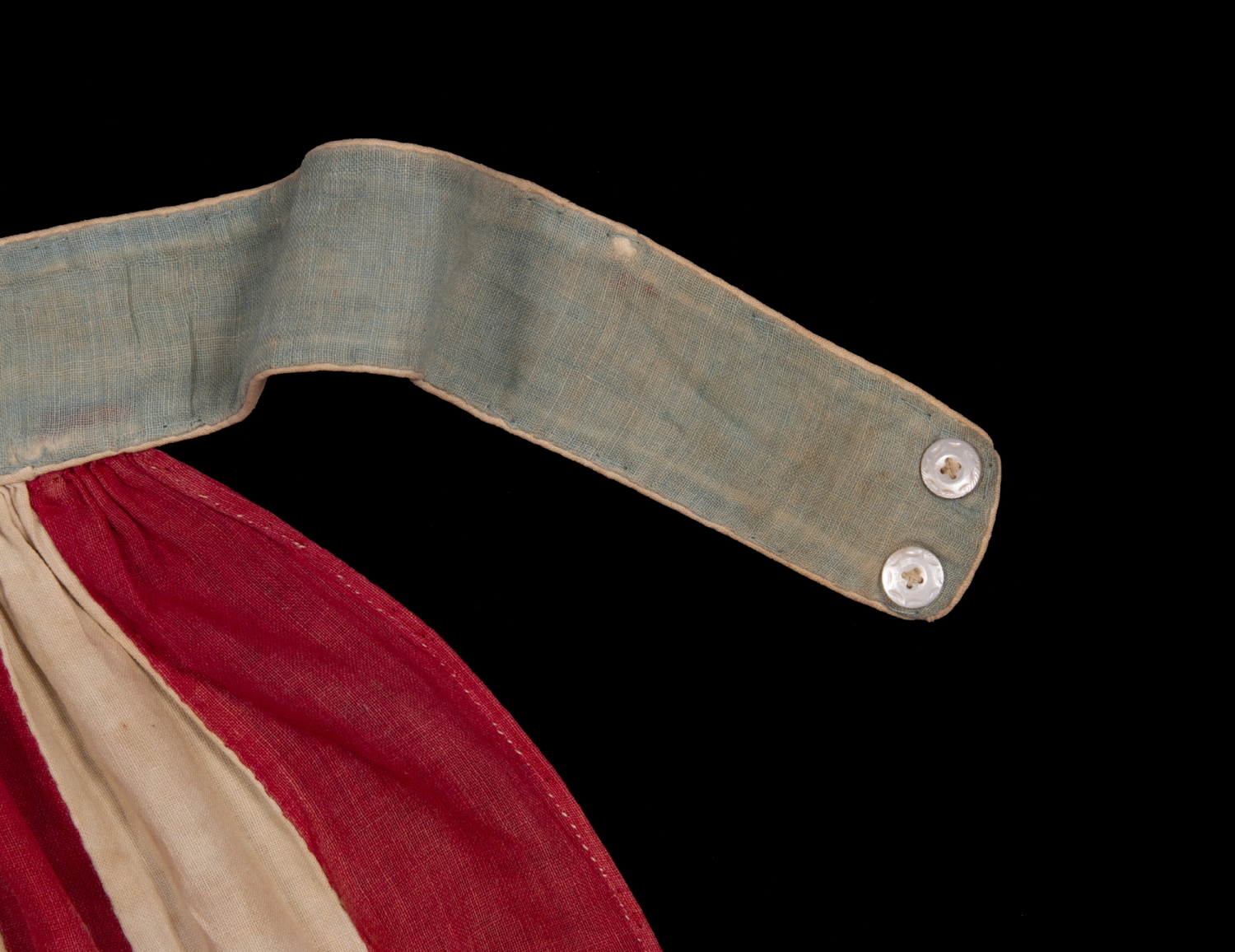
Made of lightweight, plain weave cotton and cotton muslin, this patriotic apron features 13 white, hand-embroidered stars on a faded, sky blue ground and 13 vertical stripes, alternate red and white. All but one of the stars are incorporated in the panel at the top, arranged in lineal rows of 5-4-3, with the single, remaining star below, at the center of an incorporated belt, bound with white cotton, to be secured by the wearer by way of two mother of pearl (mollusk shell) buttons. Note the whimsical, bulbous profile of the stars, rendered in pie-cut fashion, oriented in various positions on their vertical axis. Aprons of this period did not generally have a loop or tie that went about the neck, but were instead pinned in place at the breast. All of the construction was accomplished by hand-stitching.
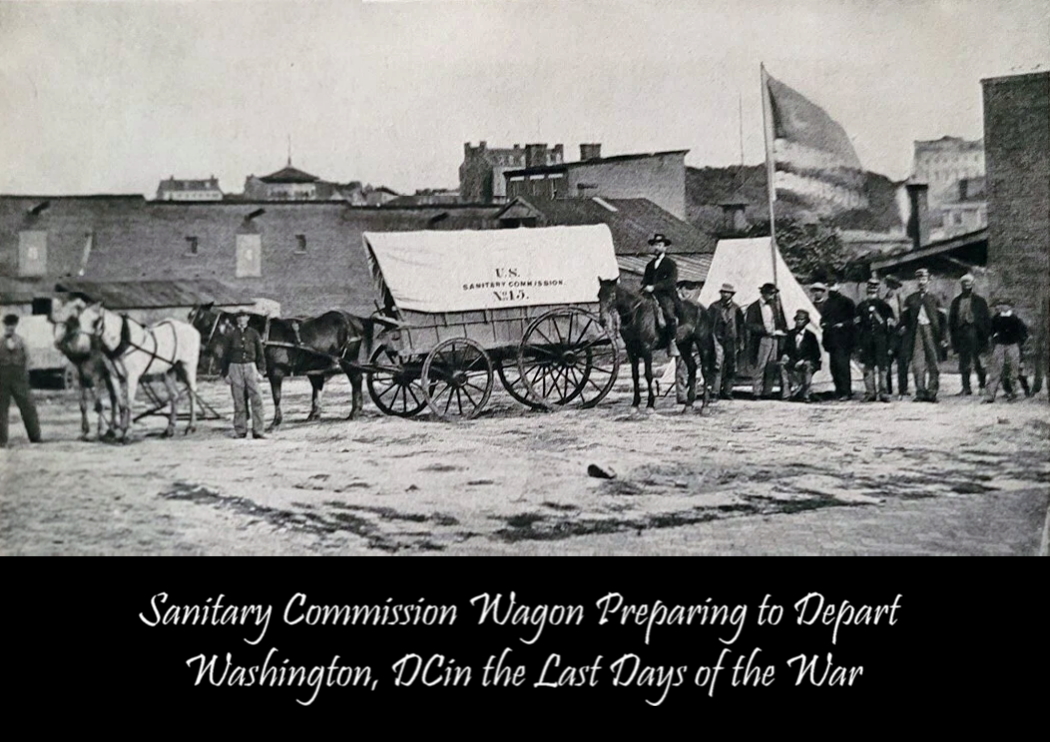
Though extraordinarily rare, aprons of this precise sort are known with history of having been worn by girls at benefits for the United States Sanitary Commission, predecessor to the Red Cross, which staffed, funded, and modernized Civil War hospitals. Others have been identified with various star and stripe counts, some of which remove the Slave States to display what newspapers reported—when describing American flags in use during the mid-19th century—as reflecting national “disunion”. Though Abraham Lincoln urged Union supporters not to do this, as his goal was to keep the Union together, people did what they wished in the emotionally-driven environment created by slavery and the war. Here the count of 13 reflects the original 13 colonies, popular not only on flags, but in all manner of related patriotic textiles and objects throughout American history, from the beginning to the present. During the Civil War era, the use of this count was especially poignant, likely because of the parallel it drew between the fight for liberty during the Revolutionary War and the present struggle over the same basic principles.
The Sanitary Commission was founded in the Spring of 1861 by private citizens in New York City, who were appalled by the Army’s lack of medical supplies and sanitary conditions in the care of Civil War soldiers. Officially sanctioned by the War Department on June 9th of that year, and approved by Abraham Lincoln on June 13th, the chief planner and organizer was Boston-born writer and Harvard-educated clergyman, Henry Whitney Bellows of New York (b. 1814, d. 1882). Bellows modeled the organization after the work of Florence Nightingale in the British Sanitary Commission of the 1850’s, and brought with him a force of volunteers belonging to an organization he led called the Woman’s Central Association of Relief of New York. In 1863, Bellows would become one of the four founders of the Union League Club of New York, with fellow Sanitary Commission leaders Frederick Law Olmsted (the designer of Central Park, considered to be the father of modern landscape architecture,) plus George Templeton Strong (American composer, painter, lawyer, and prolific diarist), and Oliver Wolcott Gibbs (Harvard professor, chemist, and physician). The goal of the Union League Club was to join like-minded and influential, moneyed men with the cause of both the Commission and the Union in general. In 1881, Sanitary Commission nurse Clara Barton would carry the torch forward, expanding upon the core concepts of the organization to form the Red Cross.
Sanitary Fairs—large and elaborate, fundraising events, with extraordinary exhibitions akin to World’s Fairs—were held as benefit for the Commission in New York, Philadelphia, Baltimore, Cleveland, Chicago, St. Louis, and elsewhere. Aprons like this were most certainly worn at the fairs. I previously owned an example with known history to the 12-year-old daughter of a physician, who attended the Cleveland fair and likely others. Several survive in museum collections, including a Confederate version that is among the holdings of the American Civil War Museum at Richmond, Virginia (formerly the Museum of the Confederacy).
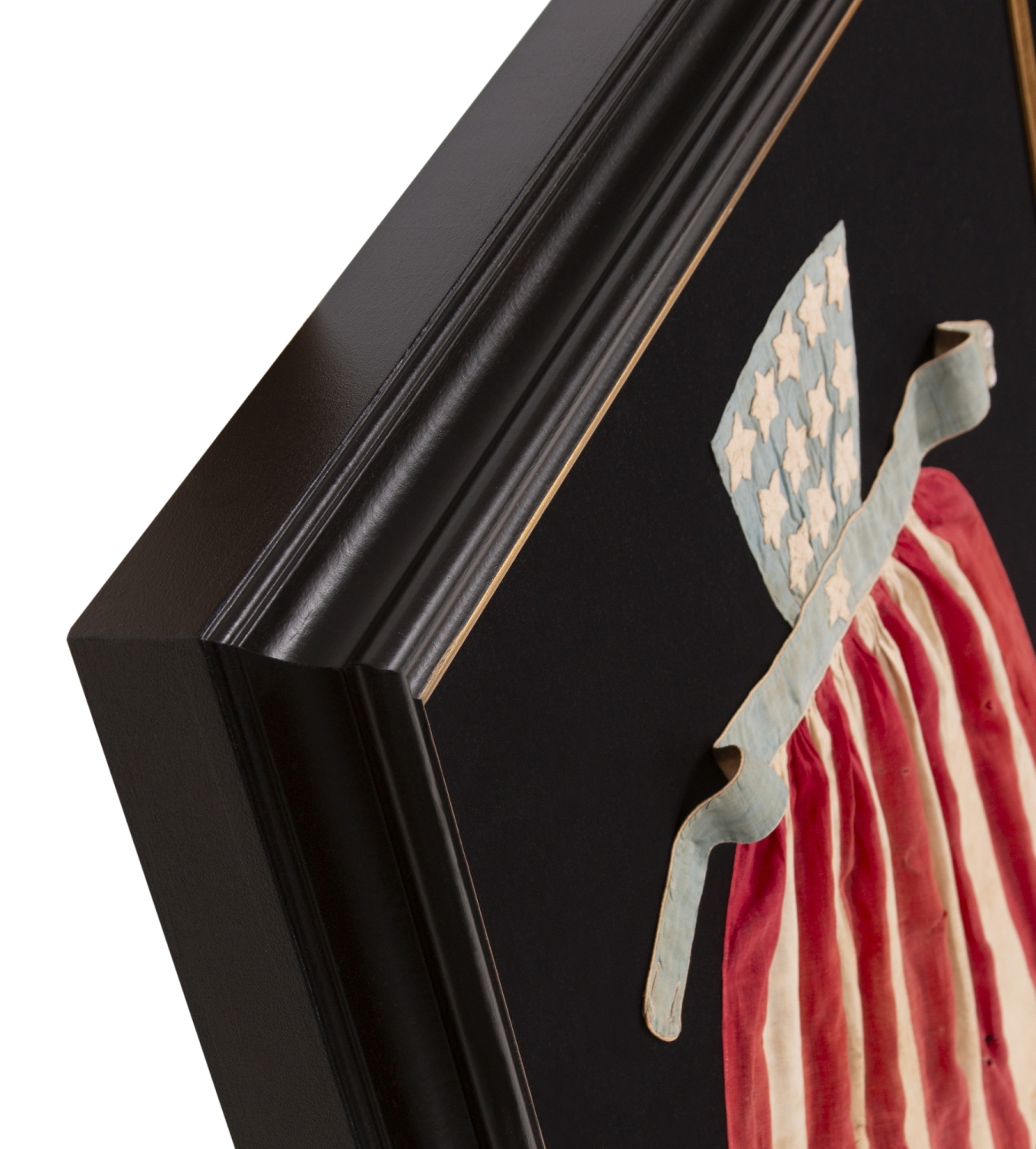
Mounting: The apron was mounted and framed within our own conservation department, which is led by expert staff. We take great care in the mounting and preservation of flags, banners, and other related textiles and have framed thousands of examples.
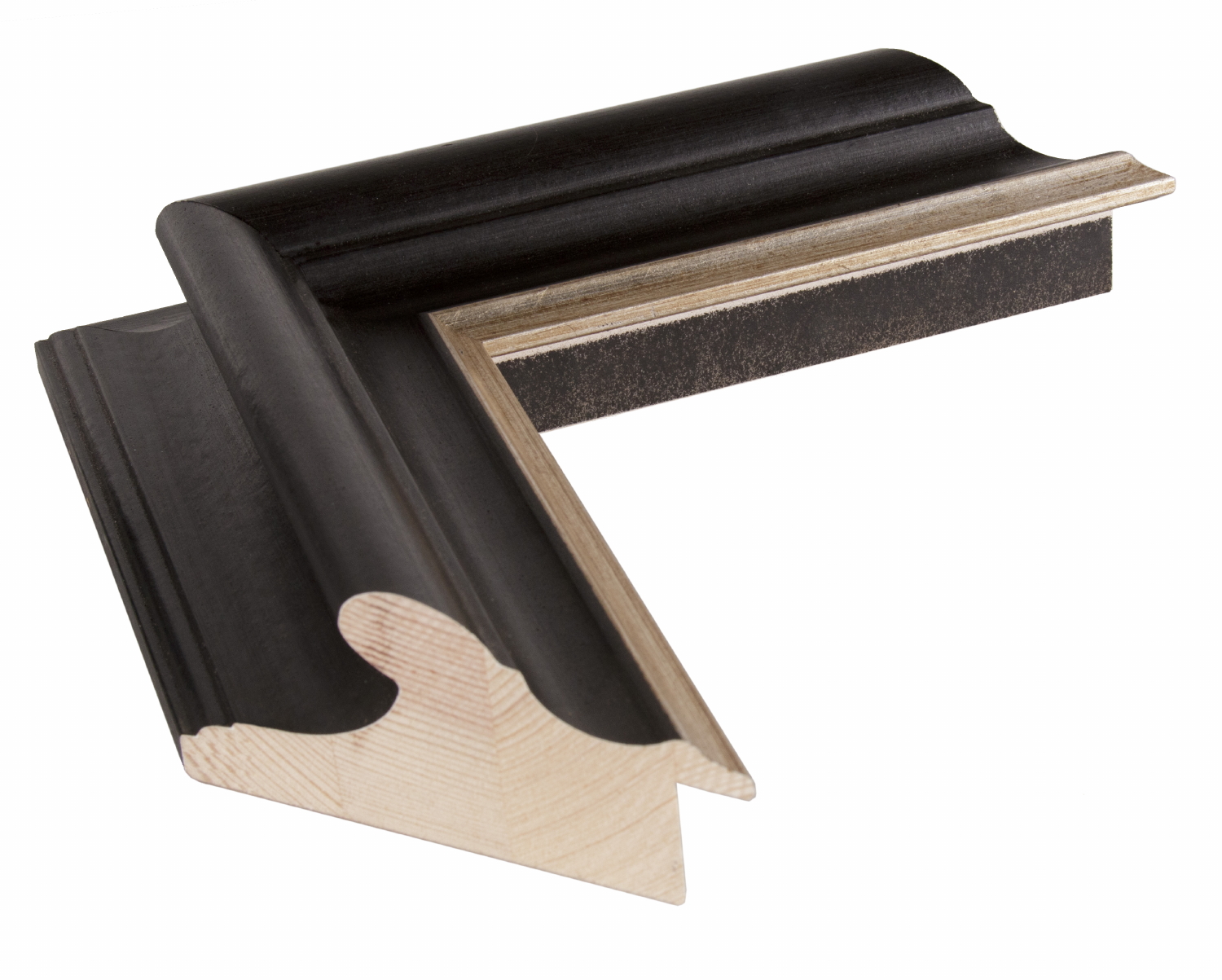
The background fabric is 100% cotton twill, black in color, that has been washed and treated for colorfastness. The substantial, black-painted and gilded molding, with its wide, shaped profile, is Italian. The glazing is U.V. protective acrylic (Plexiglas).
Condition: There are minor to modest tears, with associated loss, in all of the red stripes, and in three of the white, in addition to a significant area of loss bridging from the 4th - 6th stripes, occurring mostly in the red. We placed period fabric of similar coloration behind this area for masking purposes. There is minor to modest soiling in the white and the blue fabrics. There is significant fading of the blue cotton, though the resulting shade is especially attractive and the original shade was almost certainly far lighter in color than what would expect in a modern Stars & Stripes flag. There is only minor fading in the red stripes. The extreme rarity of the apron, and it’s beautiful, endearing presentation, well-warrant any and all condition issues. |
|
|
| |
|
| Primary Color: |
red, white, blue, black |
|
| Earliest Date: |
1861 |
|
| Latest Date: |
1865 |
|
| For Sale Status: |
Available |
|
| Price |
Please call (717) 676-0545 or (717) 502-1281 |
|
| E-mail: |
info@jeffbridgman.com |
|
 |
|
Page Views:... 218 |
|

)