| |
PAIR OF EXTRAORDINARILY EARLY (1806) PRINTED LINEN KERCHIEFS GLORIFYING GEORGE WASHINGTON, GERMANTOWN PRINT WORKS, GERMANTOWN, PENNSYLVANIA |
|
| Available: |
Sold |
| Frame Size (H x L): |
pair - 21.75" t x 34"w x 2.5" d |
| Flag Size (H x L): |
L.O.T. - approx. 11.75" x 12", E.O.P. - approx. 12.25" x 11.5" |
|
| Description....: |
|
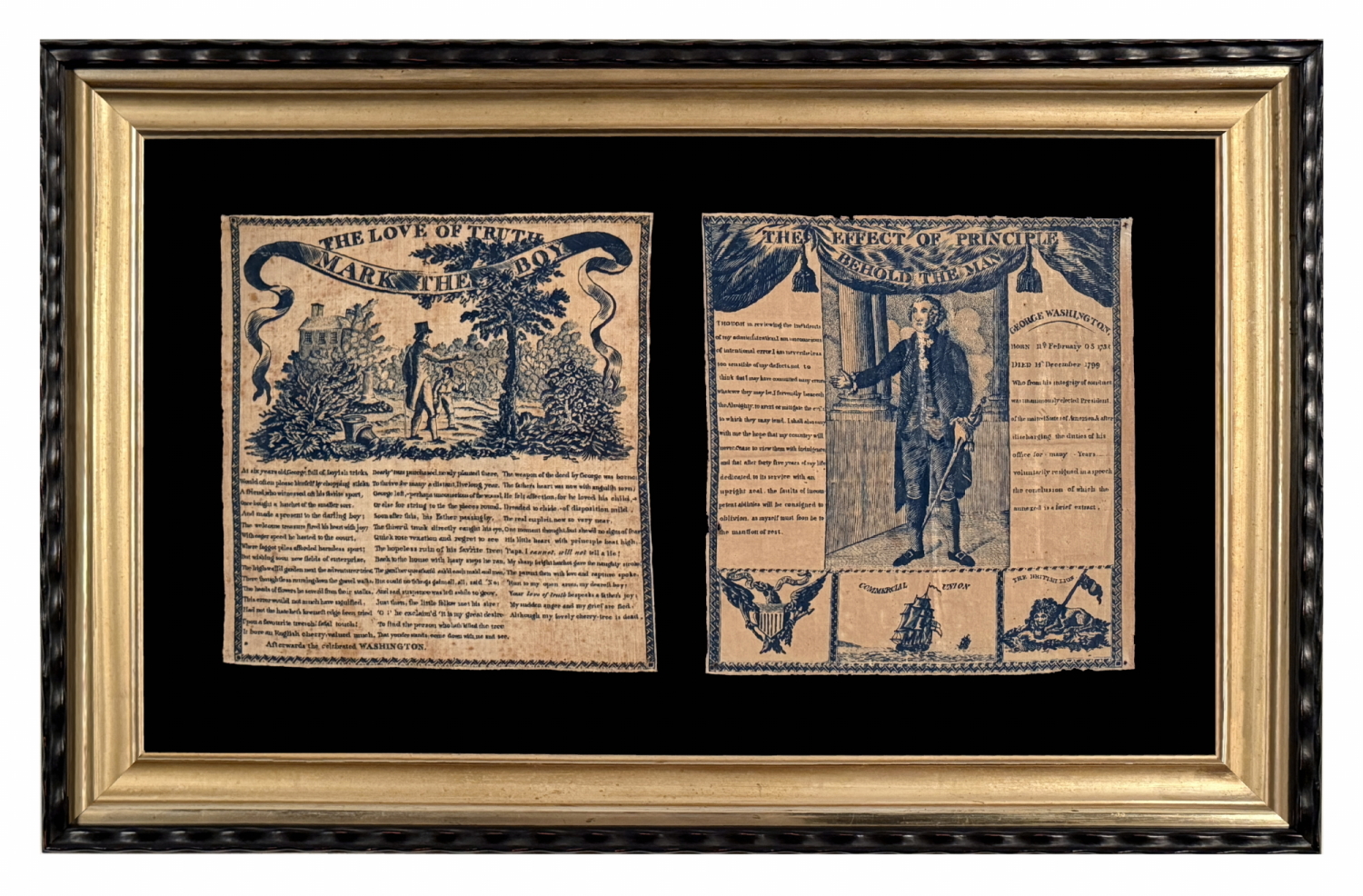
Printed in blue pigment, on coarse white linen, this pair of small, American, kerchief-style textiles displays text and images that glorify the life of George Washington. In styles known to have been printed next to one-another, as companion pieces, on the same bolt of cloth, one of these features a standing portrait, above which a tasseled, swag valance, with the following title reads: “The Effect of Principle, Behold the Man”. The image is based on a mezzotint styled after Gilbert Stuart’s very famous painting of Washington in his later years, most often referred to as the ‘Lansdowne portrait.’ Stuart painted three versions of the work, in oil on canvas, one of which was completed in 1796 for a wealthy merchant by the name of William Constable, who commissioned it as a gift for Alexander Hamilton.
To the left of the portrait is an excerpt from Washington’s farewell address to his troops, following victory in the Revolutionary War. To the right is another from his eulogy, by "Light Horse Harry" Lee.
Along the lower register is a series of three images, the center of which features a square-rigged tall ship with “Commercial Union” above it, flanked by a federal eagle on the left and the British lion to the right. It is reasonable to assume that the textile may have been produced in demonstration of the maker's desire, and/or that of others, to advance trade between the two nations. Commercial printers were extremely influential in early America, as the primary means of disseminating social and political opinions.
The mate to this textile, entitled “The Love of Truth Mark the Boy” memorializes Washington through the fabled story of the cherry tree. The imagery features the future general and president as a child, axe in hand, accompanied by his father, before his boyhood home, on a landscape of flora and fauna. Below is a poem that first appeared in the 5th edition of a well-known Washington biography in 1806, by pastor and bookseller Parson Weems (1759-1825). Because there is no surviving documentation of George’s relationship with his father, who passed when George was just 11, in 1743, Weems is suspected to have fabricated the tale to increase sales of the book, initially published on the heels of Washington’s death, but without the poem, in 1800.
Printed in at least 3 colors, the others being mulberry/red and sepia or black, the textiles are believed to have been produced by Germantown Print Works in Germantown, Pennsylvania, part of Philadelphia, that became a mecca of textile production in that city.* An example of each, in blue, is illustrated in Threads of History, Americana Recorded on Cloth, 1775 - the Present, by Herbert Ridgeway Collins (1979, Smithsonian Press), on page 63, items 38 & 39.* Each of these particular examples is recorded as being in the collection of Cornell University, though Collins also cites an uncut pair, in black/sepia, in the collection of the Western Reserve Historical Society, Cleveland, OH. Though the name "Germantown Print Works" is recorded as having been printed on the Western Reserve examples, I discovered this to have simply been misinterpreted by previous researchers, per my direct conversation with Museum Advisory Council Curator of Costume and Textiles Patty Edmonson, in December of 2025, who kindly provided images. A series of 3 pairs, in blue, still on the bolt, is among the holdings of Winterthur Museum & Library.
Copies of “The Love of Truth, Mark the Boy,” are in the collections of the Free Library of Philadelphia, Yale, the Boston Athenaeum, Brown University, and Michigan State. Examples of “The Effect of Principle, Behold the Man,” are at Yale, the Boston Athenaeum, Princeton, and The Library of Virginia. Another is documented in "Running for President, The Candidates and Their Images, 1789-1896" by Schlesinger, Israel, and Frendt, (1994, Simon & Schuster), p. 15.
Provenance: This exact copy of “The Effect of Principal; Behold the Man,” was lent by Jeff R. Bridgman Antiques, Inc. to the Museum of the American Revolution, Philadelphia, from Jan. – Aug., 2023, for an exhibition of exceptional, political, early American themed patriotic kerchiefs entitled “Nothing to Sneeze At.” The kerchief was also exhibited at the Great American State Fair in Washington, DC, from June 29th – July 10th, 2026, held to celebrate America’s 250th anniversary of independence, in the Pennsylvania Pavilion, as part of a collection of flags and banners related to that state, presented and curated by Jeff R. Bridgman Antiques, Inc..
* Collins relates that Germantown Printworks was operated by the Hewsons. In doing so he cites one of Worthington Chauncey Ford's books on George Washington, but it isn't clear which one (there are many) and no page numbers are given. John Hewson was an Englishman who came to America and opened his printing business on the advice of Benjamin Franklin. He was one of the first “calico printers” and is the earliest documented to have advertised printed kerchiefs. His ads for bandanas appear as early as June 20th, 1774. He is suspected of having produced the very first American kerchief that pictured an American president, which is documented in Collins as item 1 on page 48. Linda Eaton, curator at Winterthur, was doing in depth research on the three printers of fabrics that were operating in Germantown in early America. When I spoke with her in 2012, she relayed that she had discovered that the owner and/or operator of Germantown Print Works, while not currently known, was not John Hewson. This information was not yet published. She also noted that Winterthur possessed examples of the two George Washington textiles, which I afterwards had the privilege to view in first person, during a visit to the Winterthur archives.
Mounting: The textiles were mounted and framed within our own conservation department, led by expert staff. We take great care in the mounting and preservation of flags and have framed thousands of examples.
The gilded American molding is circa 1890-1920’s. To this a modern, rippled profile molding of shadowbox depth, black with reddish undertones and highlights, was added as a cap. The background is 100% cotton twill, black in color. The glazing is Optimum Museum Acrylic (Plexiglas), U.V. protective, anti-reflective (crystal clear), and scratch-resistant.
Condition: The Effect of Principle: There is an all-over golden oxidation of the white fabric and there is very minor staining. There are tiny tack holes in each corner and there are minor nicks around the perimeter. The Love of Truth Mark the Boy: There is moderate foxing ad staining in numerous areas throughout and there is minor to modest overall oxidation. |
|
|
|
| Collector Level: |
Advanced Collectors and the Person with Everything |
|
| Flag Type: |
|
|
| Star Count: |
|
|
| Earliest Date of Origin: |
1806 |
|
| Latest Date of Origin: |
1812 |
|
| State/Affiliation: |
Pennsylvania |
|
| War Association: |
1777-1860 Pre-Civil War |
|
| Price: |
SOLD |
|
| |
Views: 140 |
|
|
|

)



