
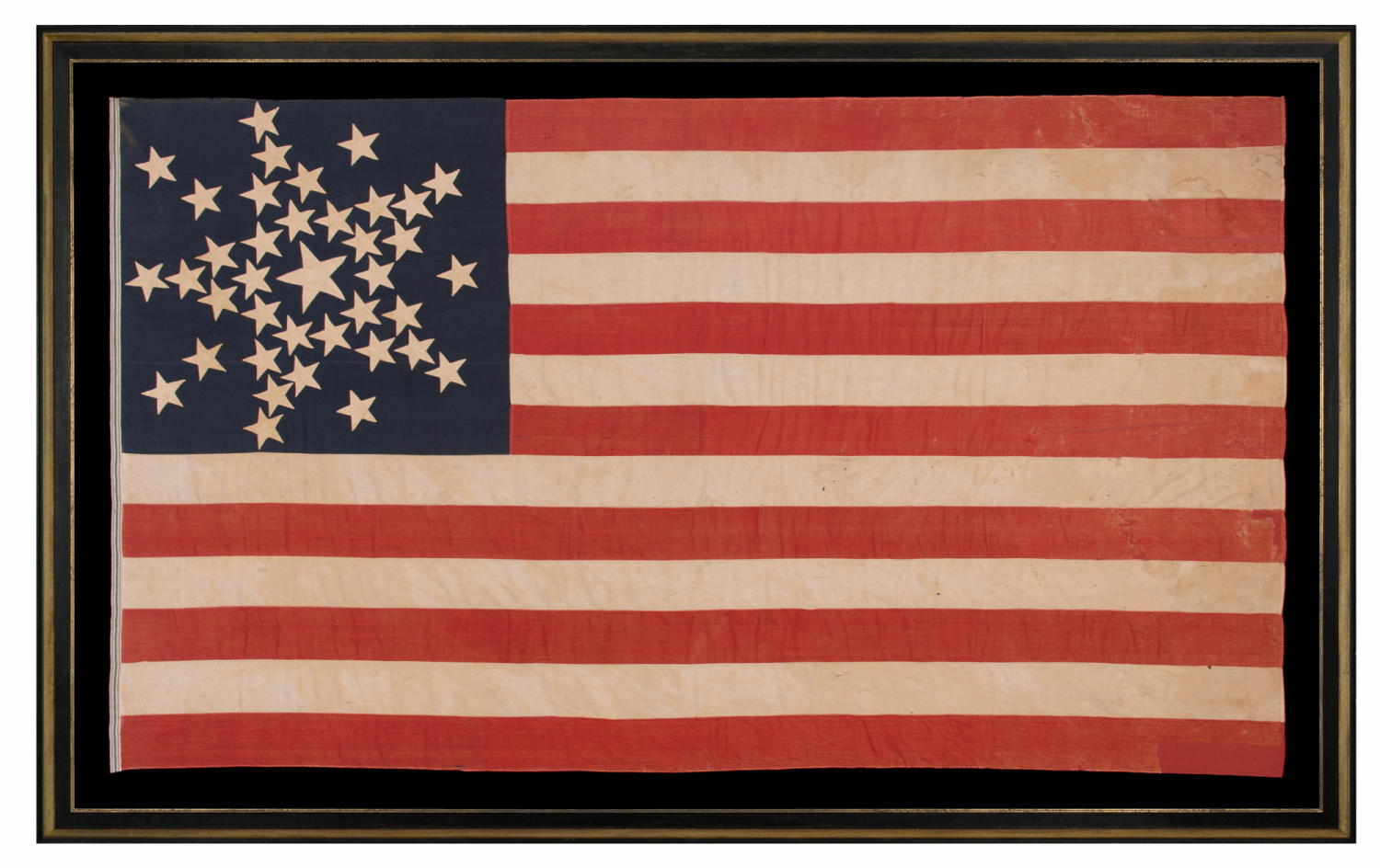
| SPECTACULAR ANTIQUE AMERICAN FLAG WITH 38 STARS, ARRANGED IN A RARE VARIANT OF THE "GREAT STAR" PATTERN THAT INCORPORATES STARS BETWEEN EACH ARM; MADE FOR THE 100th ANNIVERSARY OF AMERICAN INDEPENDENCE IN 1876, AMONG THE VERY BEST OF ALL KNOWN EXAMPLES IN THIS STAR COUNT, REFLECTS THE ADDITION OF COLORADO AS THE “CENTENNIAL STATE” |
|
| Web ID: | 38j-959 |
| Available: | In Stock |
| Frame Size (H x L): | Approx. 73" x 118" |
| Flag Size (H x L): | 60.5" x 105.5" |
| Description: | |
| In the world of antique American flags there are nearly countless designs. Because there was no official star configuration until 1912, their placement before that time was left to the whims of the maker. Most structured their stars in lineal rows or columns. A smaller number of flag-makers chose medallion designs that employ two or three consecutive wreaths, usually surrounding a large center star and with a flanking star in each corner, outside the circular field. Substantially up the rarity scale is something called the "Great Star" pattern, in which the smaller stars are arranged in the profile of one large star. Also called the “Great Luminary” pattern, this 38 star example consists of a large star in the very center, encircled by a ring of 10 stars, about which are 5 extended, triangular formations of 4 stars each, the latter of which complete the star-shaped perimeter. Note how the configuration is canted, such that one arm is directed at approximately the 11:00 position. Great Stars come in many forms. In this instance, note how some of the stars were placed within the valley created between each arm. In the three “V” shaped saddles that open toward the fly, there single stars, while in the two that open toward the hoist, there are pairs of stars, arranged in lineal succession from the center outward. The resulting presentation, not unlike an exploding firework, is both striking and apropos for the extraordinary events that occurred in the year of our nation’s 100th anniversary of independence, when we welcomed our 38th state. Colorado entered as the “Centennial State” on August 1st, 1876. Per the Third Flag Act of 1818, stars were not to be officially added until the 4th of July following a state's addition. For this reason, 37 remained the official count until July 3rd, 1877. In the latter 19th century, it became common to add stars before the respective state(s) had even entered the Union. No one cared what was official, not even the military, where the matter of practicality with regard to flags always seems to have outweighed regulations. In the private sector, commercial flag-making was a competitive venture. Few flag-makers continued to produce 37 star flags, when their competitors had jumped the star count to 38. It is for this reason that 38 and 13 stars (to reflect the original 13 colonies) are more often seen at the Centennial International Exposition, our nation’s first World’s Fair, that served as the nucleus of the national celebration. It is of interest to note that some makers of printed parade flags actually began to produce 39 star flags in 1876, in hopeful anticipation of the addition of two more Western Territories instead of one. The 39th state would not join the Union for another 13 years, however, when the Dakota Territory—thought to be coming as a single state—entered as two separate states on November 2nd, 1889. Though it technically remained official until July 3rd, 1890, the 38 star flag generally fell from production at that time. Flags with dynamic star patterns, such as the Great Star design presented here, are what one would expect during the Centennial itself. Lasting for six-months, the Centennial International Exposition, held in Philadelphia’s Fairmount Park, was characterized by extravagance and extraordinary craftsmanship. 225 buildings were produced for the event, the largest of which was the largest building in the world at the time, with a footprint of 21 acres on the interior. Everything produced for the fair was over-the-top, in all facets of its design, carved, painted, gilded, and embellished. Among flag collectors, the Great Star configuration is the Rolls Royce of all 19th century geometric patterns. It probably came about shortly before 1818, when Congressman Peter Wendover of New York requested that Captain Samuel Reid, a War of 1812 Naval hero, help to create a new design that would become the third official format of the Stars & Stripes. A recipient of the Congressional Medal of Honor, Reid became harbor master of New York following the war. During his lifetime, he created many innovations in signal use, including a system that could actually send messages from New York to New Orleans by sea in just two hours. The primary concern of ship captains was that the signal remained easily recognized on the open seas. Reid’s concept of placing all the stars in a star-shaped pattern would have kept the constellation in roughly the same format as the number of states grew and more stars were added, in a distinct design that could be quickly identified through a spyglass. 1818, Reid suggested to Congress that the number of stripes permanently return to 13 (reduced from 15) and that the stars be grouped into the shape of one large star. Though his concept for the stripes was ultimately accepted, his advice on the star pattern was rejected by President James Monroe, due to the increased cost of arranging the stars in what would become known as the “Great Star”, “Great Flower”, or “Great Luminary” pattern. Monroe probably didn’t wish to impose this cost on either the government or civilians, so he suggested a simple pattern of justified rows. Never-the-less, the Great Star was produced by anyone willing to make it and its rarity today, along with its beauty, has driven the desirability of American flags with this configuration. In summary, this is one of the most graphic great star pattern flags that I have ever seen, which places it among the very best examples of not only those within the 38 star count, but across all examples of the 19th century. Construction: The stars of the flag are made of cotton, hand-sewn, and double-appliquéd. This means that they were applied to both sides of the canton. The stripes were joined with treadle stitching. There is a cotton sleeve with 2 brass grommets. Mounting: The flag has been hand-sewn to 100% natural fabric for support on every seam and throughout the star field. Fabric of similar coloration was used for masking purposes. The flag was then hand-stitched to 100% cotton twill, black in color, which was washed to reduce excess dye. An acid-free agent was added to the wash to further set the dye and the fabric was heat-treated for the same purpose. The glazing is U.V. protective acrylic. Condition: The binding along the hoist is not original to the flag. It is a blue and white, ticking stripe, herringbone weave cotton tape, period to the flag's construction, used to complete the unfinished edge. There is minor to moderate foxing throughout, accompanied by minor fabric loss and minor fading. Fabric of similar coloration was placed behind the flag, during the mounting process. Many of my clients prefer early flags to show their age and history of use. The exceptional rarity and presentation well-warrants its condition. |
|
| Video: | |
| Collector Level: | Flags for the truest Patriots. My best offerings |
| Flag Type: | Sewn flag |
| Star Count: | 38 |
| Earliest Date of Origin: | 1876 |
| Latest Date of Origin: | 1889 |
| State/Affiliation: | Colorado |
| War Association: | 1866-1890 Indian Wars |
| Price: | SOLD |
| E-mail: | info@jeffbridgman.com |
 |
|


