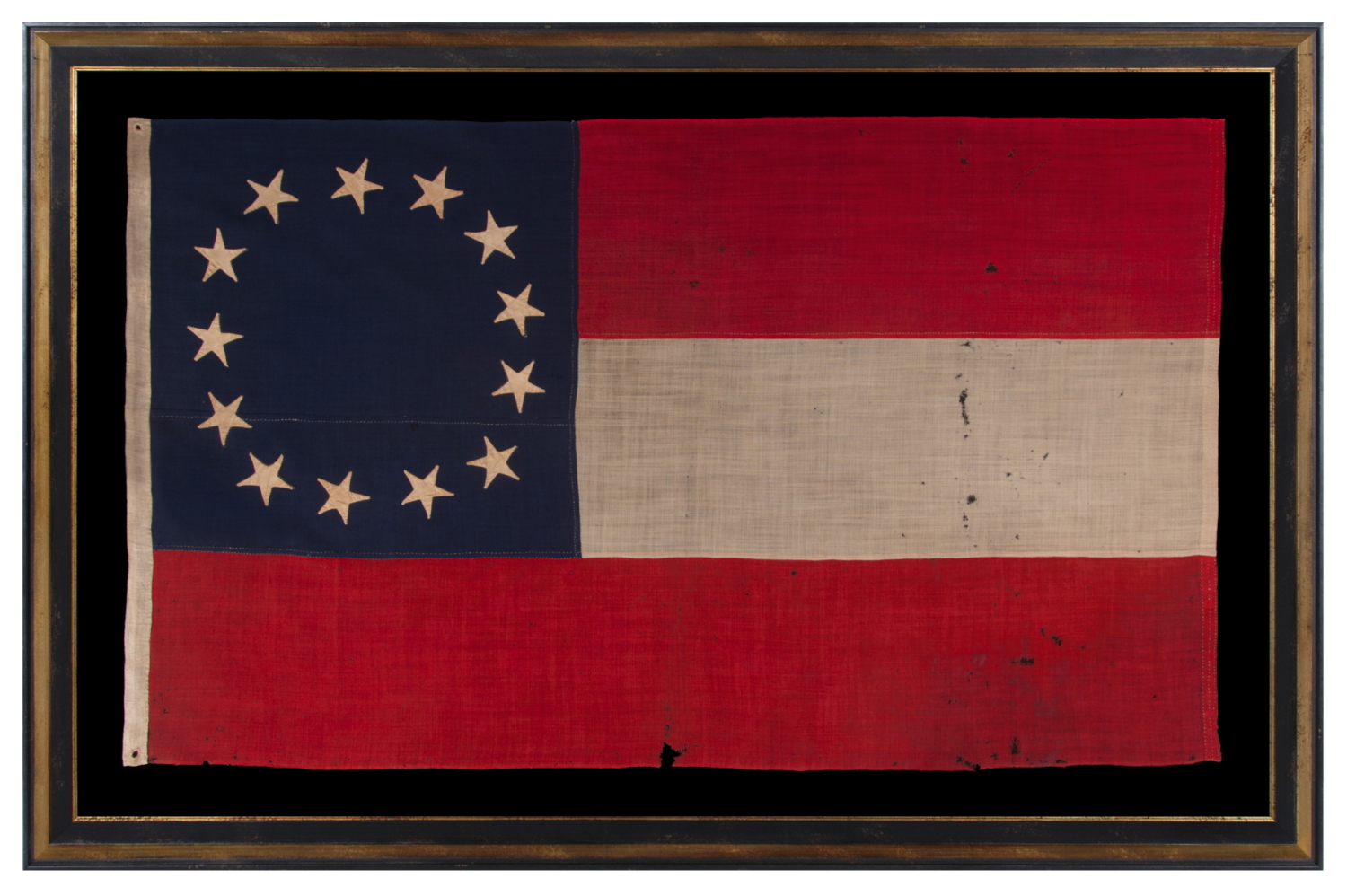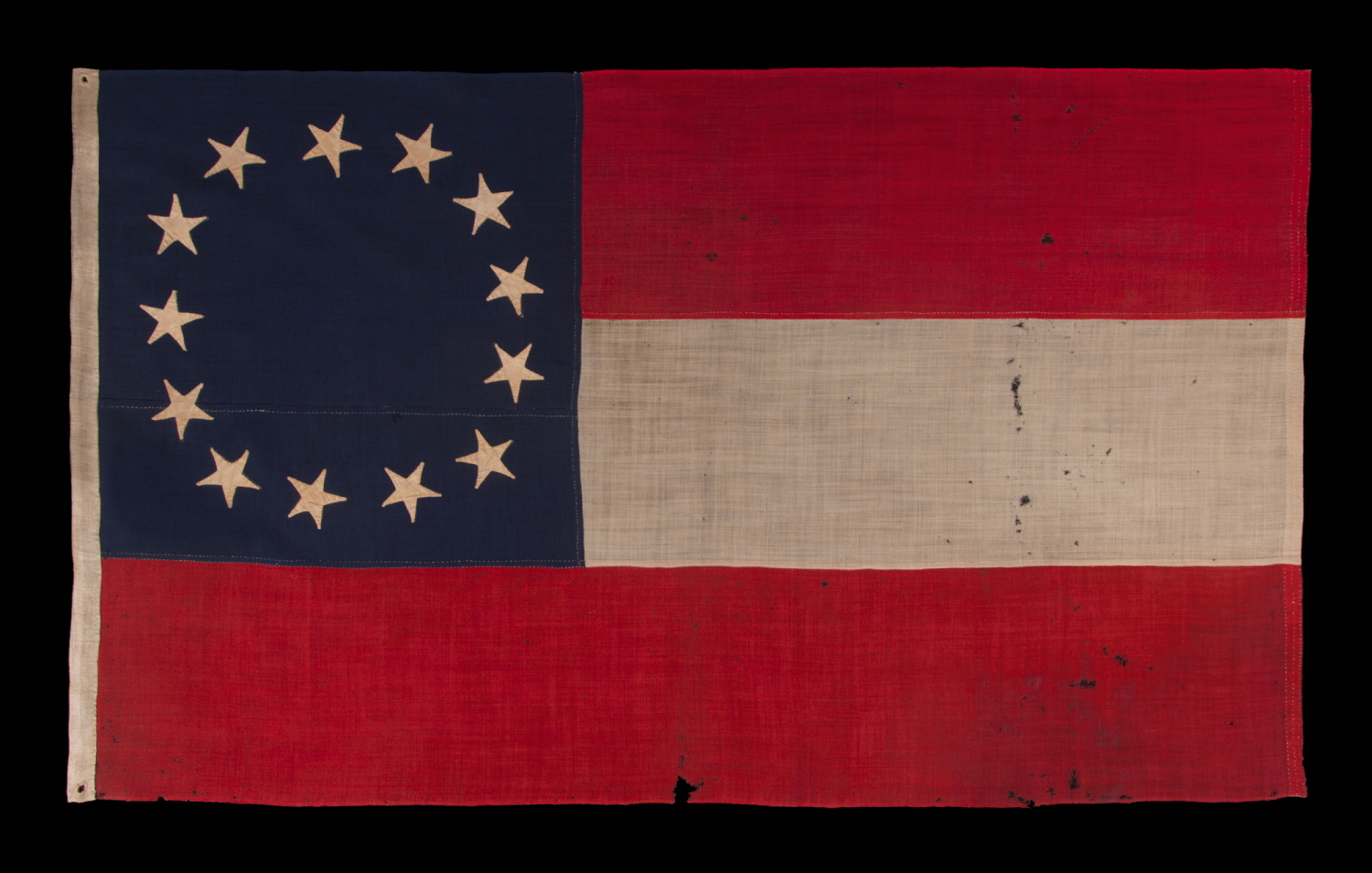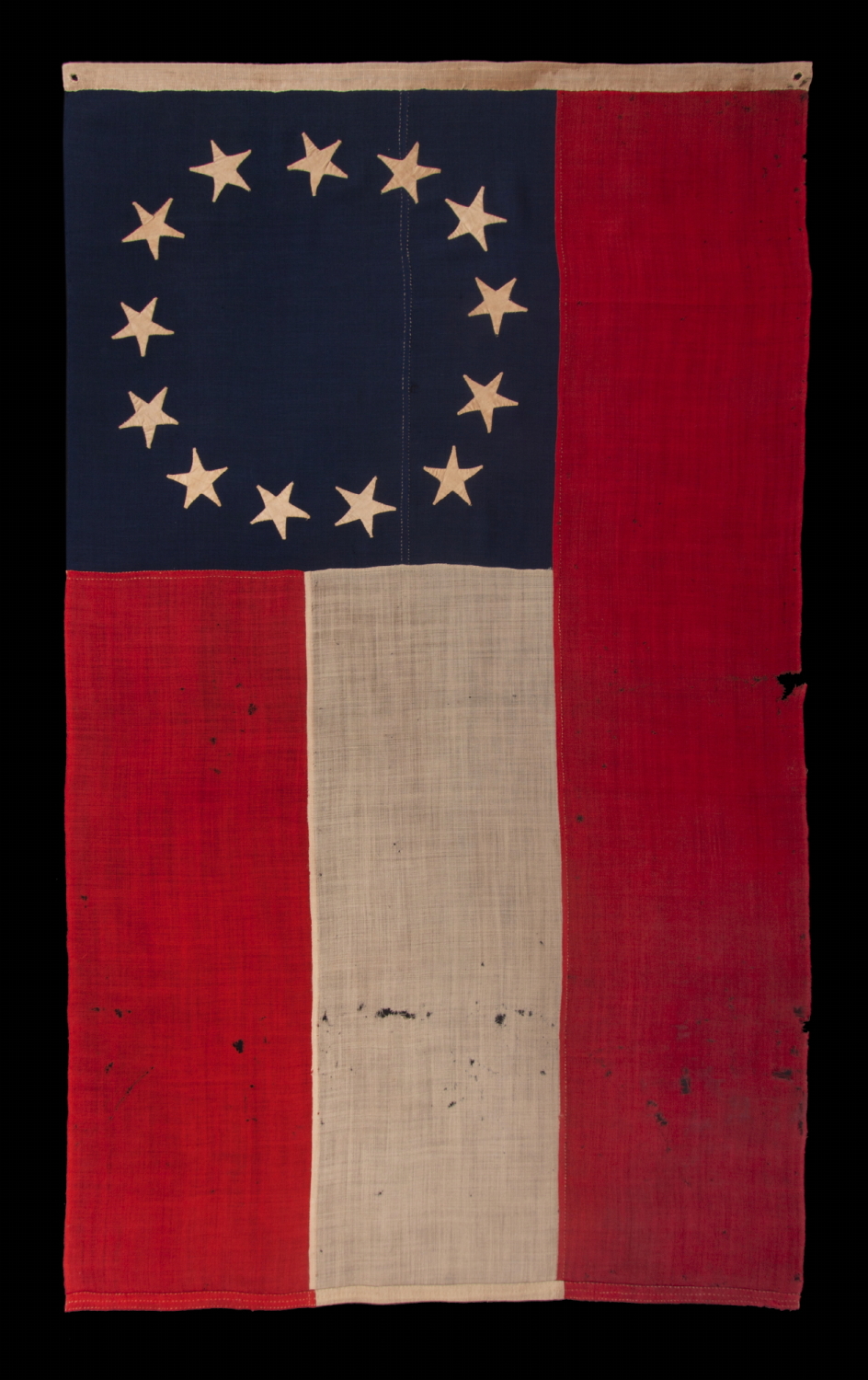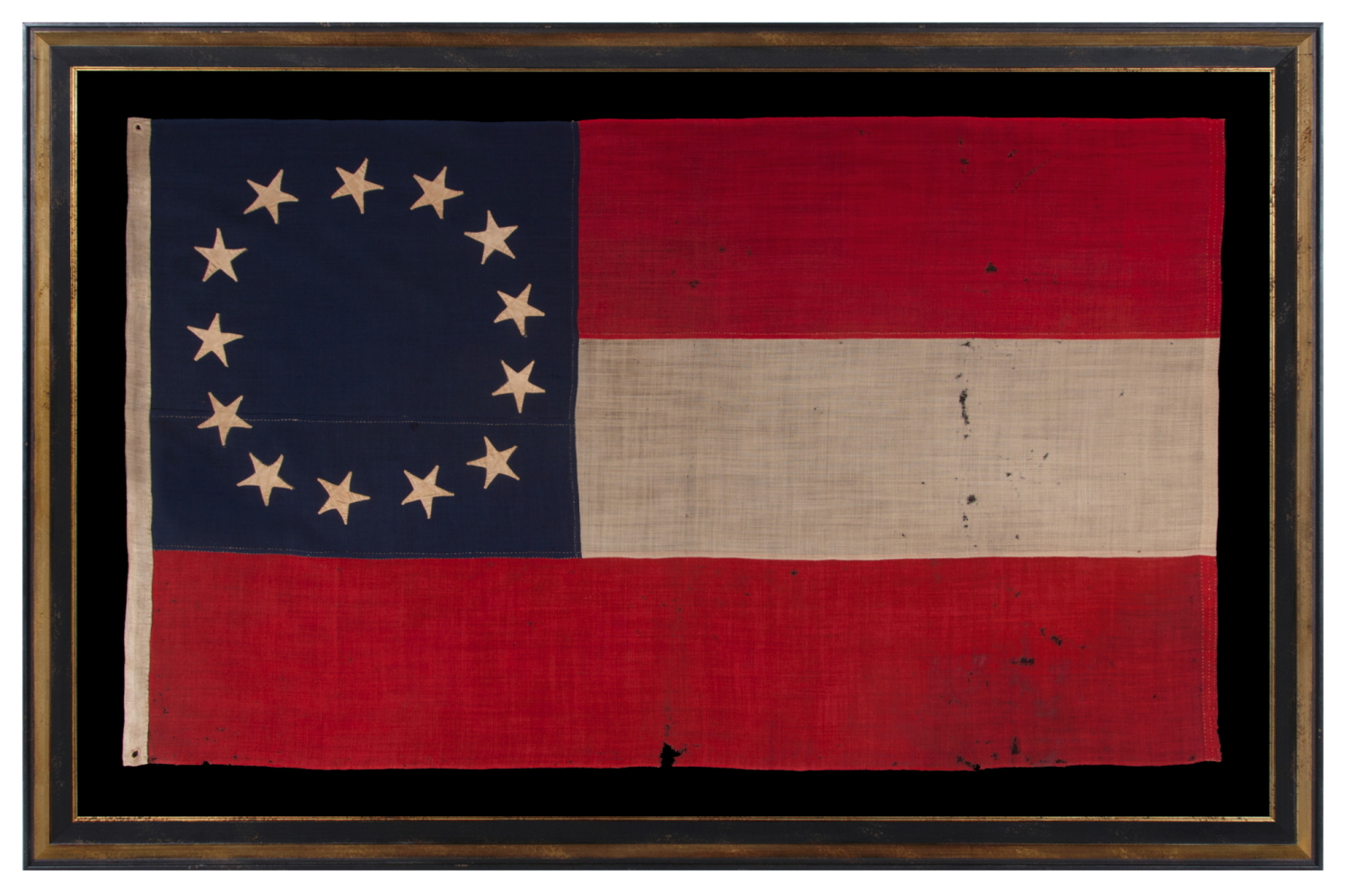
| CONFEDERATE 1st NATIONAL PATTERN COMPANY FLAG (A.K.A., "STARS & BARS"), CARRIED BY THE “GRIMES COUNTY GREYS,” FORMALLY DESIGNATED “G” COMPANY OF THE 4th TEXAS INFANTRY, INTEGRAL TO HOOD’S FAMOUS “TEXAS BRIGADE,” ARMY OF NORTHERN VIRGINIA; ATTRIBUTED TO FLAG MAKER HENRY CASSIDY OF NEW ORLEANS; SENT TO THE FAMILY OF SGT. JAMES L. GOULD IN 1863, FOLLOWING HIS DEATH AT LITTLE ROUND TOP, GETTYSBURG |
|
| Web ID: | fcj-951 |
| Available: | In Stock |
| Frame Size (H x L): | Approx. 52" x 79.25" |
| Flag Size (H x L): | 40" x 67.25" |
| Description: | |
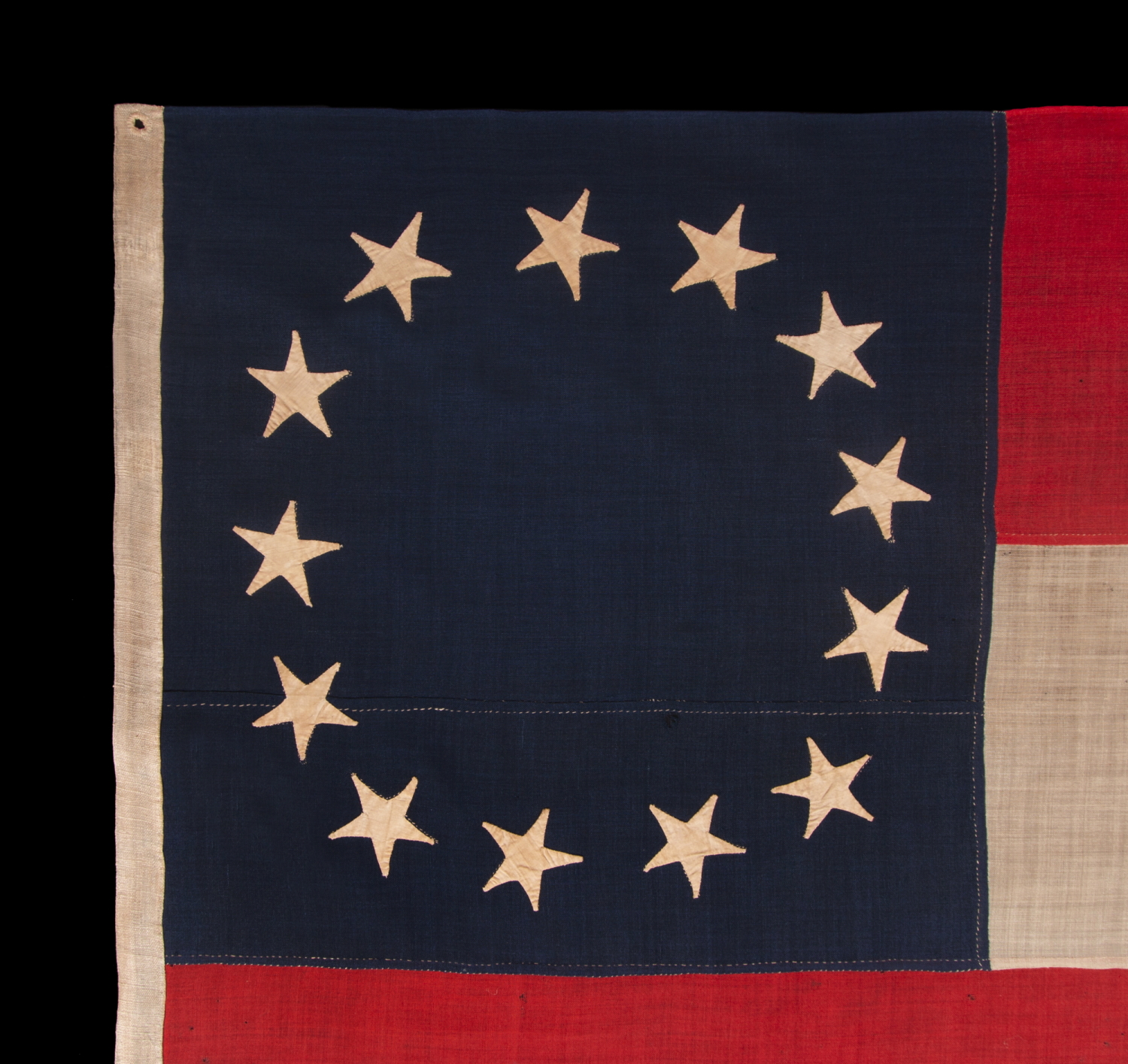
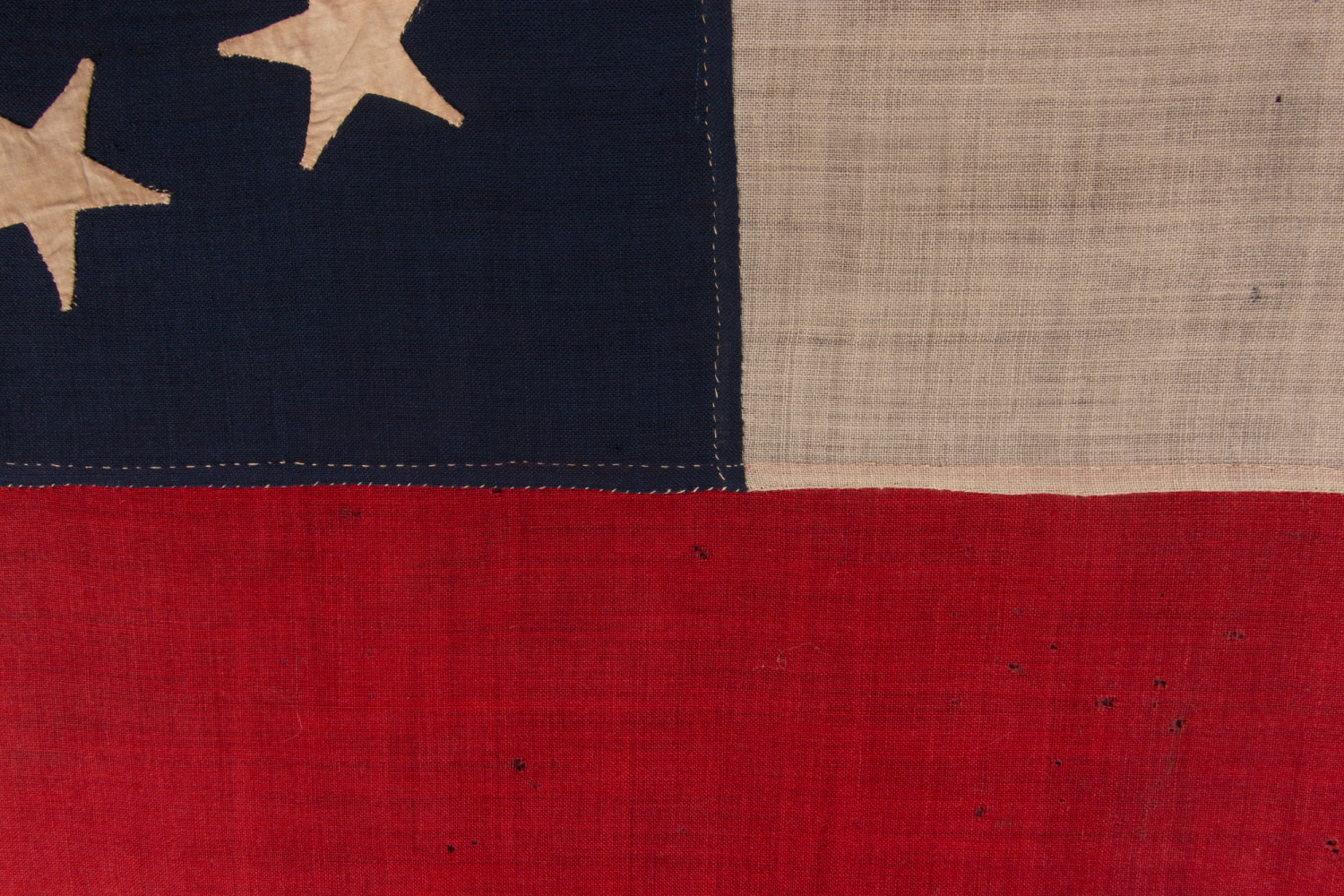
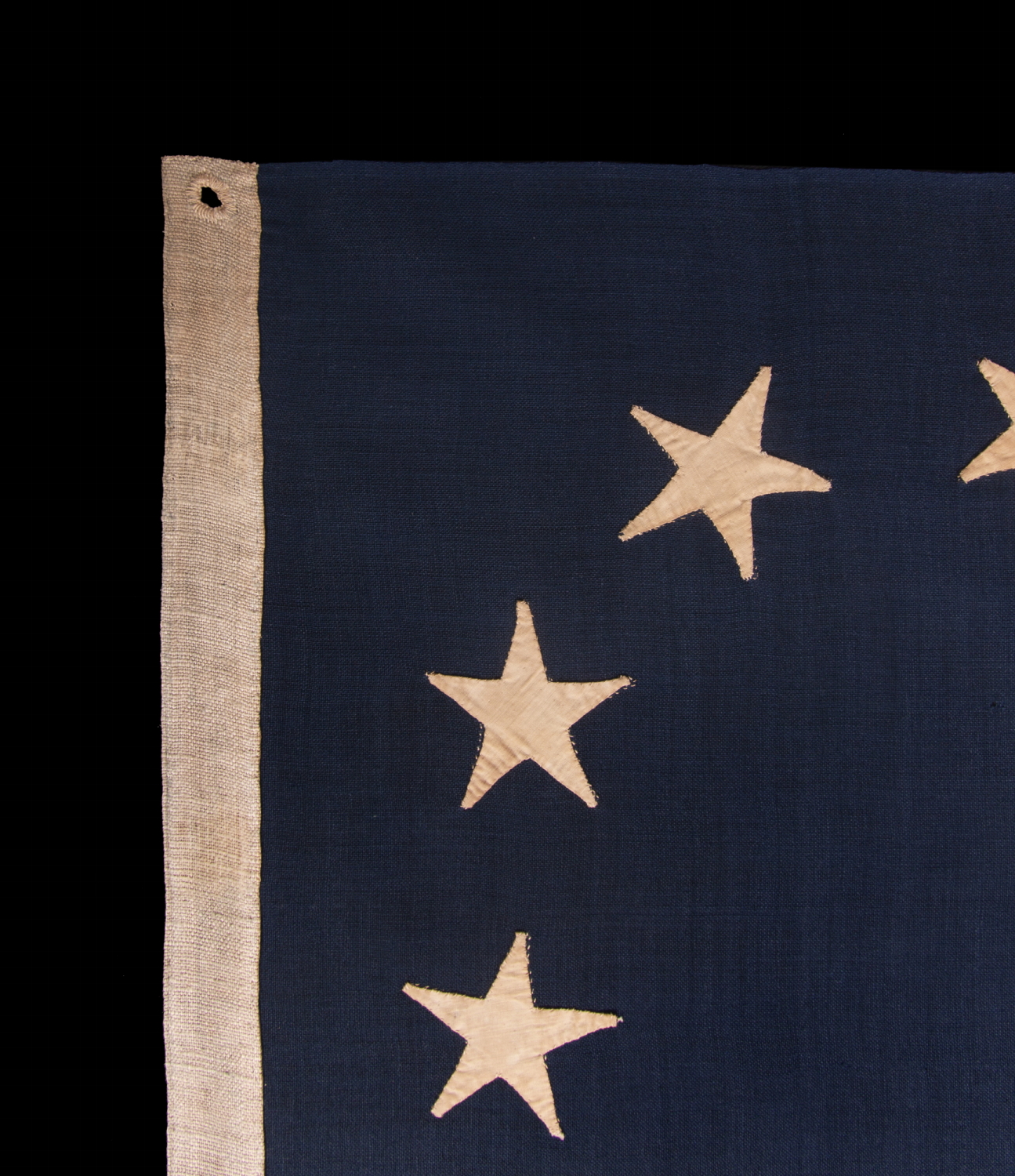
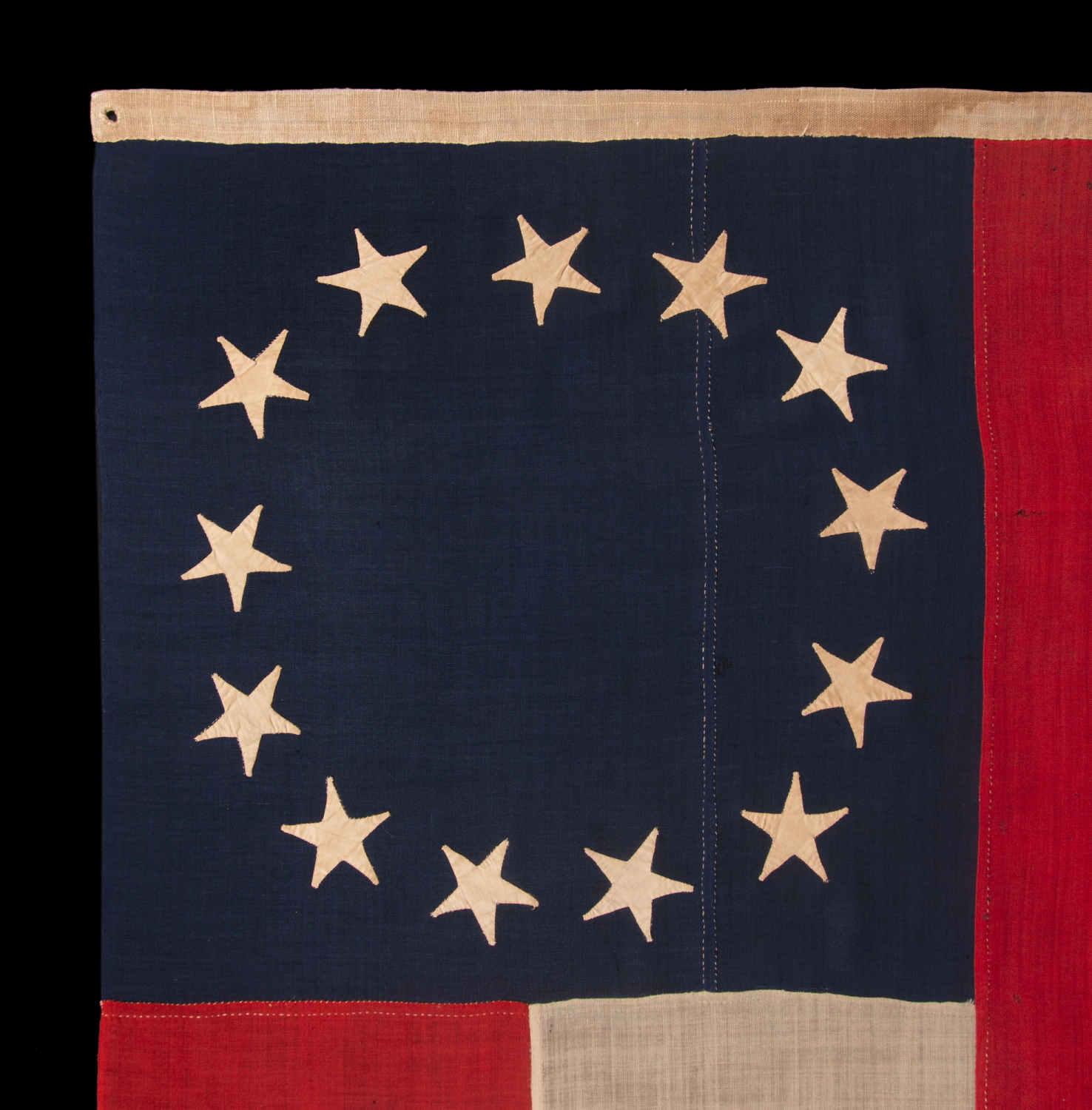
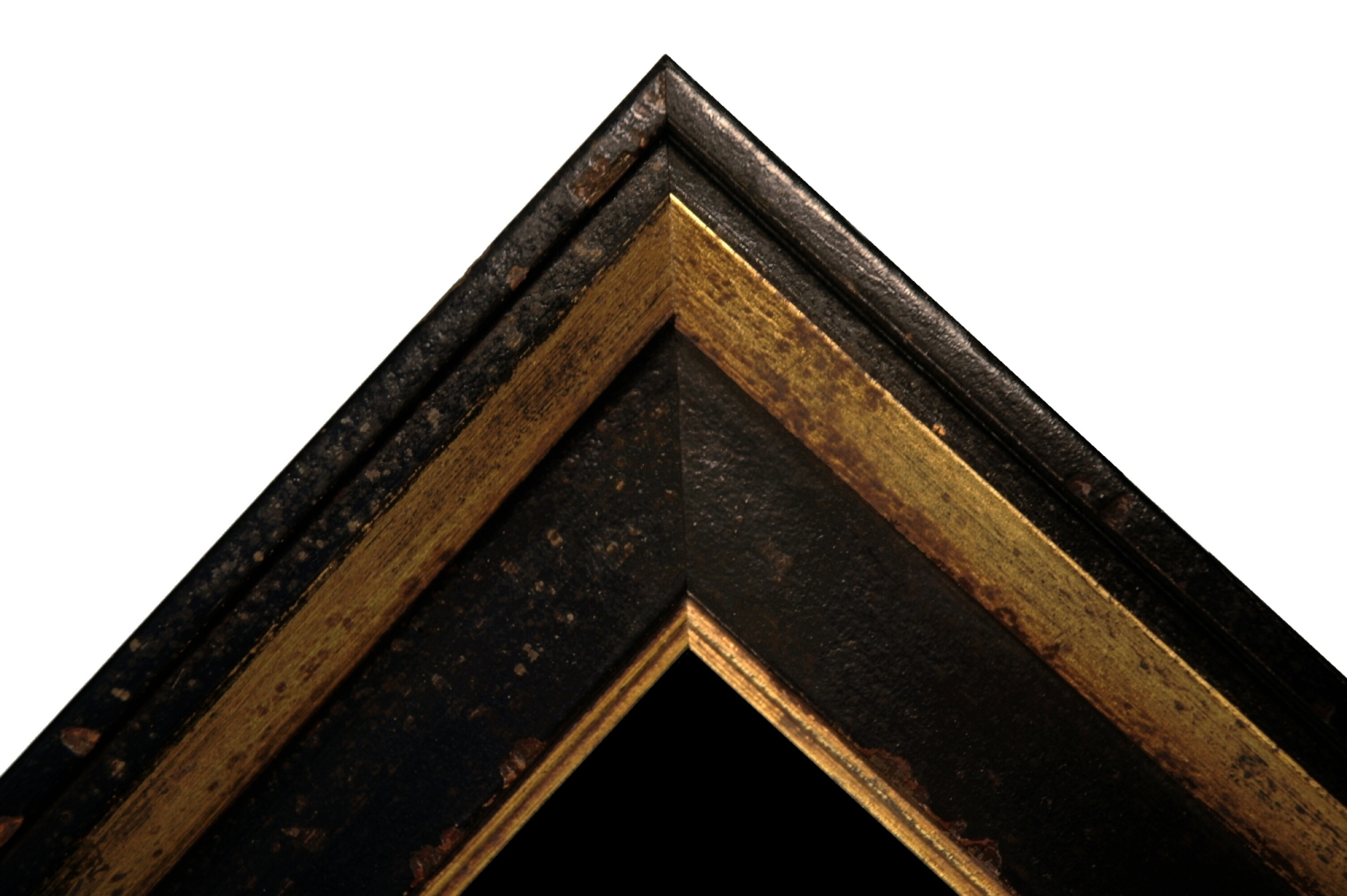
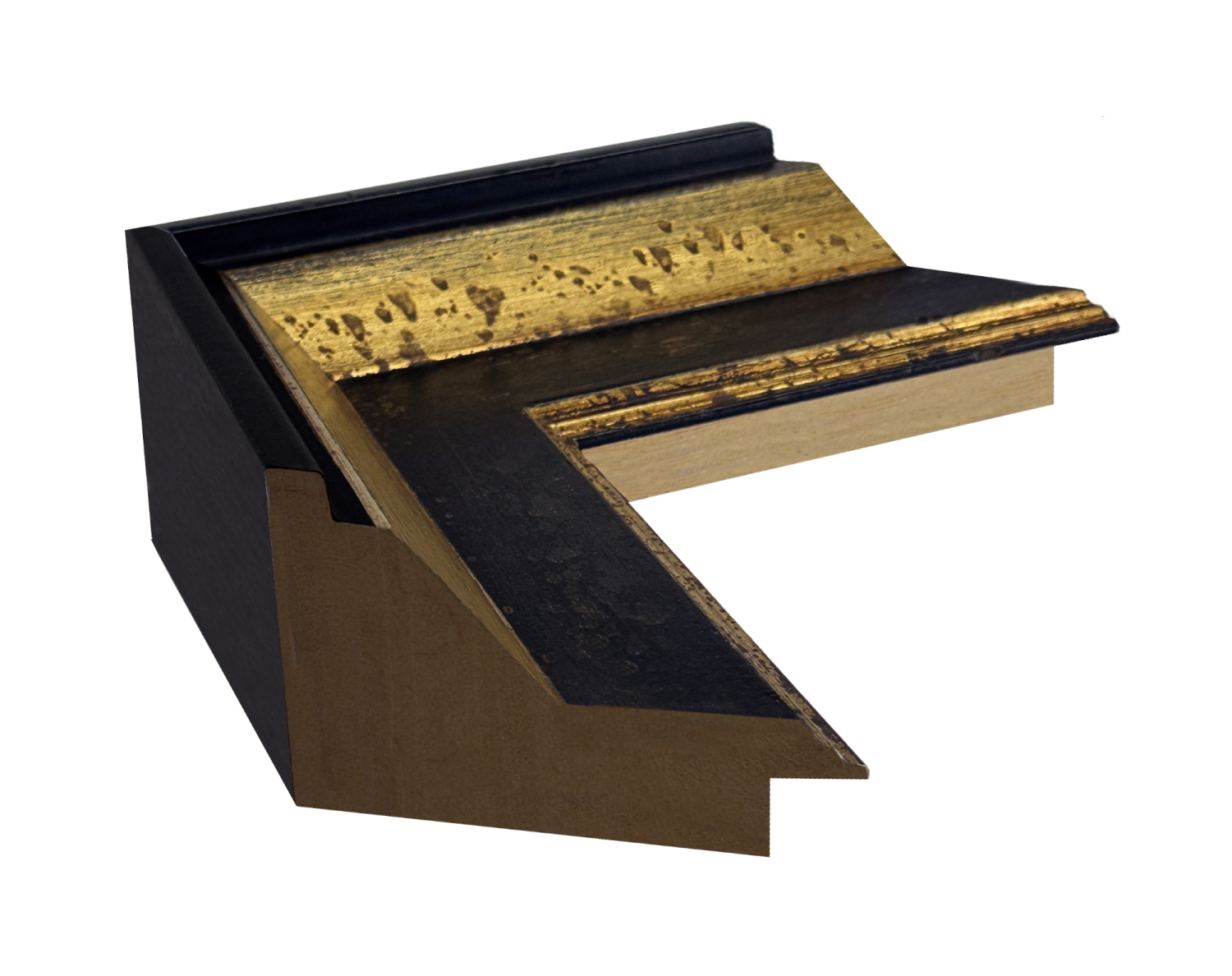
| Confederate 1st National pattern flag (a.k.a., ‘Stars & Bars’) of the Civil War period, with an open wreath arrangement of 13 stars. Likely made in Louisiana by prominent New Orleans sailmaker Henry Cassidy, this an entirely hand-sewn example, akin to other known flags supplied by him in 1862, distributed to both Texas and Mississippi units operating in Virgina. Both the blue canton and the bars, in red-white-red, are constructed of wool bunting. The stars are made of plain weave cotton are double-appliquéd (applied to both sides), with their edges formally turned under. There is a coarse binding along the hoist, likely of flax or hemp content, with two hand-sewn, whip-stitched grommets. Cassidy produced many flags for the Confederate Army from his premises at corner of Poydras & Fulton Streets, the most fabled of which were the curiously elongated, rectangular, Southern Cross battle flags with 12 six-pointed stars and wide bindings, made for Army of Tennessee Commander General Braxton Bragg. The flag was handed down through the family of James L. Gould of Anderson, Grimes County, Texas, who enlisted at Harrisburg [part of Houston] on July 19th, 1861 with the “Grimes County Greys,” at the non-commissioned rank of 1st Sergeant, under command of Captain J. W. Hutcheson. Also known as “Hutcheson’s Texas Volunteers,” the Greys were formally designated “G” Company of the 4th Texas Infantry, and soon assigned to John Bell Hood’s notorious ‘Texas Brigade,’ one of the hardest fighting units in the Confederate Army. Along with the ‘Stonewall Brigade’ of General Thomas Jonathan (Stonewall) Jackson, the pair were considered ‘shock troops’ within Robert E. Lee’s Army of Northern Virginia (ANV), thrust head-long into every major battle of the Eastern Theater, save Chancellorsville. The great-grandfather of James L. Gould, also named James Gould (hereafter “James I”, b. 1735-d. 1821), emigrated from Yorkshire, England to Rome, New York in 1750 with two of his brothers. At some point, he relocated to Granville, Massachusetts, in the Berkshires, along the Connecticut line, in 1758, married English-born Lucy Brooks (b. 1732, d. 1797), of New Hampshire. The son of James I & Lucy, known as James Gould, Jr. (James II), traveled to Maine as a youth to apprentice as a Civil Engineer, likely with Col. Loammi Baldwin, and thereafter became a lumberman in Granville. In 1796, during the last year of the administration of George Washington, he secured a government contract to survey large timber tracts in what would eventually become Florida, though not for another 49 years. In 1807, James II won another government contract, this time to build a lighthouse on St. Simons Island, Georgia, where he subsequently relocated. Completing structure in 1810, which began service in 1811, President James Madison appointed him its keeper, a role in which he served, as a member of the U.S. Lighthouse Service (pseudo-military), for the next 27 years. In the interim, Gould built a large home, acquired 900 acres, bought slaves, and grew cotton. Sometime during the latter 1820’s or early 1830’s, James II was hired to draft a proposal for what would become the New York-Erie Railroad (chartered 1832, for service between New York and Buffalo). While in New York, his two sons, James F. (James III) and Horace B. Gould, both attended preparatory school in New Haven, CT, then Yale, from which James III graduated at age 21. While in the North, James III married a New Haven girl by the name of Alice (surname unknown), the daughter of a local innkeeper, who bore him a son, James L. Gould (James IV). Though Alice’s father sought to entice James IV into the business of innkeeping, his own father made a stronger offer, buying fertile land on St. Simons known to locals as Black Banks, which he gifted to his sons. The brothers thus returned to the island to manage what became known as Black Banks Plantation. Though Alice accompanied him, she felt abandoned, was not used to or comfortable with having servants, had no homemaking skills of her own, and abhorred plantation life. She traveled back and forth, spending only about 6 months of the year in Georgia, and eventually divorced James III, though James L. (James IV) remained in Georgia with his father. On August 1st, 1850, while still in Georgia, James F. (III) remarried Frances M. Shults of South Carolina, who bore him two daughters, Rebecca and Alice, who became step-sisters of the elder John L. (IV). Parting ways for some reason, James III sold his share of Black Banks to his brother, before moving his consolidated household to Texas, drawn perhaps by the promise of cheap land and new opportunity in the Lone Star State. By 1860, the Goulds had settled in Anderson, the bustling county seat of Grimes County. At that time, Anderson was far more than a small rural village; it was a thriving commercial hub known as the "Little Rome of Texas," because it was built on seven hills. At this time the Goulds would have walked streets busy with stagecoaches, arriving at the famous Fanthorp Inn, a major stop on the line connecting East Texas to Houston. The town was a center of law and politics, hosting lawyers, judges, and merchants. It also served as an industrial asset. As tensions with the North rose, the J. H. Dance & Co. munitions firm of Anderson, (a.k.a., Dance Brothers,) converted from the making of gristmills to the manufacture of revolvers, rifles, muskets, bayonets, cannonballs, and other ammunition, eventually contracting to supply the Confederate Army. It was in this charged, patriotic atmosphere that the Gould children came of age. When Texas seceded, in early 1861, war fever in Anderson significantly impacted the community. The Gould family’s service record reflects the common split between the young, able-bodied men sent to the front lines, and the older generation left to guard the home front. In the environment that prevailed, James L. (IV) became among the first to answer the call. On May 7, 1861, he is said to have stood with his neighbors at "Red Top" to officially organize the Grimes County Greys. In July, the locally generated unit moved to a camp of instruction near Harrisburg, Texas [a segment of Houston] to ready itself for what was to come. On July 19th, 1861, James L. (IV) formally mustered into Confederate service. Though he does not appear as an officer on the hand-written record of the initial composition of the Grimes County Greys, he and was either appointed or elected First Sergeant (probably the latter), following the muster—a role that placed him as the critical link between officers and the enlisted men, likely testament to his charisma and/or leadership that emerged in the interim. During the mid-19th century, Texas law mandated that all men of a certain age participate in local militia, namely as frontier defense against native American hostile to settlers. It does not appear that either James F. (III) or Sgt. James L. (IV) had yet to subscribed to the mandate, perhaps having moved there so recently that, for one reason or another, it had simply not yet happened. Now that the war was on and younger men had left, James F. (III), is said to have enrolled at the rank of Private in the Precinct No. 1 Militia, more commonly known as the Anderson Home Guard. Organized under the Texas Militia Act, this unit was composed of men too old for regular service or those in essential trades. Leaving Texas, under Captain Hutcheson, the Greys traveled to Richmond, Virginia, via New Orleans, on foot, then by both boat and by train, where, on September 30th, 1861, it received its officially designation as Co. “G” of the 4th Texas Volunteers, Hood’s Brigade, Army of Northern Virginia. Between September of 1861 and April of 1862, the 4th participated in garrison duty and training, moving to Dumfries, Virginia in November, still in preparation for active duty, and taking up defensive positions near the Rappahannock River. With the fall and winter came significant illness. As early as October, the regiment chaplain reported that more that 400 of the original 1,187 men were sick. For some reason, on January 2nd, 1862, First Sgt. Gould changed posts with the company’s Second Sgt.. At some point thereafter, he then appears to have likely gained the venerable, though highly dangerous role of Color Sergeant, assuming custodianship of the company flag. This distinction was usually maintained by a particularly brave line sergeant, not a First Sergeant, whose duties were to instead organize, drill, and maintain discipline within the troops. Because ‘color sergeant’ was a designation, as opposed to a formal rank, the specific point at which this occurred remains unknown. Hoods Texas Brigade saw its first action during the Peninsula Campaign of 1862, in Virginia, where it participated in the Battles of Eltham's Landing (May 7th), Seven Pines (May 31st – June 1st), Gaines' Mill (a.k.a., Cold Harbor, June 27th), and Malvern Hill (July 1st). Sgt. Gould is listed as present on all extent muster rolls until wounded at Gaines' Mill, a hard-fought battle in which the Texas Brigade was credited with breaking the Union line, though at a heavy cost, with some 21 killed, 63 wounded, and 1 captured. Gould was injured in the calf during the fighting, and sent to the rear. He was admitted to Chimborazo Hospital No. 3 at Richmond on June 29th, and received a furlough on July 12th, with the notation “Atlanta, Ga.,” preceding to St. Simons Island, where he received care by relatives. On October 16th, 1862, he was admitted to Hospital No. 8, back in Richmond, for “debility,” then furloughed again, for 60 days, on October 27th. This may have been extended. He does not appear again as present on company rolls until March-April of 1863, by which time the regiment had seen action at Second Manassas (11 killed, 20 wounded), and in the fierce fighting at Antietam, where the regiment lost at total of 210 (57 killed, 130 wounded, and 23 captured/missing), as part of 550 total lost by the Texas Brigade. Within the ranks of the 1st Texas at Antietam, a sister unit, nearly ever officer was struck. Back with the company, Gould was with the Grimes County Greys, under Hood, during the Suffolk campaign, in Southeastern Virginia (April 11th – May 4th), commanded by Confederate Lt. Gen. James Longstreet. This included something called “The Investment,” involving the construction of a line of earthworks to bottle up a Union general, and the Battles of Norfleet House (Apr. 13-15) and Hill’s Point / Fort Huger (April 19th), the latter of which involved an amphibious Union assault in which 130 Confederates were captured. Sgt. James L. Gould (IV) was with the company, as part of Robertson’s Brigade, Hood’s Division, at the Battle of Gettysburg, where, on July 2nd, 1863, they participated in the attack on the Union left. The brigade line split in the advance, with the 4th and 5th Texas fighting alongside elements of Law’s Brigade, pushing across Plum Run Creek and driving back Union troops from the lower slopes of Big Round Top, before attempting three or four assaults up the wooded and boulder-strewn slopes of Little Round Top, losing some 112 killed, wounded, and captured/missing, of their 415 total count of officers and men. Sgt. Gould suffered a gunshot wound to the left leg and was among those captured. Surgeons at a Union hospital amputated the leg at the upper third of the thigh, on July 8th, in an effort to save him, but he died on the 10th, joining the 7,058 soldiers killed at Gettysburg (3,903 Confed. / 3,155 Union), plus 33,264 wounded (18,735 Confed./ 14,529 Union) and 10,790 captured or missing (5,425 Confed. / 5,365 Union). Initially buried on the field, Gould was afterwards reinterred, among his comrades, at Hollywood Cemetery’s “Gettysburg Hill,” in Richmond, Virginia. Though the disposition of the flag presently remains unnoted in battlefield reports, the late vexillologist Howard Michael Madaus, noted Civil War flag authority, documented the Gould Family’s receipt of the flag as having been recorded in the family Bible, when it arrived home in 1863. Though no images of the inscription appear to have been taken, this was 1977. In a brief letter containing a synopsis of his examination and research, dated March 22nd of that year, Madaus categorically states: “I spoke at length with [a] Mrs. Baker who showed me the family Bible with the note from 1863 about it. The flag is correct for what would have been used in the field at that time and has Projectile and powder damage evident which I noted on the drawing [attached]. There is also blood spatter as well in several places…” In the same letter, Madaus also explains how the flag “conforms to several used in Virginia supplied by Cassidy of New Orleans in 1862 to regiments from Texas and Mississippi.” Though it has been suggested that someone may have mailed the flag to Gould during his long furlough after Gaines Mill, this seems extremely unlikely. If sent in 1863, as notated in the family Bible, this would have had to occur at least 5 months after the engagement at Gaines’ Mill, with numerous major engagements occurring inbetween, in which the flag would have been present. If sent before these battles, the flag would have just been received. To soon-after retire the flag, and retire it, in perfectly serviceable condition, gifting it to a demoted soldier, willing or otherwise, who received an outwardly minor, though debilitating leg wound, that produced two furloughs from action and the horrors war, for many months, is nonsensical. In either case, someone having sent it in 1862 makes no sense, nor does having sent it in the opening months of 1863, six months or more after the incident that theoretically precipitated the sending had occurred. If Gould had performed a medal-of-honor type act, or if the flag had been made and presented by his mother or sisters at the muster point, there would at least be some plausible reason to consider such a circumstance. As it is, with a flag very likely produced by a New Orleans maker, under contract with the Confederate States of America (CSA), with 13 stars, to include Missouri & Kentucky, not accepted by Jefferson Davis and the Confederate Legislature until later that year, in November & December (respectively) of 1861, with the star count formally updated on December 10th, and the flag likely presented to the Grimes County Greys by the Army of Northern Virginia quartermaster sometime in the first half of 1862, it would have basically been a new flag at the time of the Gaines Mill engagement. In 1863, after Gould’s return, his rank was more often listed as simply “Sergeant,” suggesting that he may have in fact become more of a line sergeant, typical of a color bearer. The supposed demotion may have actually reflected a bold and/or wild personality that occasionally landed Gould on the hot seat with his superiors, but was likewise responsible for his popularity and his initial election to the First Sergeant rank. Although Gould is at two points listed as “private” in undated files, it’s difficult to determine whether or not this occurred in error. As a former First Sergeant, traits that might alternatively lead to his undoing, in terms of rank, such as drunkenness and insubordination, could be the same ones that propelled a charismatic, devil-may-care individual to take up the flag and lead in a manner that better suited his character, and, at the same time, demonstrated bravery, in an effort to save face, following months of inaction. It’s important to remember that this was now an elite group of men, who had endured a lot during Gould’s 8-9 month absence. Even today, the battle of Antietam, on Sept. 17th, 1862, remains the single bloodiest day in American history, with approximately 23,000 killed, wounded, and captured/missing. Those who survived were generally held in awe. Presentation of the flag to the Gould family in 1863, following James’ capture and death at Gettysburg, makes far greater sense, with hearts potentially stirred to such an act. One may presume that whomever picked up the flag, when Gould fell, may have perceived—along with other remaining members of the Grimes County Greys—that Gould’s ultimate sacrifice warranted the gift, especially within this tiny community in rural Texas. Whatever the case may be, surviving flags of any sort, that date to any time whatsoever within the 19th century, with any manner of Texas-related history, are both extraordinarily rare and highly desired. This is even more true in the case of a flag from Hood’s famed Texas Battalion, among the most celebrated fighting units in Lee’s army, as the CSA’s commanding general. Further, across all of the engagements of the Civil War, none is more widely revered than Gettysburg. Surviving flags from the battle, in private hands, are among the most desirable of any that exist from the 250 years since America’s birth. Detailed Construction Notes: The flag is hand sewn throughout, the canton of the flag is made of blue wool bunting, constructed from two length fabric, in widths of 18 1/4" and 8 3/4", seamed horizontally, to achieve overall measurements of 26.5" on the leading edge by 27" on the fly. There is a selvage edge at the top edge of the canton. The flag’s 13 stars measure 3.25" to 3.5" point-to-point. Arranged in a circular wreath approx. 22.5" in diameter, the stars are constructed of undyed cotton and are double-appliquéd (applied to both sides). Like the canton, the bars are constructed of cotton. The first of these (red) has an unhemmed selvage edge at the top and measures 13.5" in height. The center bar (white) measures 13.5" on the hoist, and the bottom bar (red) 13.25”, with an unhemmed selvage edge along the bottom. There is a 1.5” binding along the hoist, constructed of what appears to be golden brown linen, perhaps with some hemp content, along which there are two hand-sewn, whip-stitched grommets, situated at the extreme top and bottom. The fly end has a rolled hem, turned to the reverse, with three rows of stitching. Additional Notes: Why 13 Stars? The count of 13 stars reflects the 11 states that that formally voted to secede from the Union, with proper ratification of that vote (where required), plus, the Border States of Missouri and Kentucky, which did not follow proper legislative protocol, but were deemed to have enough Southern support with their respective populous, accompanied by the necessary will and organized resources, to make significant impact on the war and thus warrant admittance by Jefferson Davis and the Confederate legislature. The original design of the 1st national flag of the CSA incorporated 7 stars in a circular wreath. These reflected the initial 7 states to secede from the Union, in what is oten referred to as the “initial wave of secession.” Texas was the 7th of these, which also included, in order, South Carolina, Mississippi, Florida, Alabama, Georgia, and Louisiana. Each of these states voted for secession, and were accepted by the Confederate States of America (CSA) individually, but the selection of this number as the first group is hinged to the acceptance of the Provisional Constitution of the CSA on February 8th, 1861. This was actually adopted by delegates from 6 states (SC, MS, FL, AL, GA, and LA) on that day. Although the contingent of representatives from Texas didn’t arrive in time for the vote, their support was presumed. The Texas State Legislature had, in fact, approved secession on February 1st by an overwhelming majority of 166 to 7. The Constitution of the CSA was officially adopted by the Confederate Congress on March 11th, 1861 and ratified on March 29th. By this time there had been a popular vote of the people in Texas, in favor of secession, ratifying the legislative vote. By this time Jeff Davis & the CSA Legislature had officially accepted the state, and Texas representatives had formally voted to ratify the CSA Constitution. The first 7 Confederate States were followed by 4 others, individually, that also seceded by way of official, legislative means, including Virginia, North Carolina, Arkansas, and Tennessee. The necessary processes of numbers 8 through 11 were complete by July 2nd, 1861, with Missouri and Kentucky, as described above, added as numbers 12 and 13 on November 28th and December 10th, respectively. The count of 13 remained constant for the balance of the war. Provenance: Formerly displayed at the Texas Civil War Museum. Mounting: The flag has been mounted and framed within our own textile conservation department, led by expert staff. We take great care in the mounting and preservation of flags and have framed literally thousands of examples. The background is 100% cotton twill, black in color, that has been washed and treated for colorfastness. The black-painted, hand-gilded and distressed molding is Italian. The glazing is Optimum Museum Plexiglas (crystal clear but glare-reducing, U.V. protective, and scratch-resistant). Feel free to contact us for more details. Condition: The late vexillologist Howard Madaus, leading Civil War flag expert within the museum world, described the losses in this flag as having resulted from “projectile and powder damage,” also noting what he described as “blood spatter as well in several places.” At all times extremely hesitant to even suggest such a circumstance, having only done so in a tiny handful of instances in 25 years, I would make the following comment. Having owned thousands of wool flags, and seen or handled thousands more, I would agree that the patterning, size, and shape of holes seen here is largely not reflective of what I would expect from mothing, save in the case of the largest of these, in the center of the red bar, along the bottom edge. While not definitive, and I would not even raise the suggestion had Madaus not made made these observations, I would nonetheless concur that the remainder do present as if they were caused by something having passed through it other than moths, perhaps buckshot or shells from a hand-held firearm. There is modest soiling along the hoist and in the white stars, accompanied by minor to modest of the same elsewhere, in limited areas. There is an instance of modest loss in the bottom center of the last red bar, accompanied by minor to modest losses elsewhere in the barred field, most notably within the last 1/3 of the flag. Many of my clients prefer early flags to show their age and history of use. Overall the textile is remarkably intact and was obviously well-care-for. |
|
| Video: | |
| Collector Level: | Flags for the truest Patriots. My best offerings |
| Flag Type: | Parade flag |
| Star Count: | |
| Earliest Date of Origin: | 1862 |
| Latest Date of Origin: | 1862 |
| State/Affiliation: | The Confederacy |
| War Association: | 1861-1865 Civil War |
| Price: | Please call (717) 676-0545 or (717) 502-1281 |
| E-mail: | info@jeffbridgman.com |
 |
|