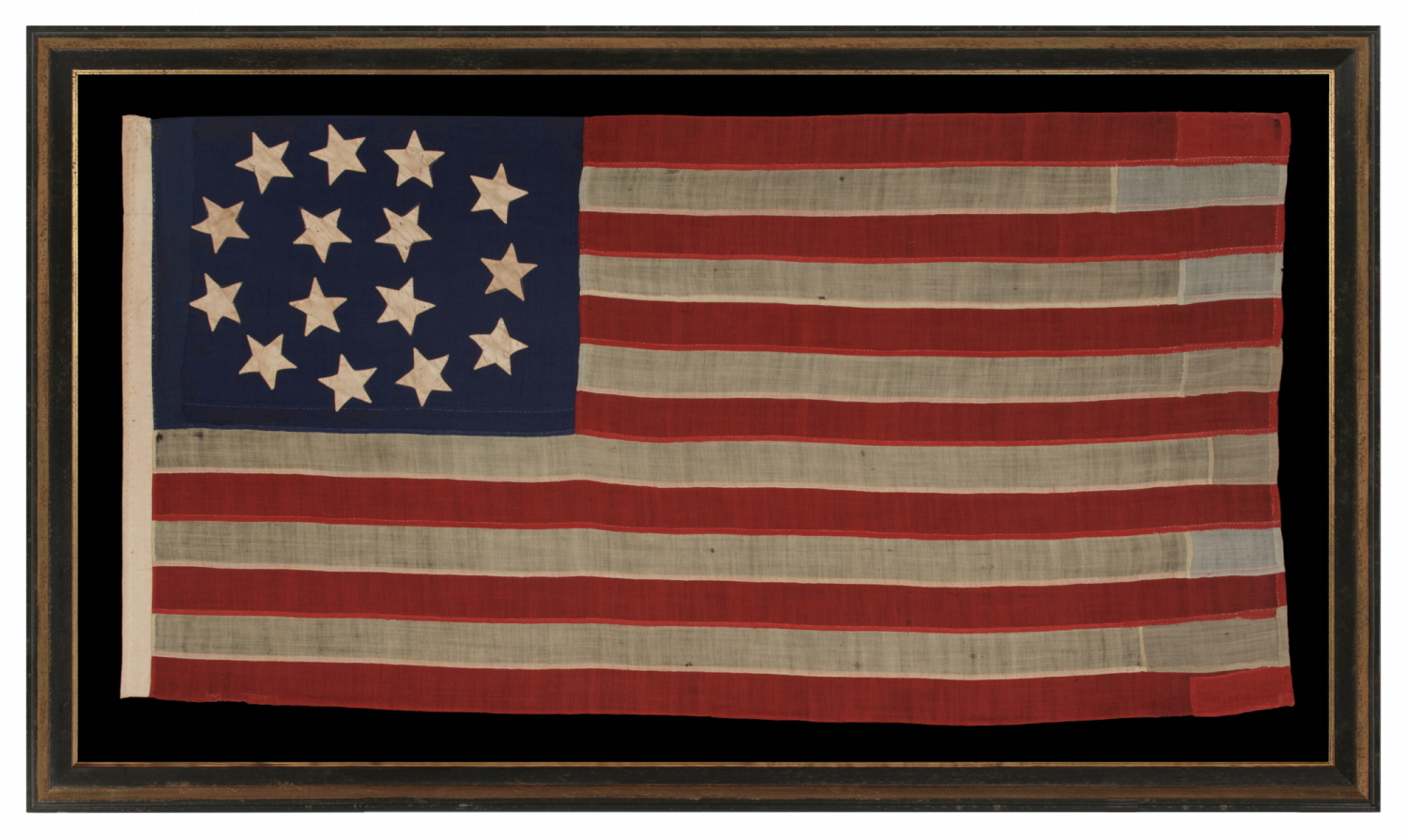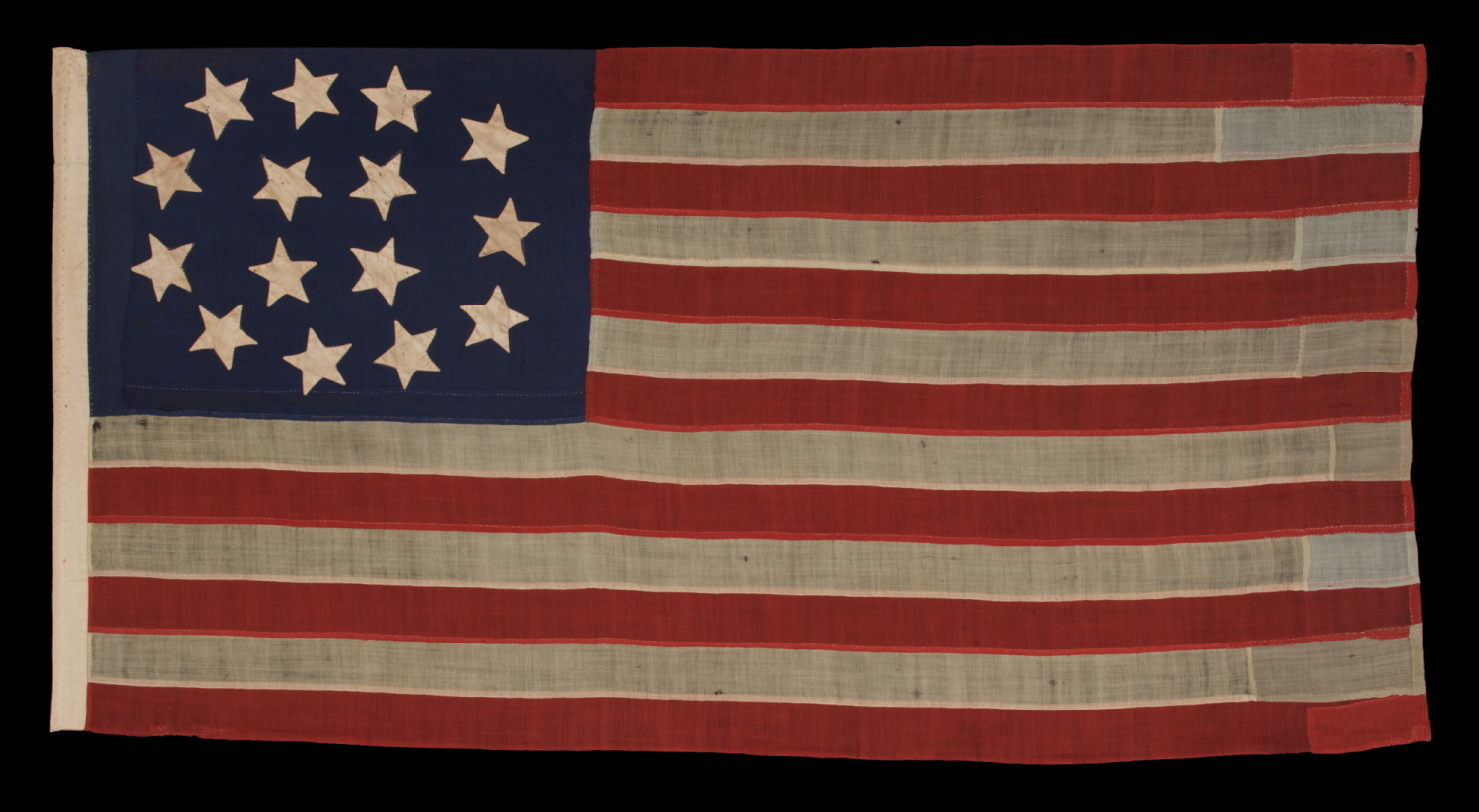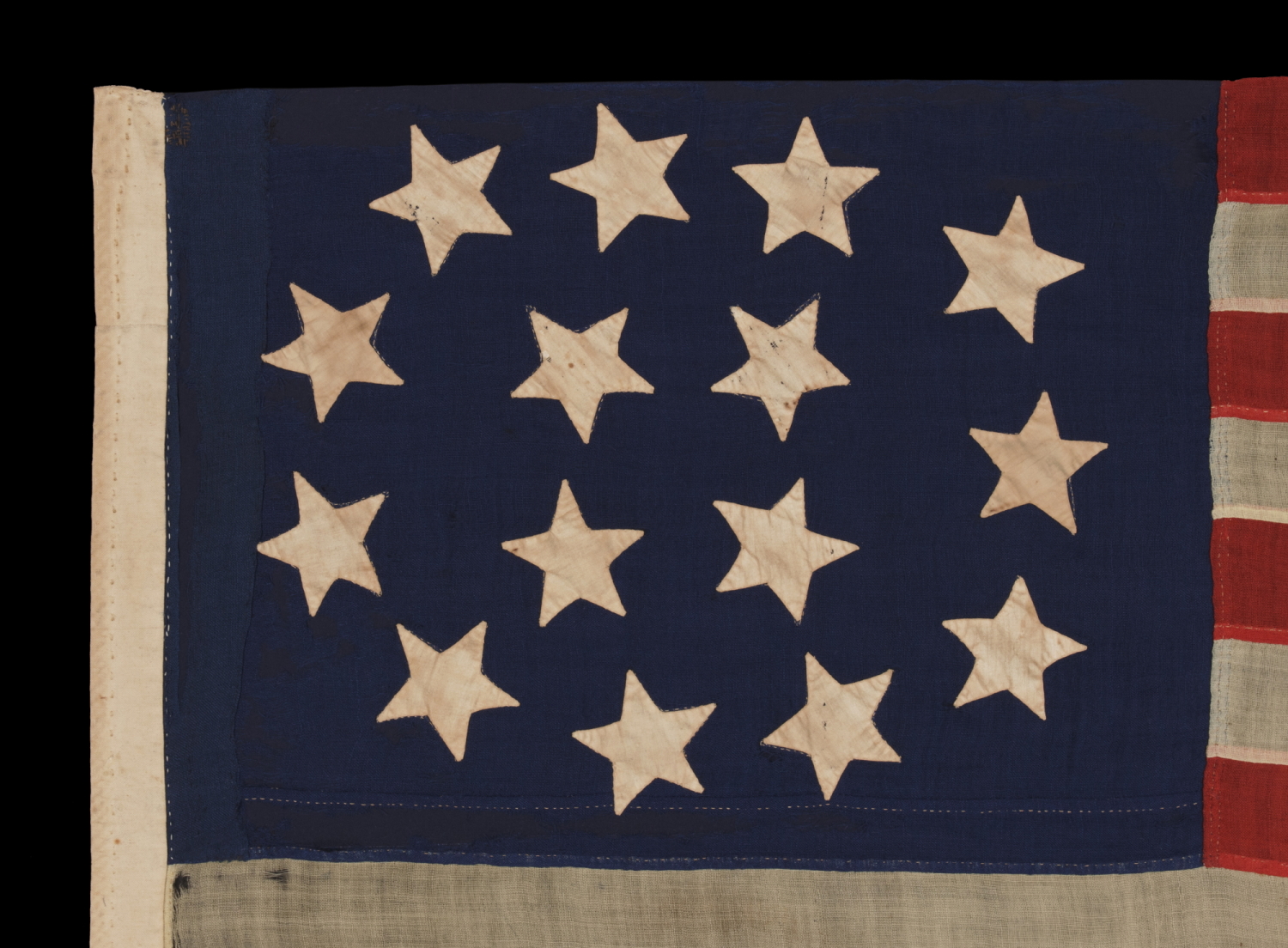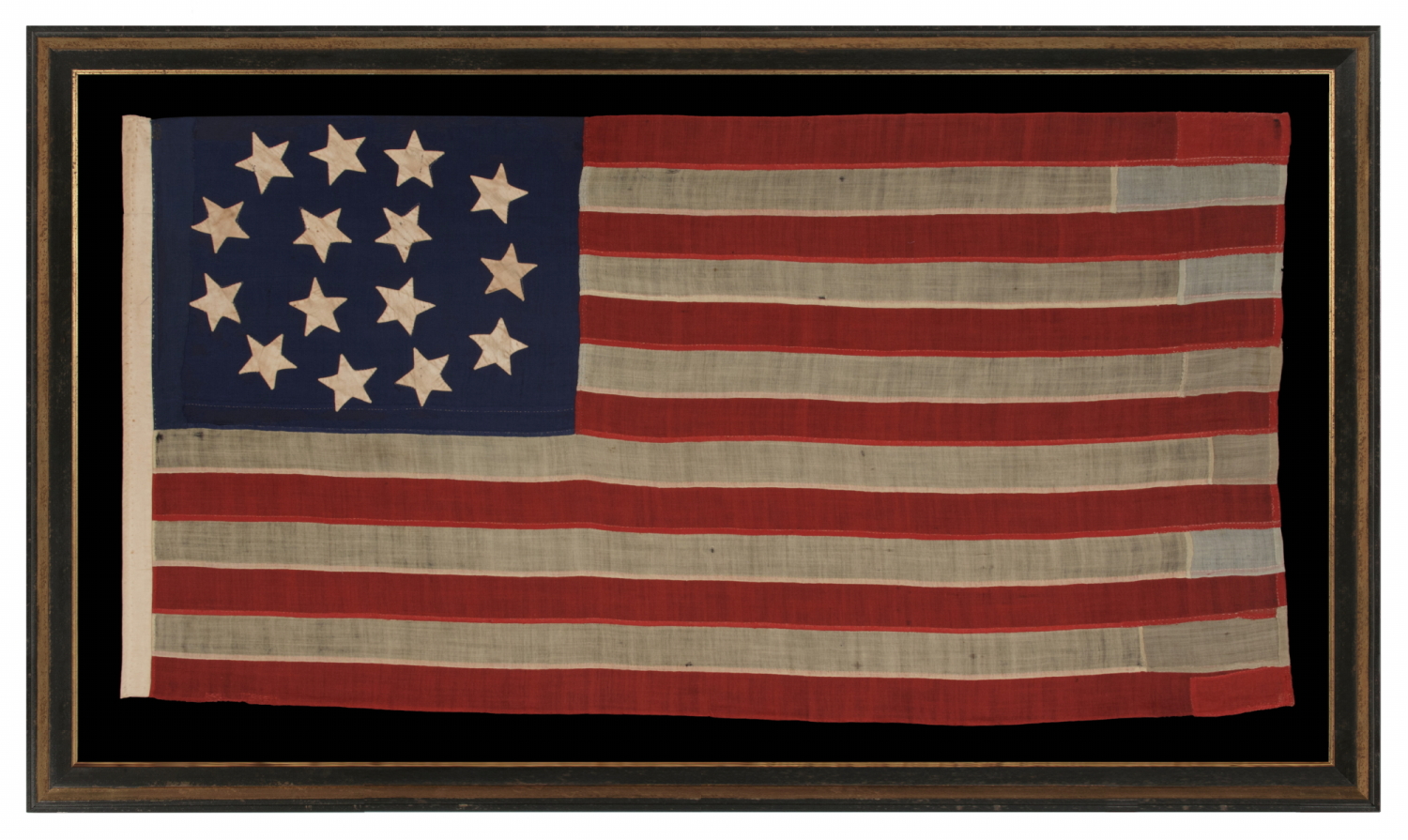
| 15 STARS IN AN EXTRAORDINARY ARRANGEMENT THAT CONSISTS OF AN OVAL WREATH OF 11, SURROUNDING A SQUARE OF 4; A UNIQUE & ENTIRELY HAND-SEWN, ANTIQUE AMERICAN FLAG MADE WITH SOUTHERN SYMPATHIES, REMOVING THE FREE STATES FROM THE STAR COUNT, LIKELY circa 1861: |
|
| Web ID: | 15j-816 |
| Available: | In Stock |
| Frame Size (H x L): | Approx. 48.5" x 80.5" |
| Flag Size (H x L): | 36.25" x 68.25" |
| Description: | |
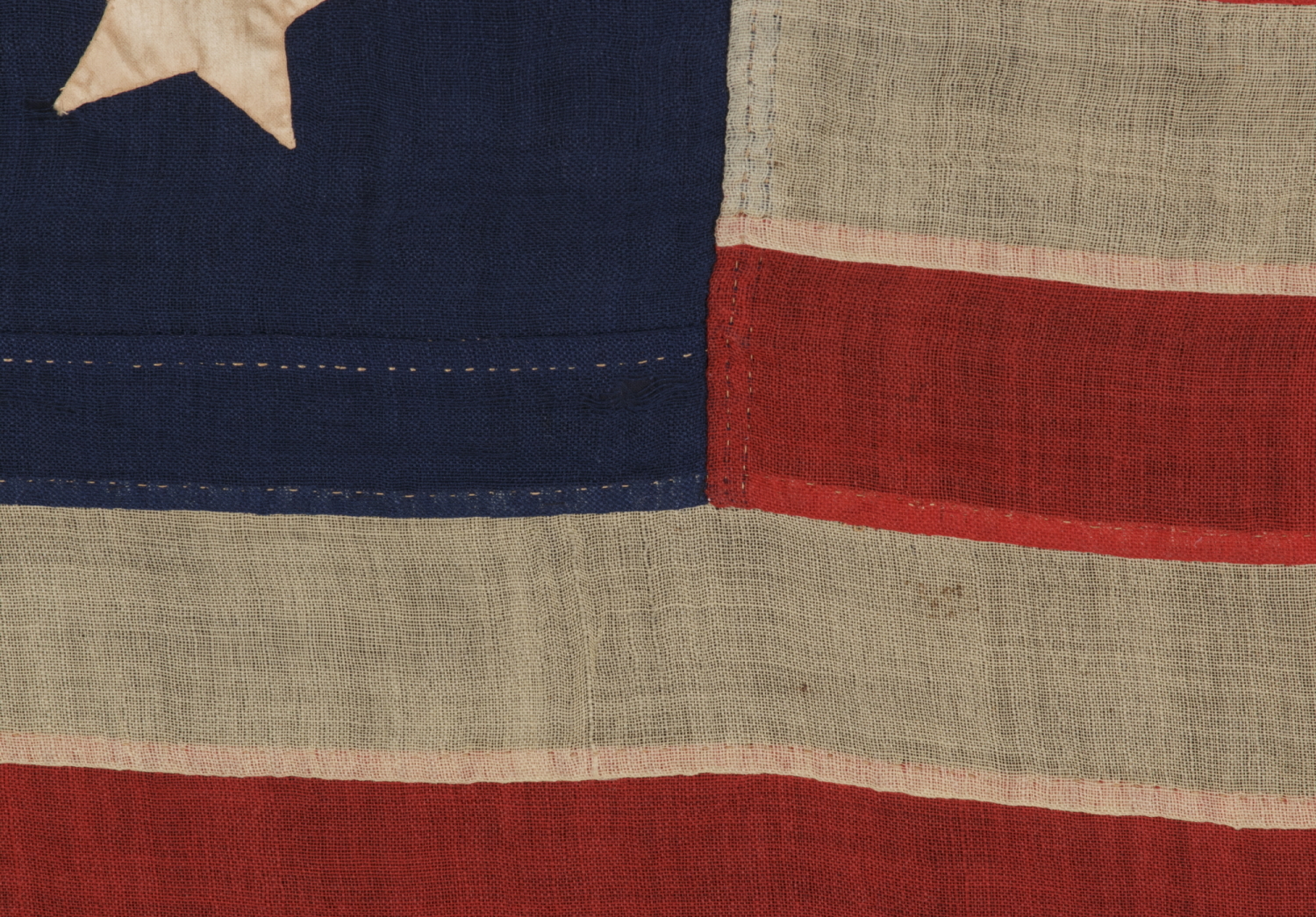
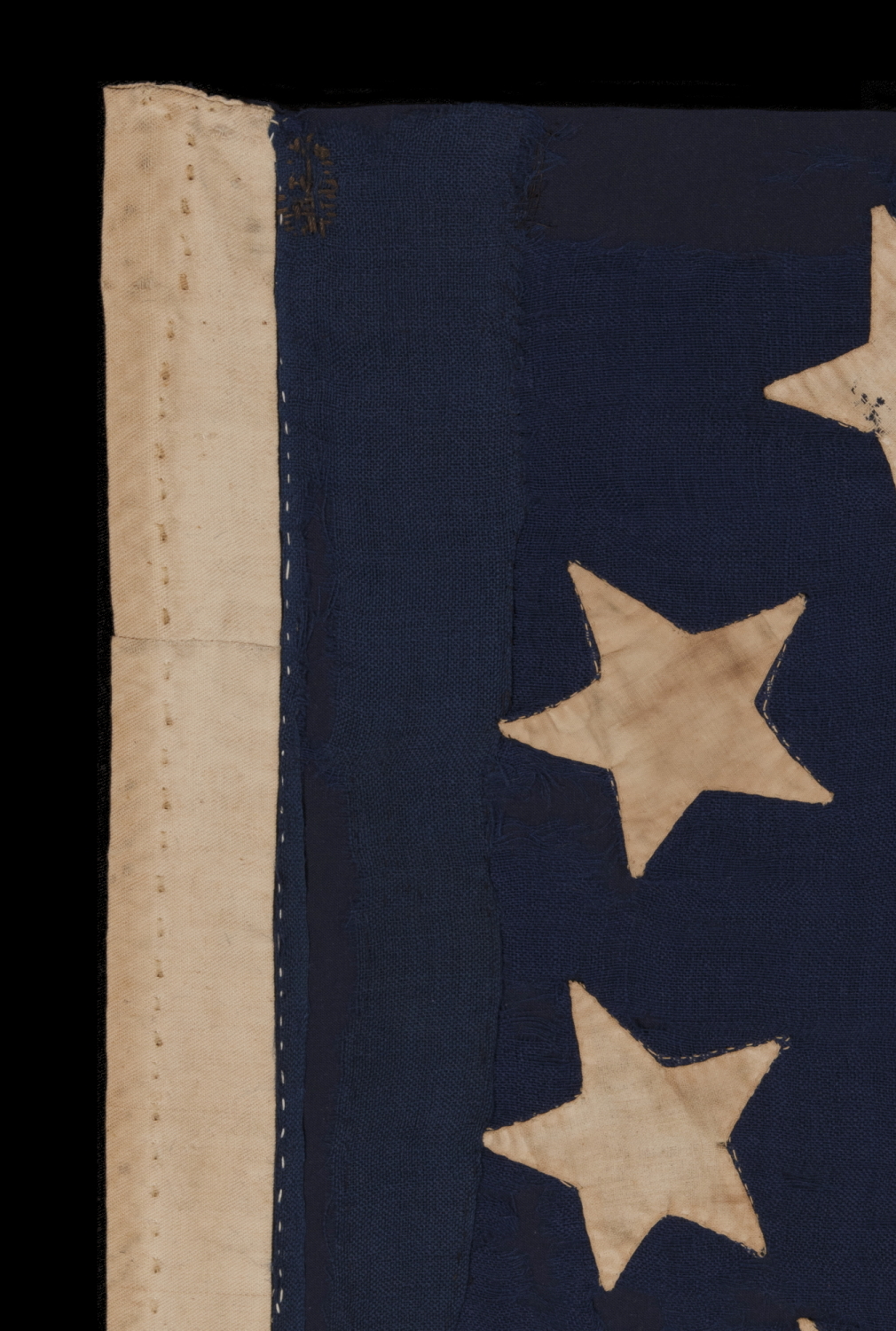
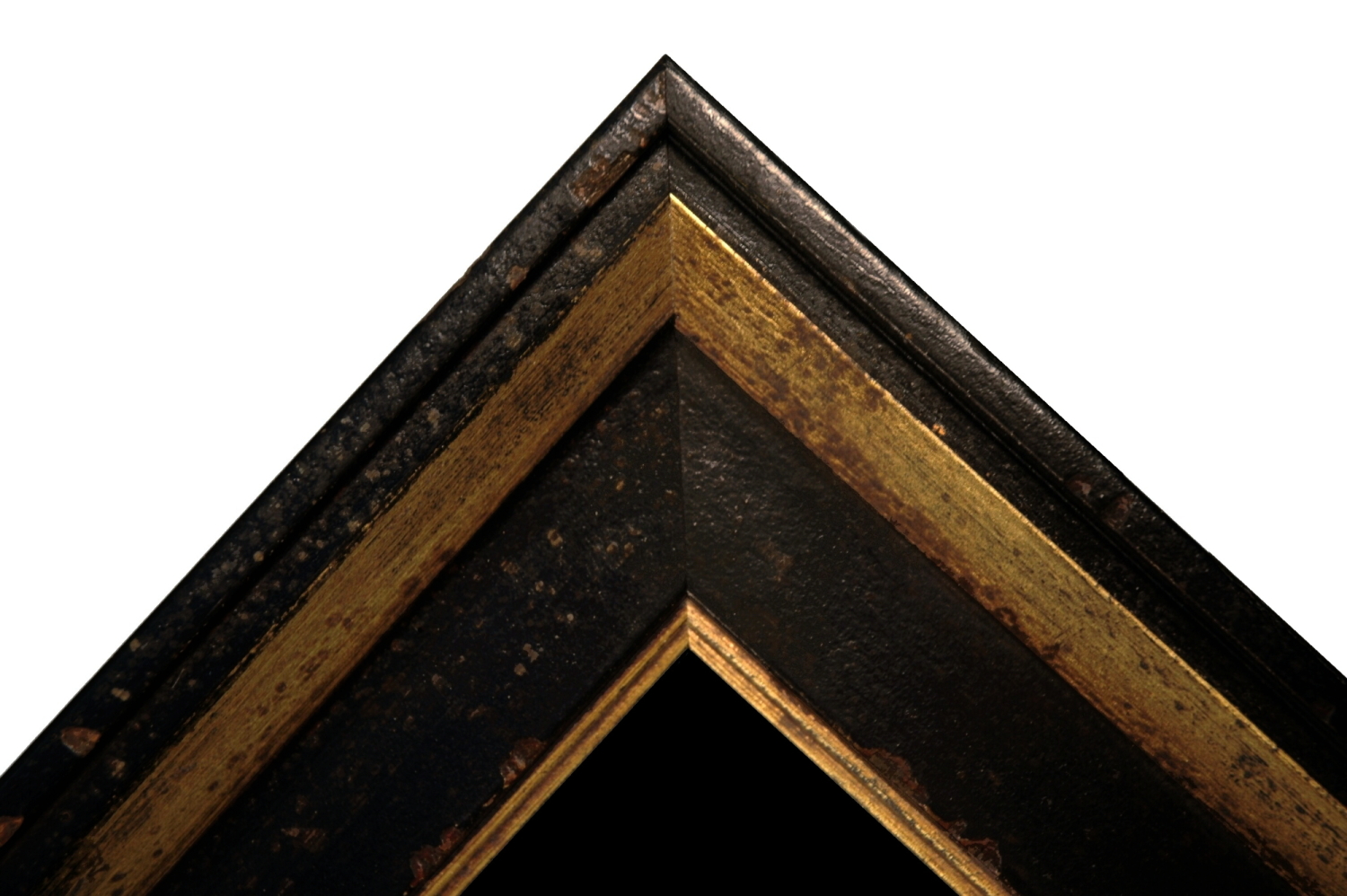
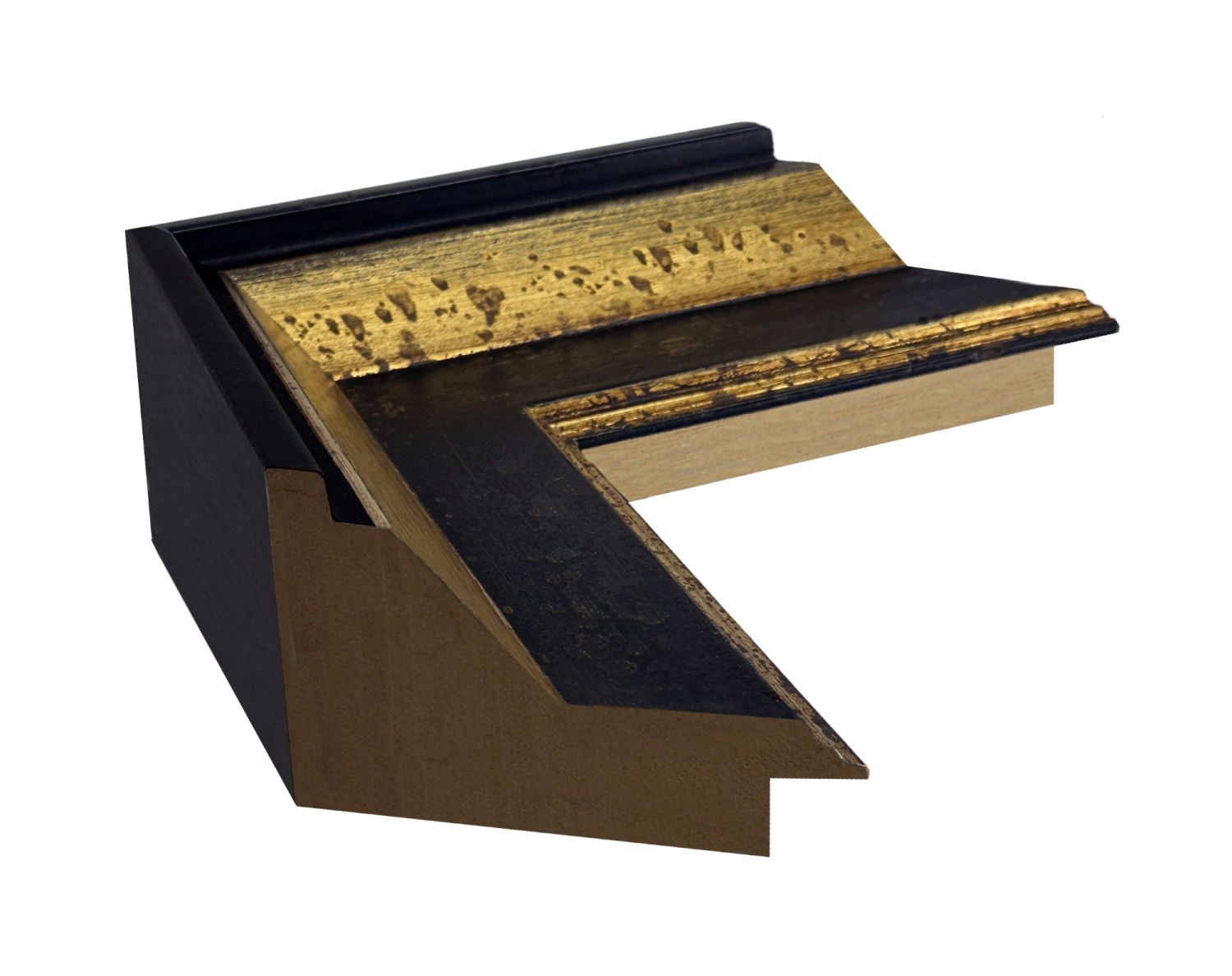
| The practice of making what American newspapers would call “Disunion flags,” with star and stripe counts altered to reflect political sentiment, appears to have begun as early as the 1840’s, if not significantly prior. With knowledge that the admittance of Florida and Texas (joined 1845) would close the available land mass from which new Slave States could form, per the Missouri Compromise of 1820, anxiety reached peak levels in the South concerning how equal representation of Free vs. Slave States could be maintained in Congress. Until that point, provisions of the corresponding legislation guaranteed that one Slave State must be added with every Free State, and vice-versa, to keep the division equal, but placed a simultaneous moratorium on the geography within which slavery would be permitted, outlawing it the land acquired in the Louisiana Purchase (1803), that had not yet become states, that fell below the 36°30′ North parallel. In 1846 and 1848, the Free States of Iowa & Wisconsin were added to counterbalance Florida & Texas, bringing the total the total of both Free and Slave States to 15 each in number. Fear became reality during this same two-year window, however, for the Slaveholding South, as the likelihood of the addition of California—as a Free State—loomed on the horizon. On July 5th, 1846, during the Mexican War (1846-48), U.S. Army Engineer John Frémont, the explorer, abolitionist, future Republican presidential candidate, and Civil War General, entered California uncontested, claiming the former Mexican-controlled land as independent. It is at this point that California because the short-term “Bear Republic,” followed just two days later, on July 7th, by the landing of U.S. Navy Commodore John D. Sloat at Monterey, who disembarked and claimed the land for the United States, supported by Frémont, who rushed there from Sonoma to join him. Any thought that the new territory would not soon become a state, evaporated with the discovery of gold on January 24th, 1848, soon followed by the arrival of Americans in masses (1849 Gold Rush). On September 9th, 1850, legislative scales permanently tipped in favor of the North, with California’s admission to the Union as the 16th Free State. During this era, 15 and 16 star flags appeared, reported by newspapers as having been displayed in support of either secession of the South (15), or of a Northern, abolitionist message (16). The latter appeared in support of Frémont specifically, when he sought the White House in 1856, on an anti-slavery ticket, as the newly formed Republican Party’s first presidential candidate. In addition to actual, surviving flags, editorial use of phrases such as “15 Stars,” to symbolize the Southern cause, can be found in both newspapers and other surviving ephemera. A rare and notable political broadside, made for the 1856 presidential campaign, illustrates a 16 star flag in opposition to Frémont, describing it as anti-Southern, flanked by the words “All North” and “No South,” while simultaneously ridiculing Frémont with satirical slogans such as “Down with the Constitution,” and “Frémont, Free Love, Free Fight.” Significant, related legislation and legal decisions in the new decade included the Compromise of 1850, the Fugitive Slave Act (1850), the Kansas-Nebraska Act (1854), and the Dred Scott decision (1857). Though the intent was to repair a bleeding wound, these only added to the heat long generated by slavery. One could reasonably argue that the political discourse of the 1850’s yielded more ill will and anger both nationally, and in Washington, than at any other point in American history before or since. In 1858, an infamous physical brawl took place on the floor of Congress over the proposed constitution of the Kansas Territory, the language of which would have legalized slavery. California was followed by the Free States of Minnesota, in 1858, and Oregon, in 1859, taking the count to 17, then 18. Though Abraham Lincoln, elected in 1860, urged the nation not to remove stars from the flag, as his goal was to keep the Union together, the concept of altering the flag in this manner, already having gained popularity, persisted throughout the war itself. The 15 star flag that is the subject of this narrative is an extraordinary one. Because there were almost no official specifications for the American flag until 1912, Americans were long used to designing the flag in any way they chose. This no-doubt made it both easier to consider traits that affected the message that they displayed symbolically, as well as graphically. Constructed of wool bunting and entirely hand-sewn throughout, the stars are arranged in a pattern seldom encountered in any star count. This consists of a square of four stars, surrounded by a single, oval wreath. I am presently aware of just one other example of an antique, Stars & Stripes variant, that shares this interesting trait. Formerly in the collection of Whitney Smith (1940-2016), who coined the term “Vexillology” in 1957, that has come to define the study of flags, it displays 13 stars instead of 15, like this example, but is likewise of pre-Civil War. Besides these two rare examples, the ‘square of stars in a single wreath’ configuration is presently unknown, and this is the only instance of it among known 15 star flags of any period. Though 15 star secessionist flags could have theoretically been made anytime within the 20-year time frame between 1846 and the Civil War (1861-65), it is very likely that this particular example dates to 1861 specifically, following the secession of South & North Carolina, Georgia, and Virginia, the 4 Slave States from within the original 13, that seceded from the Union. These may be what the maker intended to glorify in the center, surrounded by an oval ring of 11. While the making of flags of this sort, with 13 stripes, may have continued beyond 1861, as there were 13 states in total admitted into the Confederate States of America by Jefferson Davis & the CSA legislature, it is unlikely that altered versions of the national flag, now a federal emblem, continued to be produced with Southern sympathies, at least within those states that officially seceded. This is because the 1st National Confederate flag (a.k.a., Stars & Bars)--with 3 horizontal bars of red, white, red, and a blue canton with a growing number of white stars to reflect the Confederacy--adopted on March 4th, 1861, soon gained favor, followed late in the same year by the Southern Cross battle flag, which presented a more distinct signal during engagements. If a 15 star flag was made anywhere in 1861 or beyond, with 13 stripes, it would be much more likely to occur within a Border State, where more blatant displays of anti-federal sympathies would be more likely to generate a physical response. The stars of this particular flag are made of cotton and are double-appliquéd (applied to both sides of the blue canton). There is a twill cotton binding along the hoist, in the form of an open sleeve, through which a braided rope was formerly inserted, then encapsuled within a fitted track by a row of hand-stitching with heavy cotton cord. Both the flag’s construction methods and its fabric are indicative of its having been commercially produced by a professional flag or sail-maker. Because the manner in which the hoist is fashioned is consistent with U.S. Navy flags of the time, it is reasonable to suggest that the maker could have been someone who formerly produced flags for a federal Navy Yard, much of the work of which was subcontracted to the female family members of sailors. The most likely origin of the fabrics, and perhaps the maker, given the time period, the materials, and the construction, would have been the Gosport Navy Yard at Norfolk. Following Virginia secession, on April 17th, 1861, Union Flag Officer Charles Stewart McCauley, realizing that he could not defend the yard, ordered the warships scuttled and the entire shipyard burned. This included the USS Merrimack, later rebuilt as the C.S.S. ironclad Virginia, one of the most remembered ships of the war. Spiking the guns, he instructed his men to dump ammunition into the water, to prevent it from falling into Southern hands. This occurred on April 20th and 21st, ending, the second day, with the formal evacuation of Union forces. In spite of the attempt for complete destruction, most of the yard was spared, for numerous reasons, including poor planning, refusal to follow orders for fear of the destruction of nearby homes, and the rushing in or locals upon the departure of the Union fleet, to prevent spread of the fire. Among the supplies and munitions salvaged were a massive stock of wool bunting, for the making of flags, and 1,000 naval cannon. The fabric would be used for all manner of Confederate signals. One of the reason why antique American flags with 15 stars are of interest to collectors, is the simple fact that examples of any time period are so rare. The First Flag Act, passed June 14th, 1777, provided for 13 stripes and 13 stars. When Vermont and then Kentucky became the 14th and 15th states, in 1791 and 1792, respectively, there were no immediate changes to the national flag. Three years later, in 1794, the Second Flag Act was passed by Congress. Becoming effective on January 1st, 1795, this raised both the number of stars, and of stripes, to 15. The 15-star, 15-stripe flag remained official until 1818, as 5 more states came joined the Union, including Tennessee (1896), Ohio (1803), Louisiana (1812), Indiana (1816), and, finally, Mississippi (1818). The 3rd Flag Act, passed April 4th, 1818, added 5 more stars for the 5 new states, and declared that, from that point forward, that stars would be officially added on July 4th, following a state’s addition. The act also returned the stripe count to the original 13, where it remains today more than 200 years later. Surviving 15 star flags that actually date to the period when we either had 15 states (1792-1796), or when the 15 star flag was official (1795-1818), are extraordinarily rare. Just a tiny handful of examples are known, one of which is our nation’s most famous flag, the 15-star, 15-stripe Star Spangled Banner, on permanent display at the Smithsonian. One of the most intriguing state relationships to the 15 star count, on any level, is the 15th state of Kentucky. Curiously, 13 was also a significant number to that state in 1861. As a Border State, with its population split over the issues of slavery and states’ rights, men from Kentucky served on both sides of the battlefield. Though it attempted to maintain neutrality, an invasion of Confederate troops prompted official to call upon Union forces to drive out the Confederate Army. On November 10th 1861, while in a state of unrest, a sub-group within the state was formed, styling itself as a "Convention of the People of Kentucky". With 200 participants representing 65 counties, the unofficial assembly voted in favor of secession. This was enough to convince Jefferson Davis to formally admit Kentucky to the Confederate States of America, as its 13th member state, on December 10th, 1861. Because the vote wasn't cast or ratified by the official state legislature, it did not legitimately achieve secession. A different, although similar situation occurred in Missouri. Yet another curious oddity exists in the count of 4 stars present in the center, as well as the wreath of 11. Because there were 11 states that officially seceded from the Union, by way of a vote of the respective state legislatures, ratified, when required, sometimes legislatively and sometimes by a popular vote, 11 was a significant number in the South, especially between July and November of 1861, when there were exactly this number of Confederate States. Because 4 was the number of Border States at the time (West Virginia became the 5th, in 1863), one might suggest that the purpose of the star pattern is to display unity within the 11 officially seceded states, but pay homage to the 4 that contained significant populations of Southern sympathizers. The flag shows signs of having been flown extensively, very likely in wartime service. Given the elongated profile—being approximately twice as long as its height—plus the wool construction and open sleeve, fitted for a rope hoist, as well as the wear, I would strongly suggest that the intended use here was maritime. Because naval flags tended to be very large by modern standards, while this may seem to be a somewhat large flag, in modern times, this is actually a very small flag, especially among those used on ships during the Civil War era. More suitable as a small boat flag, if flown in an oceanic setting, this would have probably been a secondary standard, flown from the pilot house, for example, or hoisted as the primary one on a small skiff that transported sailors back-and-forth to shore. Based on my experience with Southern nautical flags of the Civil War, I would suggest it to have more likely served as the primary ensign aboard a river-based craft. Because there are so few examples of early American flags that can either be associated with either this star count or this state, collectors wishing to own something that is in some way representative of either one have few options, especially among flags of a manageable scale, such as this one, at just under feet on the fly, and within such an incredible star count, such as the rare and beautiful one presented here, in an entirely hand-sewn flag with interesting, Civil War history. Mounting: The flag was mounted and framed in our own conservation department, which is led by expert staff. We take great care in the mounting and preservation of flags and have framed thousands of examples. The black-painted, hand-gilded and distressed molding is Italian. The glazing is U.V. protective acrylic (Plexiglas). Feel free to contact us for more details. Condition: As a rule, use on water, devoid of the sort of wind barriers present on land, caused significantly more degradation than would be expected to occur on shore. While the hand-sewn, patched repairs, present at the fly end of the 1st, 2nd, 4th, 6th, 8th, 10th, 12th, and 13th stripes, do reflect long-term use, this may occur on any flag, no matter where it was flown. Significant breakdown and loss present along the top and bottom edges of canton, however, provide greater evidence that the flag flew in fairly extreme conditions. Losses at the bottom of the canton, while completely legitimate in this instance, are very unusual. Another point of heightened stress, in any flag, occurred at the extreme, top, hoist-end corner. In this case, note the period replacement of approximately 1/6 of the binding, at the top, that utilizes the identical twill fabric, and the vertical strip of navy blue wool bunting along the leading edge, added for stability. Losses in this region occurred even after the strip was added. These, in addition to the careful repairs, executed by hand-darning, (in the extreme top corner of the canton, along bottom edge of the last stripe, near the canton, and in the extreme fly end corner of the same stripe, ) demonstrate that the flag received significant attention from whomever was charged with its care. This is precisely the sort of task assigned to sailors aboard ship, both to keep a vessel in fine order, and to avoid the sort of trouble generated by boredom within its crew. In addition to the above, there are modest losses at the beginning of the 4th white stripe, along the hoist, accompanied by a few very minor dots of loss elsewhere in the striped field. There is minor to moderate foxing and staining of the white cotton elements. Blue cotton fabric of similar coloration was placed behind the canton during the mounting process, both for support and for masking purposes. Many of my clients prefer early flags to show their age and history of use. The colors are strong and the flag presents beautifully. The extreme rarity, as well as its bold visual presence, well-warrants any and all condition issues. |
|
| Video: | |
| Collector Level: | Flags for the truest Patriots. My best offerings |
| Flag Type: | Sewn flag |
| Star Count: | 15 |
| Earliest Date of Origin: | 1842 |
| Latest Date of Origin: | 1867 |
| State/Affiliation: | Kentucky |
| War Association: | 1777-1860 Pre-Civil War |
| Price: | Please call (717) 676-0545 |
| E-mail: | info@jeffbridgman.com |
 |
|