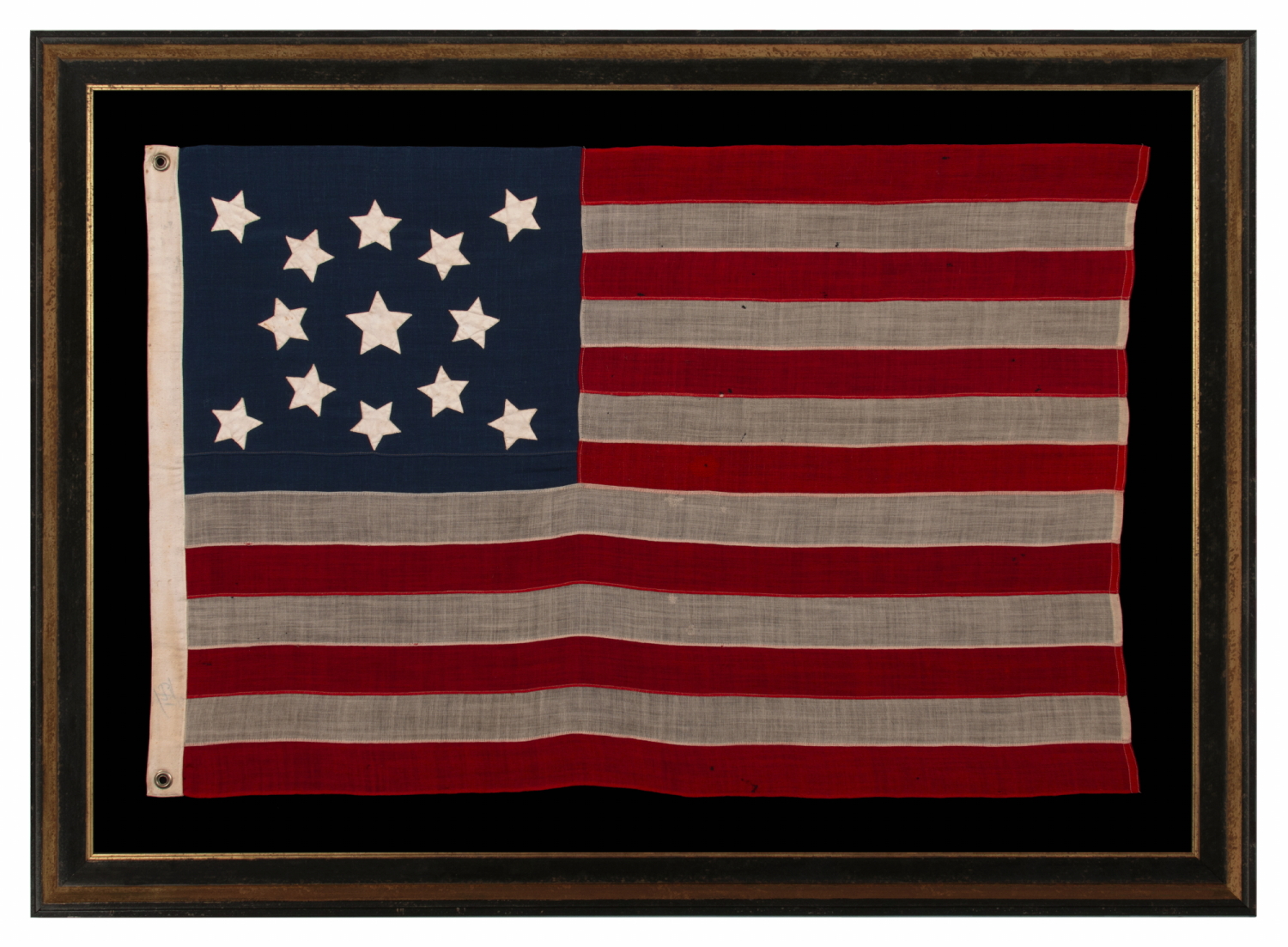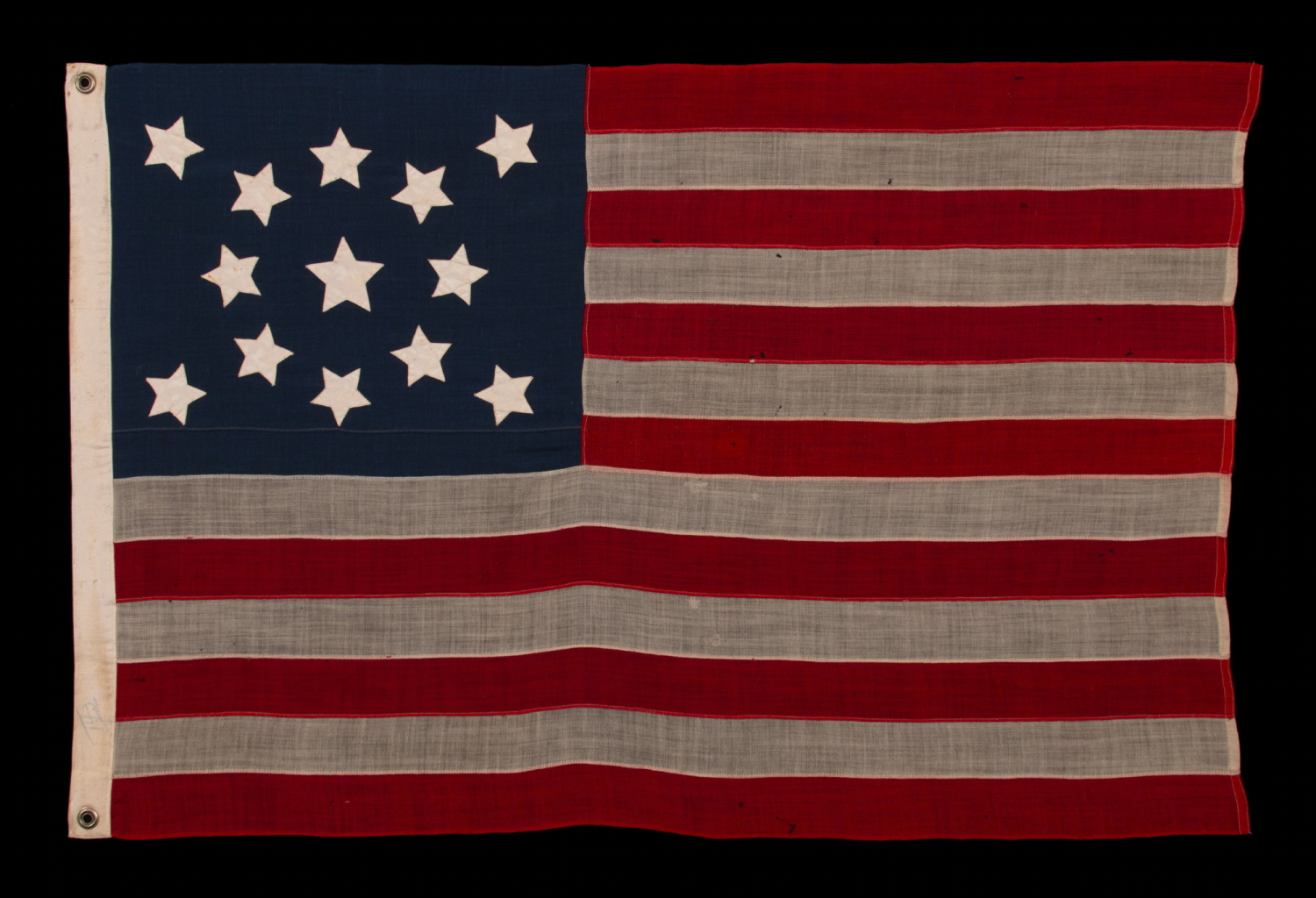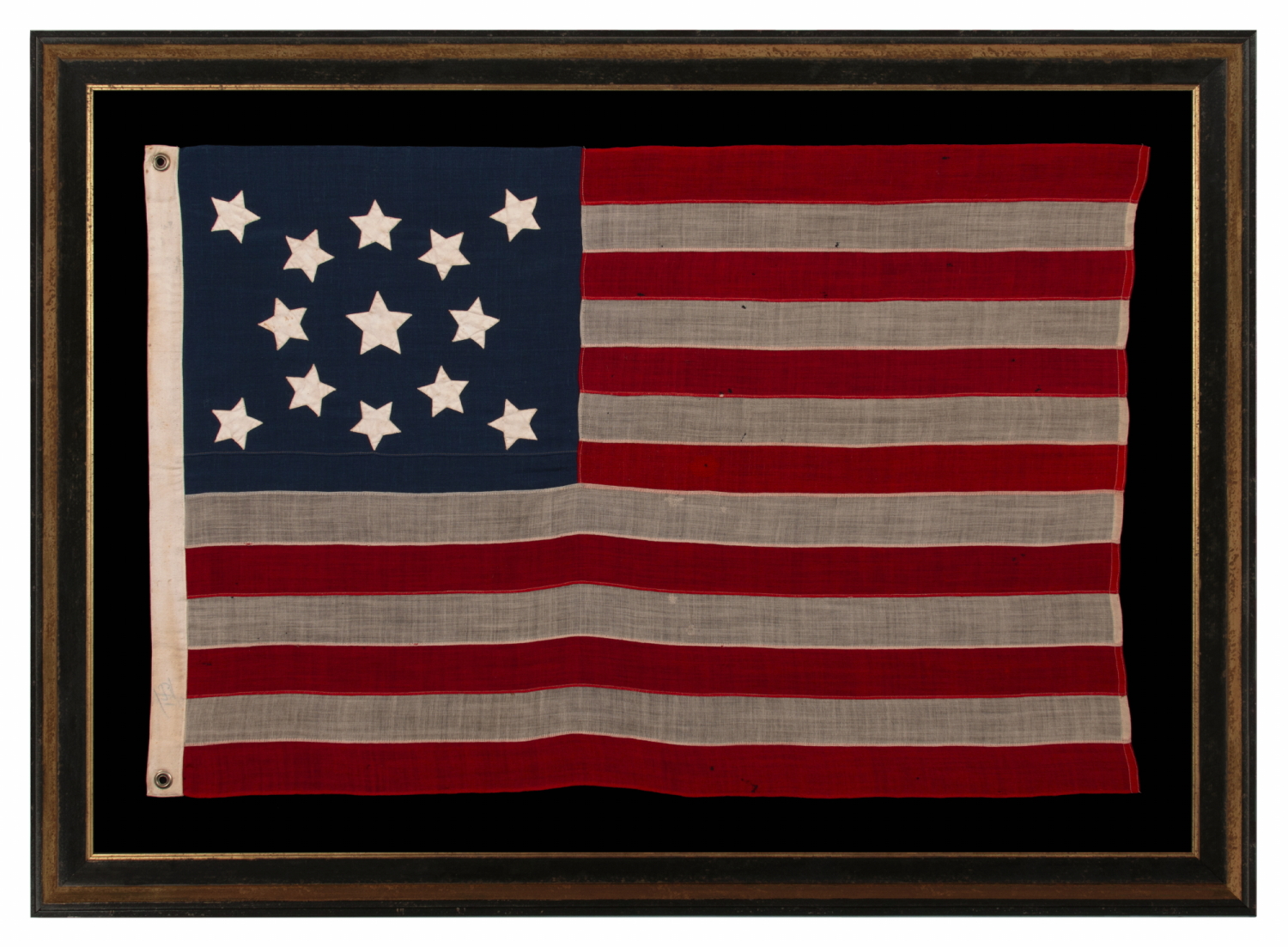
| 13 STARS IN A MEDALLION CONFIGURATION, ON A SMALL-SCALE ANTIQUE AMERICA FLAG MADE DURING THE LAST DECADE OF THE 19th CENTURY |
|
| Web ID: | 13j-1746 |
| Available: | On Hold |
| Frame Size (H x L): | Approx. 42" x 59" |
| Flag Size (H x L): | 30.25" x 46.75" |
| Description: | |
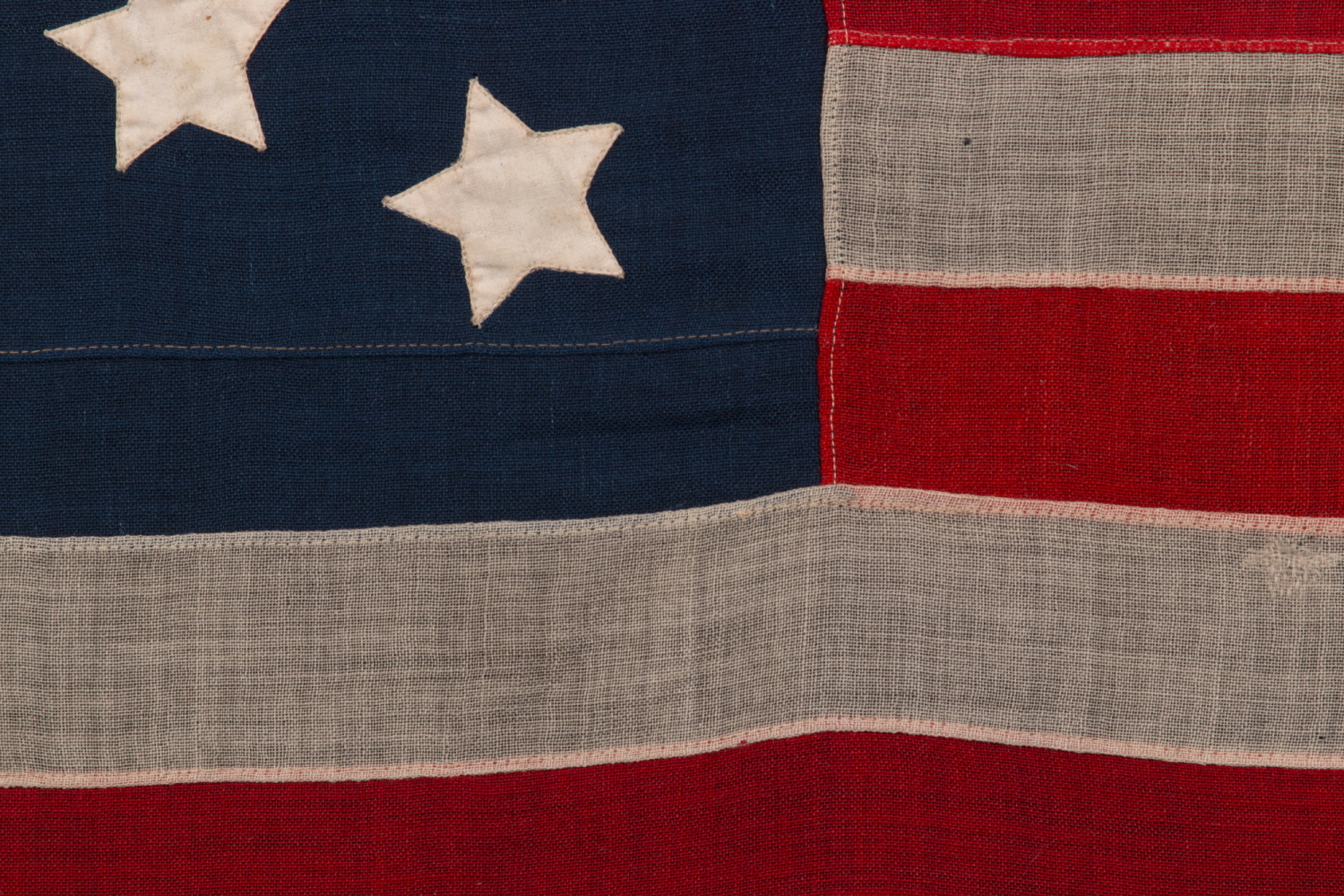
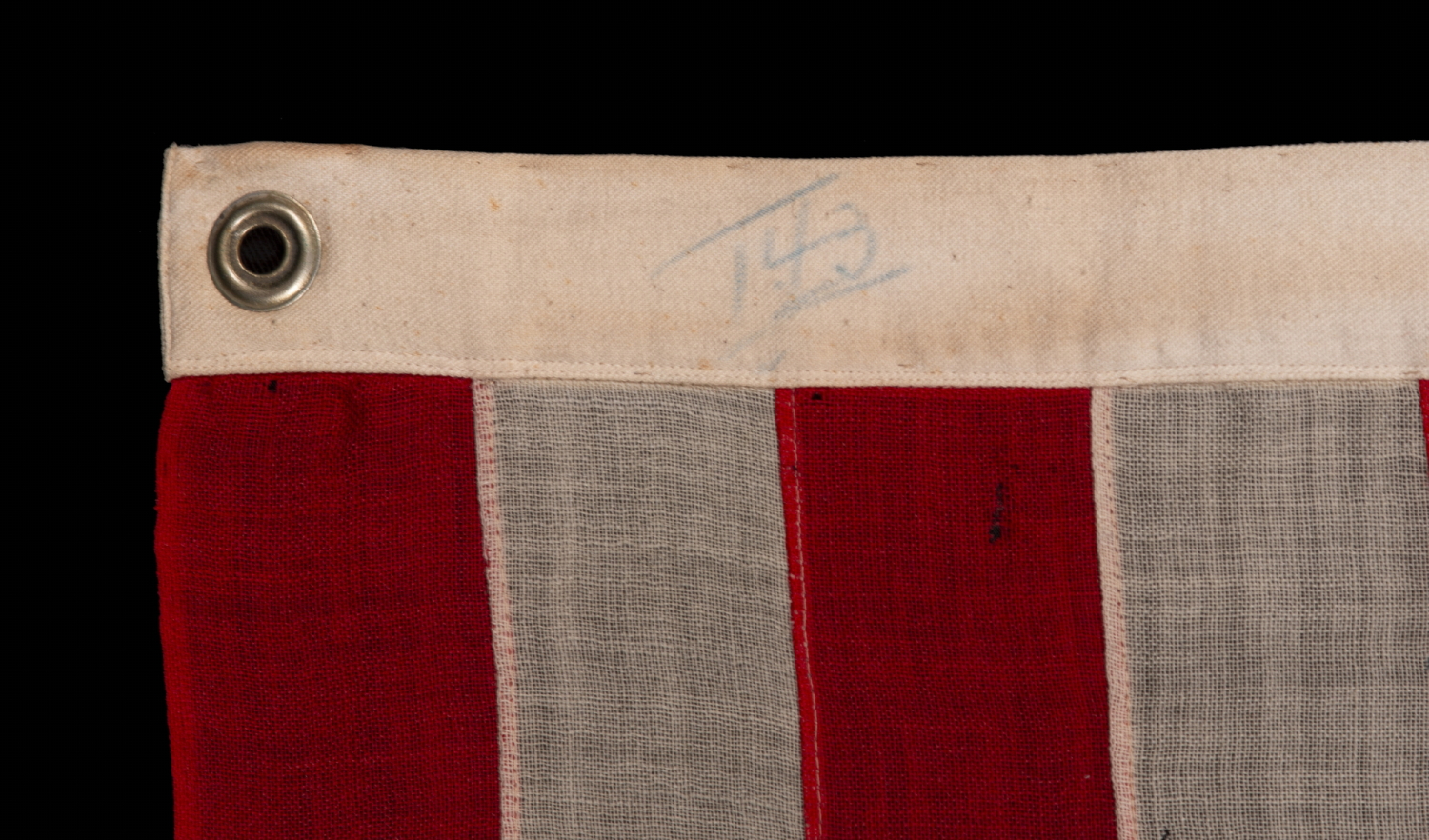
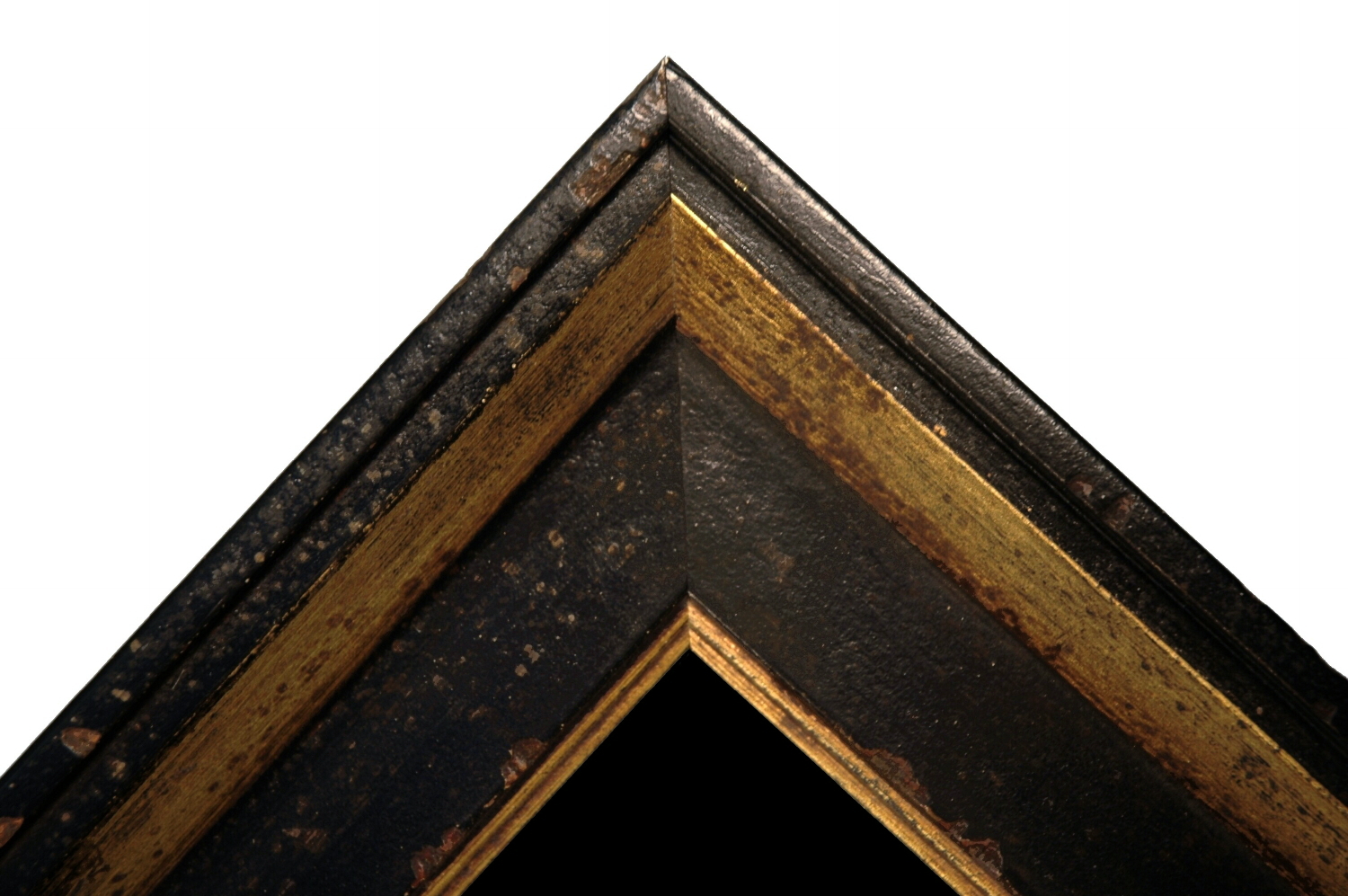
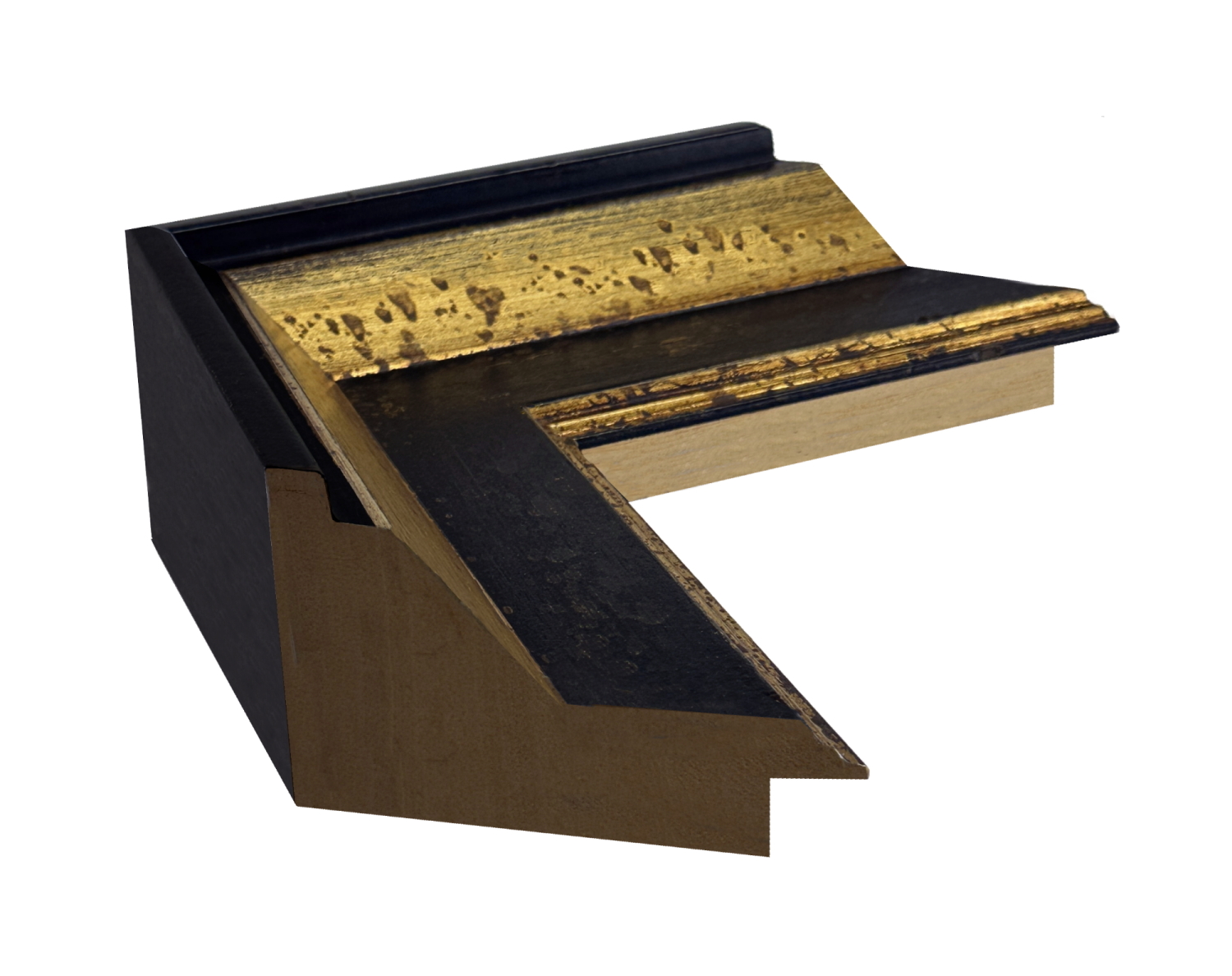
| 13 star antique American flag of the small-scale type made during the last decade of the 19th century through the beginning of the 20th. The stars are arranged in a medallion configuration that features a single center star, slightly larger than those around it, surrounded by a wreath of stars, with a flanking star in each corner of the blue canton. The stars are made of cotton and are double-appliquéd (applied to both sides) with a lineal, treadle stitch. Note their slightly bulbous profiles, that adds a pleasant visual quality to the flag’s design. The canton and stripes of the flag are made of wool bunting that has been pieced and joined by treadle stitching. There is a sailcloth canvas binding along the hoist, applied in the same manner, with two zinc-plated brass grommets. Why 13 Stars? As the number of stars grew with the addition of new states, it became increasingly difficult to fit their full complement on a small flag. The stars would, by necessity, have to become smaller, which made it more difficult to view them from a distance as individual objects. The fear was that too many stars would become one white mass and distort the ability to identify American ships on the open seas. The U.S. Navy flew 13 stars on its small-scale flags for precisely this reason. This was, of course, the original number of stars on the first American national flag, by way of the First Flag Act of 1777, and equal to the number of original colonies that became states. For all practical purposes, commercial flag-makers simply didn't produce flags with pieced-and-sewn construction, that were 4 feet in length or less, before the 1890's. There are exceptions to this rule, but until this time, the smallest sewn flags were generally around 6 feet on the fly. Lengths of 8-10 feet and larger were common. Because the primary use of flags had long been more utilitarian than decorative, flags needed to be large in order to serve effectively in their function as signals. Prior to the 1890’s, even those sewn flags made for general patriotic display were typically far larger than their modern counterparts. The original intent of the American national flag, upon its adoption on June 14th, 1777, was to mark ships on the open seas. It was soon put to use in the identification of military garrisons and government buildings, and was eventually spreading to local militia and finally to formal U.S. & state military companies. Private use grew with the passage of time, exploding in the North with the onset of the Civil War, but it would not be until nearly 1900 when demand for long-term use of flags, with sewn construction, of a more manageable scale, led to significant commercial production. Beginning around 1890, commercial flag-makers began to sew small flags for the first time, in large quantities, namely with dimensions of 2 x 3 feet, or 2.5 x 4 feet, like this example. Applying the same logic as the U.S. Navy, they chose the 13 star count rather than the full complement of stars for sake of ease and visibility. Because there was no official star design for the American national flag until 1912, the configuration of the stars was simply left to the whims of the maker. Medallion patterns like this one, with a star in the center and one in each corner, first appeared on flags of the Civil War era. Though scarce at that time, popularity grew significantly in flags made for the celebration of America’s 1876 centennial of independence, especially in printed parade flags, tacked or glued to a staff, to be waved at parades or political events. Among flags with pieced-and-sewn construction, however, the most commonly seen design in 13 star flags, from the Civil War onward, was a lineal arrangement in rows of 3-2-3-2-3. In the 1890’s, when this flag was made, approximately 70% of the 13 star flags bore the 3-2-3-2-3 arrangement. Medallion patterns were far more scarce, comprising about 20% of sewn examples. The remainder displayed something else. 13 star flags have been flown throughout our nation's history for a variety of purposes. In addition to their use by the Navy, 13 star flags were hoisted at patriotic events, including Lafayette’s visit in 1824-25, the celebration of the nation's centennial in 1876, and the sesquicentennial in 1926, in addition to annual celebrations of Independence Day. They were raised during the Civil War, to reference past struggles for American liberty, and displayed by 19th century politicians in political campaigning. The use of yachting ensigns with a wreath of 13 stars surrounding a fouled anchor, which allowed pleasure boats to bypass customs between 1848 and 1980, persists today without an official purpose. Because any flag that has previously been official remains so according to the flag acts of Congress, all 13 star, 13 stripe flags remain official national flags of the United States of America. Mounting: For 25 years we have maintained our own textile conservation department, with expert, trained staff. We take great care in the mounting and preservation of flags and related textiles and have preserved thousands of examples. The background fabric is 100% cotton twill, black in color, that was washed and treated for colorfastness. The black-painted, hand-gilded and distressed molding is Italian. The glazing is U.V. protective acrylic (Plexiglas). Condition: There is minor, scattered mothing. There are darning repairs near the center of the 7th, 8th, and 10th stripes. There is minor to modest soiling along the hoist, and very minor of the same in the stars. Many of my clients prefer early flags to show their age and history of use. |
|
| Video: | |
| Collector Level: | Intermediate-Level Collectors and Special Gifts |
| Flag Type: | Sewn flag |
| Star Count: | 13 |
| Earliest Date of Origin: | 1890 |
| Latest Date of Origin: | 1900 |
| State/Affiliation: | 13 Original Colonies |
| War Association: | |
| Price: | Please call (717) 676-0545 or (717) 502-1281 |
| E-mail: | info@jeffbridgman.com |
 |
|