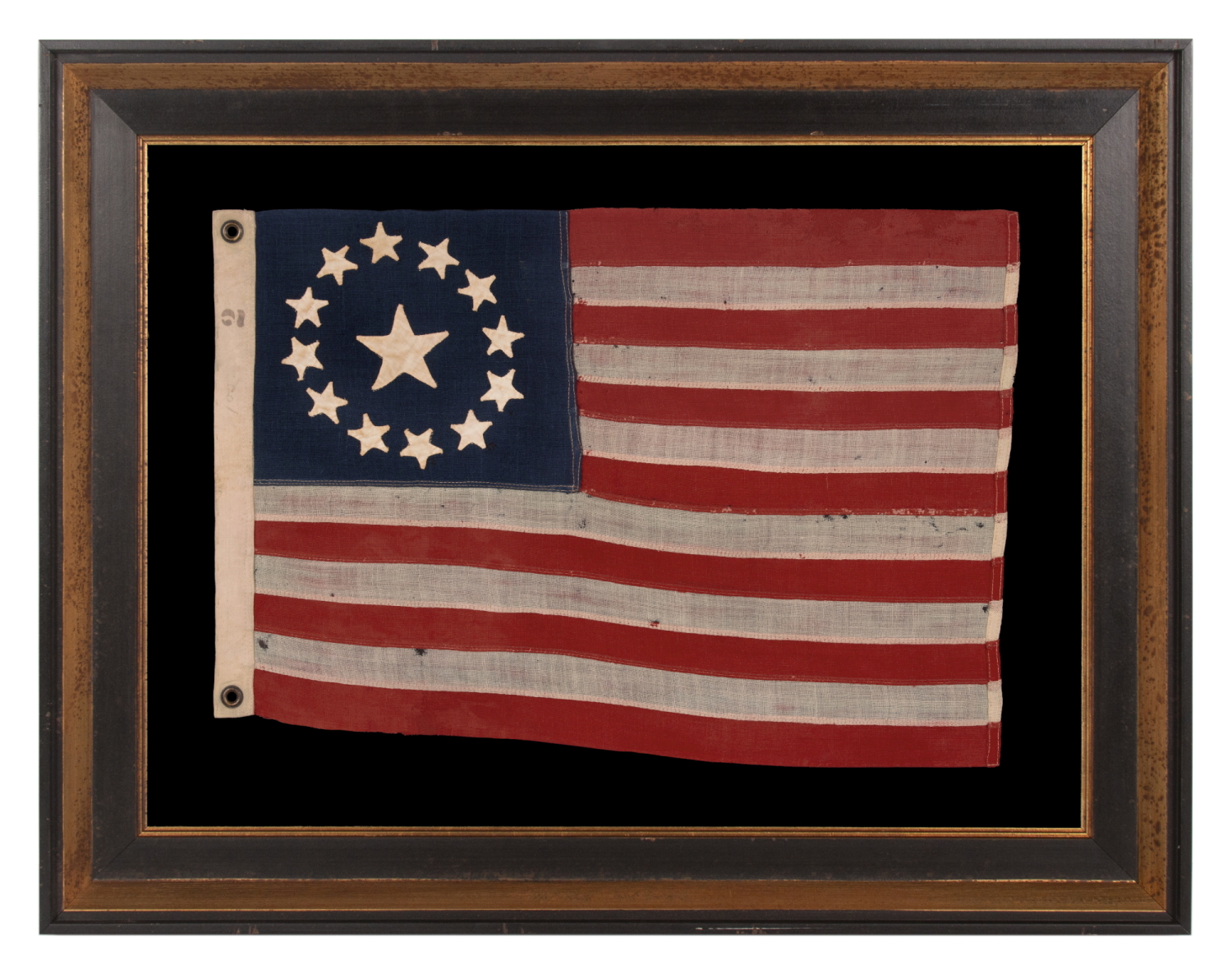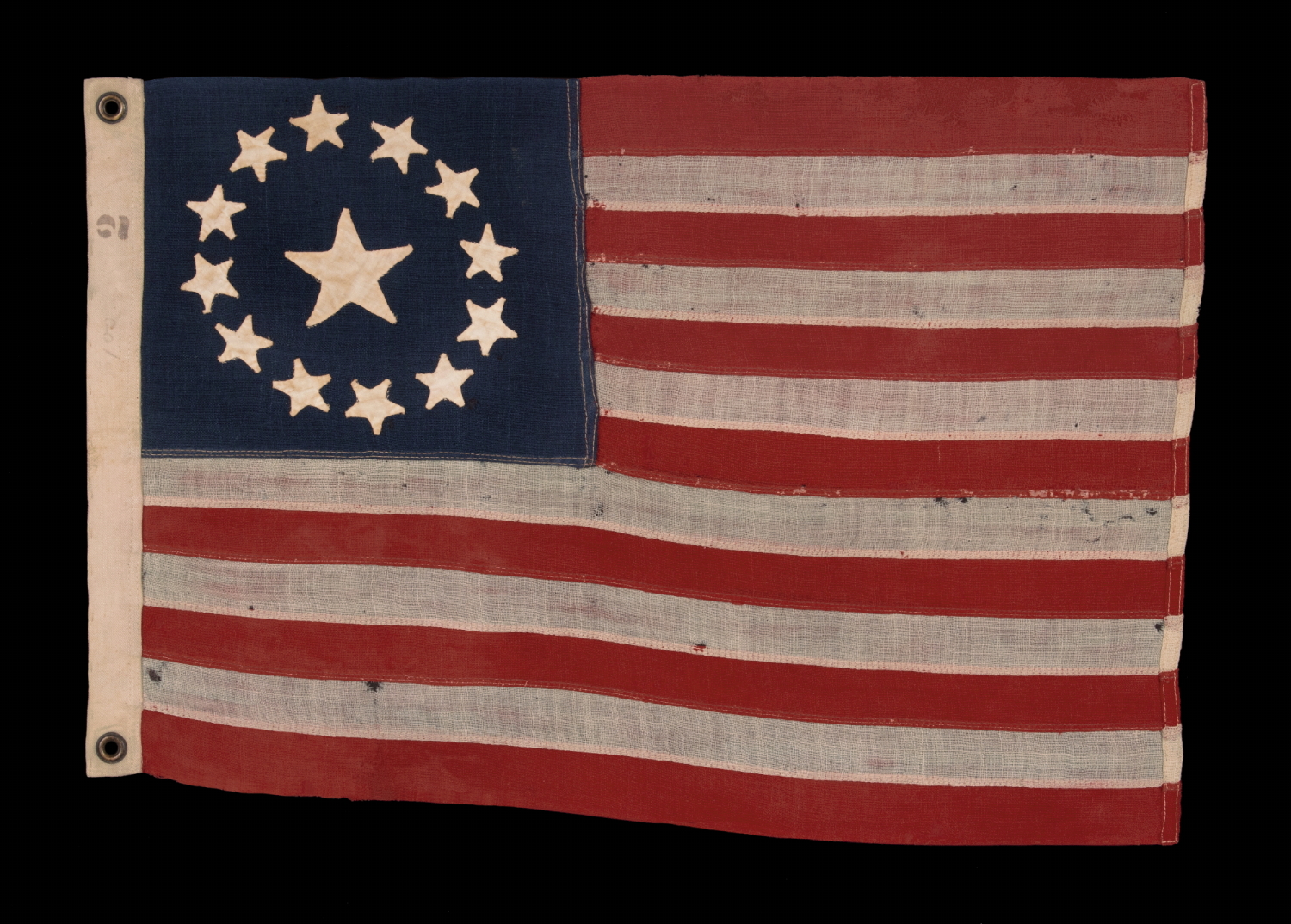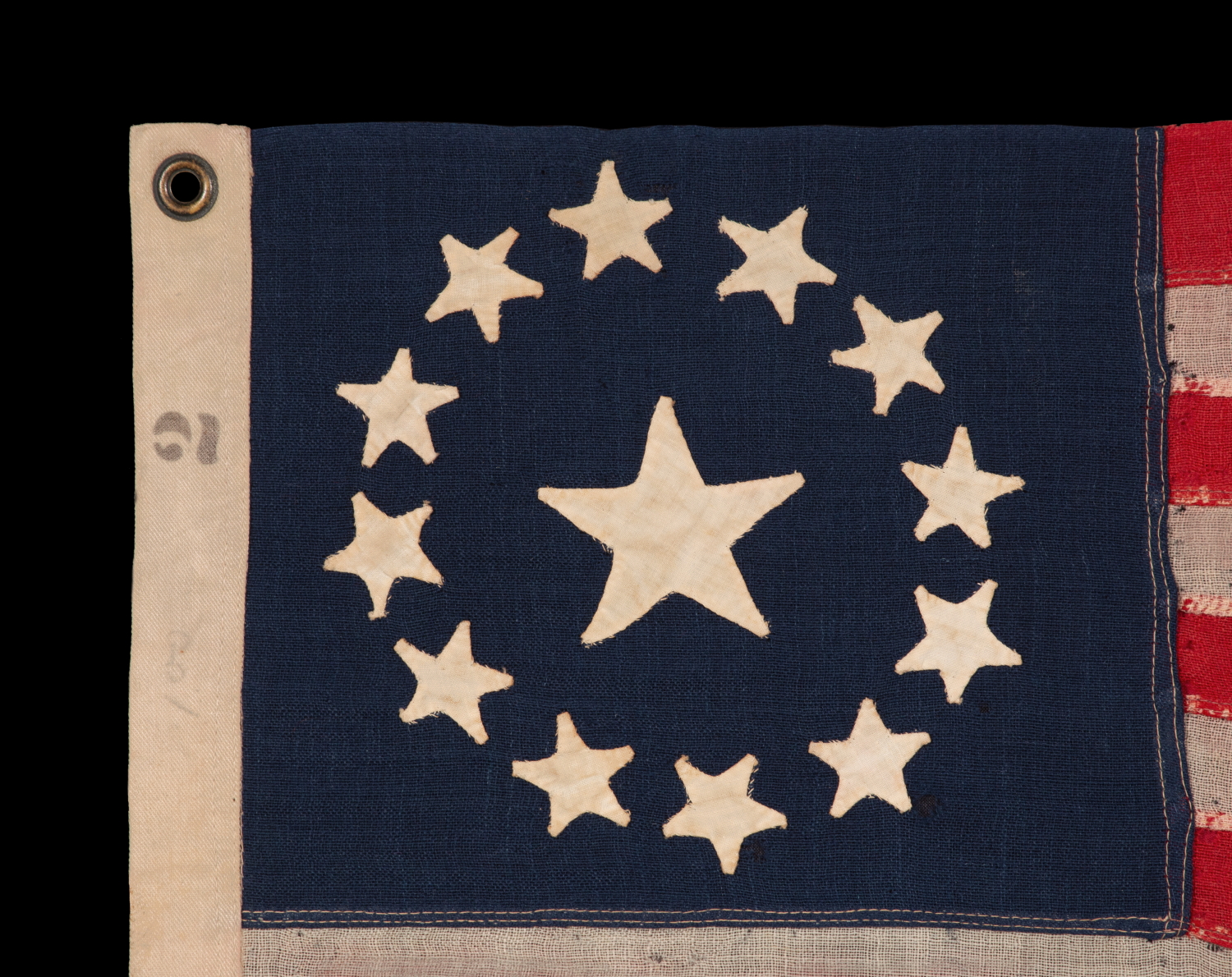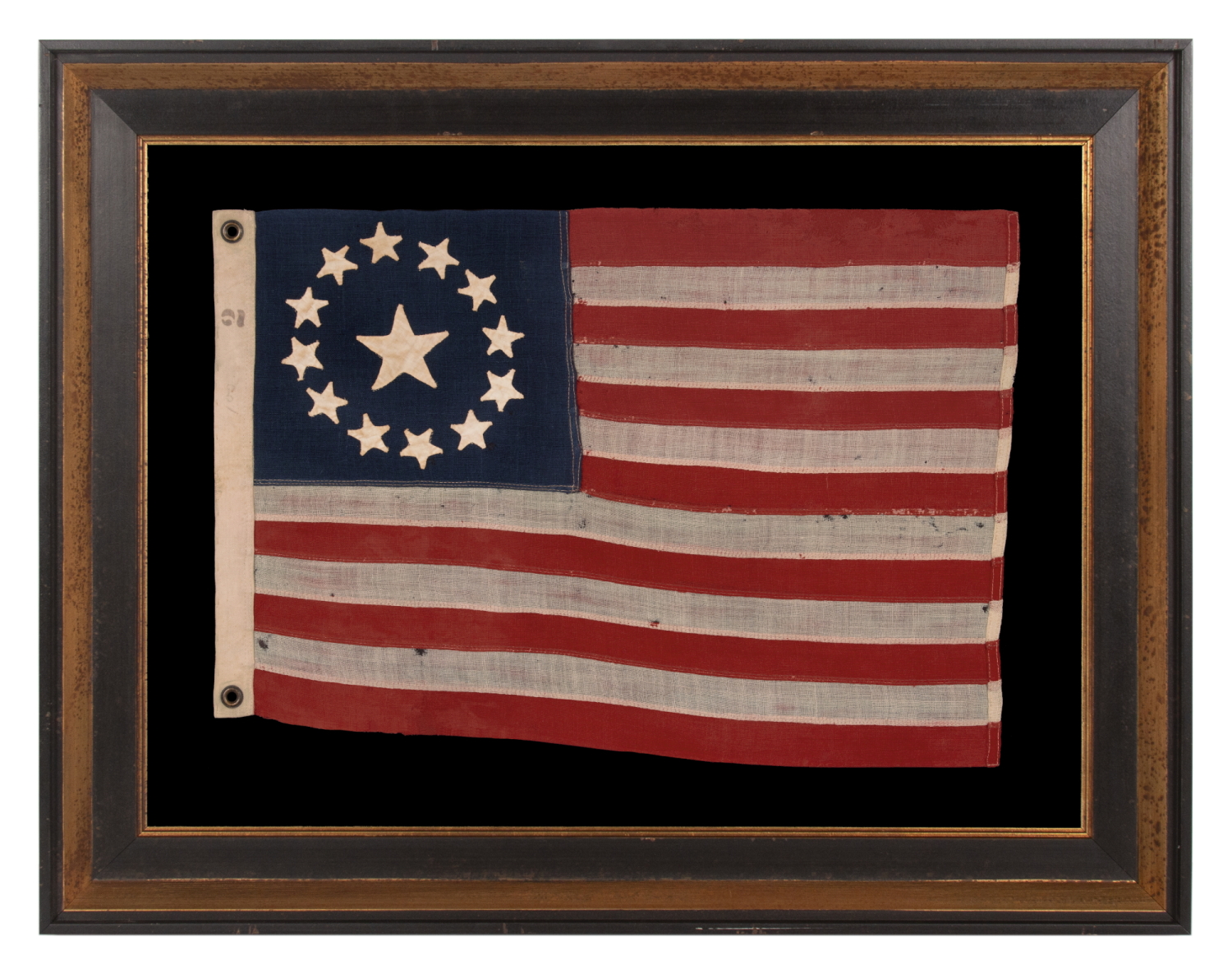
| 13 HAND-SEWN STARS IN A CIRCULAR VERSION OF WHAT IS KNOWN AS THE “3RD MARYLAND PATTERN,” ON AN ANTIQUE AMERICAN FLAG , MADE CIRCA 1876-1895, WITH A HUGE CENTER STAR, AND IN AN INCREDIBLE, TINY SCALE AMONG SEWN FLAGS OF THE 19TH CENTURY & PRIOR; AN EXCEPTIONAL ADDITION TO ANY COLLECTION |
|
| Web ID: | 13j-1585 |
| Available: | In Stock |
| Frame Size (H x L): | Approx. 27" x 36" |
| Flag Size (H x L): | 16.25 x 25" |
| Description: | |
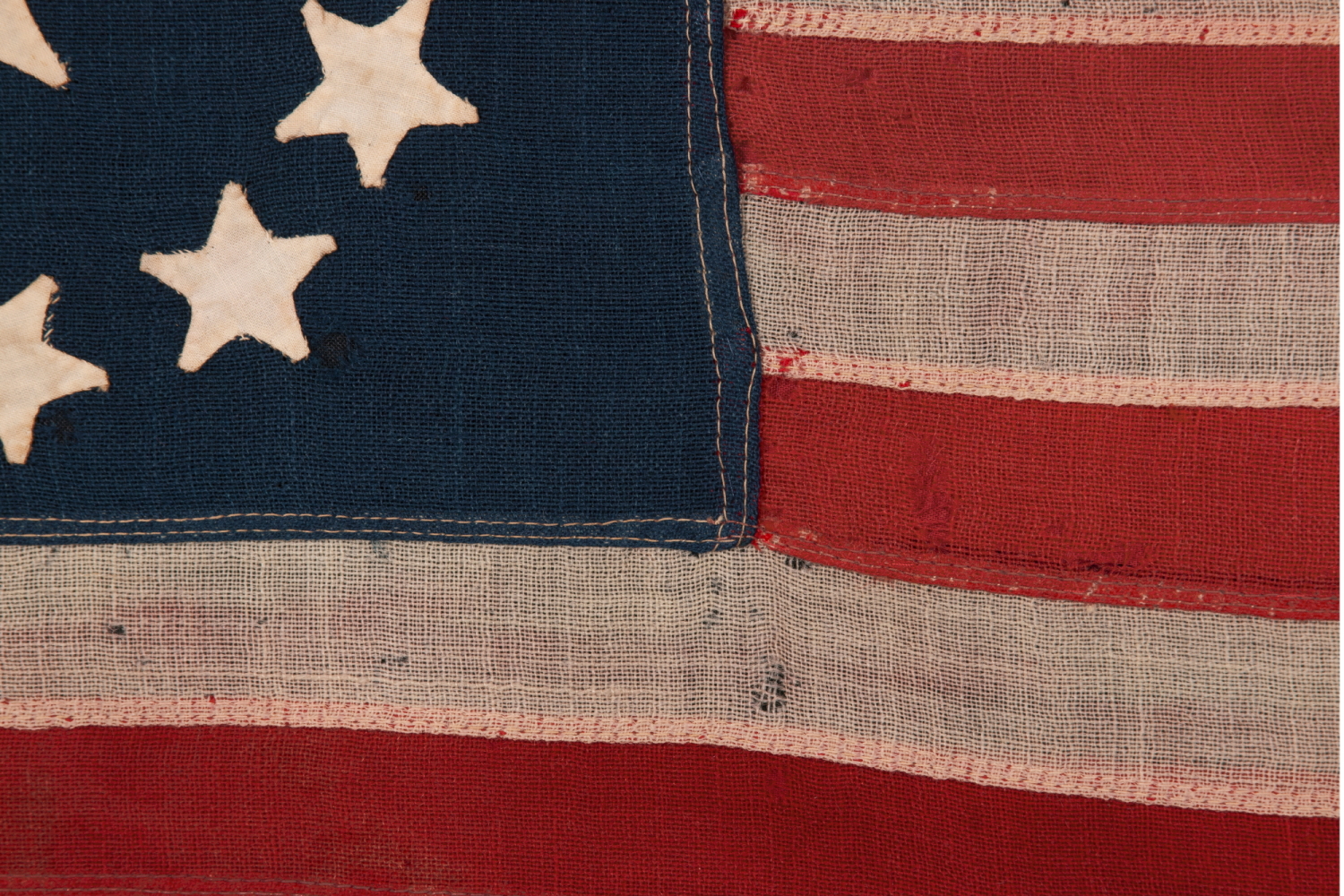
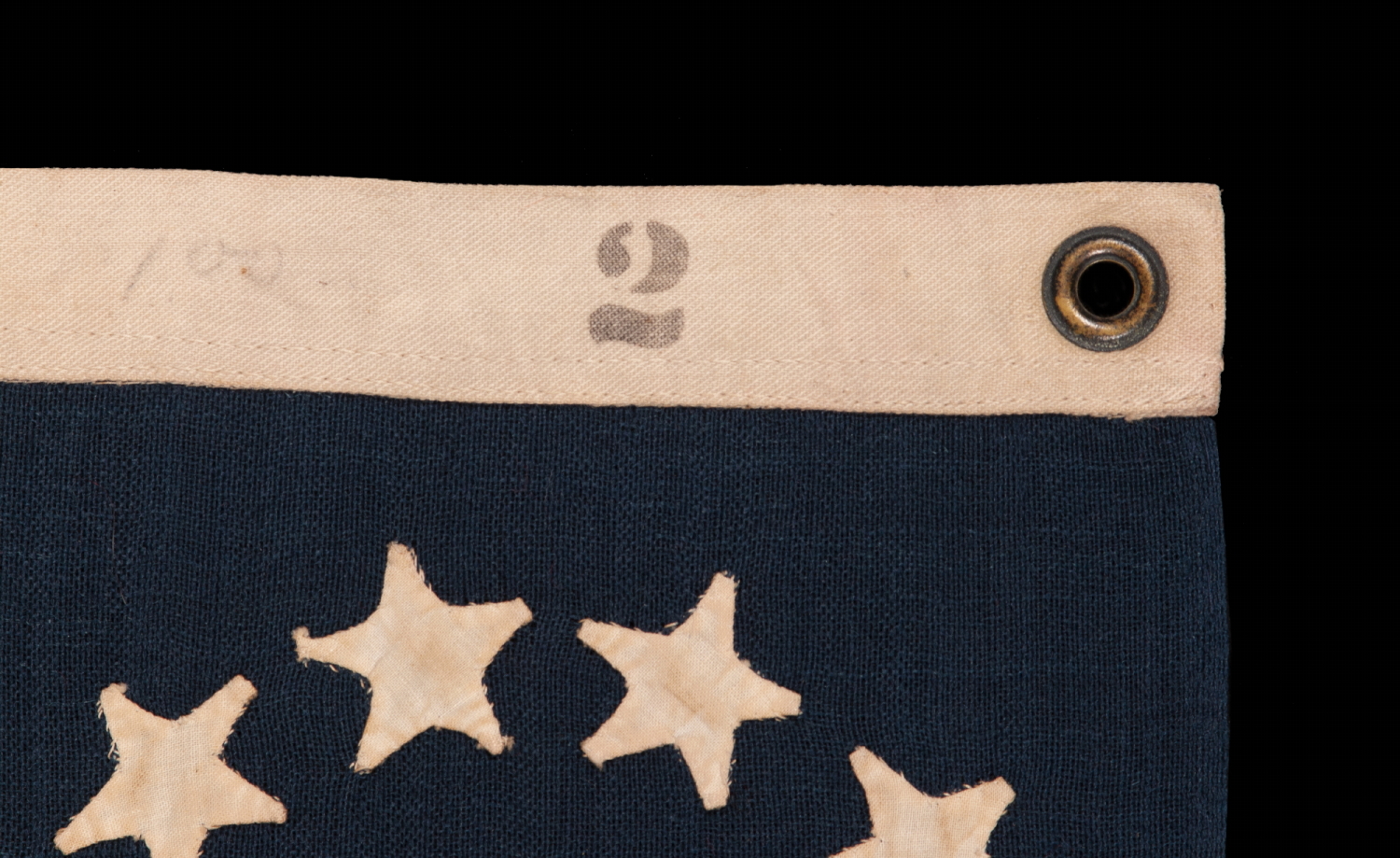
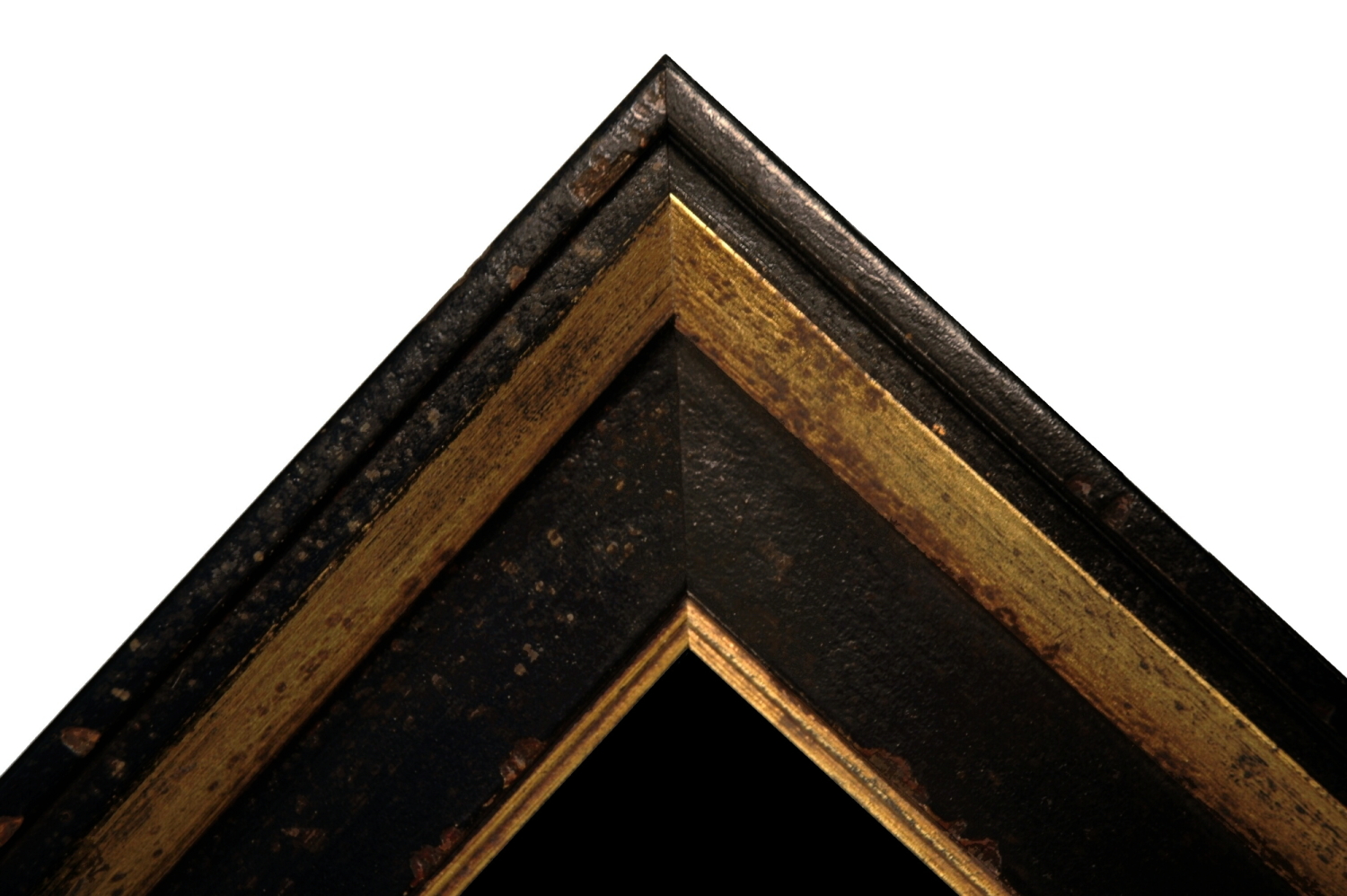
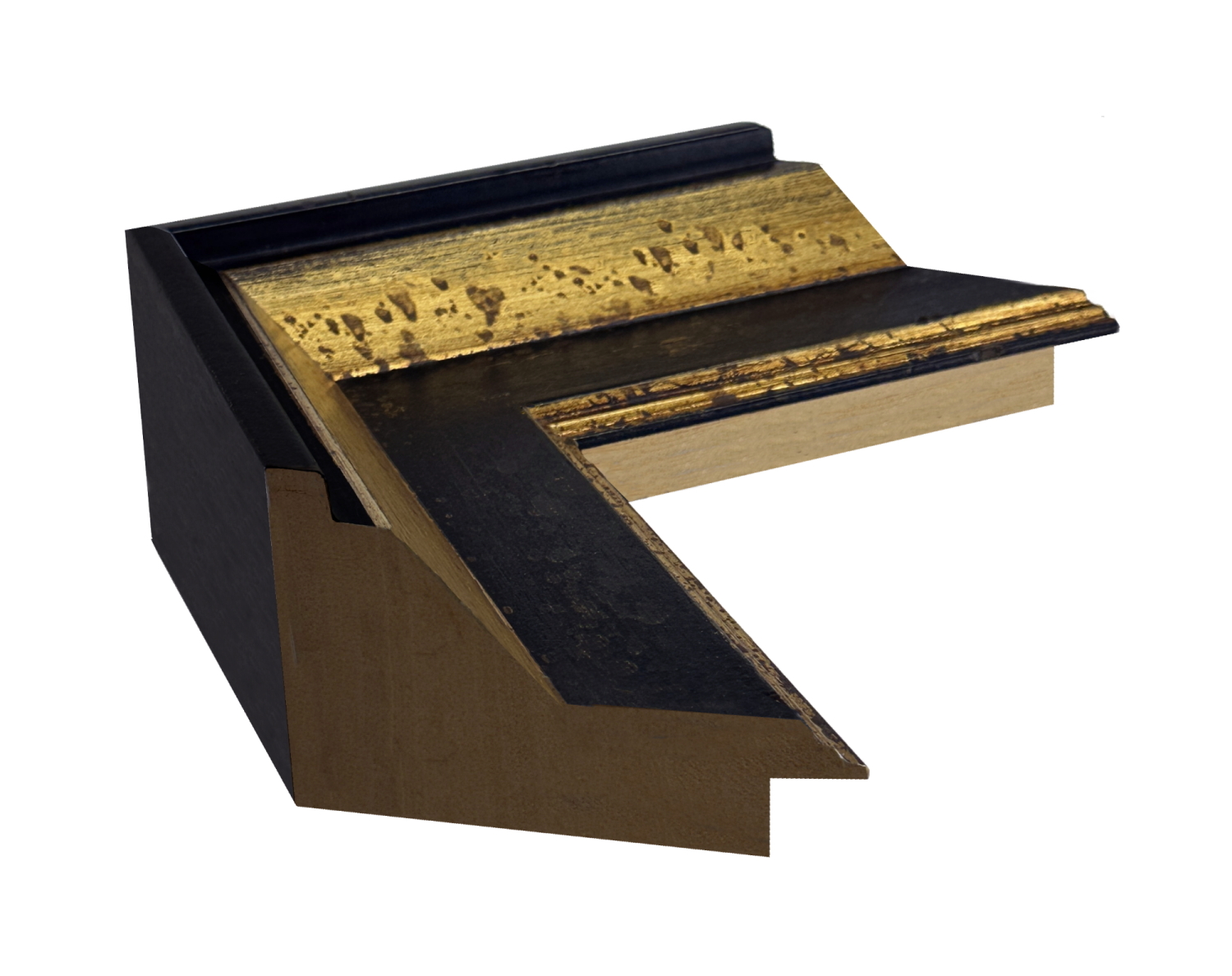
| 13 star flags have been flown throughout our nation’s history for a variety of purposes. They were hoisted at patriotic events, including Lafayette’s visit in 1824-25, the celebration of the centennial of American independence in 1876, and the sesquicentennial in 1926. They were displayed during the Civil War, to reference past struggles for American liberty, and were used by 19th century politicians while campaigning for the same reason. As the number of stars grew with the addition of new states, it became more and more difficult to fit their full complement on a small flag. By necessity, either the stars, or the amount of space between them, would, by necessity, become smaller, making them more difficult to view as individual objects. Changing very frequently, unlike most national flags, the fear was that both the changes and the distortion would place the identification of American ships in jeopardy on the open seas. For this reason the U.S. Navy often elected to use star counts lower than the official number, on smaller flags, in order that the stars be easier discerned at a distance. Primarily these “boat flags,” as they were called, or “small boat ensigns,” displayed 13 stars to reflect the original 13 colonies. This was, of course, the original number of stars on the first American national flag, by way of the First Flag Act of 1777, and equal to the number of original colonies that became states. The Navy’s use of 13 star flags occurred not only in the Revolutionary and early Federal periods, following the First Flag Act of June 14th, 1777, but throughout much of the 19th century, particularly the second half. Because private ships often mirrored Navy practice, especially with regard to use of signals, some private vessels flew 13 star flags during the same era as the Navy. Since there was no official star pattern until the 48 star flag, in 1912, their arrangement was simply left to the whims of the maker. I have identified more than 80 arrangements for 13 star flags, alone, some of these are, of course, more rare and desirable than others. The stars of this particular flag are arranged in what has come to be known as the "3rd Maryland Pattern." This configuration, whether oval or circular, is appreciated both for its visual appeal and the scarcity of its use. The design consists of a circular wreath of 12, with a single star in the very center. The name comes from a flag that has long resided at the Maryland State House, in Annapolis, long thought to have been present with General Daniel Morgan at the 1781 Battle of Cowpens. According to legend, the flag was supposed to have been carried by Color Sergeant William Batchelor of the 3rd Maryland Light Infantry, and was donated to the State of Maryland by Batchelor's descendants. Though the story was disproved in the 1970's, following an examination by the late flag expert Grace Rogers Cooper, of the Smithsonian, who discovered that the flag was, at the earliest, of Mexican War vintage (1846-48), flag collectors and enthusiasts embraced the name "3rd Maryland" and it stuck to the design. In spite of the lack of an association with the reputed regiment, the term actually received some legitimacy through the existence of a similar flag, with verified Maryland provenance, in the collection of the Smithsonian’s National Museum of History & Technology. This was carried by the Maryland & District of Columbia Battalion of Volunteers, during the Mexican War. While the configuration is known to be an early one, as evidenced by its appearance in 18th century illustrations, the pattern is most often encountered on surviving flags of the mid-19th century, roughly within the Mexican War - Civil War era (1846-1865). For some reason it seems to have not been quite as popular at the time of our nation's 100th anniversary of independence, in 1876, but some examples of that time frame are known, including this one. The design was also revived within the first small, mass-produced, commercially-made flags, made between roughly the 1890’s and the 1920's. Made sometime between roughly 1876 – 1895, this particular flag, in the 3rd Maryland pattern, has 13 beautifully hand-sewn stars. Made of cotton, these are double-appliquéd (applied to both sides), rendered in a circular variant of the design. Note in particular impressive size of the size of the center star, versus those around it, which adds a bold feature to the overall presentation. The canton and stripes of the flag are made of wool bunting, that has been pieced and hemmed by treadle stitching. There is a twill cotton binding along the hoist, with two brass grommets, along which, on the obverse (front), the numeral “2” was stenciled in black pigment. Below, a faded pencil inscription reads “1.00,” meaning one dollar—likely its original price. Of great significance is the flag’s small size. Absolutely tiny, among its counterparts of the period with sewn construction, this adds considerable appeal to collectors. While flags printed parade flags, (a.k.a., hand-wavers,) were generally three feet long or smaller, prior to the 1890’s, flags with sewn construction were generally 8 feet long and larger. A 6-footer was considered small. In early America, flags needed to be large in order to be effective in their function as signals, as opposed to today, where their use is moreover decorative and for the general display of patriotism. Even when commercial manufacture of smaller, sewn flags—generally with 13 stars—began, around 1890, almost all were in lengths of three and four feet on the fly. Almost no flags with sewn construction were in two-foot scale, like this example, particularly among those with hand-sewn stars. Because the average 19th century flag with sewn construction can be cumbersome to frame and display in an indoor setting, many collectors prefer small examples, such as this one. Incredibly rare among sewn flags, the fact that the stars are hand-sewn significantly compounds its rarity. The combination of the hand-sewn stars present here, their configuration, the huge center star, and the tiny size among sewn flags of the 19th century, makes for both beautiful and extremely desirable example, fit for any collection. Mounting: The flag was mounted and framed within our own conservation department, which is led by expert staff. We take great care in the mounting and preservation of flags and have framed thousands of examples. The background is 100% cotton twill, black in color. The mount was placed in a deep, cove-shaped molding with a very dark brown surface, nearly black, and a rope-style inner lip. The glazing is U.V. protective plexiglass. Feel free to inquire for more details. Condition: There is significant fabric loss in the top stripe, especially towards the fly end, and there are two areas of moderate loss along the bottom stripe. There are minor to modest losses elsewhere. Period wool fabric of similar coloration was placed behind the flag during the mounting process. There is minor bleeding of the red dye into the white stripes, but not in an offensive manner. Many of my clients prefer early flags to show their age gracefully. |
|
| Video: | |
| Collector Level: | Advanced Collectors and the Person with Everything |
| Flag Type: | Sewn flag |
| Star Count: | 13 |
| Earliest Date of Origin: | 1890 |
| Latest Date of Origin: | 1895 |
| State/Affiliation: | 13 Original Colonies |
| War Association: | |
| Price: | Please call (717) 676-0545 or (717) 502-1281 |
| E-mail: | info@jeffbridgman.com |
 |
|