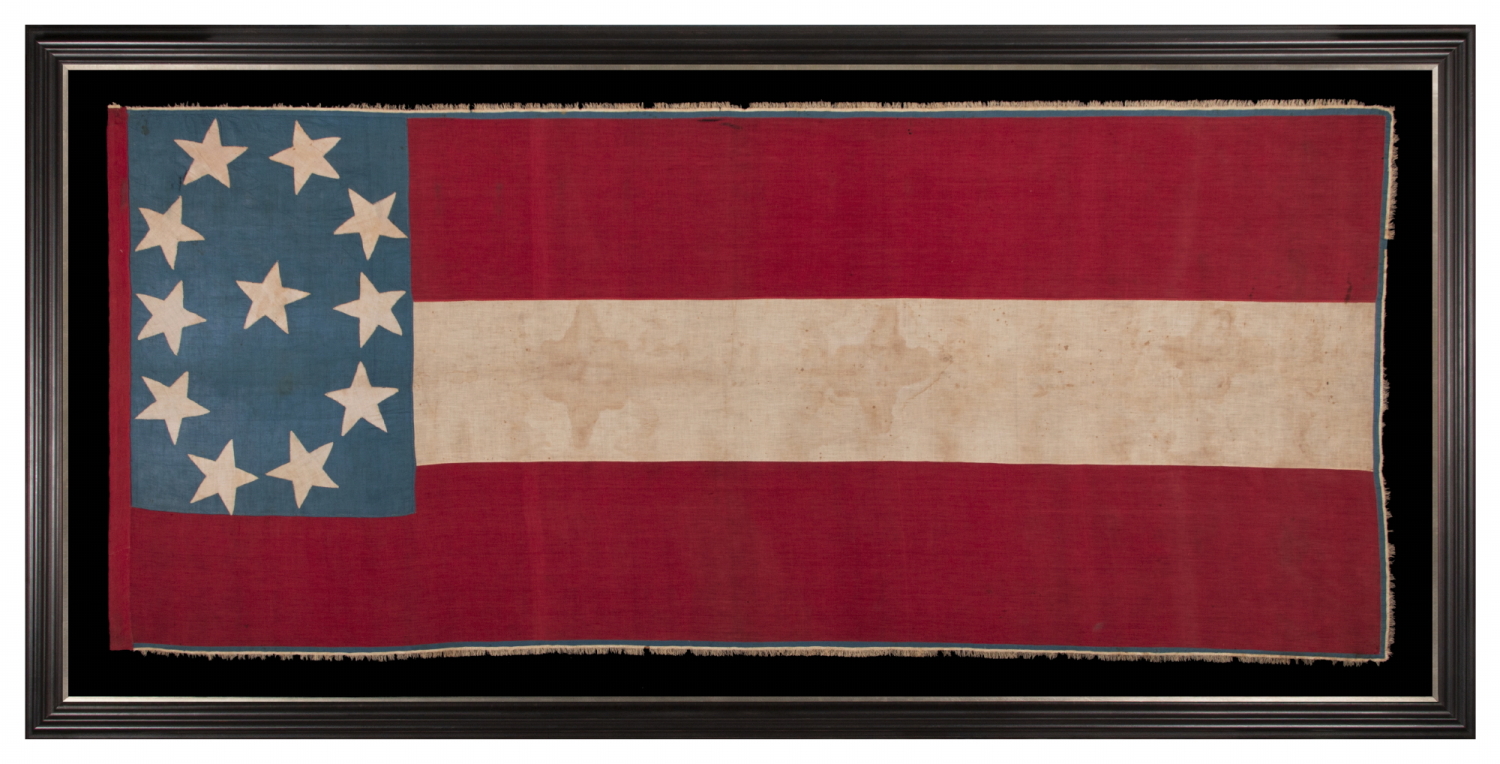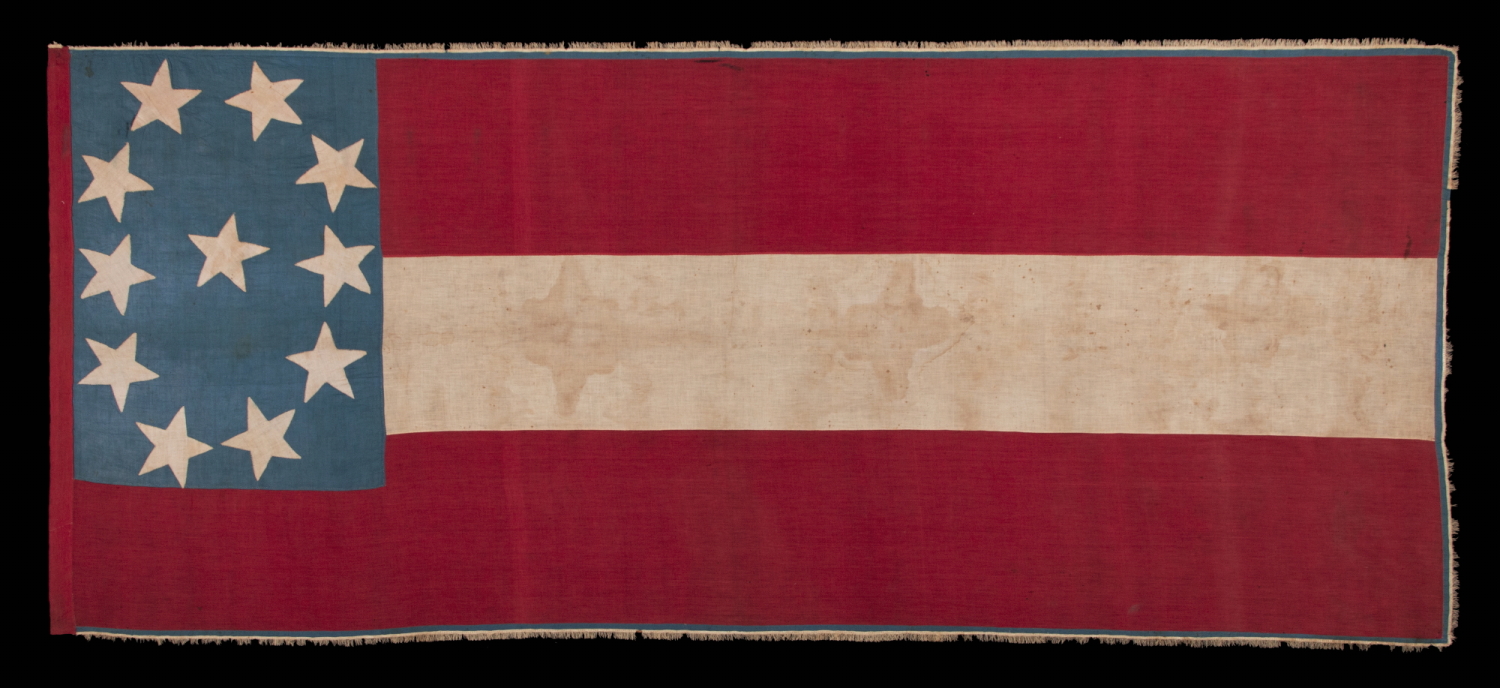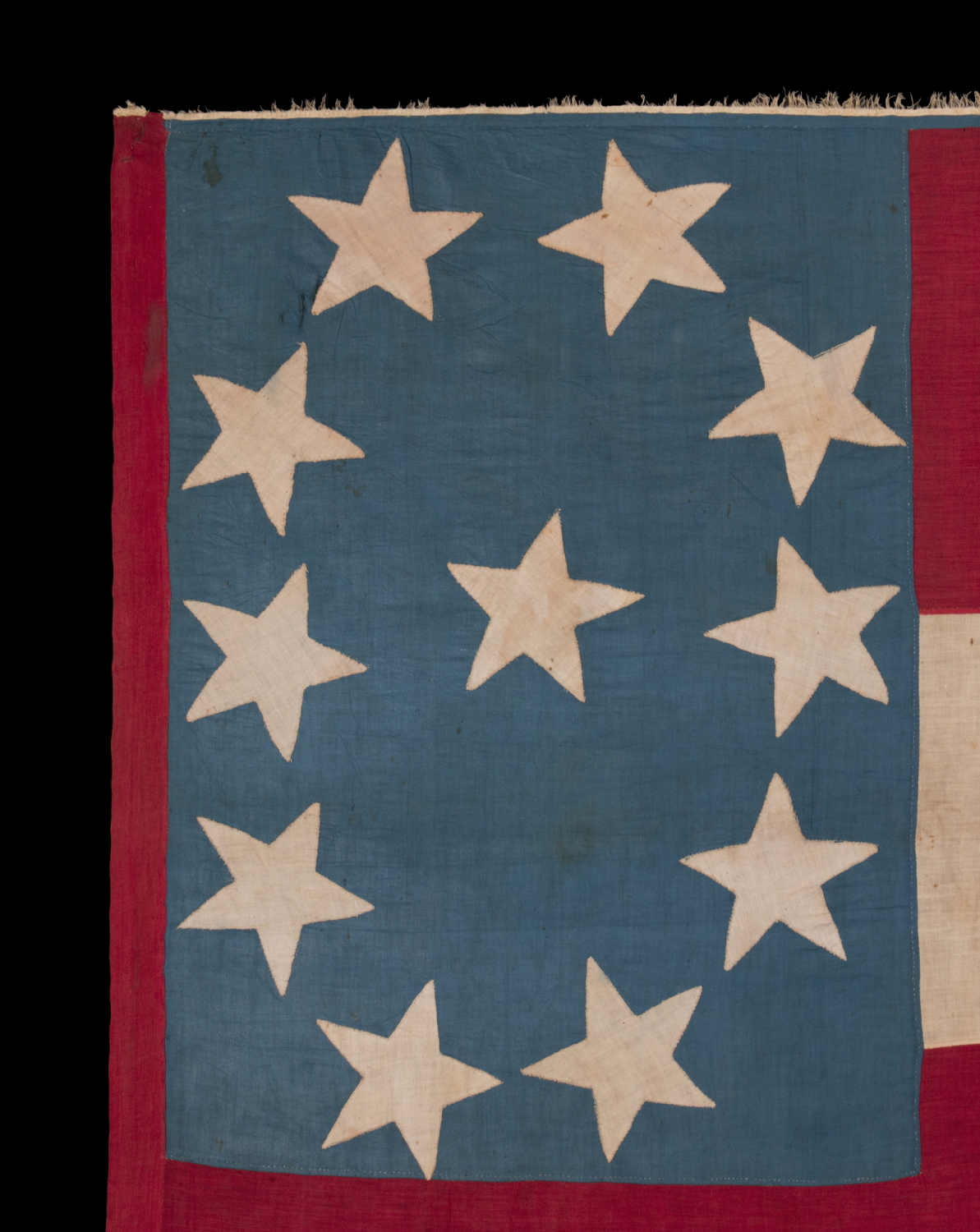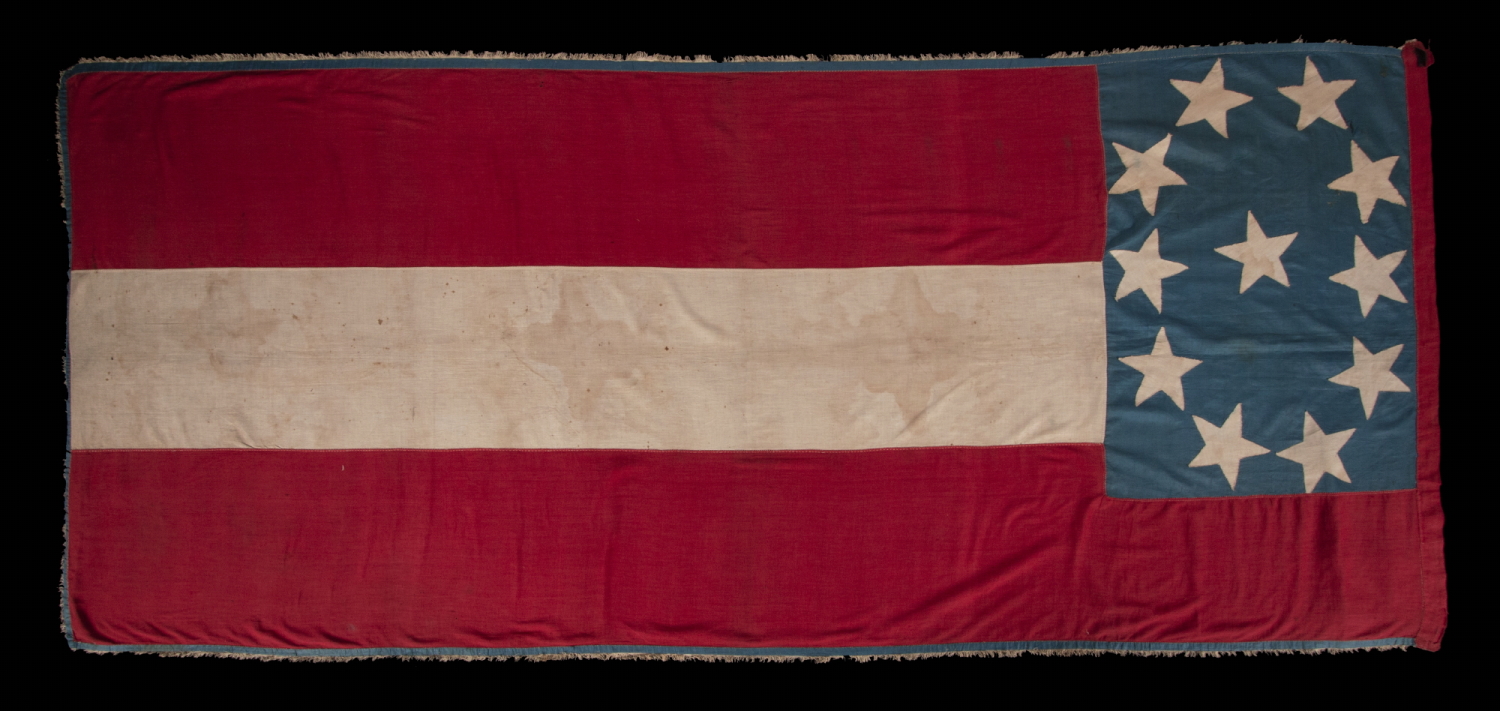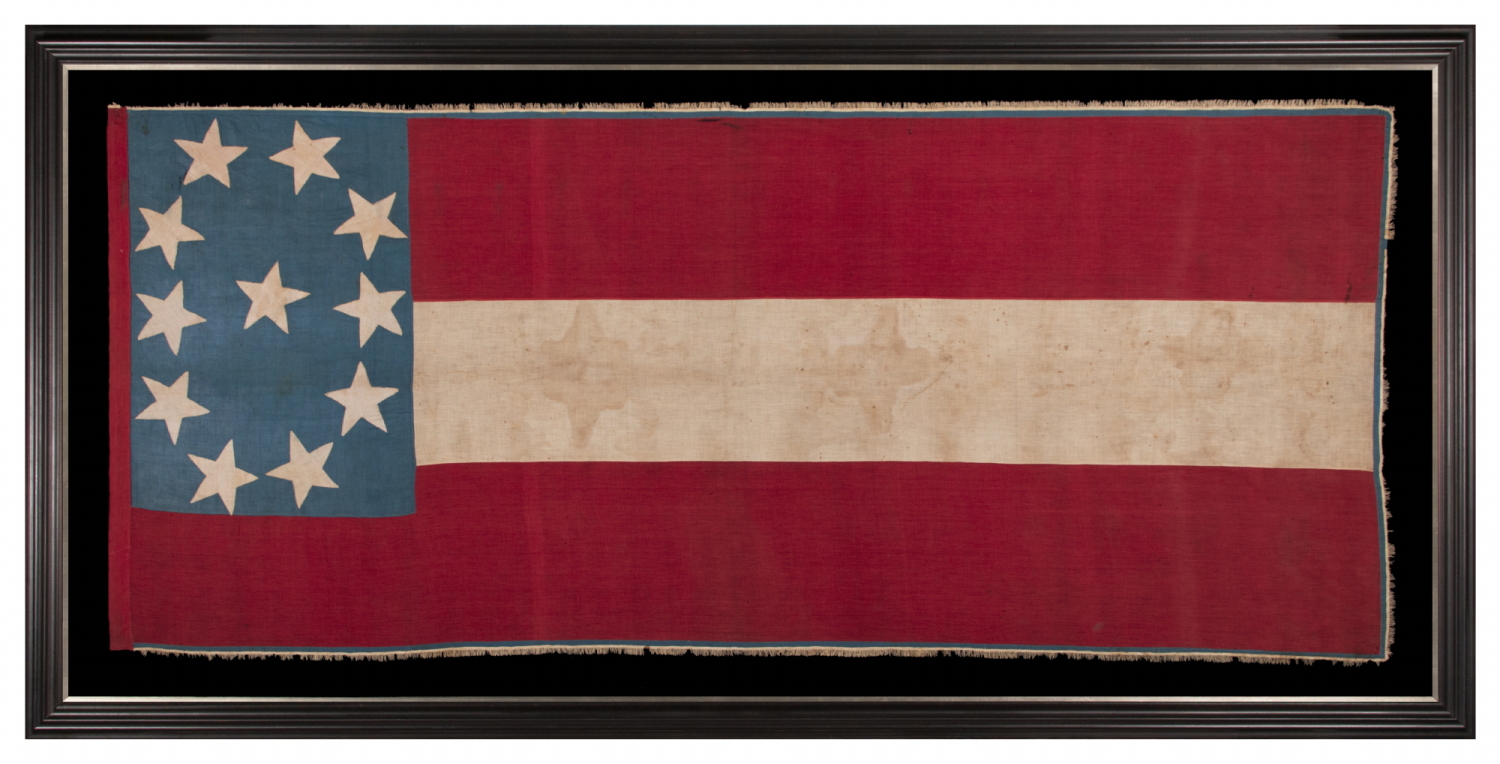
| FIRST NATIONAL PATTERN CONFEDERATE FLAG OF THE CIVIL WAR PERIOD, WITH 11 STARS, ARRANGED IN A WHIMSICAL, STANDING OVAL, ON A TALL & NARROW CANTON OF BEAUTIFULLY GLAZED, CORNFLOWER BLUE, COTTON CHINTZ; WITH A RED, OPEN SLEEVE, A BLUE BINDING, AND A NARROW FRINGE OF FINE, WHITE SILK; BEARS THE SORT OF WILDLY ELONGATED FORMAT COMMON TO A GROUP OF FLAGS CARRIED BY TENNESSEE REGIMENTS; WITH VERBAL ATTRIBUTION TO THE 21ST TENNESSEE INFANTRY |
|
| Web ID: | fcj-915 |
| Available: | In Stock |
| Frame Size (H x L): | 57" x 114.25" |
| Flag Size (H x L): | 44" x 101.25" |
| Description: | |
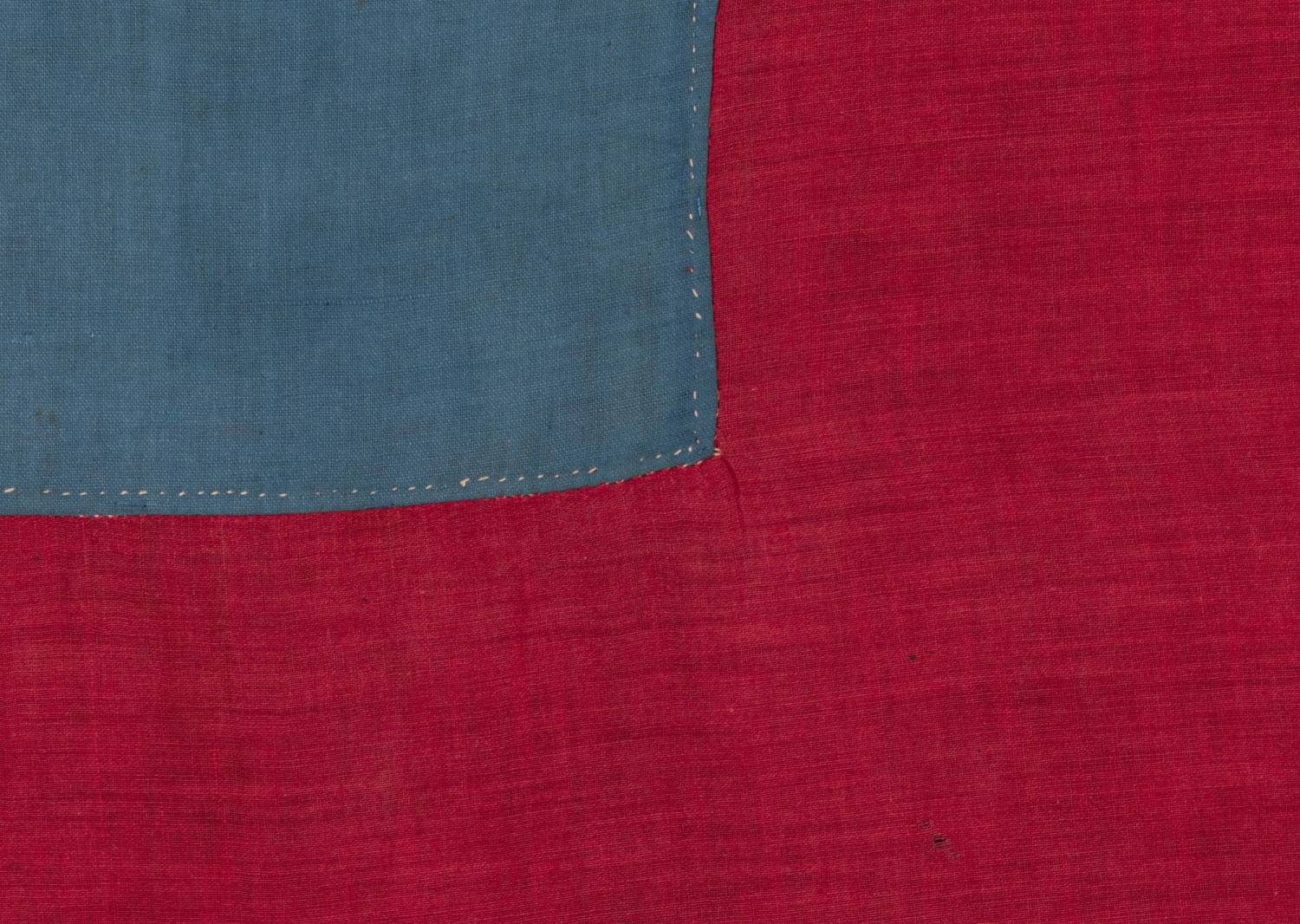
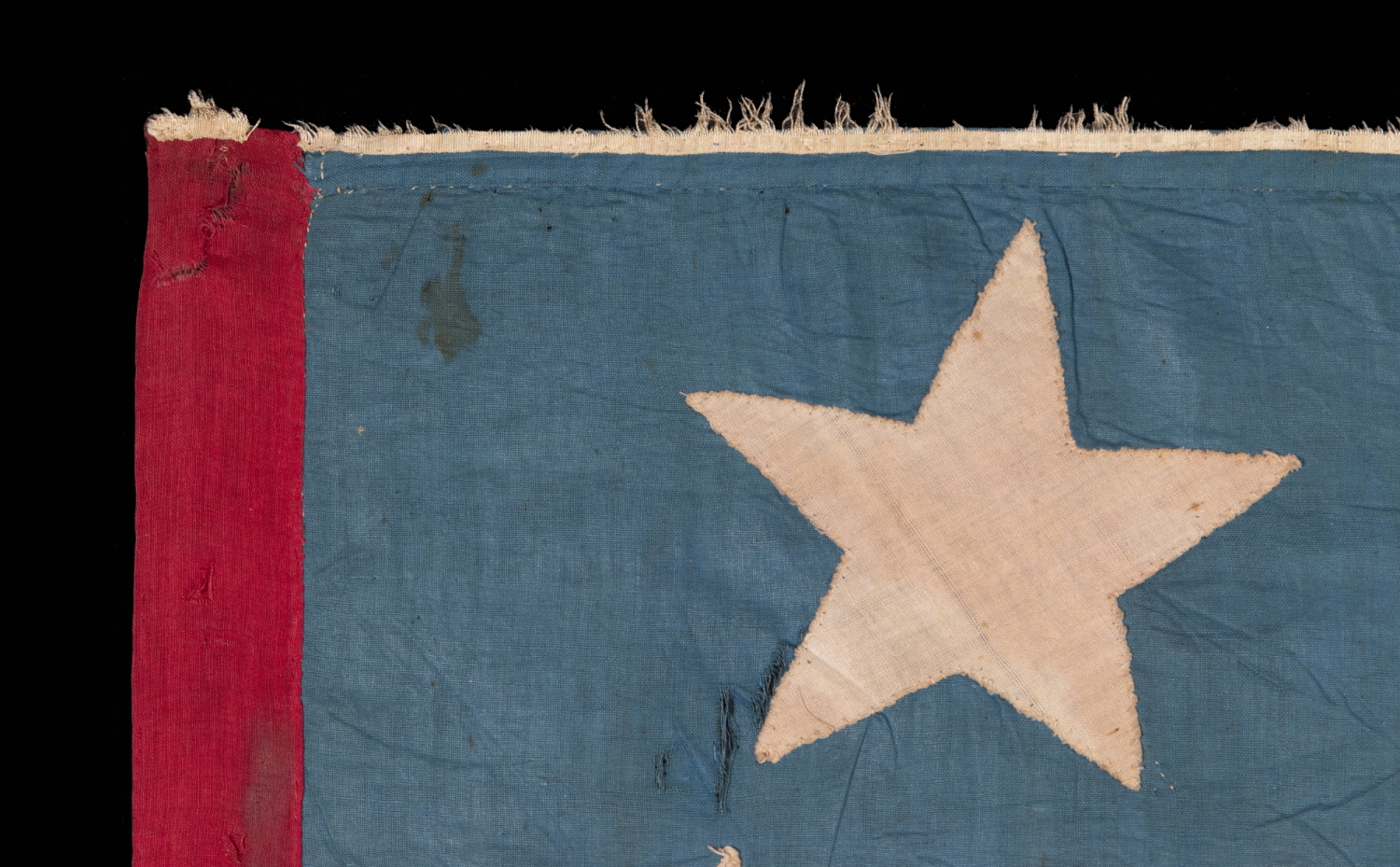
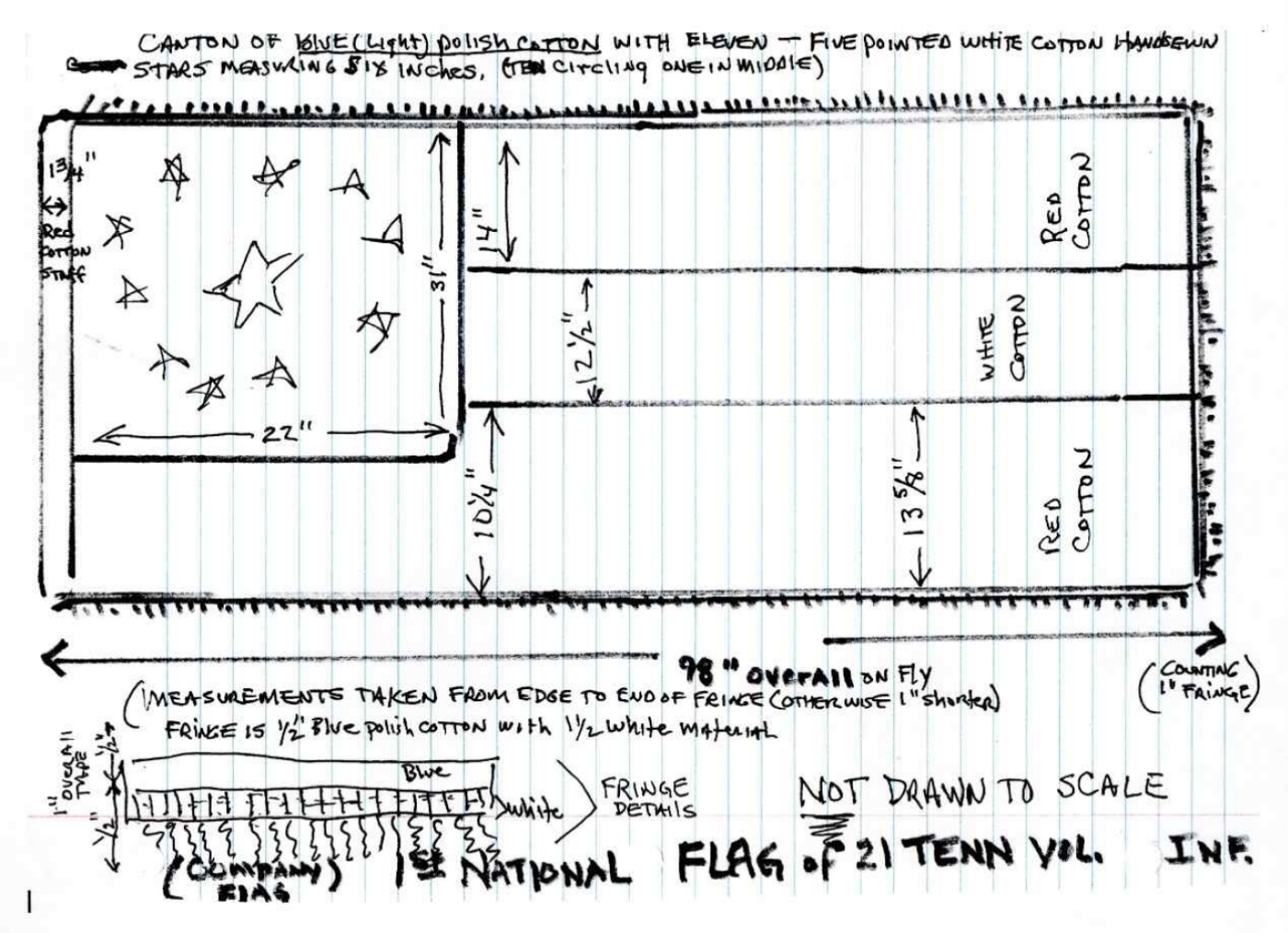
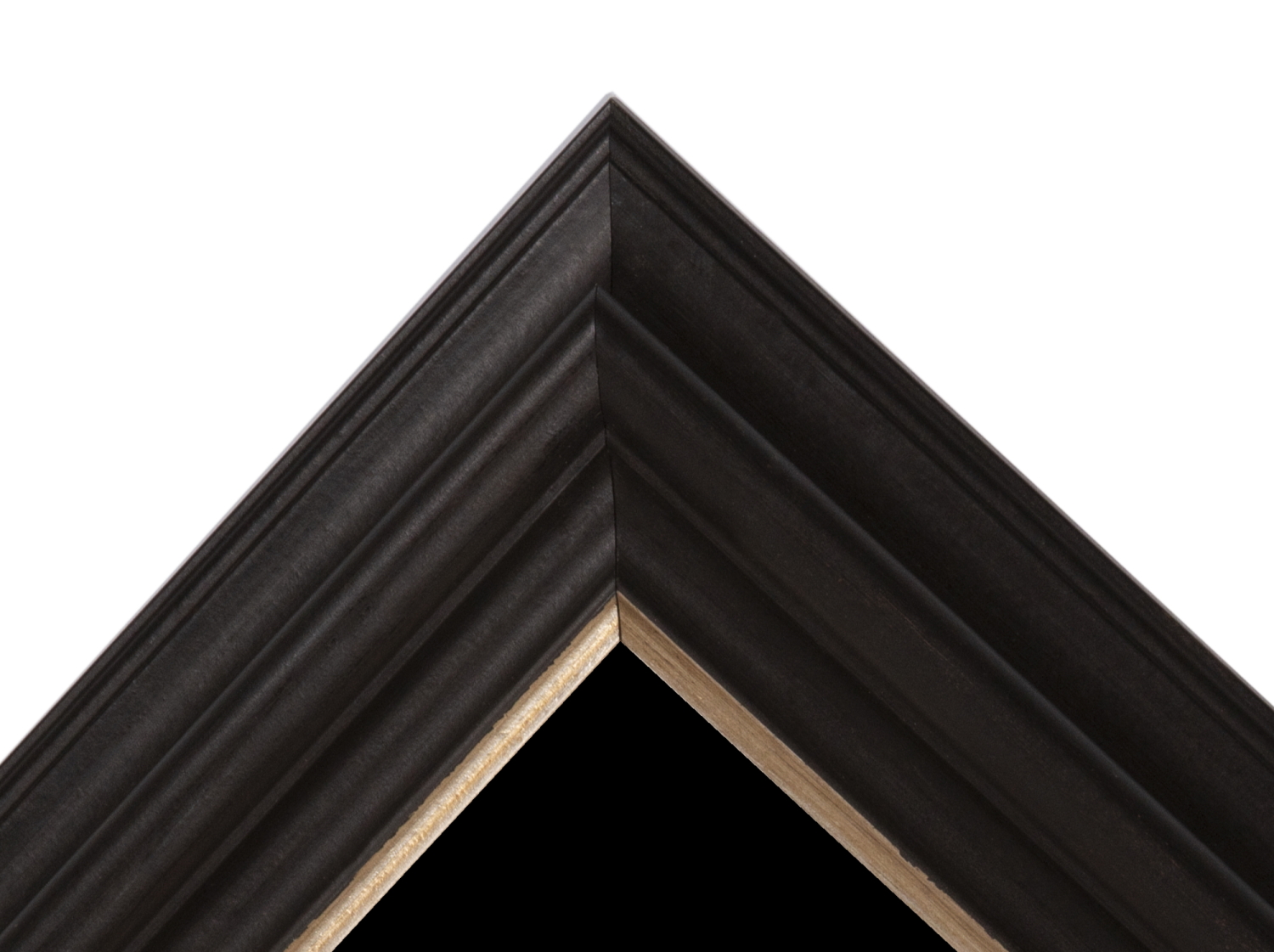
| This extraordinary, Civil War flag, entirely hand sewn, in the First National Confederate design (a.k.a, Stars & Bars), exhibits an array of stunning and unusual features. Chief among these are its remarkably tall and narrow canton, in a striking shade of cornflower blue. Made of lustrously glazed cotton chintz, the union is comprised of 11 large, white cotton stars, 10 of which are arranged in a whimsical, standing oval that hugs the interior of the available space, with the 11th situated in the very center. The fact that the flag’s vertically-oriented canton is paired with plain weave cotton bars of wildly exaggerated length, makes for one of the most dynamic expressions of early American folk art that can be encountered in Civil War flags. More than twice as long as it is tall, among the other, positive, visual elements include the narrow, blue binding, applied to three sides, trimmed with a delicate, white silk fringe. Also of merit is the red cotton hoist binding—a scarce and interesting trait—in the form of an open sleeve, through which a wooden staff would be passed and tacked into place. Note how the maker paid heed to the placement of each star, as they climb the truncated space in mirror image. From the earliest war in our nation’s brief history, the Revolution (1775-1783), battle flags carried by ground forces were typically near-to-square, in keeping of the heraldic norms of Europe. In addition to being a war-period Confederate example, from the Civil War’s opening year, one of the primary reasons why this particular flag is so interesting, is the extreme deviation of its proportions from standard military practice. Representing what one might suggest to be the widest possible swing of the pendulum, the 44 x 110-inch flag is dramatically different and from not only the 6 x 6.5-foot, regulation battle flags of the Union Army, but the iconic, 4 x 4-foot, Southern Cross style battle flags of Robert E. Lee’s Army of Northern Virginia. Although the reason(s) for employing such a narrow format thus-far remain unknown, the very purpose of displaying a flag at all—as a critical, identifying signal on the battlefield—explains why this particular design, intentional or otherwise, was a good one. Because the Confederate First National flag looked so much like the Stars & Stripes, use of both on the same battlefield created great confusion. Sometimes this led to forces firing on their own men. A key example of this occurred at the First Battle of Bull Run (a.k.a. First Manassas). One rudimentary way to overcome the unfortunate similarity in the two designs was to fly a banner that was long and skinny, as opposed to square. Proper identification of a flag, in a black powder-laden engagement, was the exact circumstance that led Confederate General P.G.T. Beauregard to request a change in the flag from the First National/Stars & Bars to the Southern Cross. The issue was communicated by Beauregard in a letter penned September 4th, 1861, to the chair of the CSA Committee on the Flag & Seal. Though the CSA legislature would refuse to sanction the design, it was approved at the field level by Confederate General Joe Johnston, who refused to permit his men to continue to be killed by friendly fire. It would be Johnson’s own orders that led to the 1861 manufacture of the first Southern Cross battle flags by ladies in Richmond, for use by the Army of the Potomac [soon after renamed the Army of Northern Virginia (ANV)]. While this would replace the First National in Lee’s Army, the Stars & Bars would continue to be produced throughout the Confederacy, and would adorn some regiments for the balance of the war. Oddly enough, the same reason that made it a poor signal is what makes the First National largely unidentifiable today, causing most viewers, in a modern context, to presume that the red, white, and blue flag is merely some sort of Stars & Stripes variant. Because 99-out-of-100 Americans are unable to identify it, the First National pattern, though poor on the battlefield, is a fine choice for modern collectors who wish to present the Civil War through period objects, without inciting controversy. Unlike Union Army national colors, which were to be 6 x 6.5 feet by regulation, often with a 2 to 2.5-inch fringe and sometimes an open sleeve, resulting in approx. 6.5 x 7 feet in total, their Confederate counterparts were, as a rule, far smaller. First National pattern flags, carried in the early part of the war, tended to hover around 4 - 6.5 feet on the fly, and were rectangular, with hoist measurements of just 3 to 4 feet. Often possessing more than two times the surface area, Union Army battle flags are nothing short of imposing, when viewed in person, while Confederate, first national colors often appear more like something one might display on a porch. Southern Cross battle flags, introduced in the late fall of 1861, were even smaller, hovering around 4 x 4 feet, if square, like the Richmond-made, ANV examples, or 3 x 4.5 feet, for the rectangular style common in war’s western theater. At 101” on the fly, the visual impact of this much larger flag is far greater, in respect to its Confederate Counterparts, and every bit as dramatic as any Union Army colors. Somewhere along the line, a former owner of this flag inscribed “1st National Flag of 21 Tenn. Vol. Inf.” along the lower edge of a drawing he produced with detailed regarding measurements and associated fabrics, along with the notation “company flag.” Though no supporting provenance is presently known to substantiate such a claim, the flag’s physical attributes, alone, provide ample enough reason to consider a Tennessee attribution, with or without any information at all. Flags with exaggerated length, at or beyond a 1:2 ratio with the hoist, just so happen to occur most often across documented examples carried by Tennessee regiments. A fairly extensive search, across all states within the CSA, yielded 12 from that state, including 10 with specific history Tennessee regiments, plus an 11th , unattributed, though with known capture history at an engagement where 17 of the 18 regiments involved were of Tennessee origin, plus a 12th of unknown origin, in the collection of the Tennessee State Museum. Tennessee regiments where the corresponding flags were carried include the 1st, 3rd, 7th, 9th, 14th, 16th, 18th, 32nd, and 34th Infantries, and the 1st Tennessee Cavalry. Research beyond that state yielded 4 examples in Missouri and 3 from Georgia, both of which border to the northwest and southeast, respectively. Though an occasional flag in this style can be encountered elsewhere, no other state records multiple examples where the length on the fly meets or exceeds twice that of the hoist. The elongated First National flags of Tennessee were early war examples. Generally sewn by local women, occasionally with painted devices or lettering commissioned from a professional sign painter, these homemade banners were traditionally presented to a local militia company, or to an officer within. Since militia units often mustered in as entire companies, or enlisted to form the nucleus thereof, such flags were typically carried at the company level, at least initially, though at least 2/3 of the recorded examples transitioned to use as the flag of the entire regiment, simply because no other was available. Two flags specifically produced to identify the 21st Tennessee Infantry Regiment as a whole are illustrated as plates 82 and 83 in “Civil War Flags of Tennessee” by Cox, Stephen D. (2020, Tennessee State Museum, University of Tennessee Press), with discussion on pp. 270-274.** These include: (1) An early-war, Polk-Style battle flag with a blue field and a red St. George's cross, made by the ladies of Memphis in an order of 45 such examples, completed on January 30th, 1862. Probably issued to the regiment while camped at Union City, TN, in February of 1862; Tennessee State Museum Collection, Nashville. (2) An 1862 "Bragg Corps" flag, made by Henry Cassidy of New Orleans [not by Mrs. R. J. Person, as sometimes reported], in the first of two orders submitted by to Cassidy on February 26th and March 5th, 1862; privately held. The most significant flag of the 21st that remains unaccounted for is the original flag of the regiment, probably a First National, likely presented to the regiment when it mustered into service on July 9th, 1861. Presumably this would have displayed 11 stars—like the flag that is the subject of this narrative—congruent with the time frame. Raised largely in and around Memphis, a more populous region, where the bulk of the associated men were raised, the chances of the star count being accurate were probably greater. Because no detailed account or description has been published, however, any and all attributes of such a flag remain unknown. Across the 10 companies (A-K) that initially formed the 21st Reg’t., just one surviving flag is identified. Attributed to “I” Company, this was made by Ms. Letitia Austion while volunteering with the Ladies Aid Society of Memphis & the Southern Mothers Association, and presented to her new husband, Captain Charles W. Frazier, on July 4th, 1861, at the home of Mr. J.M. Tate, Orleans Street, Memphis. Smaller than a Union cavalry guidon, at just 18” on the hoist by 34.5” on the fly, its dimensions are of the sort expected for the personal flag of an officer, more appropriate for drilling than for use as a company battle flag. Details concerning two other known company flags are recorded by Cox, but no images are included and each of these is recorded “missing.” Excluding the 11 star First National flag that is the subject of this narrative, an examination of the other 12 elongated profile flags, with probable Tennessee origin, bear counts that range from 7 stars (1), to 8 stars (3), 9 stars (2), 10 stars (1), 11 stars (1), 13 stars (1), 15 stars (1) and No Stars at All (1). It is of interest to note that 6 of the above don't even technically include Tennessee in the star count, given its ultimate position as the 10th or 11th state to join the Confederacy. Because 7 states approved the provisional Confederate Constitution, and 7 was the count on the original flag, when approved on March 4th, 1861, the 7 star First National definitely does not include Tennessee, though it could theoretically be represented in an 8 or 9 star flag, if made in advance of Tennessee’s secession, as a means of promotion. It is important to note that the number of states in the CSA, or on its flag, may simply not have been known to the rural women who made these flags at home, for family members, or for their communities. Though many newspapers existed—Memphis had 3 in 1861—few in rural areas were likely to have had regular access. Even so, the literacy rate among white women in rural regions of Tennessee, reflecting about 90% of its population, is estimated to have fallen somewhere between 44-55% in 1861 (47.5” statewide in the 1850 census). Expected sources of information on flag design are likely to have been slim at best, obtained by whatever illustration someone had, likely outdated, if any, or by verbal description / here say, or by an actual flag of some sort, probably rather rare, especially near the war’s outset and even more so in far-flung locations. The star count on Confederate flags is a complex subject, even today, regardless of what hobbyists or many vexillologists off-handedly report. The order in which states joined the Confederate cause can be assigned to as many as four possible dates. Among these are (1) day upon which its legislative body voted in favor of secession; (2) the day upon which the general populous ratified that vote (when necessary); (3) The day when the agreed upon measure took effect, if not immediately; and (4) the date upon which a state was formally accepted into the CSA by its governing body. An 11 star First National flag, like this particular example, would theoretically date somewhere between May and November, 1861. On May 20th, 1861, the North Carolina legislature voted unanimously in favor of secession, becoming one of just two states to do so, the other being South Carolina. Curiously, while South Carolina led the charge, on December 17th, 1860, North Carolina was the last of the 11 legislatures to put the measure to vote, holding out until, save the Atlantic coast, it was fenced in on all sides, sharing no borders with Union States. The decision to wait was probably a sound one, for several reasons, lacking the folly of haste and diverting unwanted federal attention. In some states a popular vote of the people was necessary for ratification of the measure passed by the state legislature. Because no such requirement existed in North Carolina, its vote was ratified by default on the same day and took immediate effect. Because popular votes, required in both Virginia and Tennessee, had not yet occurred, North Carolina became No. 9 in this line-up, with Virginia and Tennessee as No.’s 10 & 11. Some states also specified a future date, upon which the approved act of secession would take effect. Because North Carolina, Virginia, and Tennessee did not, they maintained the same order tendered by the popular vote. The fourth means by which dates of secession could theoretically be measured across states was the order in which they were officially accepted into the Confederate States of America (CSA) by President Jefferson Davis and the CSA legislature. This did not precisely measure secession, but the admittance of the state into the new entity. By this list, North Carolina was No. 10, followed by Tennessee as No. 11. In terms of an official count, the 11th star was officially added to the First National flag of the CSA in July of 1861. Because few gave heed to official star counts, especially in the case of homemade flags, 11 star examples of the First National design would theoretically appear as early as May. Some flags actually featured 15 stars, to include all of the Slave States, disregarding not only the order of secession, but whether or not it occurred. In terms of an official count, two other states, Missouri & Kentucky, though they did not ‘officially’ secede, were nonetheless accepted into the CSA in November and December of 1861. The official star count was increased from 11 to 13 on December 10th of that year. Whatever the case may be with regard to the flag’s similarity to the elongated, early war, Stars & Bars, presentation colors of Tennessee, without more information, all that can truly be said of this exaggeratedly long flag is that a relationship to the 21st Tennessee Volunteers was assigned for reasons unknown, and that its proportions, while most common in that state, are shared with other flags from a region that extends into the bordering states of Missouri and Georgia, as well as with a scattering of distinct, singular examples carried elsewhere. When the size and dramatic shape of this flag are combined with its incredible star configuration, set against such a slender canton, made of polished fabric, in a shade of blue adored by both flag collectors and connoisseurs of early American textiles, the notches on the tally stick reach well into the Masterpiece level. Add to this the matching blue binding, red hoist, and unordinary white fringe, on a flag made in the earliest segment of the Civil War, and the result is one of the most graphically memorable Confederate examples one can hope to acquire. ** A regimental color, black with a red border and red fringe, though of unknown design, is likewise described by Cox, captured from the 21st Tennessee after crossing the Mississippi at Columbus, Kentucky; Lost when the 21st plus 3 other TN regiments engaged federal forces under Ulysses S. Grant, the flag is listed as "missing." Another flag, in the Hardee pattern, blue with a white disc and a white border, was carried after a July 1862 consolidation of the 21st with the 2nd Tennessee, to form the 5th Confederate Infantry (later the 9th). Among the collection of the Tennessee State Museum, Cox illustrates this flag as Plate 44. Mounting: The flag has been mounted and framed within our own textile conservation department, led by expert staff. We take great care in the mounting and preservation of flags and have framed literally thousands of examples. The background is 100% cotton twill, black in color, that has been washed and treated for colorfastness. The black-painted, hand-gilded and distressed molding is Italian. The glazing is U.V. protective acrylic. Feel free to contact us for more details. Condition: Full report to follow. |
|
| Video: | |
| Collector Level: | Flags for the truest Patriots. My best offerings |
| Flag Type: | Sewn flag |
| Star Count: | 11 |
| Earliest Date of Origin: | 1861 |
| Latest Date of Origin: | 1861 |
| State/Affiliation: | Tennessee |
| War Association: | 1861-1865 Civil War |
| Price: | Please call (717) 676-0545 or (717) 502-1281 |
| E-mail: | info@jeffbridgman.com |
 |
|