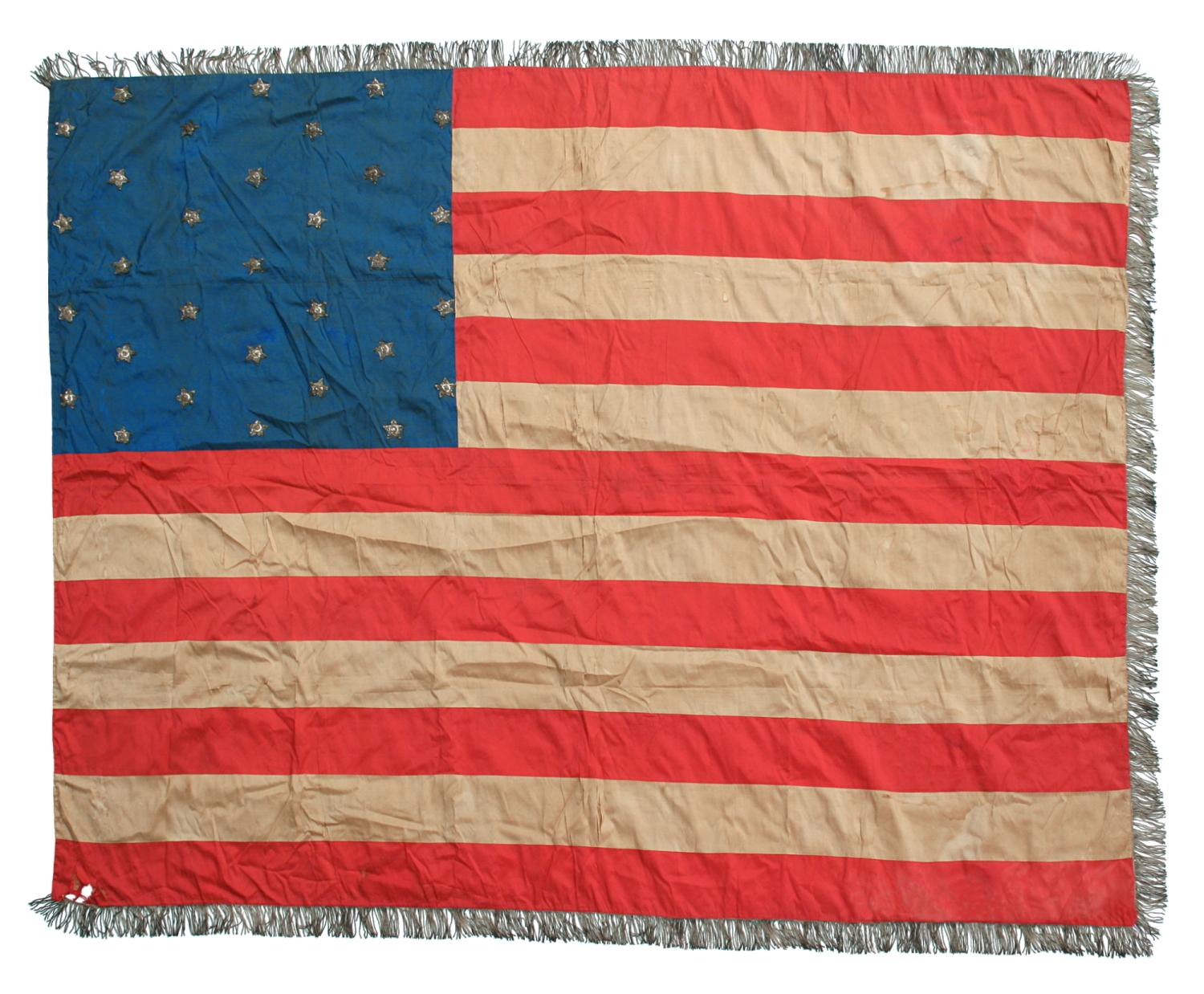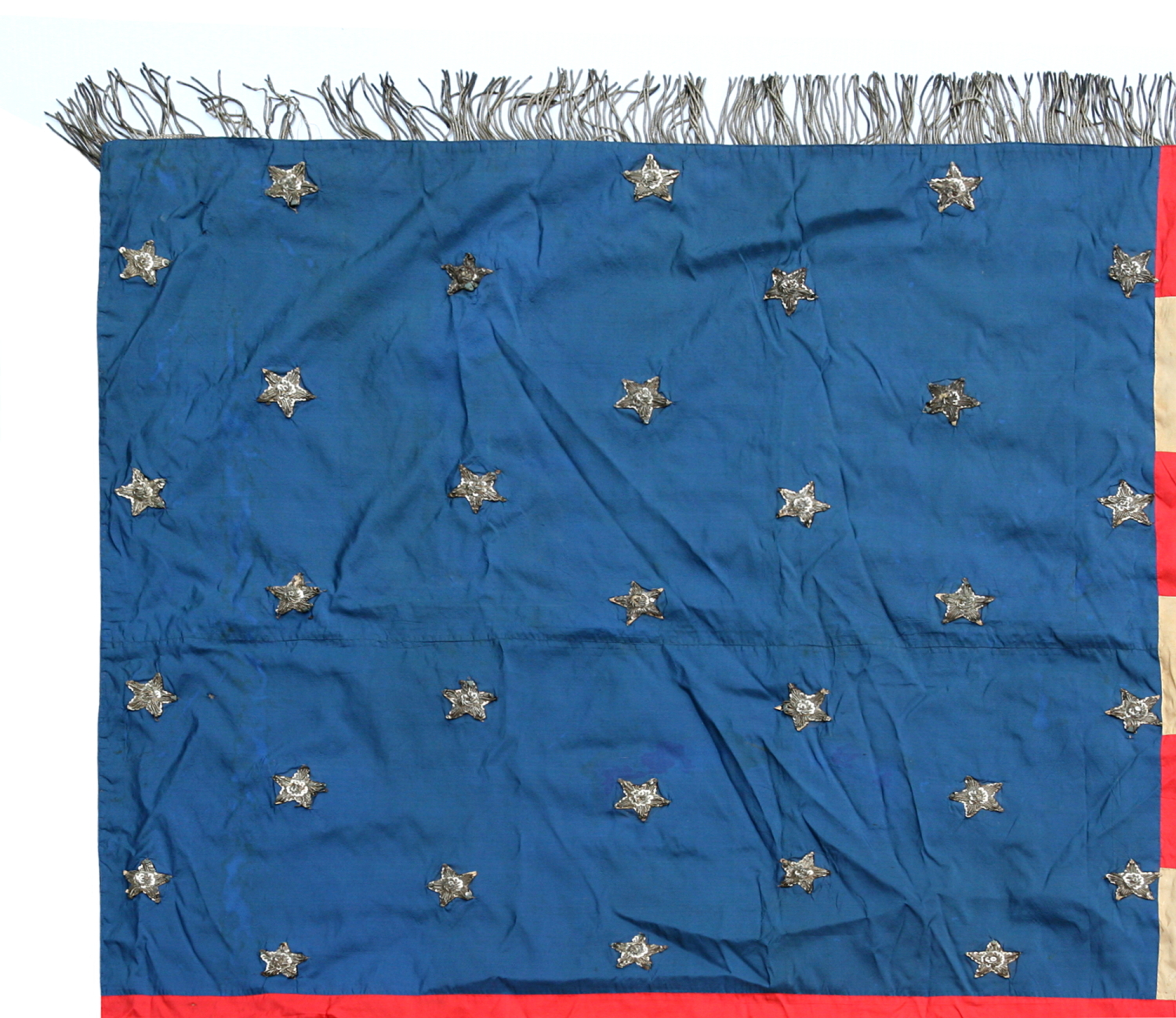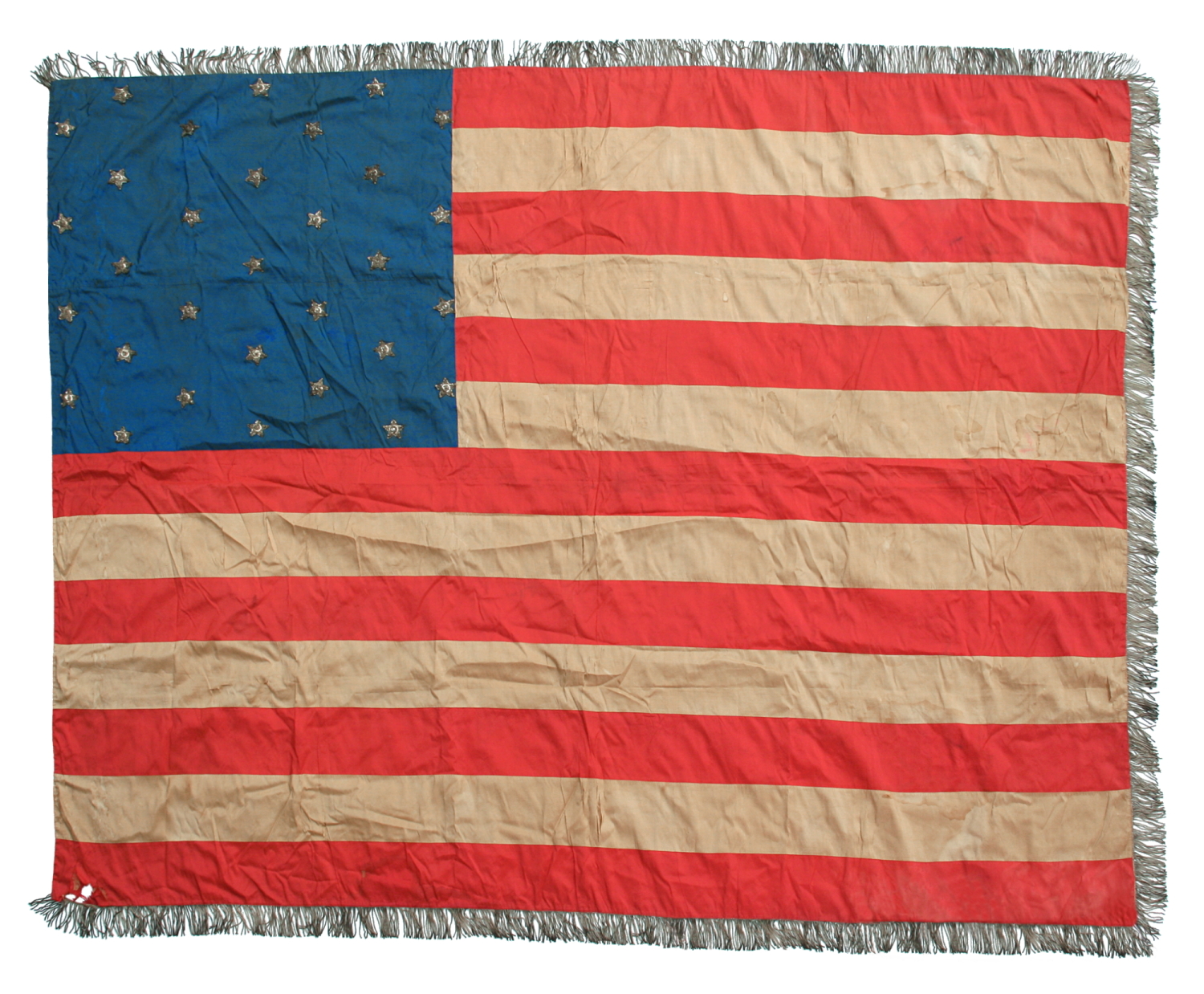
| 31 STARS ON AN ANTIQUE AMERICAN FLAG OF THE PRE-CIVIL WAR ERA, MADE OF SILK, WITH METALLIC BULLION STARS & FRINGE AND WITH ITS CANTON RESTING ON THE ‘WAR STRIPE,” REFLECTS THE ADDITION OF CALIFORNIA AS THE 16TH FREE STATE, circa 1850-1858, IN THE WAKE OF THE GOLD RUSH |
|
| Web ID: | 31j-813 |
| Available: | In Stock |
| Frame Size (H x L): | Approx. 97" x 111" in a 3.2" wide molding |
| Flag Size (H x L): | Approx. 85" x 99" |
| Description: | |
| 31 star American national flag, made in the era prior to the opening of the American Civil War (1861-65), when use of the Stars & Stripes as something other than to mark ships, or in some manner of military or government service, was extraordinarily limited. California, entered the Union as the 31st state on September 9th, 1850. Though a 31st star would not be officially added until July 4th, 1851, no one cared what was official. Flag-makers both commercial and private would have begun adding a star for the state as soon as it was in, if not even sometimes prior, in hopeful anticipation. The latter became more common as the nation grew, through the balance of the turn-of-the-century and into the 20th. Surviving flags with sewn construction are generally one-of-a-kind when of pre-1861 manufacture, and this is no exception. The flag displays several highly unusual traits among its scarce counterparts of the time. Made in the ‘squarish’ format of a ground-use, military battle flag, one of these is its impressive size. At a time when U.S. Army regulations specified 6 x 6.5 feet for the colors of infantry and artillery units, this example measures just over 7 x 8 feet (including the fringe). Another noteworthy attribute resides in the three dimensional stars. Made of silver, metallic bullion sequins and twisted wire, while these can occasionally be seen on flags, but are more commonly encountered to patriotic and political sashes of the mid-later 19th century. These are accompanied by a matching bullion fringe that, while uncommonly long, is fitting with the bold scale size of the flag itself. The canton and stripes are made of treadle-sewn silk. In this instance, the construction in comprised of two, complete, one-sided flags, sewn back-to-back. This manner of construction is sometimes seen on early silk flags of the highest quality. In this instance, an inner layer of fine cheesecloth was incorporated between the two halves. Use of a supportive structure of this sort likely contributed to the longevity of the textile, which has remained relatively intact over the past 175 or so years of its existence. Note how the canton rests on a red stripe, as opposed to white. When this occurs, some flag historians have referred to this as the “blood stripe” or the “war stripe”, suggesting that the flag was constructed in this fashion when the nation was at war. In actuality, because there was no official legislation governing the placement of the canton against the striped field until 1912, there was no specified position. In this case one may note that it rests on the 7th stripe. Regardless of the reason, purposeful or otherwise, the war stripe feature is highly coveted by collectors. The layered, bullion stars were hand-sewn to both sides, and the fringe was affixed by hand-stitching. The latter was originally applied to all four sides, which, though highly unordinary, can sometimes be encountered in 19th century examples. Though otherwise expertly constructed, this peculiar aspect, along with the oversized profile, leads me to believe that this was a homemade flag, sewn by local women, to present to whatever group was intended to carry or otherwise display it. Prior to the Civil War, local peacekeeping was moreover provided by volunteer militia. Such units, though often state-organized, were typically fraternal in nature, self-outfitted through their own fundraising and charitable donation. Because there was far less standardization at the time in all aspects of flags, uniforms, and other regalia, the atypical aspects of this flag’s design and construction are fully expected. Display by a militia company is certainly of high probability, though use by some other patriotic fraternal entity, such as the Junior Order of American Mechanics (JrOAM), or the Patriotic Order Sons of America (POSofA), is an alternative possibility worth mention. Whatever the case may be, square flags offered the best opportunity to display the most surface area, both in parades and on smoke-laden battlefields. Flags that were rectangular drooped without a strong breeze, were more easily entangled, and thus less maneuverable. The path that led California to statehood originated within the United States Congress and the push for western expansion. In the latter Antebellum this was led by Senator Thomas Hart Benton of Missouri, who sent his future son-in-law, U.S. Army engineer, explorer, and future presidential candidate, John Frémont, to map the Oregon Trail, first in 1842, and then again in 1843-44. On the latter expedition, Frémont became the first officer of the U.S. Army to enter the Mexican-owned Alta California Territory. Benton’s endeavors were subsequently fueled by expansionist President James Polk, who sent Frémont on a third expedition, in 1845-46, which coincided with the Mexican War (1846-48). Entering California uncontested on July 5th, 1846, Fremont claimed the territory independent, at which time it became the short-lived “Bear Republic.” Two days later, on July 7th, U.S. Navy Commodore John D. Sloat landed at Monterey to claimed the land for the United States, supported by Frémont, who rushed there from Sonoma to join him. Any thought that the new territory would not soon gain statehood, evaporated with the coincidental discovery of gold on January 24th, 1848, followed soon after by the arrival of Americans by the masses, in the 1849 Gold Rush. Fremont’s fourth expedition occurred during the same two-year period, this time funded by Benton and other outside investors, with the goal of assessing the feasibility to cross the severe San Juan Mountains, in present-day Colorado, with a transcontinental railroad connecting the Mississippi River, at St. Louis, to the Pacific. Balance between the North and South in Congress ended with California’s admission as the 16th Free State, in 1850, forever tipping the scales in Favor of the North. Measures hoped to mitigate the damage included the Compromise of 1850, the Fugitive Slave Act (also 1850), the Kansas-Nebraska Act (1854), and the Dred Scott Decision (1857), with accompanying negotiations and rhetoric, spewed more controversy and anger than had thus-far been present at almost any other point in American history. The most infamous physical brawl that took place on the floor of Congress occurred in 1858, over the proposed constitution for the Kansas Territory, that would have legalized slavery. Flags made prior to the Civil War are rare, comprising one to one-and-a-half percent of 19th century flags that have survived into the 21st century. Prior to the Confederate attack on Fort Sumter, the Stars & Stripes was simply not used for most of the same purposes that we employ it in today. Private individuals did not typically display the flag in their yards and on their porches, or wave flags as observers of parades, purely for the display of patriotism. There was some use of this nature during events of extremely historical importance, and, beginning in 1840, in political campaigning, but the occurrence, on the whole, was very unlike modern times. Private use of the national flag rose swiftly in the North, during the patriotism of the Civil War, then exploded in 1876. Even the military did not use the flag in a manner that most people might think. The primary purpose before the Civil War was to mark ships on the open seas. While flags were used to mark garrisons, those of ground troops were often limited to the flag of their own regiment, with a design peculiar unto itself, and perhaps a standard that featured the numeric designation on a painted or embroidered streamer, on a solid buff yellow or blue ground. Most people are surprised to learn that ground forces were not authorized to carry the Stars & Stripes until it was assigned to artillery regiments in 1834. Infantry was afforded the privilege in 1841, just prior to the Mexican War (1846-1848), while cavalry regiments were not issued their iconic, swallowtail, Stars & Stripes format guidons until the second year of the Civil War, in 1862. All-in-all, an exceptional, early flag, utilizing the most costly materials of the time, with a stunning appearance and with all manner of unusual attributes. Mounting: The flag has not yet been mounted. Condition: There are some splits and losses, as noted above, but less than is typically seen in a silk flag of this size and early date, and it is surprisingly intact considering the weight of the metal stars and fringe. Approximately 1.5 feet of the fringe was absent in the lower fly end corner. Strands of the original were carefully removed and re-applied in this region, in order that new materials would be added to the flag. I elected to remove the fringe along the hoist, which was, in my opinion, a mistake, on behalf of the maker, who did not realize that flags were to be fringed along the top, bottom, and fly only. The notion is carefully stored on the reverse of the mount. I would be pleased to reattach this at no cost, if desired. |
|
| Video: | |
| Collector Level: | Flags for the truest Patriots. My best offerings |
| Flag Type: | Sewn flag |
| Star Count: | 31 |
| Earliest Date of Origin: | 1850 |
| Latest Date of Origin: | 1858 |
| State/Affiliation: | California |
| War Association: | 1777-1860 Pre-Civil War |
| Price: | Please call (717) 676-0545 or (717) 502-1281 |
| E-mail: | info@jeffbridgman.com |
 |
|