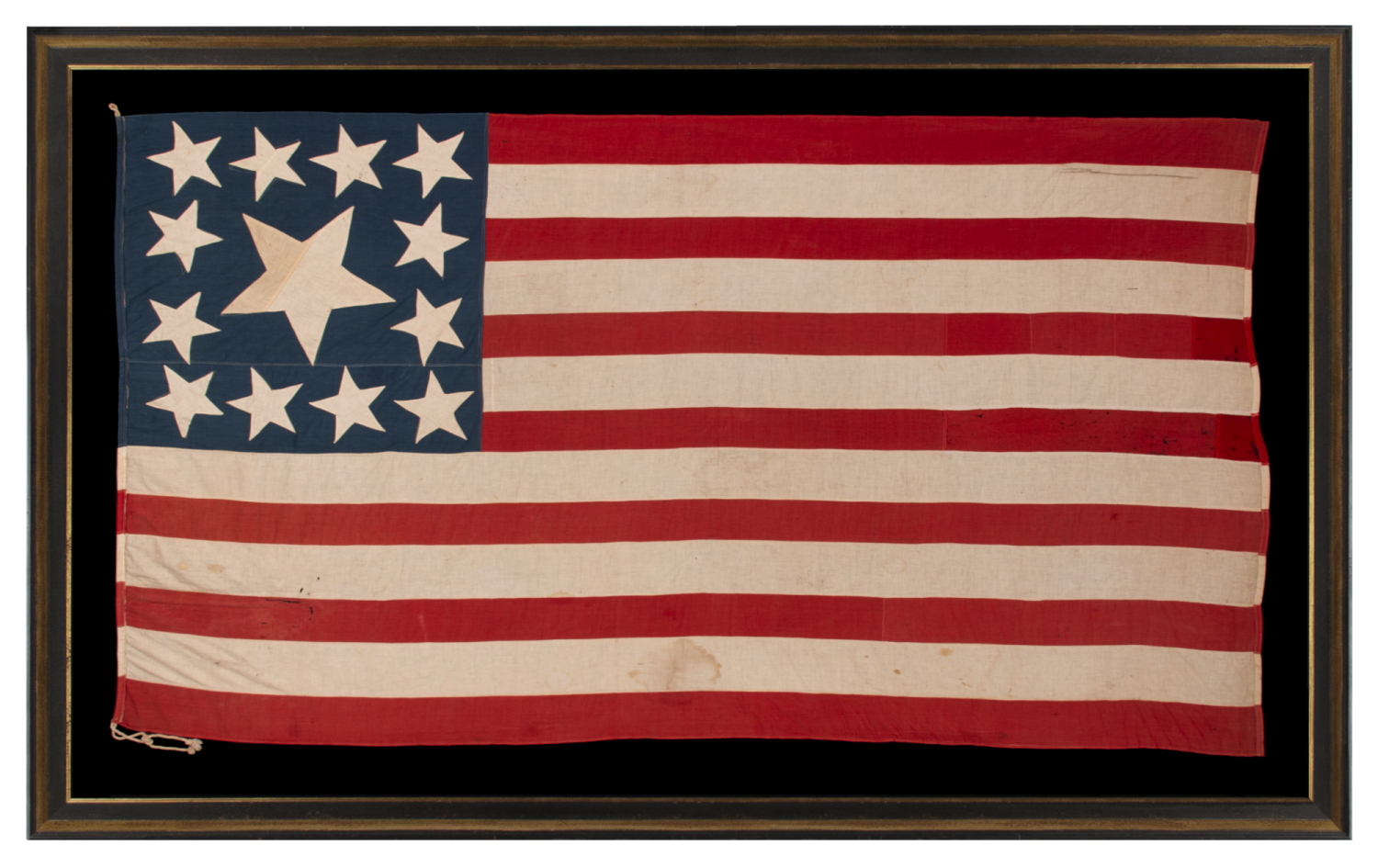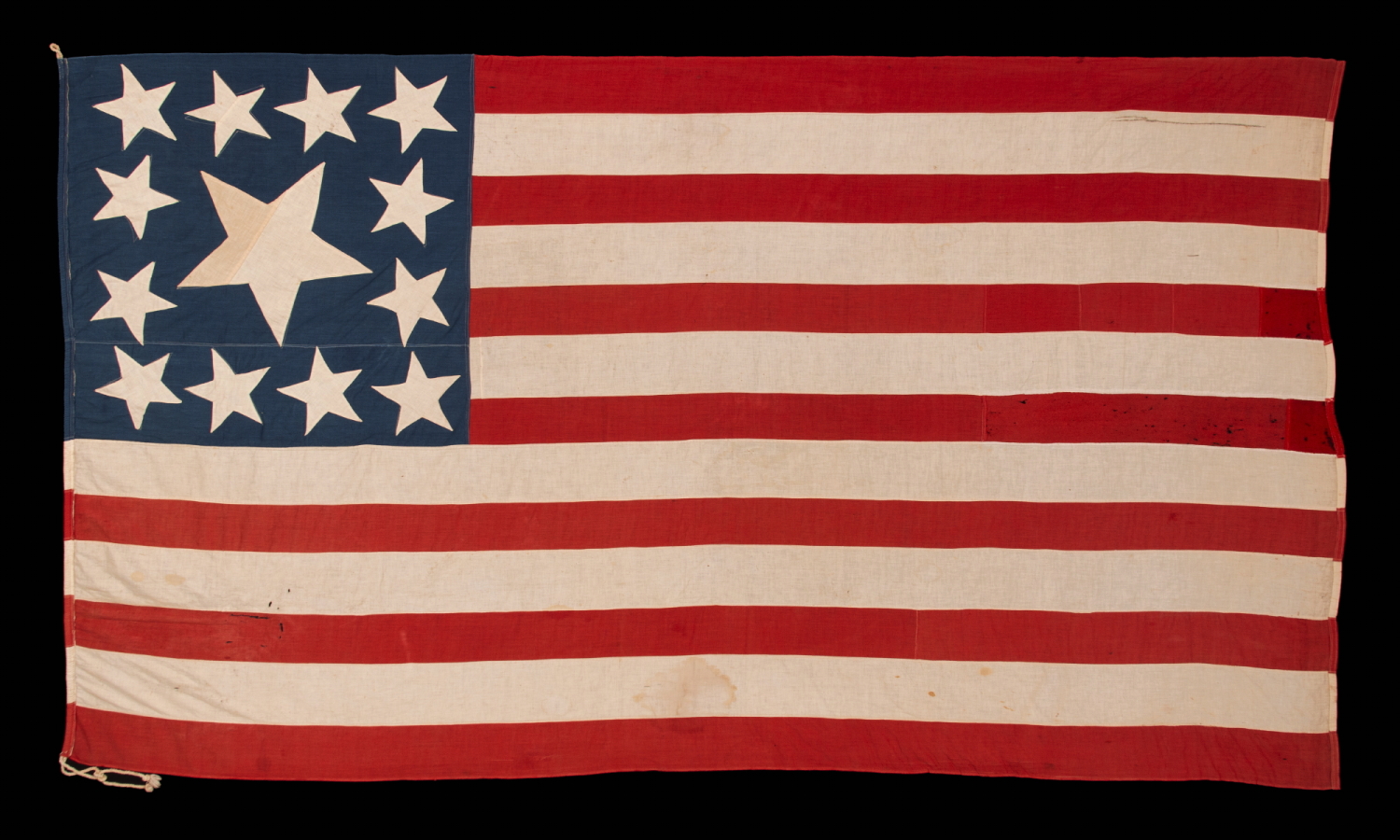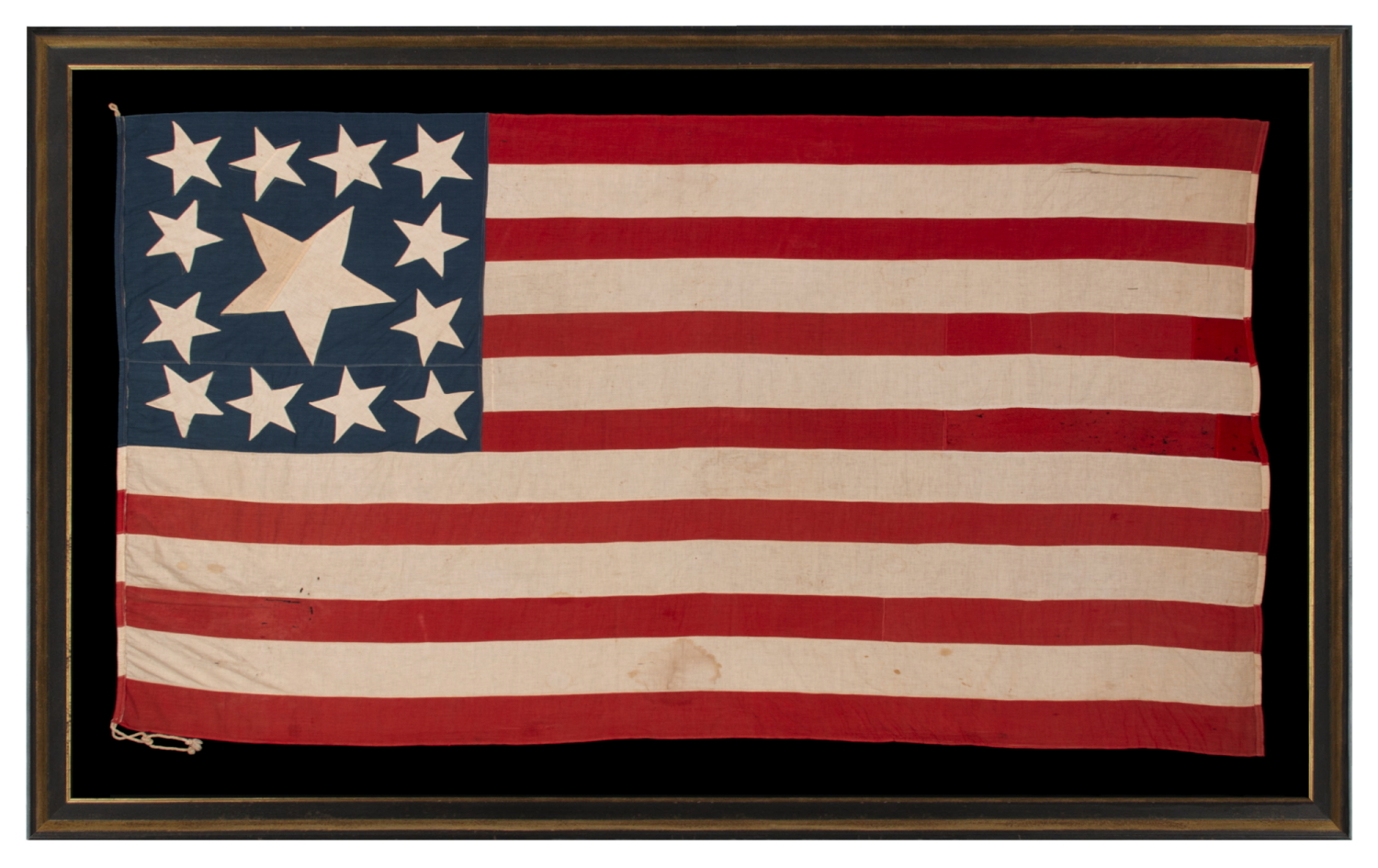
| 13 STARS IN THE RARE AND VERY DESIRABLE TRUMBULL PATTERN, WITH AN UNUSUALLY ENORMOUS CENTER STAR, ON A HOMEMADE, ANTIQUE AMERICAN FLAG PRODUCED SOMETIME BETWEEN THE CIVIL WAR (1861-1865) & THE 1876 CENTENNIAL OF AMERICAN INDEPENDENCE; THE CONFIGURATION IS NAMED FOR ARTIST JOHN TRUMBULL, WHO BRIEFLY SERVED AS GEORGE WASHINGTON’S AIDE-DE-CAMP (1776), THEN TRAINED UNDER WORLD-RENOWNED PAINTER BENJAMIN WEST IN BRITAIN, WAS IMPRISONED AS A SPY, RELEASED & RETURNED, WHERE HE AGAIN SERVED IN THE CONT |
|
| Web ID: | 13j-931 |
| Available: | In Stock |
| Frame Size (H x L): | 71” x 115” |
| Flag Size (H x L): | 58” x 101” |
| Description: | |
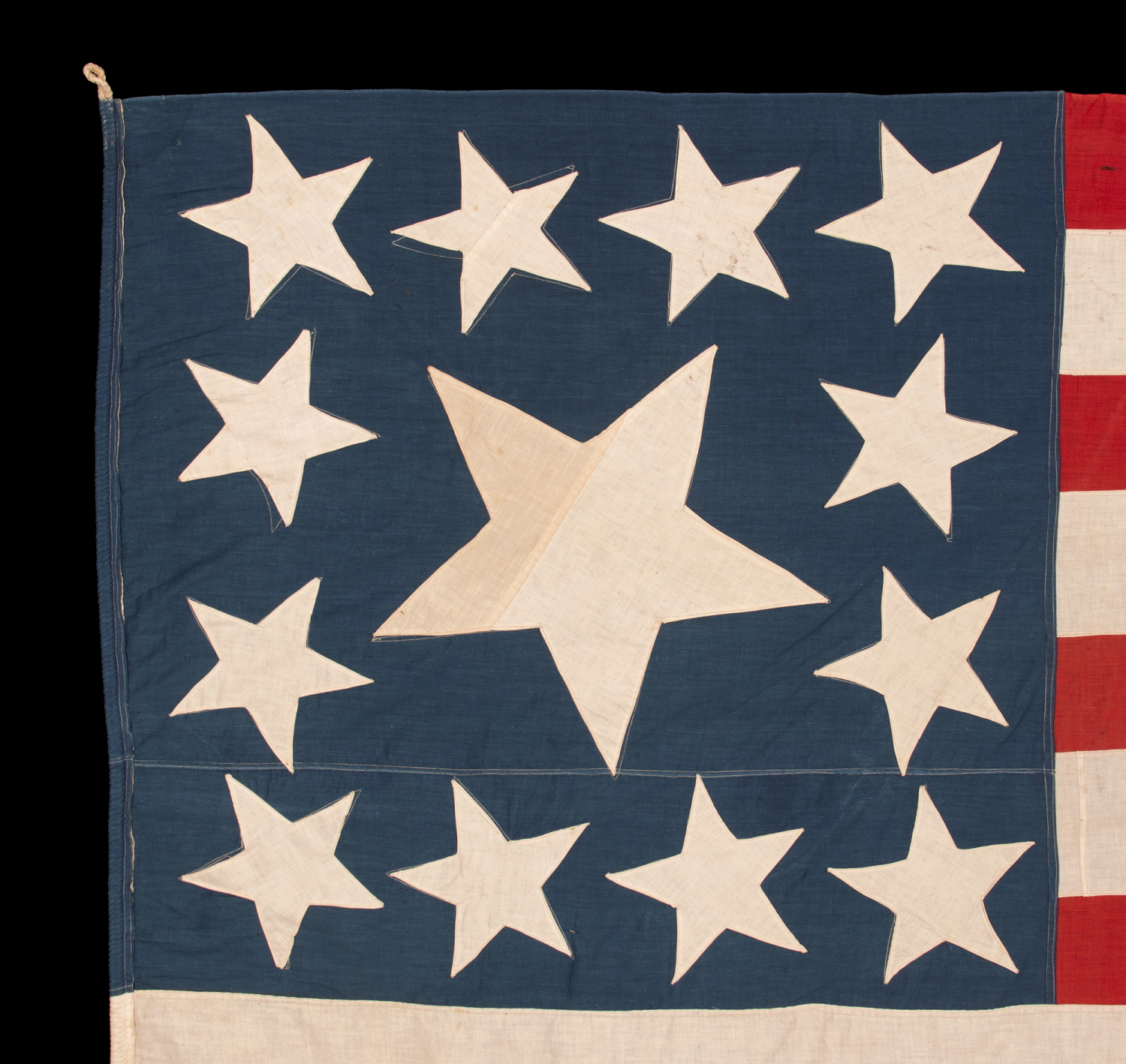
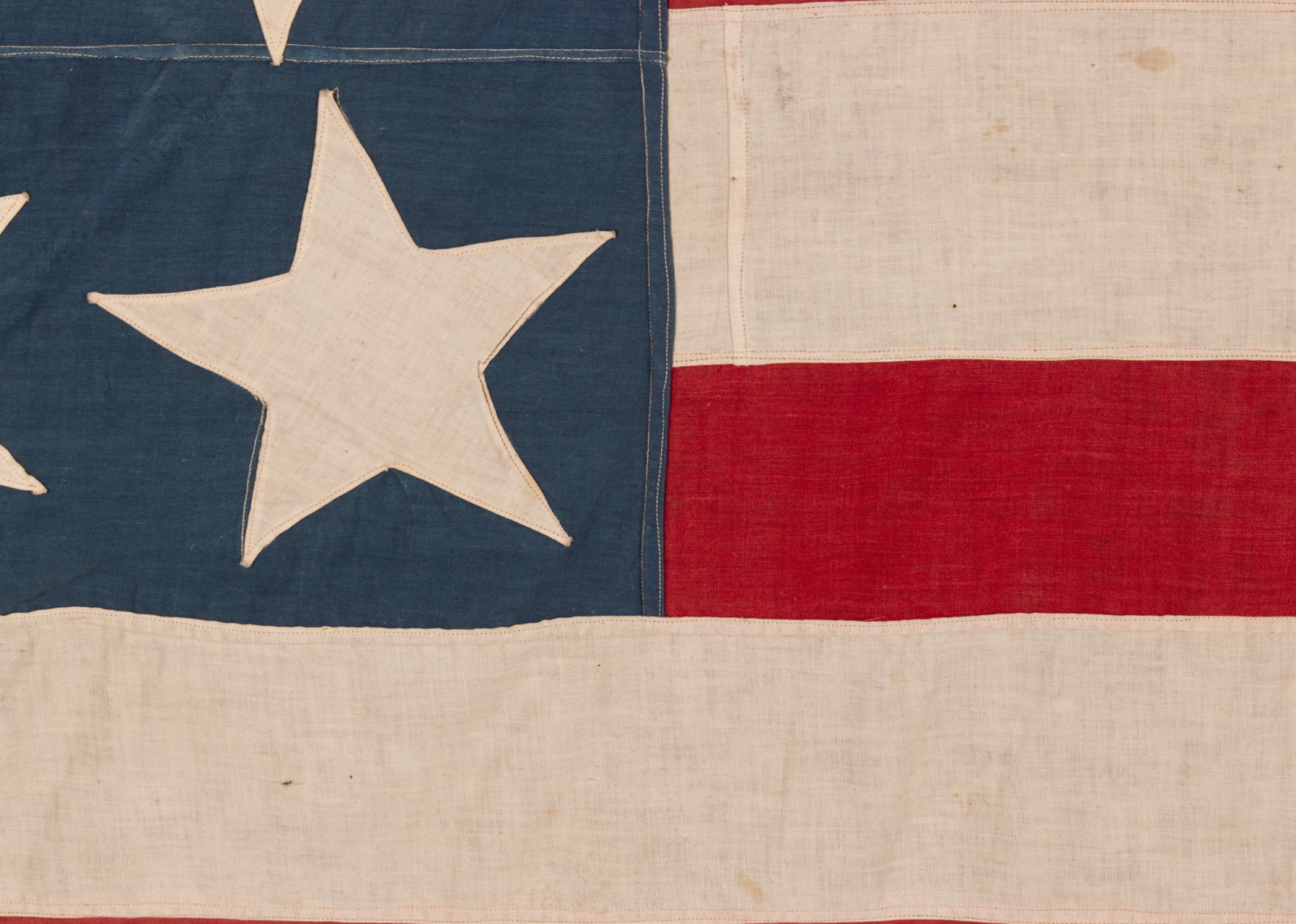
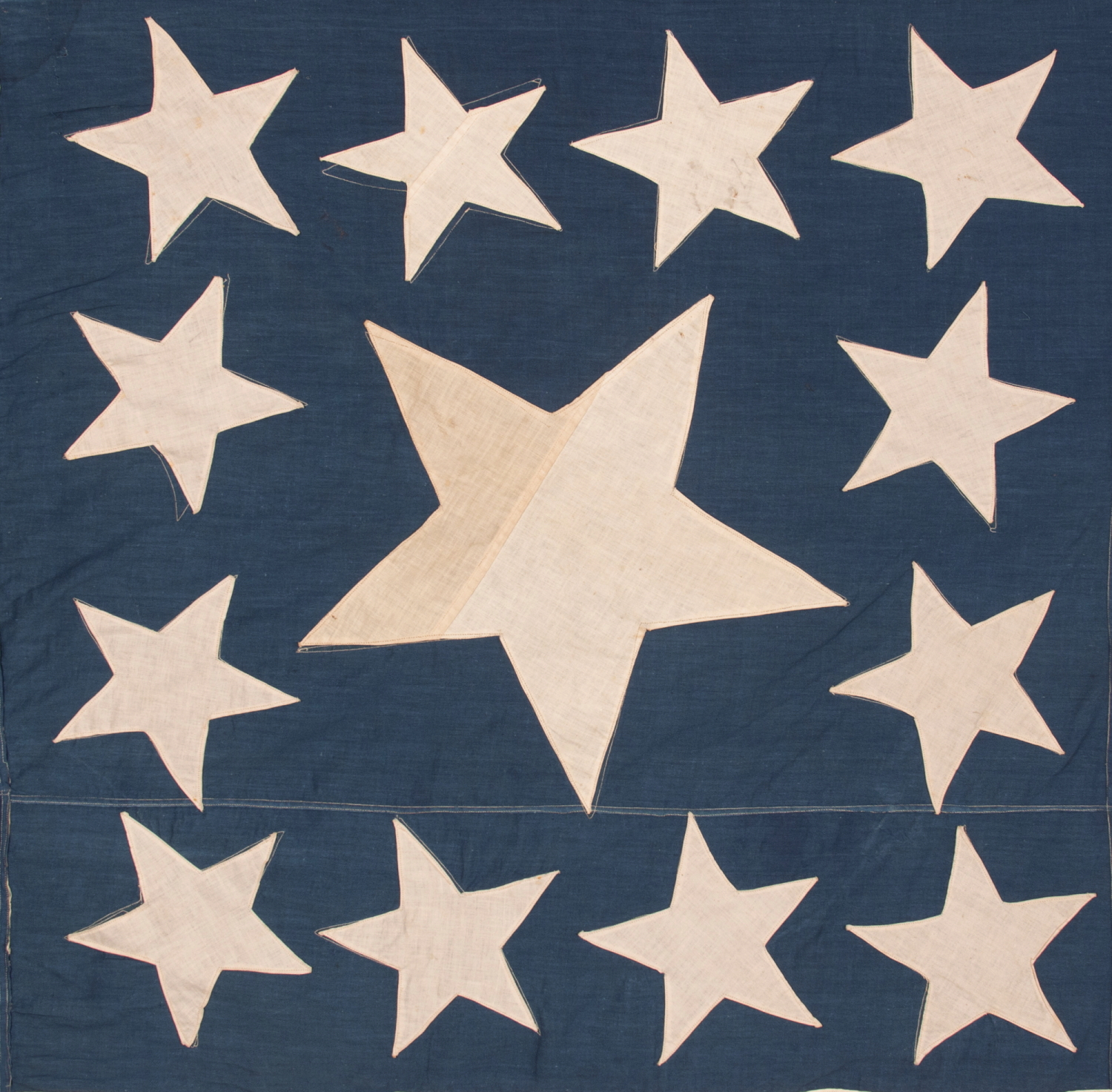
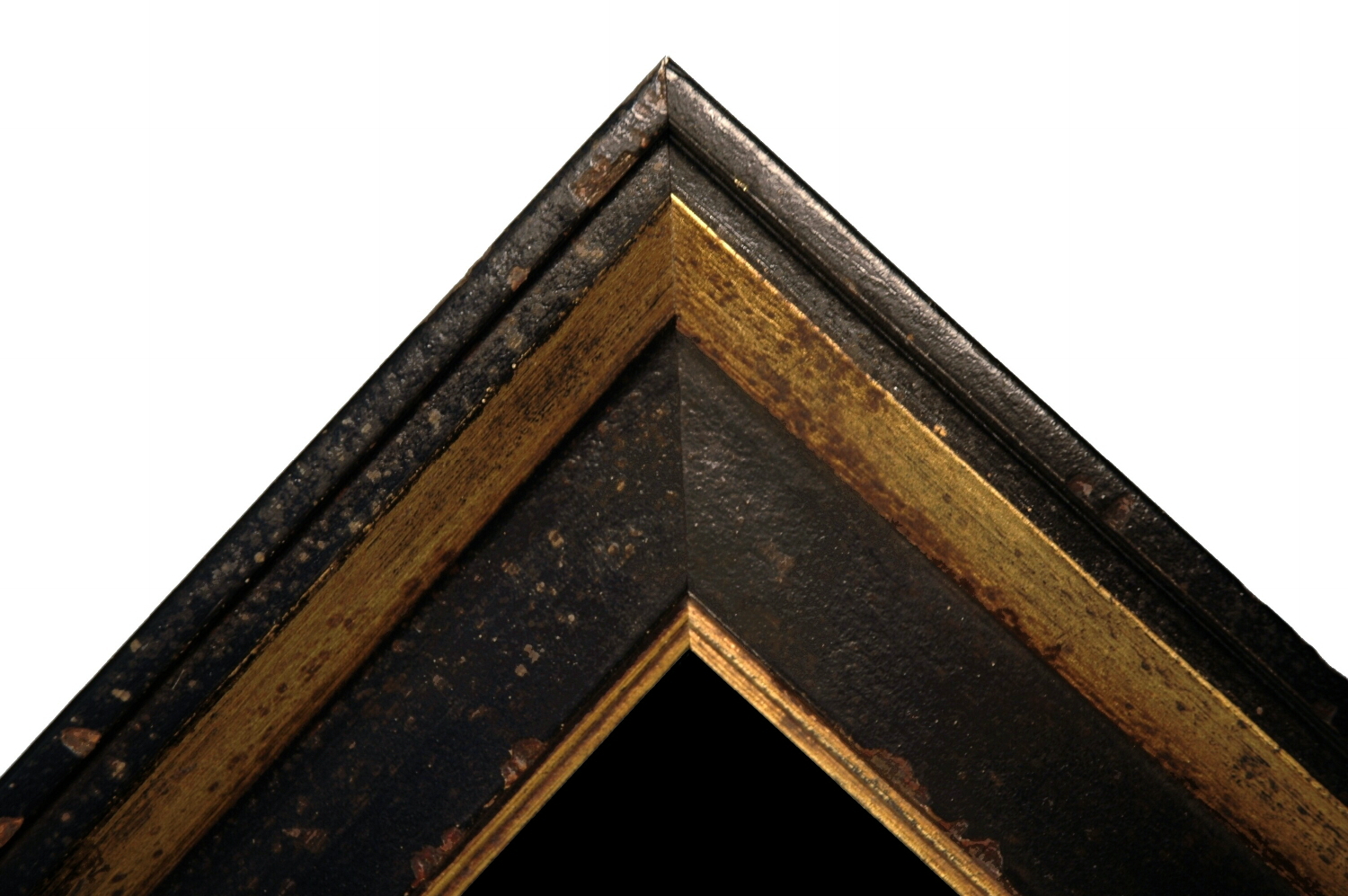
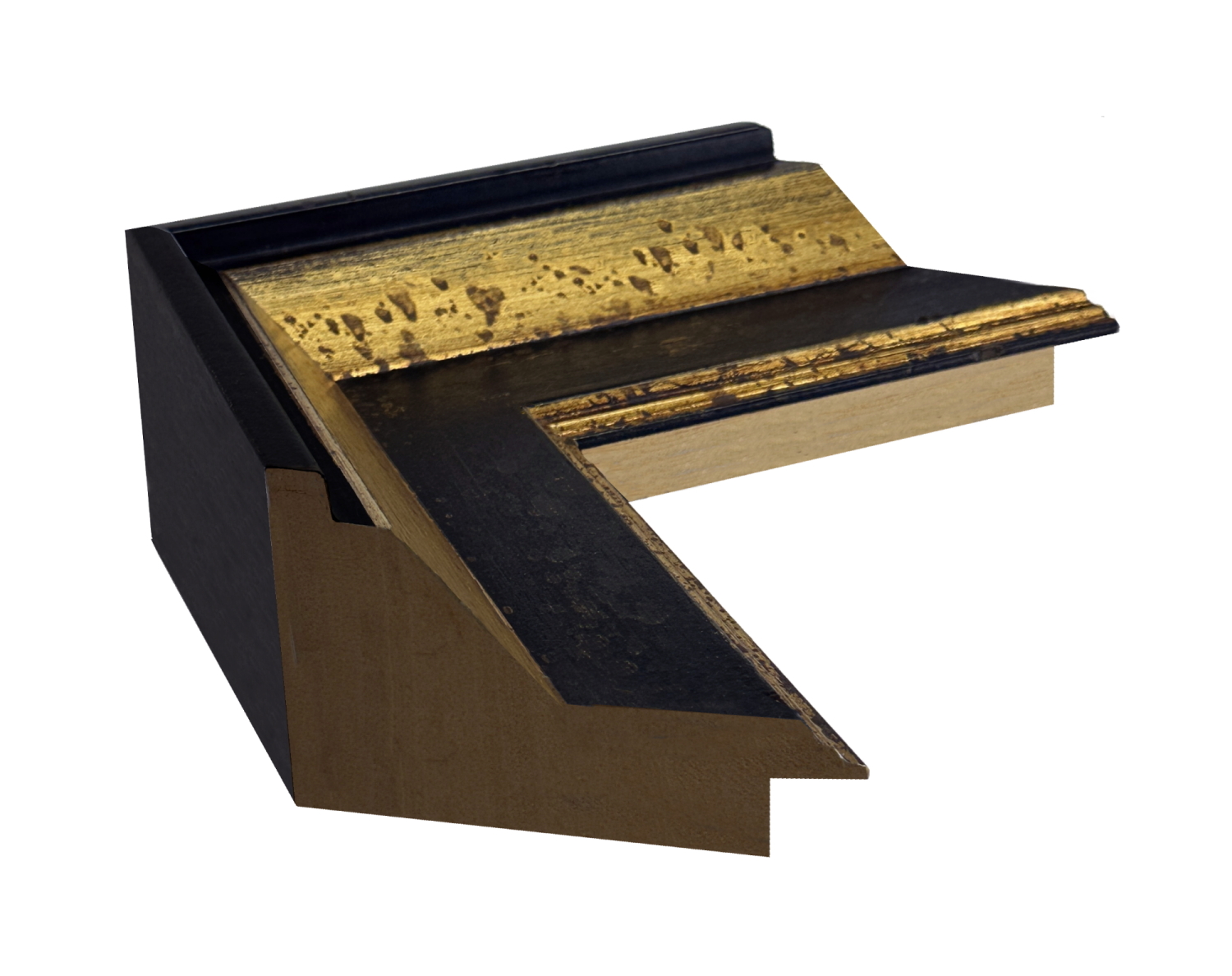
| Rare, homemade, American national flag, with what is known as the Trumbull configuration of 13 stars. This beautiful and very rare star arrangement is comprised of a single center star, contained within a square or rectangular perimeter of 12 stars. The design pays homage to the revolutionary war officer, John Trumbull (1746-1853), Harvard graduate and son of the Governor of Connecticut, who joined the Colonial Army in 1775, where, among other appointments, he served as George Washington's aide-de-camp, as well as within the staff of General Horatio Gates. Resigning in 1777, following a disagreement over the date of his military commission, Trumbull traveled to England to study art. There he was introduced by Benjamin Franklin to American painter Benjamin West, the most celebrated artist in the world at the time, who was at that time living abroad. While training under West, Trumbull was imprisoned for treason against the crown. This occurred when a scapegoat was sought, after a British officer, of similar military rank to Trumbull’s former appointment, was captured and hung in America. Six months later he was released to the States, where he once again participated in the fight for independence by aiding his brother in supplying the Colonial Army during the winters of 1782 and 1783. After the war, Trumbull returned to England, where he was encouraged by West to paint significant American historical figures and American military scenes. He commenced doing so in 1785 and was especially prolific, producing more than 250 works within this genre. Trumbull included American flags with his former commander in several versions of his most notable views. In three of these he depicted a configuration of 13 stars that consisted of a single center star, set within a rectangular box of 12. These include: The Death of General Mercer at the Battle of Princeton In the collection of the Yale University Art Gallery, painted sometime between 1789 and 1831. Depicts the events of January 3rd, 1777. The Surrender of General Burgoyne at Saratoga, New York Installed in the United States Capitol Rotunda in 1821, painted in 1821. Depicts the events of October 17th, 1777. The Surrender of Lord Cornwallis at Yorktown, Virginia Installed in the United States Capitol Rotunda in 1820, painted between 1820 and 1821 (one of at least 4 versions illustrating 4 different flags). Depicts the events of October 19th, 1781. In his landmark book, Standards & Colors of the American Revolution, noted flag historian Edward Richardson describes Trumbull as "meticulous to the accuracy of uniforms and accoutrements; therefore, the flags depicted in [his] paintings should be considered as accurate versions of the time.” One extremely good argument against this assertation, is that the Battle of Princeton occurred more than 6 months before the First Flag Act was passed by Continental Congress, on June 14th, 1777. At that time, given present knowledge, the Stars & Stripes didn't exist. Though Washington may have displayed the Stars & Stripes, ground forces weren't formally authorized to carry it until well into the 19th century. The practice was not officially authorized until 1834 (artillery), 1841 (infantry), and 1862 (cavalry). Due to the above facts, and other supporting documentation—or lack thereof—some vexillologists have surmised that the American national flag was included by Trumbull, simply because the American public somehow expected it to be there, in a way not so very different from the modern perception today. One of several explanations for this phenomenon is that, with such inconsistency across both the flags of colonial regiments, and their uniforms, it was important to include some sort of common device that the viewer could identify as American. Whatever the case may be, the box medallion pattern in three of Trumbull's works led to a permanent association between this exceedingly scarce design with the Trumbull name. Whatever the case may be, his inclusion of the Stars & Stripes on the battlefield, be it fact or fiction, illustrates the appropriateness of its presence in the American consciousness from very early on. It could also be argued that Trumbull’s inclusion of the flag, prior to June 14th, 1777, may suggest that there is reason to speculate as to whether the 13-star, 13-stripe American flag was actually being displayed prior to that time. If so, it might explain why the language used in the legislation to make it official was so brief. Perhaps it was already familiar to those involved. Note the absolutely enormous size of the center star in this particular example, canted at a rakish angle and with most of the far smaller stars, about it, following suit. In addition to the great disparity between the scale of the center star, greater, proportionally, than just about any I have ever encountered, note also how the profile of the canton is relatively near-to-square square, unlike modern flags. All of the above features lend exceptional folk quality to the flag’s design. The flag was originally constructed entirely of plain weave cotton, though repairs, probably made in the era of its use, were completed with scraps of twill woven blanket wool. Though cotton was a poor fabric for flags made for long-term outdoor use, as it absorbed water, became heavy, and was thus subject to tearing and rot, it was nonetheless the fabric of choice for homemade flags. Unlike wool bunting, an open weave fabric used exclusively for the commercial manufacture of flags and banners, and silk, expensive and delicate, cotton was, in general, both reasonably priced and widely available. The stars of the flag are double-appliqued (applied to both sides) with a lineal, treadle stitch. The striped field was pieced and joined by treadle stitching, then hemmed to the canton by the same method. The body of the flag was rolled over along the hoist, to create an open sleeve, which contains a length of braided rope, looped at the top and knotted at the bottom, stitched firmly into place. The construction, star pattern, and fabrics employed, including those in its repairs, together suggest that it was made sometime between the Civil War (1861-1865) and the 1876 centennial of American independence. The culmination of rare and beautiful features lends to an example with extremely strong visual impact; and a terrific addition to any collection. Some Notes about 13 Star Flags 13 star flags have been continuously produced throughout our nation’s history for purposes both patriotic and utilitarian. Because this was the original number of stars on the American flag, representing the original 13 colonies, it was appropriate for any flag made in conjunction with celebrations of American independence. 13 star flags were hoisted at patriotic events, including Lafayette’s visit in 1824-25, the celebration of the nation’s centennial in 1876, and the sesquicentennial in 1926. They were displayed during the Civil War, to reference past struggles for American liberty, and were used by 19th century politicians while campaigning for the same reason. 13 star flags were flown by American ships both private and federal. The U.S. Navy used 13 stars on the ensigns made for small boats, because they wished the stars to be easily discerned at a distance. As the number of stars grew with the addition of new states, it became more and more difficult to fit stars on a small flag so that they may be viewed from afar as individual objects. Because any star count that has previously been official remains so today according to the Congressional flag acts, all 13 star flags in an otherwise appropriate design remain official flags of the United States. Mounting: For 25 years we have maintained a specialized department for this purpose. Our lead conservator holds a master's degree in textile conservation from one of the nation’s top university programs. We take great care in the mounting and preservation of flags and related textiles and have preserved thousands of examples. The background fabric is 100% cotton twill, black in color, that has been washed and treated for colorfastness. The substantial, black-painted and gilded molding, with its wide, shaped profile, is Italian. The glazing is U.V. protective acrylic (Plexiglas). Feel free to contact us for more details. Condition: There is a moderate to significant lateral tear in the first white stripe, near the fly end, accompanied by a small area with minor to modest tears would then the 10th and 11th stripes, near the hoist, and a few very minor holes and or tears in limited instances elsewhere.. There is a minor to modest water stain and the last white stripe coming near the center, and minor instances of soiling or the same, in addition to general oxidation of a minor nature throughout the white cotton fabric. The center star is constructed of two lengths of fabric, one of which was from a different lot, bleached to a different degree in the process of its manufacture. Some of the piecework in the striped field is original to the flag’s construction, as conscious use of available fabric. Those at the end of the 3rd and 4th red stripes were undertaken as a means of repair. Included are three lengths of twill-woven blanket wool, salvaged from some other textile. Modest to moderate losses here are a product of mothing. Many of my clients prefer early flags to show their age and history of use. Overall condition is excellent for the period, among its counterparts of this scale, especially in consideration the rarity of 13 star flags in the Trumbull pattern. |
|
| Video: | |
| Collector Level: | Flags for the truest Patriots. My best offerings |
| Flag Type: | Sewn flag |
| Star Count: | 13 |
| Earliest Date of Origin: | 1861 |
| Latest Date of Origin: | 1876 |
| State/Affiliation: | 13 Original Colonies |
| War Association: | |
| Price: | Please call (717) 676-0545 or (717) 502-1281 |
| E-mail: | info@jeffbridgman.com |
 |
|