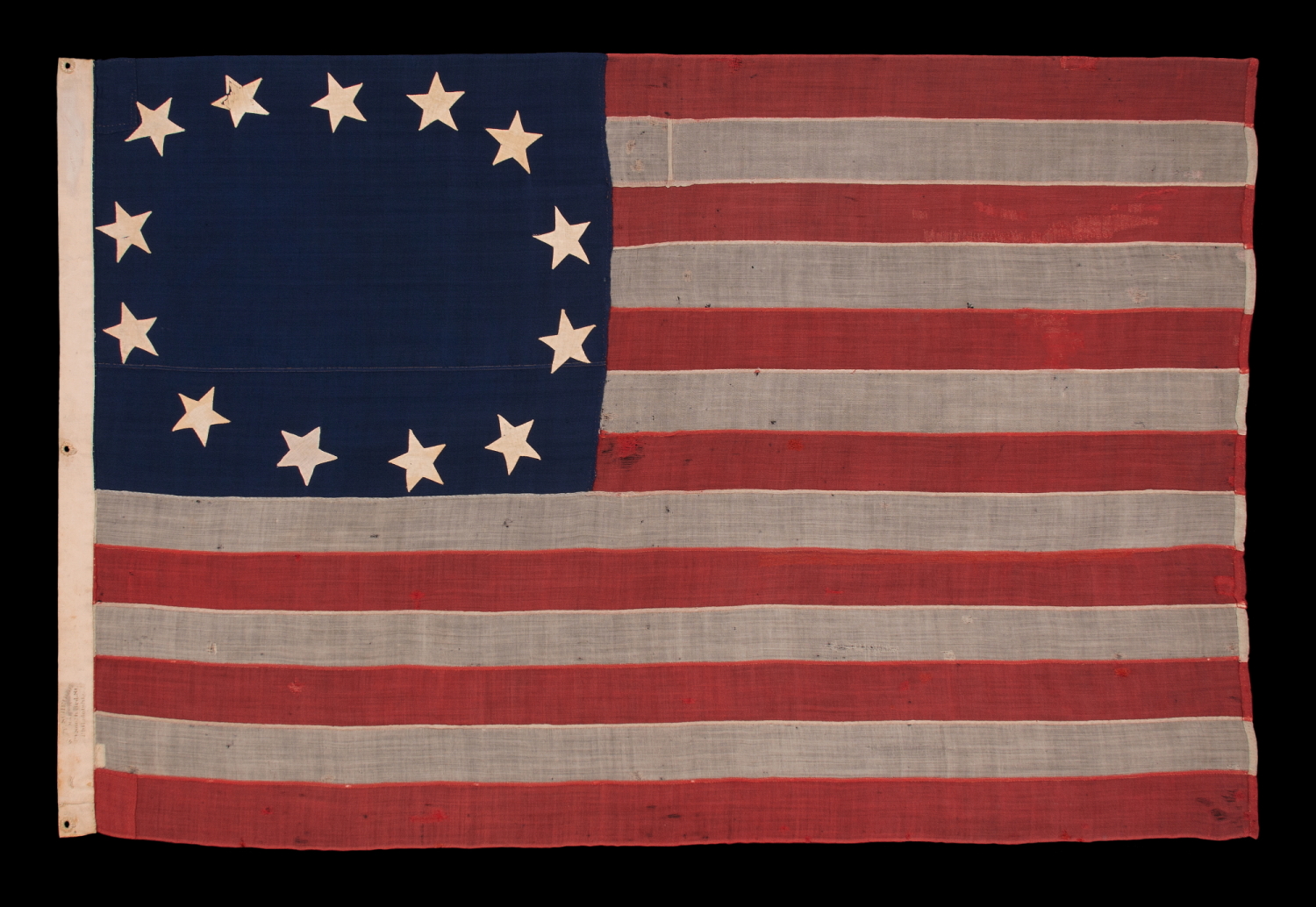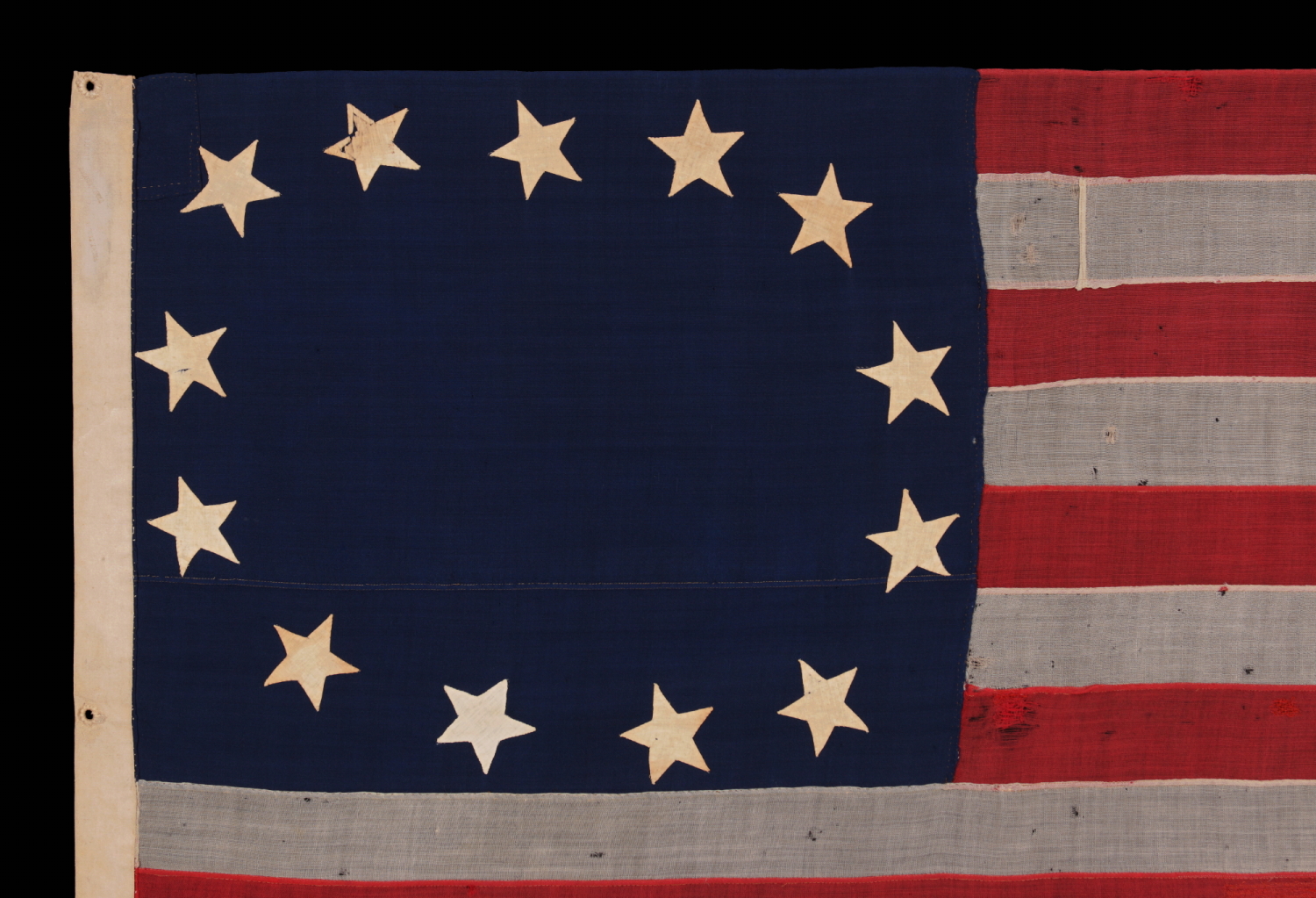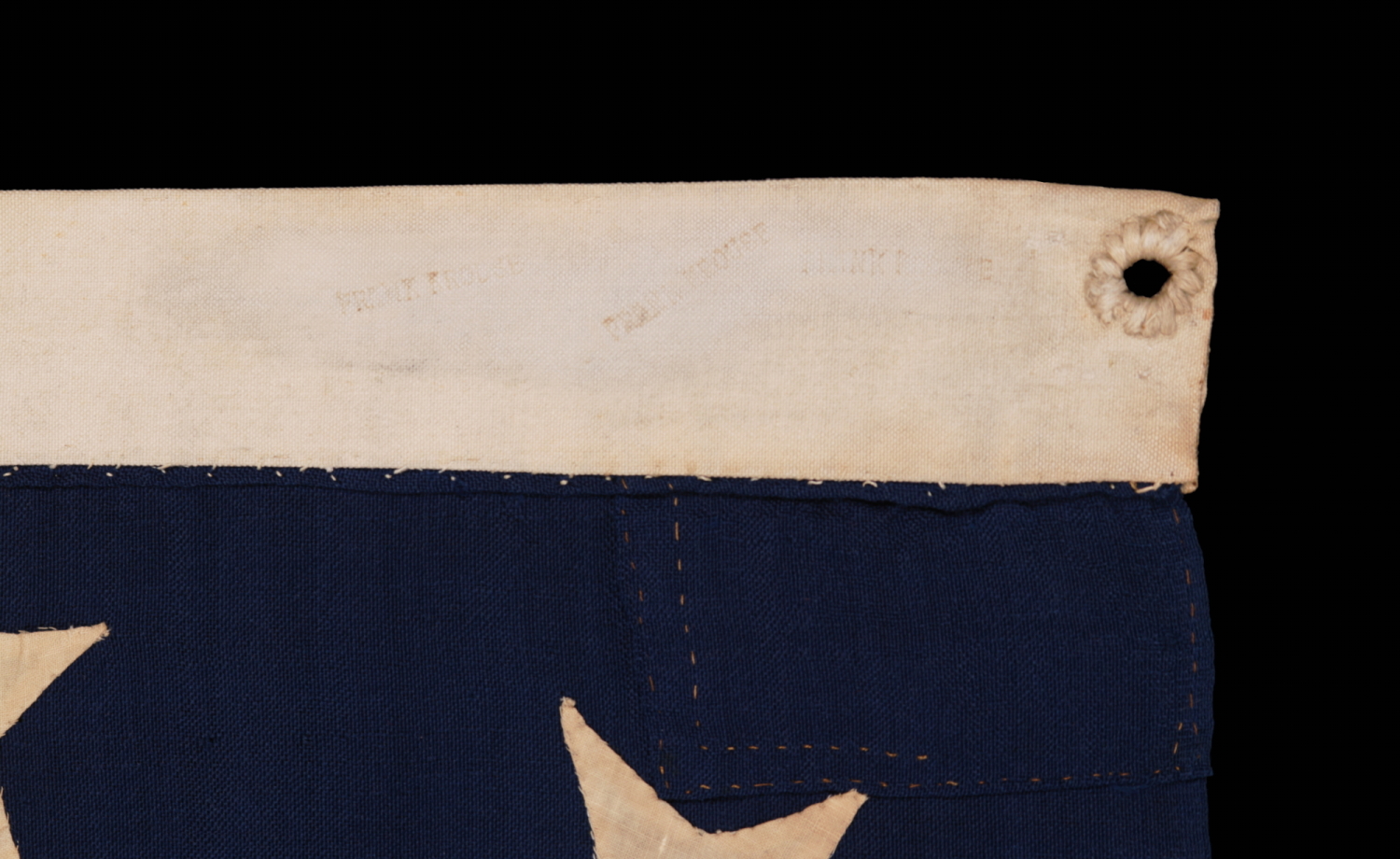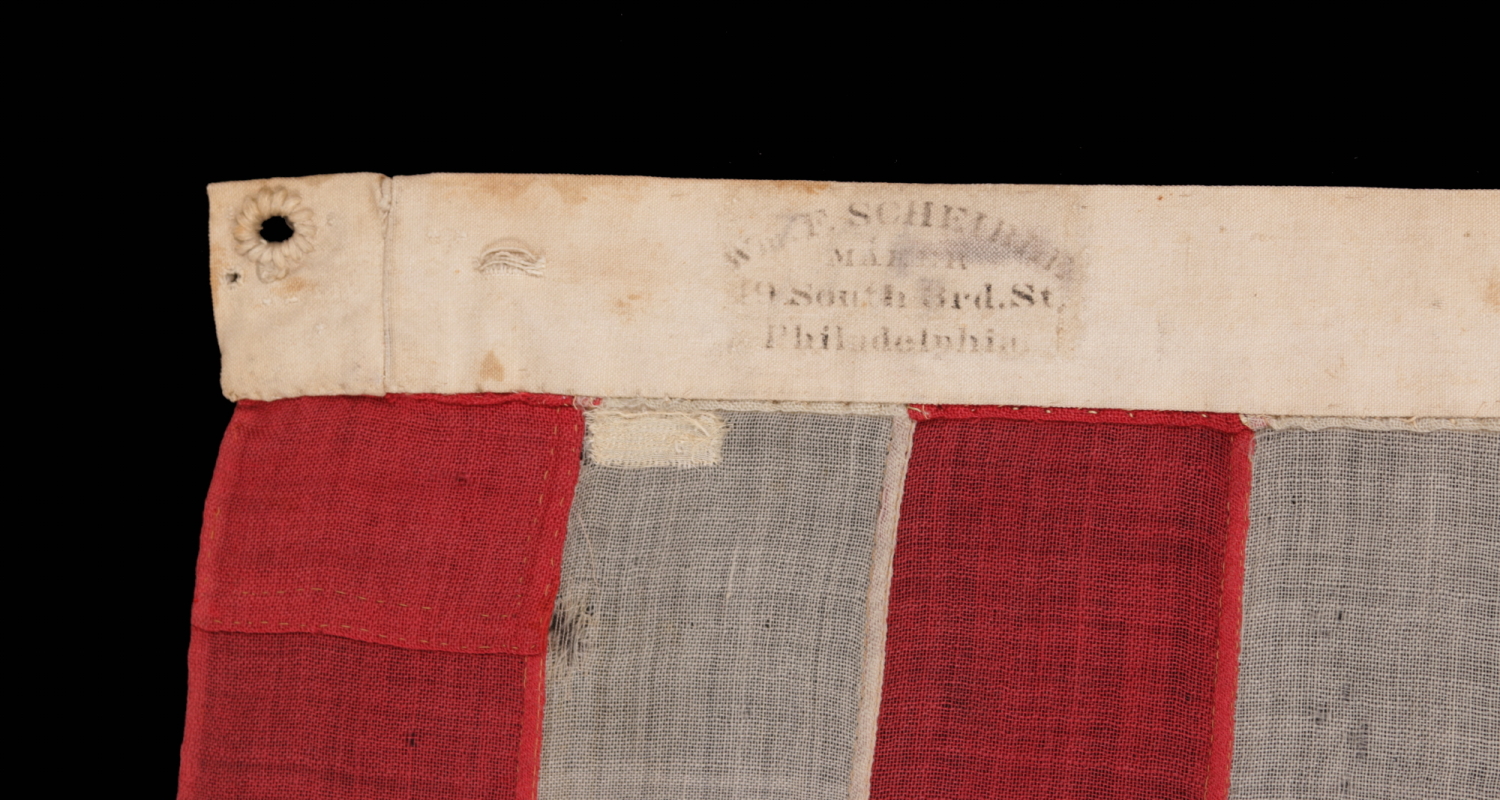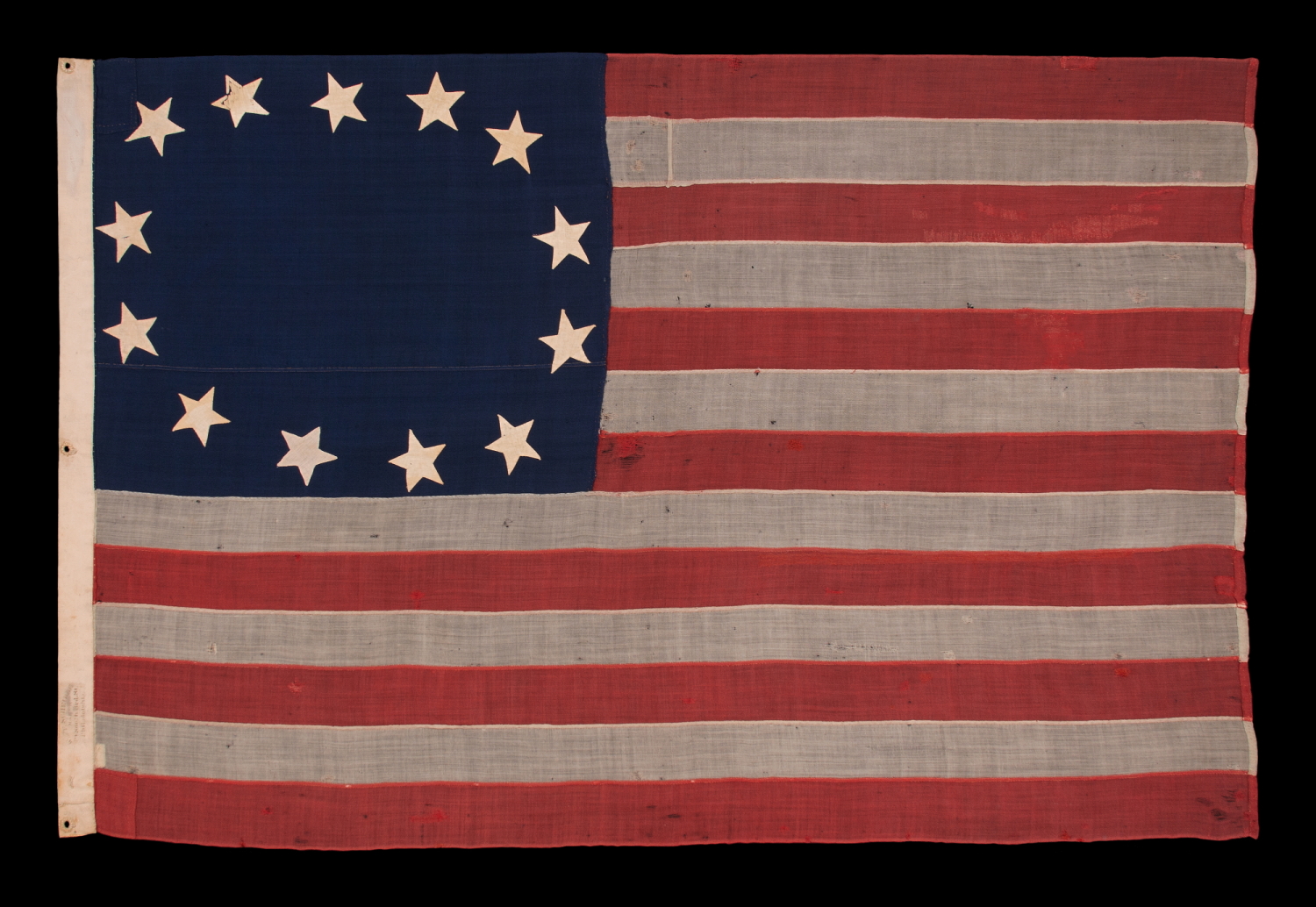
| 13 STARS IN A CRUDE SINGLE WREATH, REMINISCENT OF THE BETSY ROSS PATTERN, THOUGH RENDERED AS MORE OF AN OVAL; ON AN ANTIQUE AMERICAN FLAG MADE & SIGNED BY THE SHOP OF WILLIAM SCHEIBLE, 49 S. 3RD STREET, PHILADELPHIA, APPROX. TWO BLOCKS FROM INDEPENDENCE HALL AND THE SAME FROM THE BETSY ROSS HOUSE; A CIVIL WAR ERA FLAG, WITH AN EXTREMELY RARE & DESIRABLE CONFIGURATION OF STARS FOR THIS PERIOD, CIRCA 1861-65 |
|
| Web ID: | 13j-1738 |
| Available: | In Stock |
| Frame Size (H x L): | Approx. 58.5" x 83.5" |
| Flag Size (H x L): | 47" x 71.75" |
| Description: | |
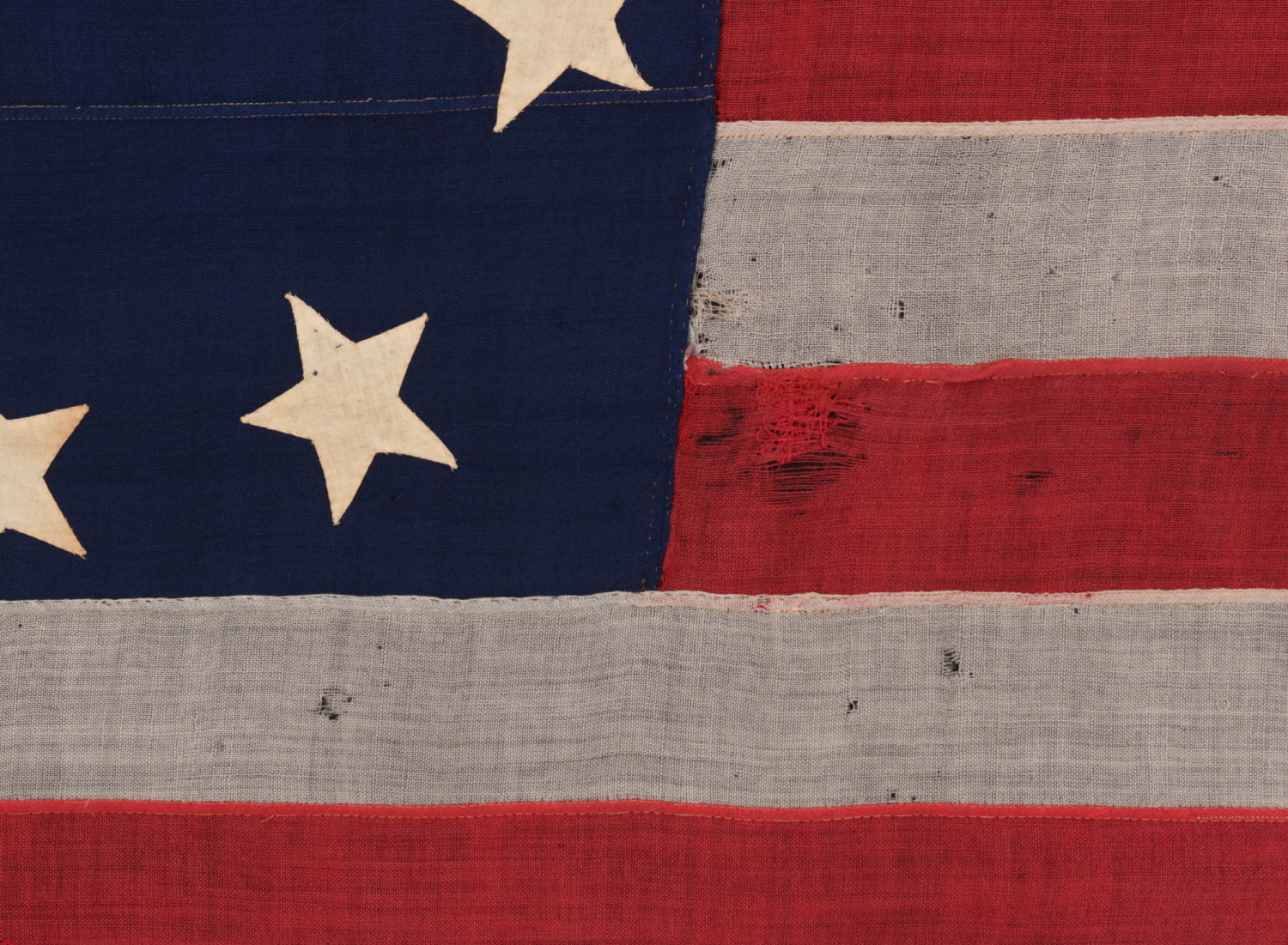
| American national flag of the Civil War era, with 13 stars arranged in a single wreath. Made in the Civil War era by an identified flag maker, note how the constellation falls somewhere between the perfect circle pattern, often attributed to Betsy Ross, and the broad oval of stars, sometimes associated with French-American military engineer & architect Major Pierre L'Enfant, designer of the City of Washington, D.C.. Lopsided and whimsical, stretched almost to the confines of the rectangular perimeter of the blue canton, single wreath designs are incredibly rare in early examples of the Stars & Stripes, in any star count. Among those with 13 stars, specifically, just a handful are known, all but one of which I have had the great privilege to own. In a circular format, I know of just three, excluding this example, that pre-date the last decade of the 19th century. Among ovals, there is presently but one known flag. Formerly in the collection of Boleslaw and Marie D’Otrange Mastai, in their 1973 book, “The Stars & The Stripes” (Knopf, New York), they tie this unique variant to a sketch rendered by L’Enfant, in 1783—the closing year of the Revolutionary War—when asked to create a diploma for members of an elite organization of commissioned wartime officers and their descendants, known as the Society of the Cincinnati. Curiously, the pattern survives on the draft only, not on the actual engraving for the document. The flag that is the subject of this narrative exhibits the stenciled mark of William F. Scheible, who opened a shop that spanned 47-49 South 3rd St., Philadelphia, producing stencils, awnings, lithographs, and, eventually, flags. Establishing in the mid-late 1850’s, by the time of the 1860 presidential election, he is known to have been producing campaign flags, which he advertised, and by 1861, held military contracts through multiple federal supply depots, namely Schuylkill Arsenal (later known as Philadelphia Quartermaster Depot), and the New York depot in Manhattan. In terms of his having produced a 13 star flag with a single wreath star pattern, it is of particular interest to note that Scheible operated about halfway between the Betsy Ross House and Independence Hall, situated just 2 blocks from each. In spite of Scheible having produced thousands of flags within the 1850-1870 era, and in spite of my role as a researcher today, as well as the most aggressive buyer of all manner of Civil War flags and campaign flags, both, for many years, I have yet to encounter a single example with a Scheible signature, outside institutional collections. Though certain styles of both national and regimental colors are identifiable to Scheible’s shop, it is of interest to note that no campaign flags have thus far been identified, nor any that fall outside the general category of regulation military colors. Further, among the few publicly held flags with Scheible marks, none share the bold, arched format of the design present here, that reads: “WM. F. SCHEIBLE; MAKER; 49 South 3rd. St.; Philadelphia.” Why 13 stars? 13 star flags have been produced almost continuously throughout American history, from the beginning to the present, for reasons both practical and celebratory. In a commemorative capacity, they were hoisted at patriotic events, including Lafayette’s final visit to America and Grand Tour (1824-1825), the centennial of American independence (1876), and annual celebrations of July 4th. 13 star flags were displayed during the Civil War, to reference past struggles for American liberty, and were displayed by 19th century politicians, while campaigning, for the same reason. The U.S. Navy used the 13 star count on small boats, in addition to various other low counts, because it was easier to discern a smaller number of stars at a distance, on a small flag, and since commercial ships often mirrored Navy practice, especially with regard to use of signals, some private ships flew 13 star flags, as well, during the same period as the Navy—a practice that endured until an Executive Order of President Woodrow Wilson 1916, just prior to America’s involvement WWI (1917-18). Because there was no official star configuration for the American flag until 1912, shortly following the addition of the 47th and 48th states, the arrangement was left to the whims of the maker. The makers of flags both commercial and at home took great advantage of such leniency. Across both illustrations of the 18th and 19th centuries, as well as actual, surviving flags, I have documented more than 80 different star patterns, merely within the 13 star count alone. Though the first public announcement of the Ross story in occurred in 1870, in a paper written by Betsy’s grandson, William Canby, to the Pennsylvania Historical Society, at the time he made no mention of the flag’s appearance, save that the stars were 5-pointed, per his grandmother’s suggestion. In fact, the circular configuration so universally recognized, and widely attributed today, does not actually get linked to Betsy Ross until artist Charles Weisgerber paints the most widely recognized image of the fabled meeting between her, George Washington, Robert Morris, and George Ross, to discuss the flag’s design and potential means of construction (1892). This briefly preceded Weisgerber’s acquisition of the Betsy Ross House (1898), which he opened to the public as a museum, and the making of little flags by Betsy’s great-granddaughter, Rachel Albright, in the East Wing of Independence Hall (1898), that she sold to tourists while relaying family lore. Widely disseminated, the tale solidified into myth. By the 1920’s the Betsy Ross pattern was forever etched in the minds of Americans. For this reason, they are very desirable in the marketplace for both antique and vintage flags. More to follow... |
|
| Video: | |
| Collector Level: | Flags for the truest Patriots. My best offerings |
| Flag Type: | Sewn flag |
| Star Count: | 13 |
| Earliest Date of Origin: | 1861 |
| Latest Date of Origin: | 1865 |
| State/Affiliation: | Pennsylvania |
| War Association: | 1861-1865 Civil War |
| Price: | Please call (717) 676-0545 or (717) 502-1281 |
| E-mail: | info@jeffbridgman.com |
 |
|