| |
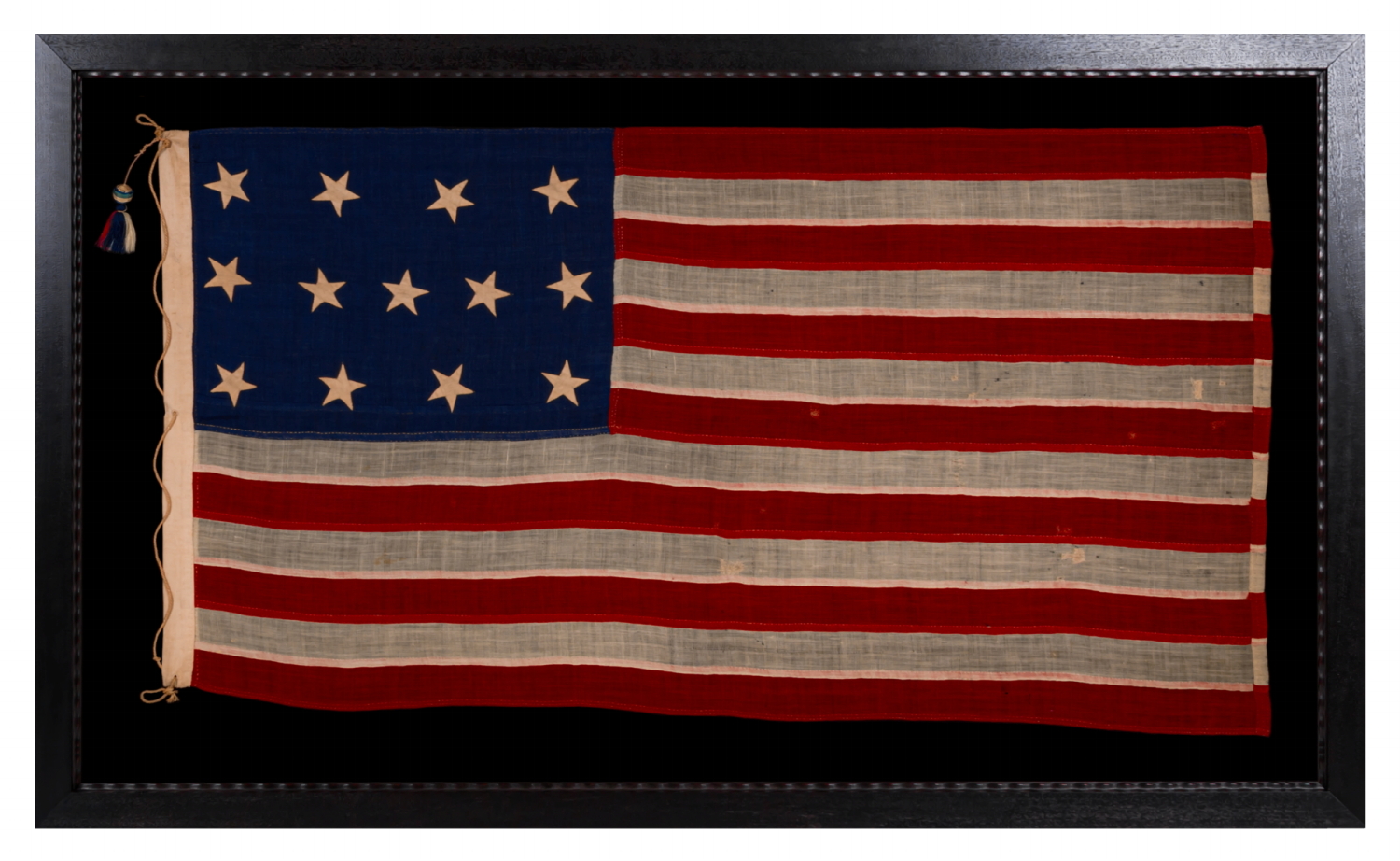
13 STARS IN THE 4-5-4 PATTERN ON AN ENTIRELY HAND-SEWN FLAG OF THE CIVIL WAR PERIOD, OR JUST PRIOR, circa 1854-1864, WITH HEMP ROPE AND A SINGLE TASSEL; PROBABLY A U.S. NAVY SMALL BOAT ENSIGN; SIGNED “JENNIE B. SEAVER,” NEWTON, MASSACHUSETTS |
|
| Available: |
Sold |
| Frame Size (H x L): |
Approx. 49.5" x 80" |
| Flag Size (H x L): |
37.5" x 69.25" |
|
| Description....: |
|
13 star American national flag, made during the Civil War era or immediately prior. Constructed sometime between the mid 1850’s - 1863/64, and entirely hand-sewn throughout, the canton and stripes of the flag are made of wool bunting. The stars are made of cotton and are double-appliquéd (applied to both sides). These are arranged in rows of 4-5-4, which, according to historical record, as well as surviving flags, was a popular configuration in the earliest periods of American history, present on some of our nation’s eldest examples. Because no one is certain what the very first flag looked like, and because this was a seemingly popular variant, I have long speculated that the 4-5-4 pattern is on the short list of possible candidates to have appeared on the very first flag. Due to these considerations, as well as the general scarcity of the pattern, this is a very desirable arrangement.
There is a sailcloth canvas binding along the hoist, with three, whip-stitched, hand-sewn grommets, through which a length of braided hemp rope is threaded, looped and knotted at the top and bottom. To this, a single, red, white, and blue tassel was at some point added, with a blue and white, thread-decorated ball.
Note, in particular, the crude, offset placement of the stars themselves. Tipped this way and that on their vertical axis, note also how their alignment lacks uniformity. The whimsical effect of these traits adds significant folk appeal to the flag’s presentation.
13 star flags have been produced throughout our nation’s history for purposes both patriotic and utilitarian. This was the original number of stars on the American flag, representing the original 13 colonies, and thus appropriate for any flag made with reference to American independence. As the number of stars grew with the addition of new states, it became more and more difficult to fit them on a smaller flag. Ship captains were concerned that the stars be more easily viewed from a distance as individual objects, so that their union didn’t become cluttered. For this reason the U.S. Navy often employed reduced star counts, particularly from the mid-19th century onward. Although the full star count of the respective period was certainly applied in some cases, as evidenced by both surviving examples and illustrations, I believe the Navy tradition of using lower counts, especially 13, may have prevailed from the 18th century all the way through to the early 20th, until at least 1916, when President Woodrow Wilson put an end to the practice via Executive Order. Because the use of signals on private ships often mirrored Navy practice, 13 star flags appear on privately owned vessels, as well, especially in the mid-19th century and prior.
The 4-5-4 pattern of 13 stars, specifically, was preferred on what the Navy termed “boat flags,” (a.k.a., small boat ensigns,) until the latter portion of the Civil War (est. 1864-65), when they instead began to appear with rows of 3-2-3-2-3. Although the configuration of the stars, as well as their number, was unspecified in the first official “boat flag” regulations of 1854, the change seems to have coincided with the subsequently adopted regulations of 1864. That said, because variation tends to have been more of a rule than an exception, with regard to the Navy’s production and procurement of early flags, and because ships’ stores generally held more than one flag, it’s hard to make any concrete statements about precisely when 4-5-4 pattern flags were no longer flying on U.S. Navy ships.
Generally speaking, unless the demands of war outstripped the limits of production, the Navy made its own flags. This probably occurred at all six Navy Yards that existed within the 1835-1850’s era. Although the 4-5-4 pattern flag that is the subject of this narrative, does not conform to the precise measurements on U.S. Navy regs, differences from one to the next would have been significantly impacted by not only the whims of the individuals in charge, but the traditions and quirks of each yard, and, most certainly, by the skills, habits, and eccentricities of the many women who sewed them.
Most decisions regarding production and variation within antique American flags of the 18th and 19th centuries, was driven by reasonable measures of common sense and availability. At U.S. Navy yards, makers were often the wives, sisters, and daughters of both civilian employees and of sailors. Commercially-made flags might also be requisitioned, not only at times of high demand, but simply as a matter of practicality. This is to say nothing of flags made in foreign ports, or at sea, where, flown on open water, they lasted about a month.
The above having been said, this particular flag bears all of the expected hallmarks of U.S. Navy production of the 1850’s and early 60’s, when the 4-5-4 pattern is in use. At nearly 6 feet on the fly, in spite of appearing somewhat large to the modern observer, this is actually two inches less than the smallest of the Navy’s boat flags, per its own specifications, until 1864, when a 5-foot version was introduced (notedly rare among surviving examples). Small boat flags could be as long as 10 feet until the 1880’s. Even Union infantry battle flags, carried on foot, were 6 x 6.5 feet until WWI (U.S. Involvement 1917-18). Because framing typically adds about a foot, collectors tend to prefer small flags, such as this one, that can be more easily framed and displayed in a modern, indoor setting.
The following was inscribed with a dip pen on the reverse of the hoist binding:
“Property of Jenny B. Seaver; Newton Lower Falls Mass.”
Born in New Brunswick, Canada, to British & Irish parents, Jennie D. Blundell (08/04/1855 – 11/05/1947), married William Seaver (07/19/1855 – 11/03/1901) in December of 1879 at Brookline, Massachusetts.
Seaver appears to have worked various positions in trainyards, including porter, machinist, and perhaps as a conductor. For many years he worked a route between Boston and the Riverside stop at Brookline. A Seaver Family genealogy records him as having served in some sort of military capacity during the Spanish-American War (1898). If this is accurate, Seaver would have been 43 years old at the time of service. Likely considered to be too old for combat, he may have worked for the quartermaster depot, or as a machinist. Post-war, in 1901, Seaver was scabbing for a railroad in Columbia, South Carolina, which had been experiencing violence in rail-related strikes during the summer of that year. When he was shot and killed, on November 3rd of that year, the local sheriff was not certain if the assailant was acting in response to the strike, or to a woman who was letting a room to Seaver and a St, Louis man who resided with him. The Boston Daily Globe reported his funeral on November 7th. For much of the remainder of her life, Jennie lived in Vermont, in the employ of a wealthy inn manager by the name of Hubbard Eddy, for whom Jennie worked as a housekeeper. Traveling between Brattleboro and Wardsboro, Jennie may have also worked at a seed factory and florist called “The House of Flowers.” Unless William Seaver was somehow awarded the flag when in Navy service, or received it due to brief involvement in veteran’s affairs post-Spa-Am War, it is unclear how Jennie ended up with a 13 star flag made between the mid-1850’s and the opening years of the Civil War. I could find no other instances of American military service, either in Jennie’s family, or her husband’s, or in that of Hubbard Eddy, that would otherwise explain her receipt of the artifact.
Whatever the case may be, I expect that the flag was made at the Boston Navy Yard at Charlestown. Whatever its history may have been, it survives as a magnificent example of the period, all hand-sewn, in a desirable star pattern, and of manageable scale, with extraordinary strength of color, graphics, and in an incredible state of preservation.
Brief Additional Notes on the Use of 13 Star Flags
In addition to their practical application on ships, 13 star flags were sometimes hoisted at patriotic events in the pre-Civil War era. They are known to have been displayed during Lafayette’s grand tour of America in 1824-25, immediately prior to our nation’s 50-year anniversary of independence, to festoon the many, garishly decorated receptions and parades held in honor of the of the beloved Revolutionary War general. The 13 star count also appears on some of our nation’s earliest flags made for political campaigning, where it is presumed to glorify past struggles for American liberty. This message persisted during the Civil War, when 13 star flags appeared within those produced by both private and commercial makers.
Mounting: The flag was mounted and framed in-house. For 25 years we have maintained our own specialized department for this purpose, with expert staff. We take great care in the mounting and preservation of flags and related textiles and have preserved thousands of examples.
The two-part frame consists of a black-painted, solid mahogany molding of dramatic, shadow-box depth, to which a rippled profile molding, black with reddish highlights, was added as a liner. The background is 100% cotton twill, black in color, that has been washed and treated for colorfastness. A shadowbox was created to accommodate the tassel. The glazing is Optimum Museum Acrylic (Plexiglas), U.V. protective, anti-glare, and scratch resistant. Feel free to contact us for more details.
Condition: There are minor instances of mothing. There are some darning repairs in the striped field, beyond the canton. Many of my clients prefer early flags to show their age. The overall state is exceptional for a wool flag of this period. |
|
|
|
| Collector Level: |
Flags for the truest Patriots. My best offerings |
|
| Flag Type: |
Sewn flag |
|
| Star Count: |
13 |
|
| Earliest Date of Origin: |
1854 |
|
| Latest Date of Origin: |
1864 |
|
| State/Affiliation: |
Massachusetts |
|
| War Association: |
1861-1865 Civil War |
|
| Price: |
SOLD |
|
| |
Views: 7 |
|
|
|

)



