
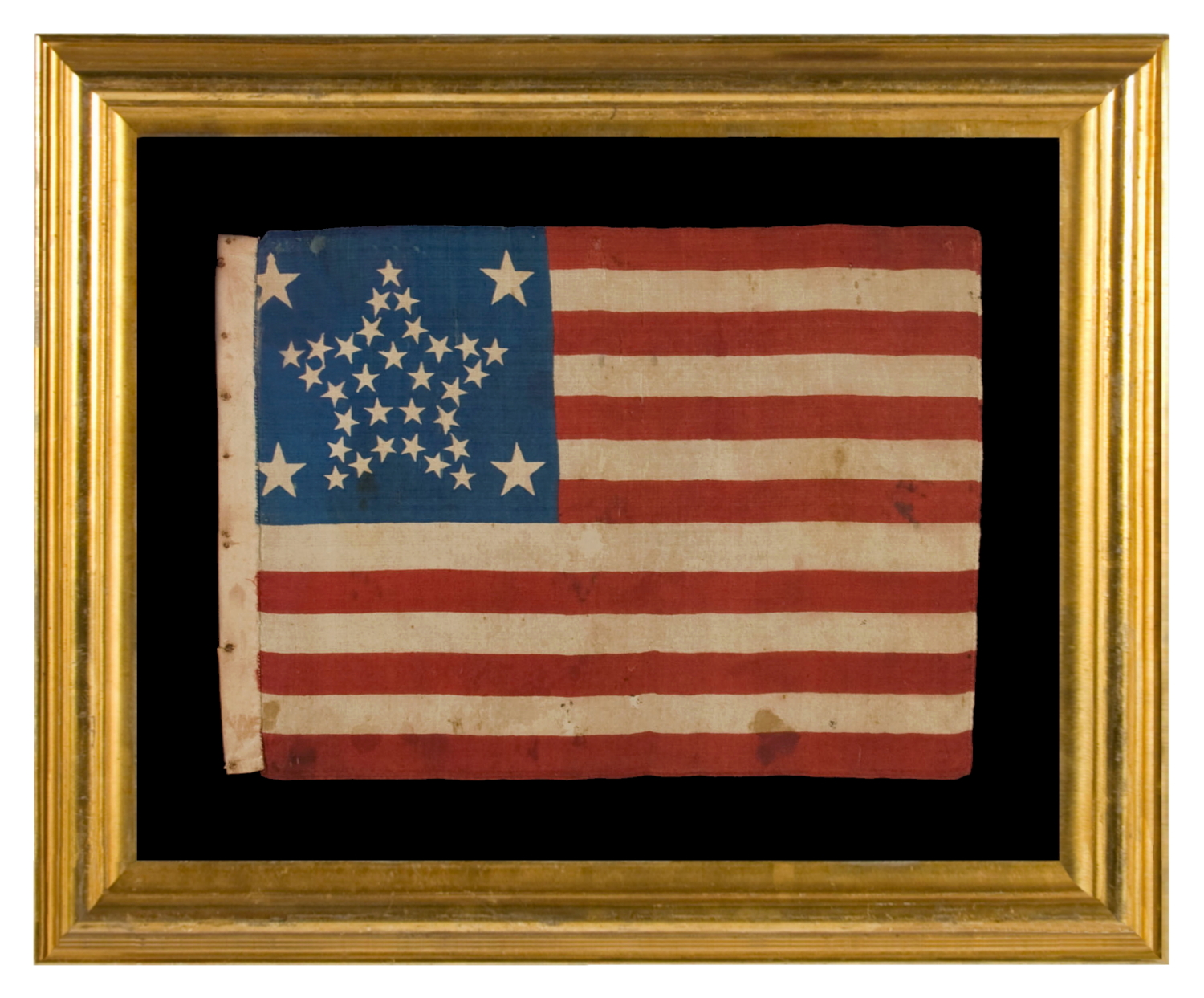
| 34 STARS IN A RARE “GREAT STAR” PATTERN THAT INCORPORATES HUGE CORNER STARS, ON AN ANTIQUE AMERICAN PARADE FLAG MADE DURING THE OPENING TWO YEARS OF THE CIVIL WAR, circa 1861-63; REFLECTS KANSAS STATEHOOD |
|
| Web ID: | 34j-900 |
| Available: | In Stock |
| Frame Size (H x L): | 23.25" x 28.25" |
| Flag Size (H x L): | 14.25" x 20" |
| Description: | |
| 34 star American national parade flag of the Civil War period, printed on silk, with an extremely rare and desirable version of what is known as the “Great Star” pattern, comprised of one large star, assembled from smaller ones. Significantly larger than most all of its known, silk counterparts, made between 1850 and the 1876 centennial era, within variants of this star arrangement, this particular example is dynamic for more than just its favorable measurements. Great Star patterns come in many forms. This one is comprised of a pentagon of 5 stars, set within a star-shaped perimeter of 25 more, all 30 of which appear in the same, small size. What really sets the configuration apart, however, from practically all other antique American flags of any sort, is the 4, exaggeratedly huge corner stars that flank the primary device. Note how this contributes to the overall graphic impact of this beautiful Civil War example, made in the opening 2 years of the bloodiest conflict on American soil. Among flag collectors, In the field of early American flags, the Great Star configuration is generally regarded as the Rolls Royce of 19th century geometric patterns. Although conceptualized as early as 1782, and depicted in that year on the first die cut of the newly adopted Great Seal of the United States, the popularity of arranging the stars in the form of one big star seems to have spread shortly after the War of 1812. In hopes of standardizing the flag's appearance, Congressman Peter Wendover of New York requested that Captain Samuel Reid, a War of 1812 naval hero, be charged with the creation of a design that would become the third official format of the Stars & Stripes. A recipient of the Congressional Medal of Honor, Reid became harbor master of New York following the war. During his lifetime, he created many innovations in signal use, including a system that could actually send messages from New York to New Orleans by sea in just two hours. Use as a Naval signal had been the primary reason for the initial creation of an American national flag in 1777, but since there was no official star design, the appearance of our flag varied greatly. Reid and Wendover’s primary concerns centered on both consistency and ease of recognition. Their hope was that as more and more states joined the Union, and more and more stars were thus added to the flag, that it would remain easy to identify its design on the open seas. In 1818, Reid suggested to Congress that the number of stripes permanently return to 13, (their count having been increased to 15 in 1795 with the Second Flag Act, which added two more stars for the newest States of Vermont and Kentucky,) and that the stars be grouped into the shape of one large star. Reid’s proposal would have kept the star constellation in roughly the same format, in a pattern that could be quickly identified through at a distance as the number of states grew. His concept for the stripes was ultimately accepted, but his advice on the star pattern was rejected by President James Monroe, due to the increased cost of arranging the stars in what would become known as the “Great Star”, “Great Flower”, or “Great Luminary” pattern. Monroe probably didn’t wish to impose this cost on either the government or civilians, so he suggested a simple pattern of justified rows. Never-the-less, the Great Star was produced by anyone willing to make it and its rarity today, along with its beauty, has driven the desirability of American flags with this configuration. Kansas was admitted into the Union as the 34th state on January 29th, 1861, about 2 ½ months before the Confederate assault on Fort Sumter that marked the beginning of the Civil War. The 34th star was officially added on July 4th of that year, but most flag makers would have added a 34th star with the addition of Kansas in January. The star count remained official until July 4th, 1863, and 34 star flags would have been produced until the addition of West Virginia in June of that year. v Though it is not especially unusual to see large corner stars in some of the more dynamic, medallion-based configurations of the 1845-1825 era, especially in circular wreath patterns, it is exceedingly rare to find them in flags that do not feature an equally prominent center star. This is especially true when the disparity between the different sizes of the stars incorporated is as significant as it is here. Because many of the elements of the American flag were unaddressed by the first three flag acts (passed 1777, 1794, and 1818), many of the aspects of its design were left to the whims of the maker. With such great leniency present in the most basic features, all manner of symbolism, some subtle and some not, can be found in early examples. At no time was this more prevalent than during the latter segment of the Antebellum (1815-1861) through the close of the Civil War (1861-65). As far-fetched and unintentional as it may seem, even among those well-acquainted with American history, as well as within the field of Vexillology, the use of 4 large corner stars, with a less conspicuous ring of 5 in the center, may have relevant meaning. These two numbers, and their total of 9, manifested in three distinct ways in early America. The first of these equaled the number of colonies that sent delegates to New York, in 1765, to oppose the Stamp Act, a major turning point on the path to independence. The first flags of the Sons of Liberty organization, whose members—America’s earliest forefathers—bravely pushed back against the British crown, bore 9 vertical, red & white stripes. Another significance of 9, more cryptic to the modern observer, is rooted in something called the “Radical Math of ‘45’.” The recently released documentaries of Ken Burns, on the American Revolution, highlight what I believe to be one of the most commonly misunderstood facts about the importance of the American Colonies to Mother England. While knowledge of the importance of American resources to Britain, such as tobacco, pitch, tar, furs, wood for the masts of ships, etc., seems fairly well-communicated in primary and/or secondary education in the States, much less understood is how critical the consumption of English-made goods in America was to the crown, in the context of the cause for war. When King George III inherited the throne in 1760, he found a nation crippled by the debt attained during the 7 Years War. Though today we tend to think of Colonial America as having been fairly small, insignificant, and woefully unindustrialized, by 1765 the 13 colonies were consuming roughly 25% of British export goods, making them the single largest ‘foreign’ consumer. In desperate search of revenue to re-right the ship, measures such as the Stamp Act, and 1767 Townshend Acts, though extremely unpopular, were pursued by King George as required means to an end. Most Englishmen understood the American position, even if they neither desired nor dared to actively support it. The numbers 4 and 5 reference “issue No. 45” of The North Briton, a radical 1763 newspaper published by the outspoken and controversial British statesman, John Wilkes. Popular and powerful enough to defy the crown, Wilkes criticized King George for his handling of the 1763 Treaty of Paris that ended the Seven Years War. Though his words were not American-specific, the sentiments were. Imprisoned temporarily, he dodged execution and was released on grounds that he was merely reporting statements made before Parliament, which offered him the protection of Parliamentary privilege. The related proceedings were viewed as a landmark victory for free speech and freedom of the press. Wilkes, who soon thereafter became Lord Mayor of London, creatively capitalized on public opinion by intentionally selecting the number 45 to evoke something called the Jacobite Rising of 1745, an unsuccessful attempt by Scottish royalty to re-take the British throne, well-known throughout Britain as “The Forty Five. When King George III replaced King George II, in 1760, he elevated a Scott to a position of great power, who just so happened to share the same surname as the noble who led the 1745 insurrection. This angered many, who likewise opposed the new king’s tyrannical tendencies, including Wilke’s unfair imprisonment. American perception of the common thread between such sentiments, and those of the American cause, transformed Wilkes to celebrity status in the Colonies, and the number “45” into political shorthand for defiance against tyranny. Thereafter the digits 4 and 5, and their sum total of 9, were cleverly worked into all manner of rituals, objects, etc. Liberty poles were raised to a height of 45 feet. Sons of Liberty banquets featured 45 separate toasts to freedom. Parades were held with marchers in blocks of 45. The windows of homes were lit by 45 candles. English porcelain was produced, for the American market, decorated with such phrases as “Wilkes & Liberty” on one side and “45” on the reverse. The fact that this “Radical Math of 45” (4+5 = 9), as it is sometimes called, represented the number of colonies that gathered at the 1765 Stamp Act Congress, and thus the count of vertical stripes on Sons of Liberty flags, was conveniently—some may even suggest divinely—coincidental. Turned on end, so horizontal, these would, for more than 100 year to follow, on rare occasion, be combined with the blue canton and white stars of the national flag, presumably in rebellious, patriotic reverence to the spirit of the Revolution, the pursuit of Liberty, and American Independence. Often with a complement of 13 stars, a count of 9 stripes can also appear on flags with larger number of stars, reflective of the corresponding timeframe. I have theorized that the reason for the somewhat common alteration, especially early on, occurred in rebellious, patriotic reference to the spirit of the Revolution, the pursuit of Liberty, and American Independence. The third relevance of “9” to America’s formative years occurred in the supermajority of 9 states needed to approve most major issues of Congress, when governed by the Articles of Confederation (‘Congress of the Confederation,’ 1781-1789). Though amendments to the Articles, that governed the body itself, required unanimous vote, the most important decision of this era was of even greater magnitude. On August 30th, 1887, the decision was made to abandon the requirement of unanimity, as it applied to the approval of the United States Constitution, settling on 9 votes for ratification. Though once again seemingly coincidental, the number may have been subject to favorable ‘vibes,’ for lack of better term, from its meaningful reference. The top and bottom of the flag are the finished, selvage edges of the bolt of fabric, itself. The fly end was rolled over and hemmed with extremely fine hand-stitching. The same level of hand-sewing is present on the hoist binding, in the form of an open sleeve, through which a wooden staff would be passed, then affixed with metal tacks. Made plain weave cotton, clear evidence of this is present along the outer edge, where there are telltale holes, minor indentations, and associated rust stains. Though smaller than specified in Army regulations, flags such as this were occasionally employed as infantry guidons, to mark the left and right flanks of an assemblage of soldiers. Such an example might also appear within the ranks of marchers in a parade, in support of a particular candidate or party. Though the 34th star was not officially added until several months after Kansas’s addition as the 34th state, in mid-1862, and well after the 1860 presidential campaign, and though a 35th star had been added by the time of the next election year, in 1864, no one cared what was official. Stars were often added months before a state’s actual edition, in hopeful anticipation. In addition, with the count of stars changing all of the time, flags were certainly used beyond the point where their star count matched the number of states. Whatever the case may be, this flag was certainly used for a prolonged period, and wears the resulting heart of having done so on its sleeve (no pun intended). All-in-all, an exceptional Civil War flag, with the Rolls Royce of Star Configurations, saturated colors, very strong folk qualities, and probable hidden symbolism. All-in-all, an exceptional flag of the period, with the Rolls Royce of Star Configurations, saturated colors, strong folk qualities, and probable hidden symbolism that ties to the birth of America. Mounting: The substantial, water-gilded molding has a raised, convex center and dates to the period between 1830 and 1860. This is a pressure mount between 100% cotton and U,V. protective acrylic. The background fabric was washed to reduce excess dye. An acid-free agent was added to the wash to further set the dye and the fabric was heat-treated for same purpose. Condition: There is significant separation between the sleeve and the hoist end of the body of the flag. There is minor to moderate fabric breakdown throughout with some associated loss, but the colors are strong and the rarity and desirability of great star designs warrants almost any condition. 100% natural fabric of similar coloration was placed behind the flag during the mounting process. Many of my clients prefer early flags to show their age and history of use. |
|
| Video: | |
| Collector Level: | Flags for the truest Patriots. My best offerings |
| Flag Type: | Parade flag |
| Star Count: | 34 |
| Earliest Date of Origin: | 1861 |
| Latest Date of Origin: | 1863 |
| State/Affiliation: | Kansas |
| War Association: | 1861-1865 Civil War |
| Price: | Please call (717) 676-0545 or (717) 502-1281 |
| E-mail: | info@jeffbridgman.com |
 |
|


