
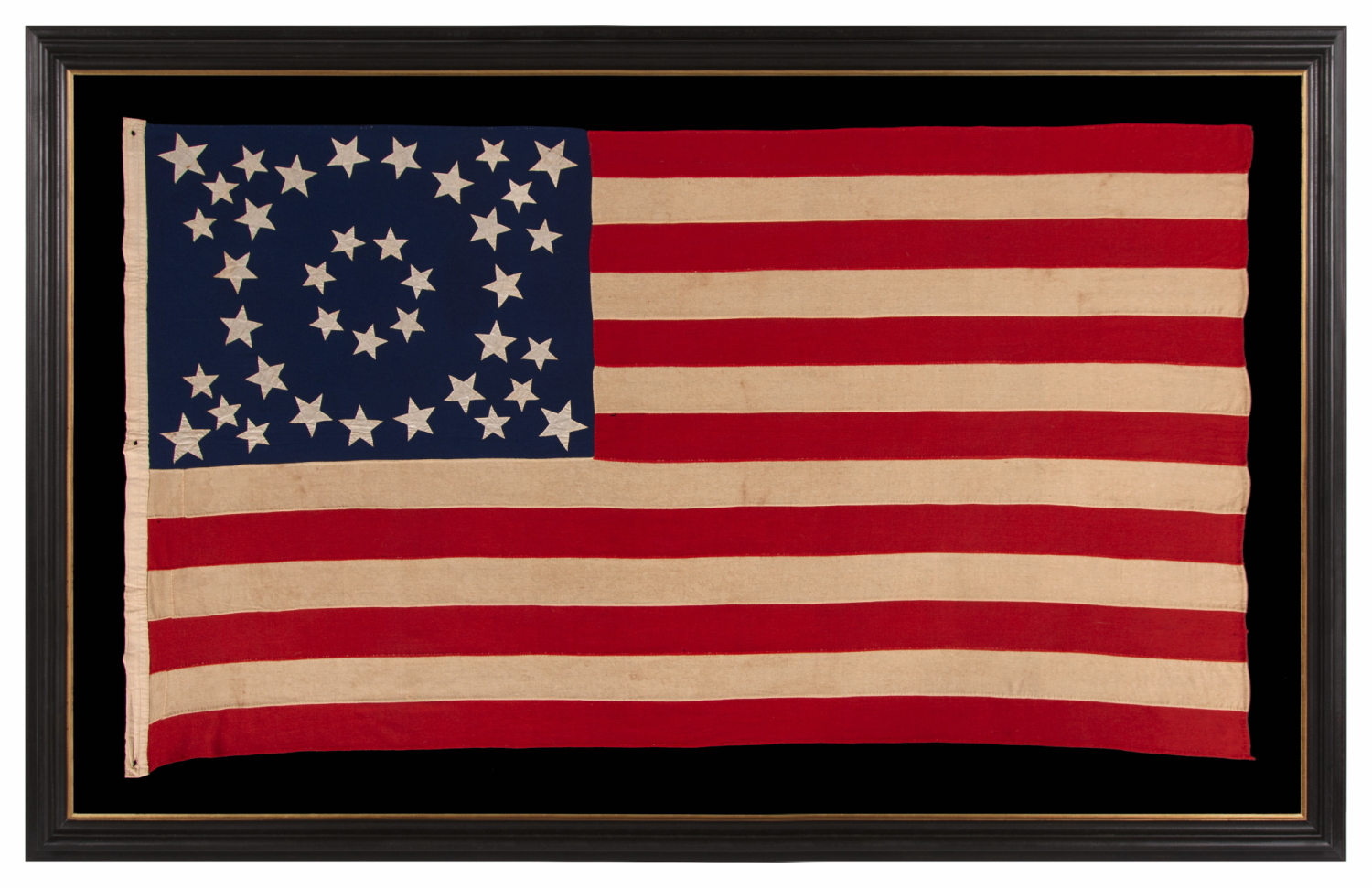
| EXCEPTIONAL ANTIQUE AMERICAN FLAG WITH 38 GLAZED COTTON STARS, IN 3 DIFFERENT SIZES, CONFIGURED LIKE AN EXPLODING FIREWORK, WITH A WIDELY SPACED DOUBLE-WREATH, FLANKED BY TRIOS OF STARS, PUNCTUATED BY A LARGE STAR IN EACH CORNER; FOUND NEAR PHILADELPHIA; ALMOST CERTAINLY MADE FOR THE CELEBRATION OF THE 1876 CENTENNIAL OF AMERICAN INDEPENDENCE; REFLECTS THE ADDITION OF COLORADO THAT YEAR AS THE CENTENNIAL STATE |
|
| Web ID: | 38j-1176 |
| Available: | In Stock |
| Frame Size (H x L): | Approx. 57" x 97" |
| Flag Size (H x L): | 45.25" x 84.75" |
| Description: | |
| 38 star American national flag with its stars arranged in a configuration that falls among the very best one will encounter across 19th century examples. This is an extremely unusual variant of what is generically referred to as a double wreath style medallion. This type of pattern typically consists of two rings of stars, with a star in the center—often larger than the rest—and a flanking star in each corner, outside the basic pattern. Here the design is so different from its counterparts, both graphically and academically, that it falls into line with the best of its kind. Instead of having a single star in the center, note the rather tight, inner ring of 7 small stars, with an open center, beyond which is an unexpectedly wide expanse of open space, followed by an outer ring of 15 stars in a distinctly larger size. Instead of a single star in each corner, beyond the basic pattern, there is a trio of small stars, followed by a much larger star. The fact that the stars in each corner are the largest in the entire field, is very unusual. Though the same odd attribute is present in two extremely scarce designs, produced by Horstmann & Sons of Philadelphia, a major Civil War military outfitter that played a hug role in decorating the Centennial International Exhibition (America’s first World’s Fair, that served as the nucleus of the national celebration), the trait is practically never encountered elsewhere. The stars of the flag are made of a beautifully polished cotton chintz, a seldom encountered fabric in appliquéd stars. These were applied to both sides of the heavy, twill-woven, blanket or clothing grade wool canton, in a rich shade of royal blue. This was hand-sewn to a field of plain weave, merino wool stripes that were pieced and joined by hand-stitching throughout. There is a sailcloth canvas header along the hoist, applied with three rows of chain-style treadle stitching, along which are 3 hand-sewn, buttonhole grommets. From the spectacular configuration of the stars to the luxurious merino wool fabrics and lustrous glazed cotton, to the chain stitch that incorporated far more thread than alternative methods, everything about the flag’s construction speaks to the fact that whoever sewed it spared no cost in its making. Likely sewn by a professional commercial flag maker, I expect it was commissioned by a wealthy entity for the celebration of America’s 100th anniversary of independence. With all of the thought and effort that appear to have been expended in the flag’s design, as well as cost, it’s difficult to believe that the choice of star size and pattern were without purpose. I expect that the count of 7 stars, in the center, reflects the 7 Free States from within the original 13 colonies (New York, Pennsylvania, New Jersey, Connecticut, Massachusetts, Rhode Island, and New Hampshire). Though I have spent many years studying all manner of celebratory and disunion / exclusionary star counts, and can speak extensively to the various numbers portrayed here, at other times in American history, plausible reasons for the layout and star counts present here are difficult to surmise. Whatever the case may be, the presentation of the stars is extraordinary. The widely spaced double medallion, with three sizes of stars and the whimsical corners, illustrates something one might best describe as an exploding firework. Apropos for the associated anniversary of American liberty this 38 star example can be counted among the very best I have ever had the privilege to own. Colorado joined the Union as the 38th state on August 1st, 1876. Heralded as the “Centennial State,” though it arrived in the year of our nation’s 100th anniversary, its star would not officially be added until the 4th of July, 1777. Per the Third Flag Act, of 1818, this marked the roll of the official “flag year.” Because few cared or perhaps even knew what was official, though 37 remained the official star count until July 4th, 1877, flag-making was very much a competitive business. Manifest destiny was on the forefront of the national agenda and the West was in the process of being settled. As soon as it was suspected that a new state was coming, stars were often added by the makers of flags both public and private. Some would have begun adding a star for the 38th state before it even entered the Union, in the early part of 1876. Practically none would have continued to produce 37 star flags, when their competitors were making 38’s. It is for this reason that flags with 38 and 13 stars, the latter to reflect the original 13 colonies, are most frequently encountered at the Centennial International Exposition, the six-month long World’s Fair, held in Philadelphia, that served as the nucleus of the national celebration. It is of interest to note that many makers of printed parade flags were actually producing 39 star examples in that same year, in hopeful anticipation that two more Western Territories, instead of just one, would be added to the Union. The 39th state would not join for another 13 years, however, when the Dakota Territory, entered as two states (numbers 39 and 40) on the same day, on November 2nd, 1889. Montana entered just a few days later, on November 8th, followed by Washington State on November 11th. So within a period of just 9 days, 4 new states had joined the Union. It was at approximately this time that the 38 star flag fell from regular use. Mounting: For 25 years we have maintained a specialized department for this purpose. Our lead conservator holds a master's degree in textile conservation from one of the nation’s top university programs. We take great care in the mounting and preservation of flags and related textiles and have preserved thousands of examples. The background is 100% cotton twill, black in color, that has been washed and treated for colorfastness. The black-painted and hand-gilded molding, with its wide, serpentine profile, is Italian. The glazing is U.V. protective acrylic (Plexiglas). Feel free to contact us for more details. Condition: There is minor soiling and oxidation throughout, accompanied by a few instances of modest soiling. Overall exceptional for a wool flag of the period, with extremely strong color. |
|
| Video: | |
| Collector Level: | Flags for the truest Patriots. My best offerings |
| Flag Type: | Sewn flag |
| Star Count: | 38 |
| Earliest Date of Origin: | 1876 |
| Latest Date of Origin: | 1889 |
| State/Affiliation: | Colorado |
| War Association: | 1866-1890 Indian Wars |
| Price: | Please call (717) 676-0545 or (717) 502-1281 |
| E-mail: | info@jeffbridgman.com |
 |
|


