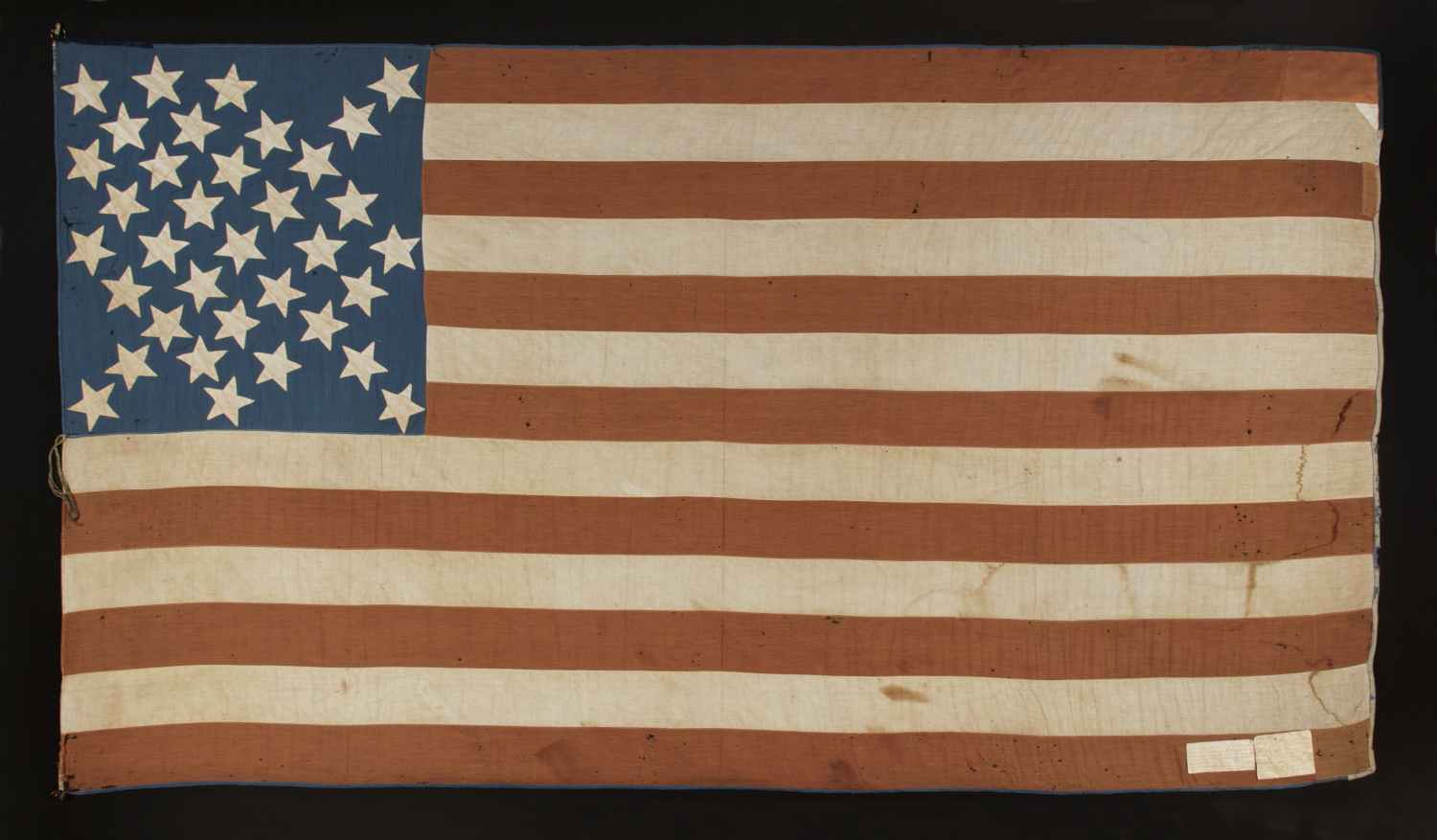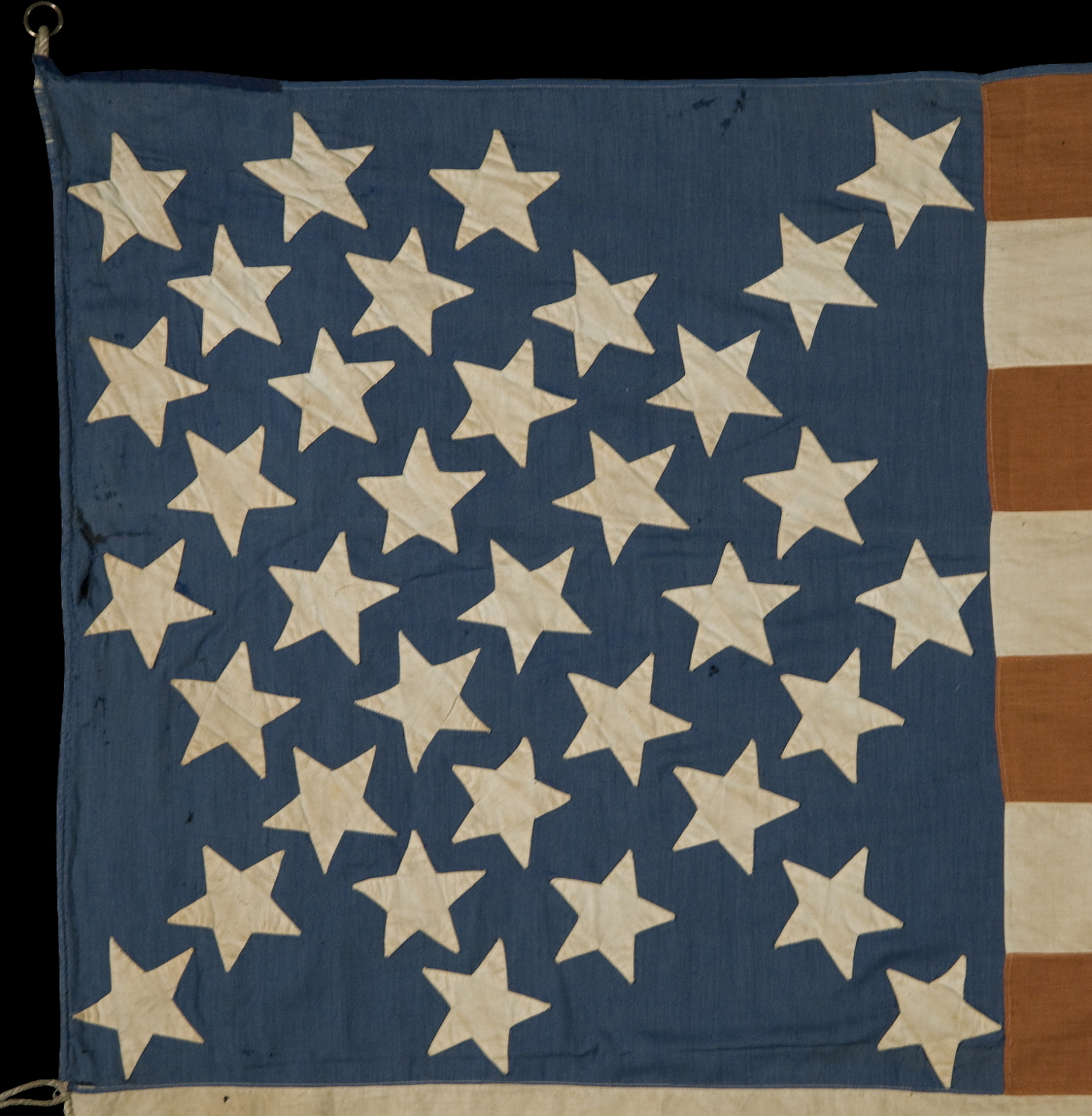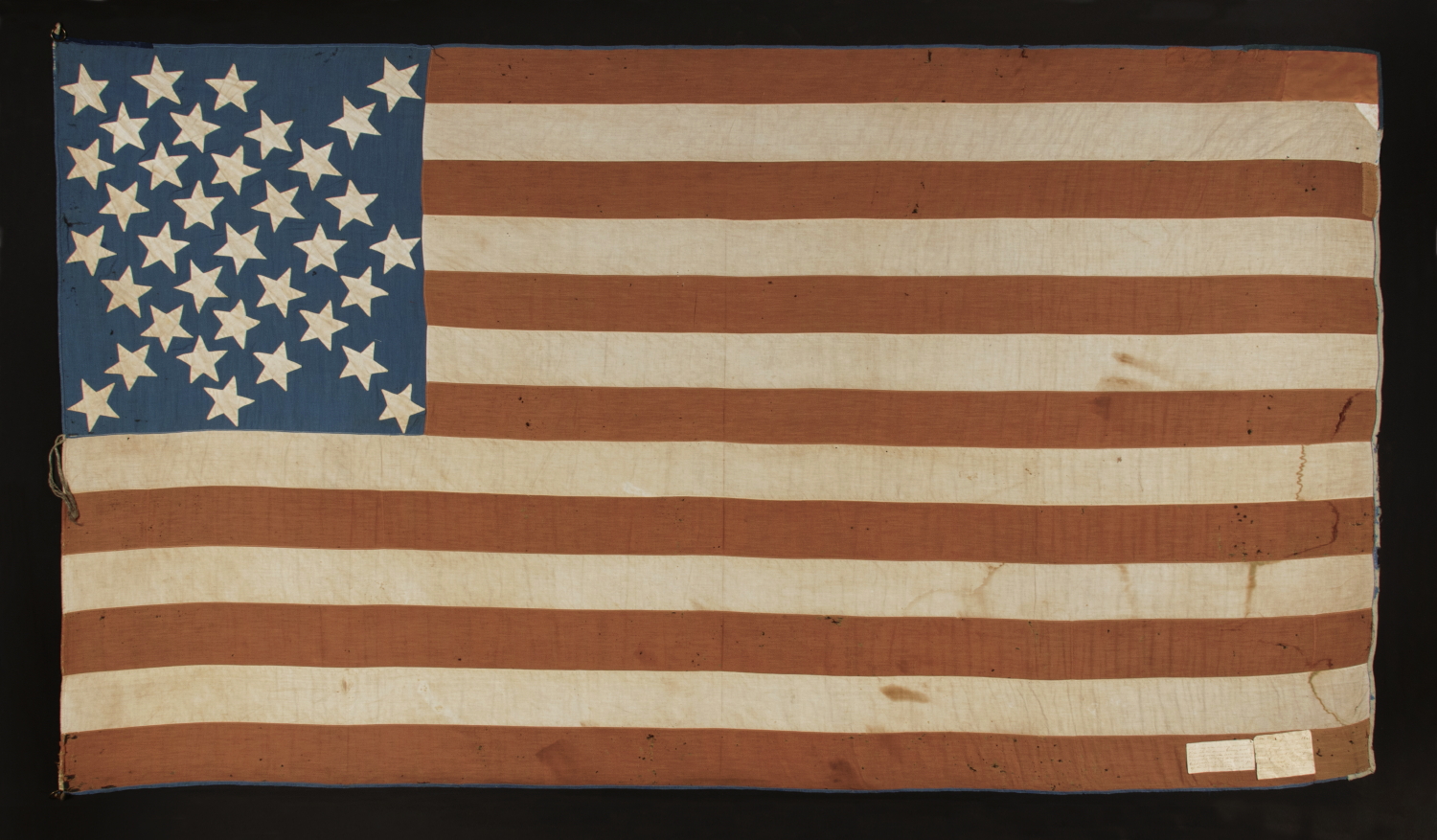
| 33 STARS, UPDATED TO 35, IN AN EXCEPTIONALLY RARE DIAMOND MEDALLION & WITH HAND-WRITTEN NOTES RECORDING IT AS HAVING BEEN FLOWN TO MOURN THE DEATHS OF ABRAHAM LINCOLN, JAMES GARFIELD, & WILLIAM McKINLEY, AS WELL AS TO CELEBRATE WARTIME VICTORIES IN THE CIVIL WAR & WWI; MADE BY HAT SHOP OWNER & PATRIOT, ELIZA DUNN, OF ERIE COUNTY, PENNSYLVANIA, circa 1860-1861 |
|
| Web ID: | 35j-821 |
| Available: | In Stock |
| Frame Size (H x L): | Approx. 67" x 109" |
| Flag Size (H x L): | 56" x 98" |
| Description: | |
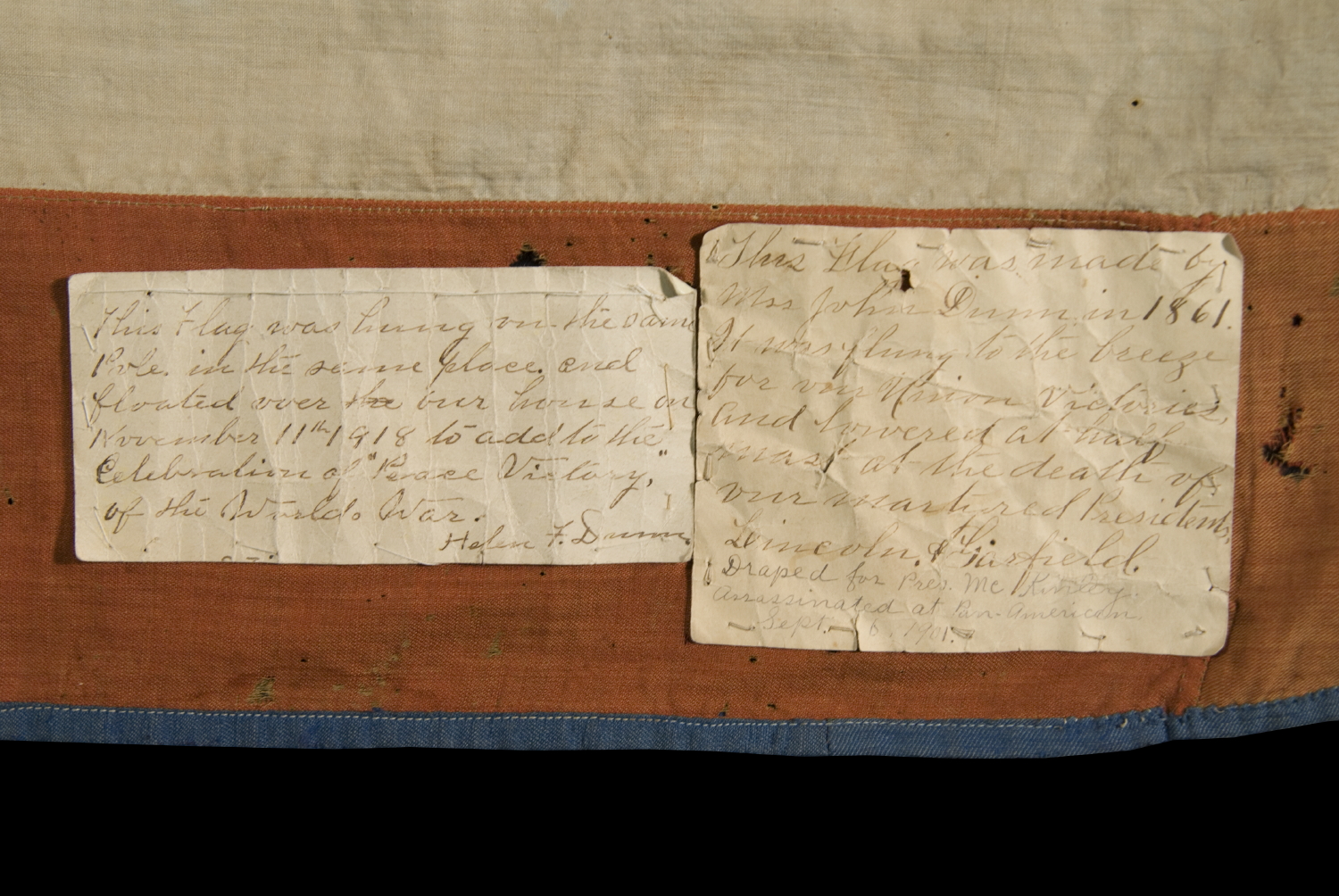
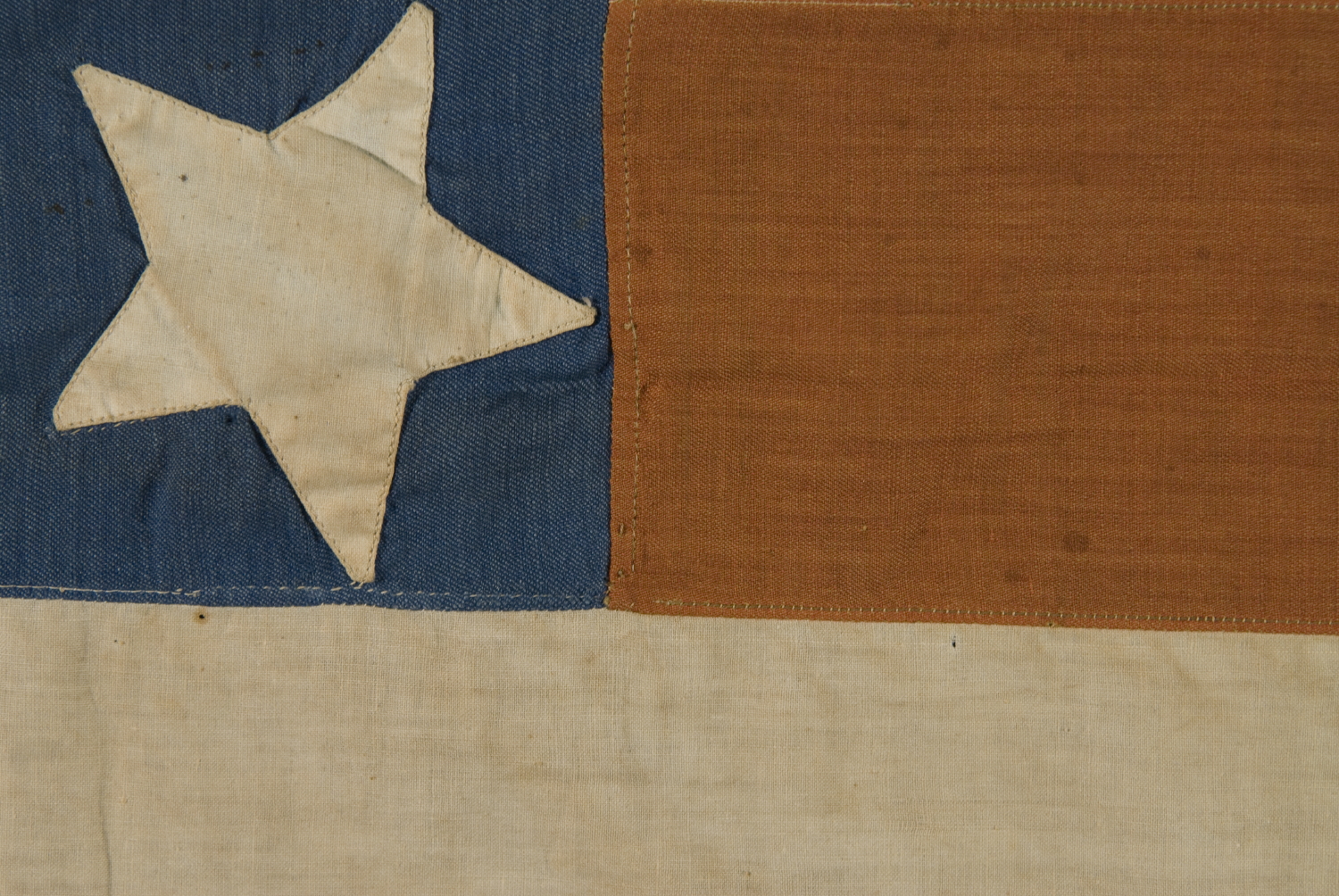
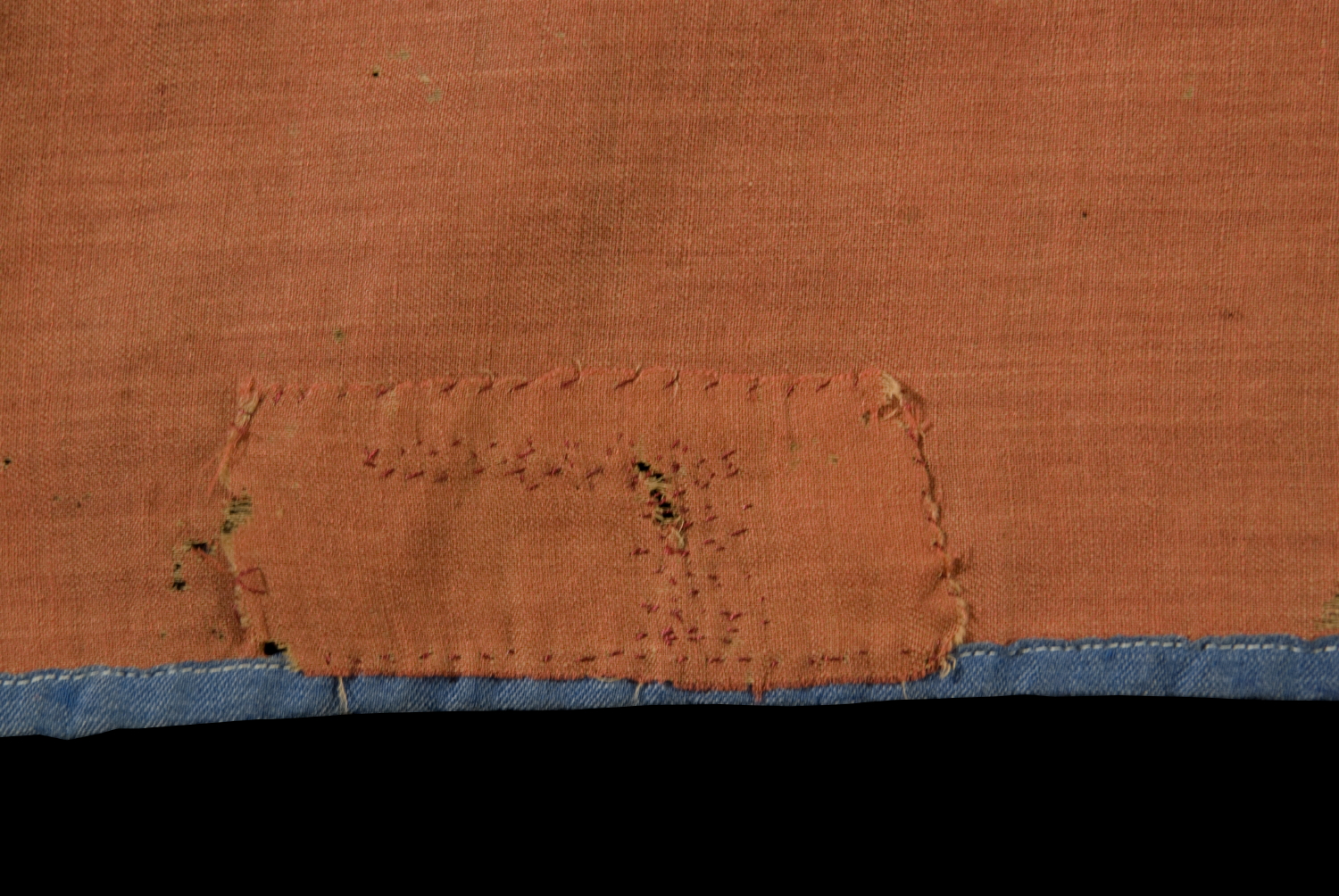
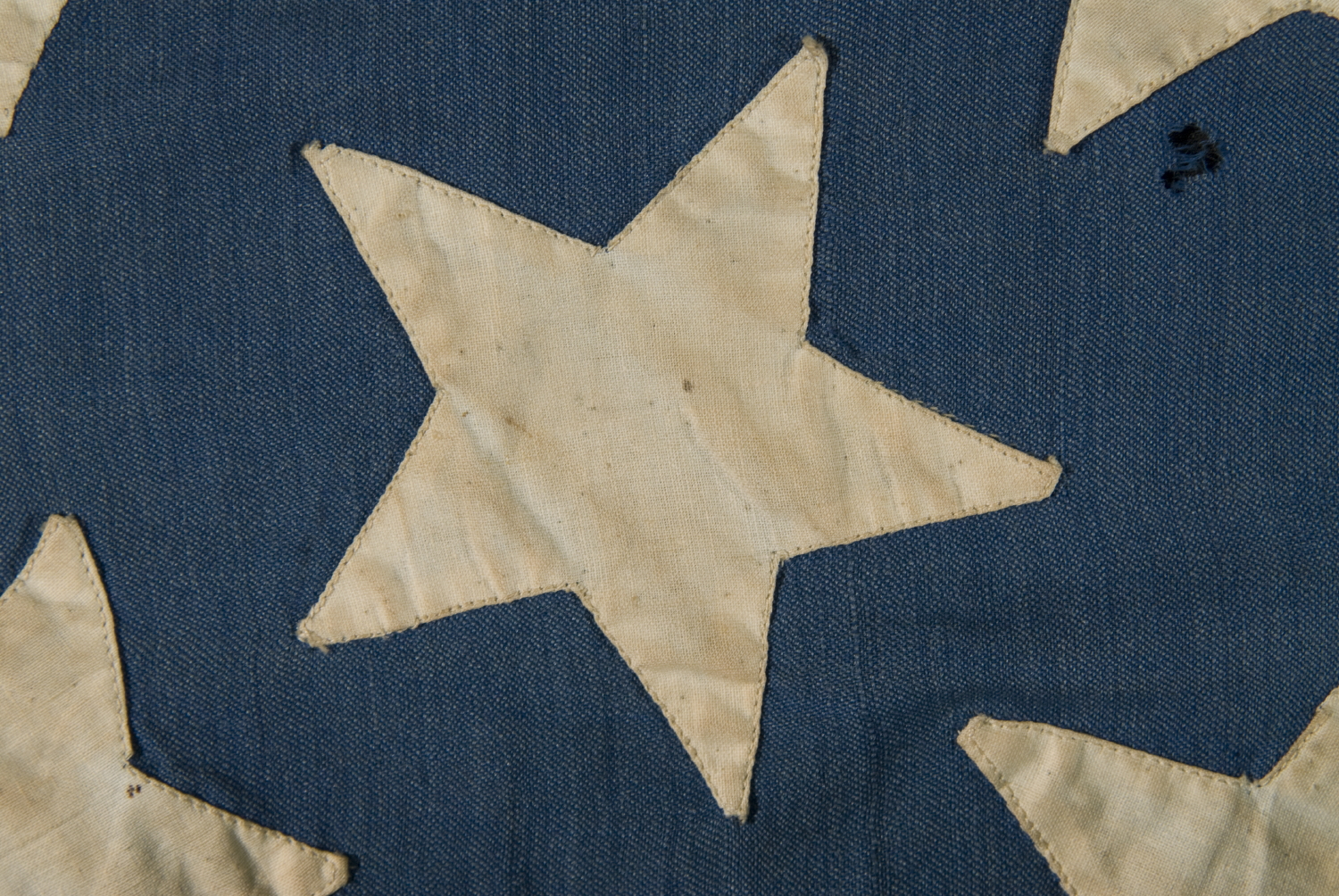
| Found in Erie County, Pennsylvania, this remarkable early American flag, with a host of interesting features and provenance, was made either immediately pre-Civil War (circa 1859-1861), or during its opening months. Chief among the flag's outstanding visual traits is its highly unusual diamond configuration of 33 stars, too which an additional 2 stars were presumably added to achieve a total of 35. Because there was no official star pattern until 1912, nor an official number of points that the stars needed to have, official proportions, shades of red and blue, or an official way in which the canton needed to be situated against the striped field, many of the most fundamental elements of our flag's design were simply left to the whims of the maker. Diamond-shaped star configurations are among the most rare and interesting that exist on early examples of the Stars & Stripes, comprising just a tiny handful that have survived from the 19th century. The most famous of these was flying during the Confederate attack on Ft. Sumter, in April of 1861, that marked the onset of war. When federal forces, led by Major Anderson, surrendered the garrison, they were allowed to take the flag down and peaceably vacate the premises with it. Six days later, Anderson was in New York. Unfurling the flag in Union Square, it is estimated that 100,000 people came to view it. This is thought to have possibly been the greatest gathering of people, thus far, in the history of America. Because private use of the American flag was extremely uncommon before, and virtually explodes thereafter, I have suggested that Major Anderson's display of the Ft. Sumter flag, following the first major Confederate attack, to be the turning point at which the nation came to adopt the American national flag, and the elements thereof, as the focal point of its patriotic identity. The dynamic star pattern, present on this example, is far from the flag's only important aspect. The keenly beautiful and unusual fabrics used to construct it, constitute another, as do the the uncommon shades of red and blue. Beyond the compelling overall graphics, and the time period of use, reflected in the star count(s), is known historic record of its maker, an of subsequent owners. These are identified by way of two hand-written notes, penned by members of the Dunn Family of Miles Grove (now Lake City), in Erie County, Pennsylvania, that were at some point actually stitched to the flag, situated in the lower, fly end corner of the obverse (front). The earlier of the two notes reads as follows: “This flag was made in 1861 by Mrs. John Dunn. It was flung to the breeze for our Union Victories and lowered at half mast at the death of our martyred presidents, Lincoln & Garfield.” To this, further verbiage was later amended: “Draped for Pres. McKinley, assassinated at Pan-American, Sept. 6, 1901.” A subsequent note, affixed to the left, reads: “This flag was hung on the same pole, in the same place, and floated over our house on November 11th, 1918 to add to the Celebration of “Peace Victory,” of the World War. [signed] Helen F. Dunn.” The two women referenced in the note, “Mrs. John Dunn” and “Helen F. Dunn” are mother and daughter. The former is Elizabeth Ann [Reed] Dunn, a.k.a., “Eliza,” born in 1812 in Oswego, New York to George Reed (b. 1778, York County, PA, d. 1857, Erie, PA). George moved his family from New York to Erie County, Pennsylvania, where Eliza met and married John Dunn, born in 1807 in Erie Co., near the Crawford Co. line. John was the son of Simeon Dunn, a successful businessman with considerable wealth in real estate, born 1782 in New Brunswick, New Jersey. Simeon descended from a line of Dunns that settled the state. According to “A History of Erie County…” by John Miller (1909, Yale University Press, Lewis Publishing, Chicago, p. 145-146), Simeon Dunn was part of the Erie Light Infantry, the first local militia company in the region, in which he served at the rank of private, in a company led by Captain Thomas Atkinson. The Erie Light Infantry company of citizen soldiers was attached to the 137th Reg’t Pennsylvania Militia. According to Miller, Simeon Dunn was stationed in Buffalo for five months during the War of 1812 (1812-1815), where he “regularly served as an express rider to carry messages to Commodore [Oliver Hazard] Perry.” One of America’s most celebrated naval heroes, Perry became famous, during the war, for his 1813 victory at the Battle of Lake Erie. In the same text, Miller describes how a young John Dunn, during the Revolutionary War, came to view the British fleet, on the lake, from the Pennsylvania shoreline. The Dunns were among Erie’s earliest and most prominent residents. According to another historical text on the region, entitled “A History of Erie County, Pennsylvania,” by Samuel P. Bates (1884, Warner, Beers & Co.: Chicago, Part III, Chapter V, p. 586): “In the year 1806, the first schoolhouse was built in Erie, on the southwest corner of Seventh and Holland streets, where the present school building (No. 2) stands. It was a hewed-log house, about 18 x 20 feet, built by John Greenwood, for the sum of $30, which was paid by contributions of the citizens. This first temple of learning was surrounded by the native forest, a foot-path leading to the school from the village of 100 inhabitants, collected in the vicinity of German street, below Fourth street. Mr. Anderson was the first teacher, and his immediate successors were Mr. Blossom and Dr. Nathaniel Eastman. Dr. Eastman taught the school during the year 1812; the roll, the oldest handed down, with a portrait of the Doctor…contains the names of forty boys and thirty girls…” Among the students listed were John Dunn, his elder brother, George, and a close friend by the name of Cyrus [sometimes alternately recorded as 'Silas'] Reed. George and Cyrus were three years older, each born in 1804. Cyrus’s grandfather, Lt. Col. Seth Read (1746-1797), a Revolutionary War officer, built what is considered to be the first permanent building in Erie, a log home, which he constructed in 1795. Cyrus was seems to have been permitted to serve with John’s father in the Erie Light Infantry. His 1883 death notice, in the Dec. 13th, Paxton, Illinois Record, states that he was the last of the company to honor Lafayette in that city, during his final visit to, and Grand Tour of America, in 1824-25. John Dunn--husband to the flag’s maker, Eliza, and father of Helen--was listed as a farmer in most surviving census records. In 1870, he is more specifically described as being a "grape-grower," while Eliza is listed as “housewife.” The Dunns had two boys, Henry Clay Dunn ( Apr. 2, 1834 - Apr. 28, 1908) and George Wilbur Dunn (1839 - 1912). The remainder of the Dunn household were girls—at least 5 of them. Helen F. Dunn (Feb. 18, 1841 - Mar. 21, 1935), the eldest, outlived all of her siblings, save one. Helen appears in the 1880 census as a “milliner” (hat-maker), which suggests, in combination with the evidence provided by the flag itself, that she may have developed an affinity for sewing and textiles from her mother. In 1887, Helen was recorded as a delegate to a convention of the Women's Relief Corps, which served as the women’s arm of the Grand Army of the Republic (GAR). The GAR was the primary association of Union, Civil war veterans, representing all branches of the military. Helen's name and residence appear in the "Journal of the Fifth National Convention of the Women's Relief Corp, Auxiliary of the Grand Army of the Republic, St. Louis, Missouri, Sept. 28, 29, 30, and Oct. 1, 1887," (George Spaulding & Co., Printers, San Francisco), p. 28. As a leader within the organization, and a seamstress, Helen would have been exactly the sort of individual to assume custodianship of a flag made by her mother, brought out for display at key occasions throughout her lifetime. [full description to follow] |
|
| Video: | |
| Collector Level: | Flags for the truest Patriots. My best offerings |
| Flag Type: | Sewn flag |
| Star Count: | 35 |
| Earliest Date of Origin: | 1861 |
| Latest Date of Origin: | 1861 |
| State/Affiliation: | Pennsylvania |
| War Association: | 1861-1865 Civil War |
| Price: | Please call (717) 676-0545 or (717) 502-1281 |
| E-mail: | info@jeffbridgman.com |
 |
|