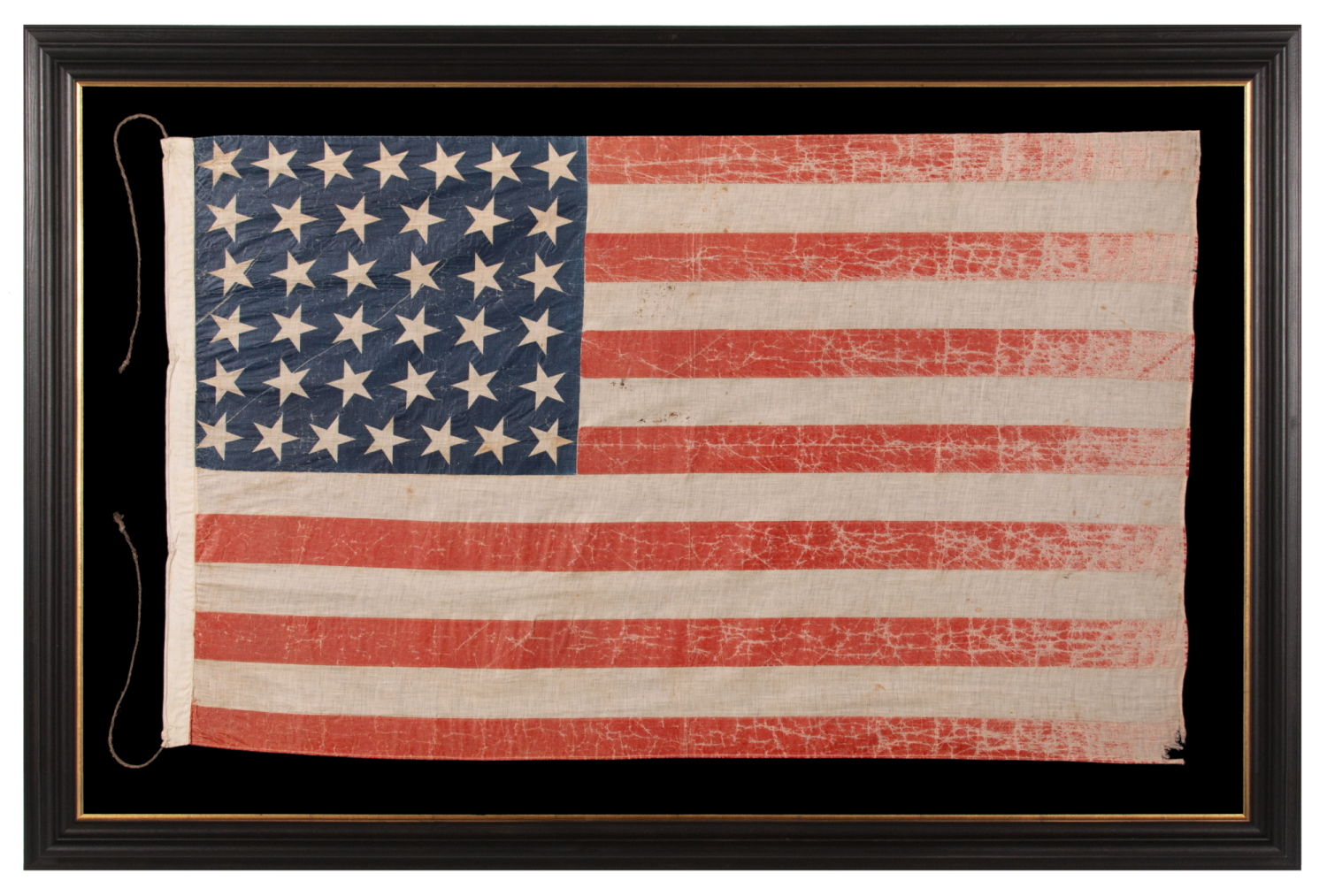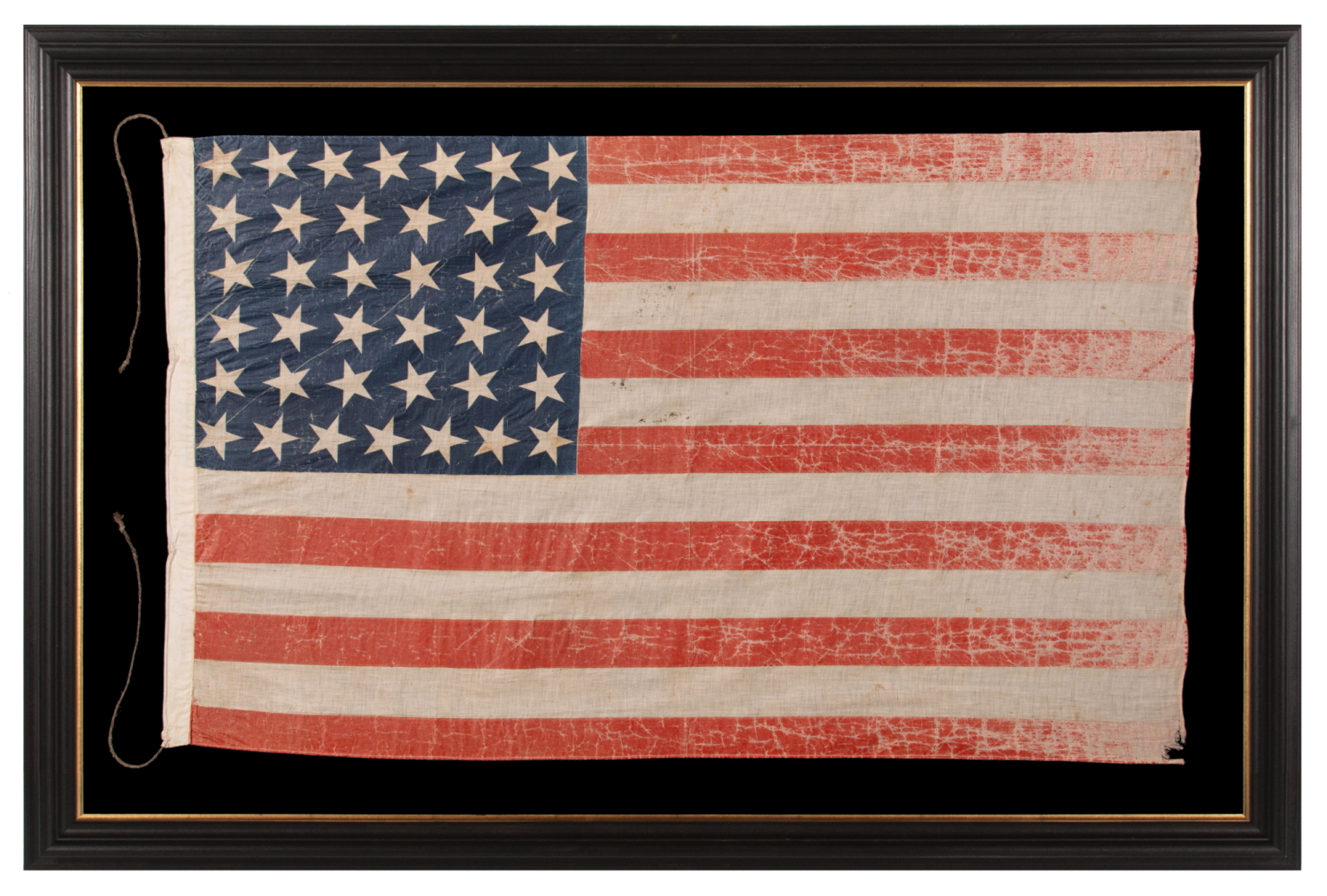
| 38 STAR ANTIQUE AMERICAN PARADE FLAG IN AN UNUSUALLY LARGE SCALE, WITH ENDEARING WAR FROM OBVIOUS LONG-TERM USE, AND WITH DANCING ROWS IN AN HOURGLASS FORMATION; COLORADO STATEHOOD, 1876-1889 |
|
| Web ID: | 38j-1183 |
| Available: | In Stock |
| Frame Size (H x L): | Approx. 46" x 67" |
| Flag Size (H x L): | 33.75" x 55.25" |
| Description: | |
| 38 star American parade flag, printed on glazed cotton, possibly with some flax content, in an unusually large scale among its counterparts and with endearing wear from long-term use. Note how the position of the stars on their vertical axis varies from one row to the next. When viewed on the obverse (front), in the first row, each star has one point directed in the approximate position of 11:00, while in the next row, each has one point directed toward 1:00, alternating back-and-forth, from one row to the next, throughout the formation. Because the overall effect is similar to lines of dancers, I have termed this configuration "dancing rows," though it may also accurately be referred to as tilting or canted rows. Note also how the entire formation, arranged in lineal rows of 7-6-6-6-6-7, is justified such that the left and right sides are concave, like a broad hourglass. Though subtle, this is a fairly unusual feature in 38 star examples. Flags with pieced-and-sewn construction, in the era when our nation had 38 stars, were typically 8 feet or longer on the fly. Parade flags, by contrast, were usually 3 feet long or smaller. Though there are exceptions to each, they are far more rare. At approximately 33.5 x 49 inches, this is a particularly large parade flag, with the hoist measurement actually exceeding the length of most surviving examples on the fly. Cotton and silk parade flags were intended for one day’s use at parades or political events, or perhaps a few days at the most, say for a reunion encampment of soldiers, a political convention, or a fraternal caucus. Larger examples, like this one, were sometimes augmented by the maker, seller, or their owners, by adding a binding for stability. That is the case here, in the form of an open sleeve, through which a length of hemp rope or jute was threaded, knotted at the top and bottom, then bound in place by hand stitching at the top, bottom, and at two points in-between. Flown extensively, with beautiful wear that provides endearingly graphic impact, the combination of the size, the ties, the large stars and their dancing arrangement, provides for an absolutely terrific parade flag of the 38 star era. Colorado joined the Union as the 38th state on August 1st, 1876. This was the year of our nation’s 100-year anniversary of independence. Per the Third Flag Act of 1818, stars were not officially added until the 4th of July following a state's addition. For this reason, 37 was the official star count for the American flag in 1876. Flag-making was a competitive venture, however, and few flag-makers would have been continuing to produce 37 star flags, when their competitors were making 38’s. It is for this reason that 38 and 13 stars (to represent the original 13 colonies) are more frequently encountered at the Centennial International Exposition, the six-month long World’s Fair, held in Philadelphia, in honor of the event. Some flag-makers would have been adding a star for the 38th state before it even entered, in the early part of 1876 or prior. In fact, many makers of printed parade flags were actually producing 39 star examples, in hopeful anticipation of the addition of two more Western Territories instead of one. The 39th state would not join the Union for another 13 years, however, when the Dakota Territory entered as two states (numbers 39 and 40) on the same day, on November 2nd, 1889. Mounting: The flag was mounted and framed within our own conservation department, led by expert staff. We take great care in the mounting and preservation of flags and have framed thousands of examples. The background is 100% cotton twill, black in color, that has been washed and treated for colorfastness. The black-painted molding, with its wide, shaped profile and gilded inner lip, is Italian. The glazing is U.V. protective acrylic (Plexiglas). Feel free to contact us for more details. Condition: There is minor to modest, scattered pigment loss in the canton and in the first 2/5 of the striped field, accompanied by two modest streaks of the same in the canton. Losses increase in the latter 3/5 of the field, from moderate to significant at the fly. There are very minor instances of soiling in limited areas.. There is a minor, vertical tear along the hem, at the fly end, in the top stripe, and there is minor fabric loss in the bottom, fly end corner, in the last stripe. Many of my clients prefer early flags to show their age and history of use. In stark contrast to other antique textiles, sometimes the presentation of a flag is such that losses and wear can actually add to its desirability, rather than detract, as-is the case here. |
|
| Video: | |
| Collector Level: | Intermediate-Level Collectors and Special Gifts |
| Flag Type: | Parade flag |
| Star Count: | 38 |
| Earliest Date of Origin: | 1876 |
| Latest Date of Origin: | 1889 |
| State/Affiliation: | Colorado |
| War Association: | |
| Price: | Please call (717) 676-0545 or (717) 502-1281 |
| E-mail: | info@jeffbridgman.com |
 |
|