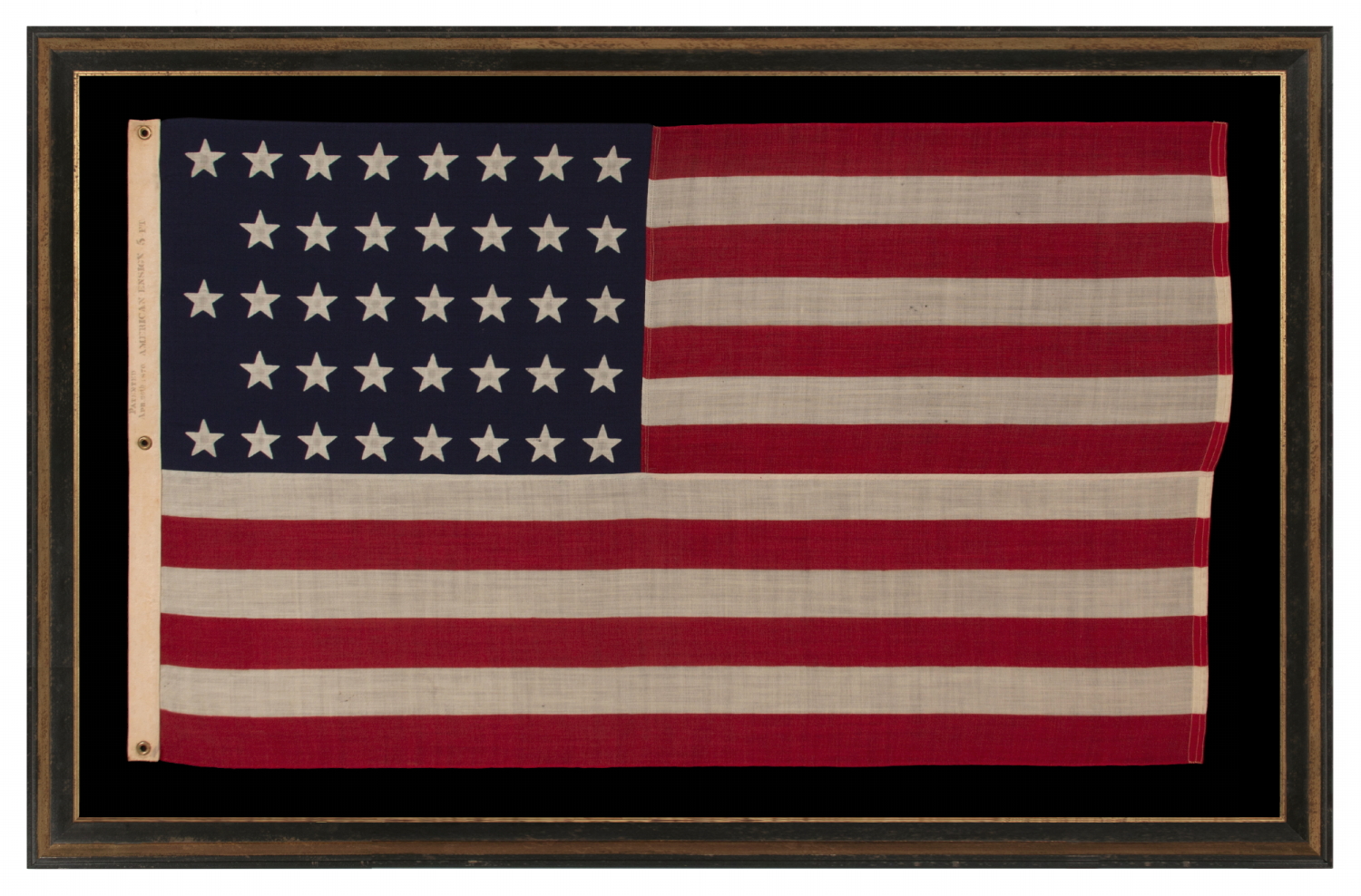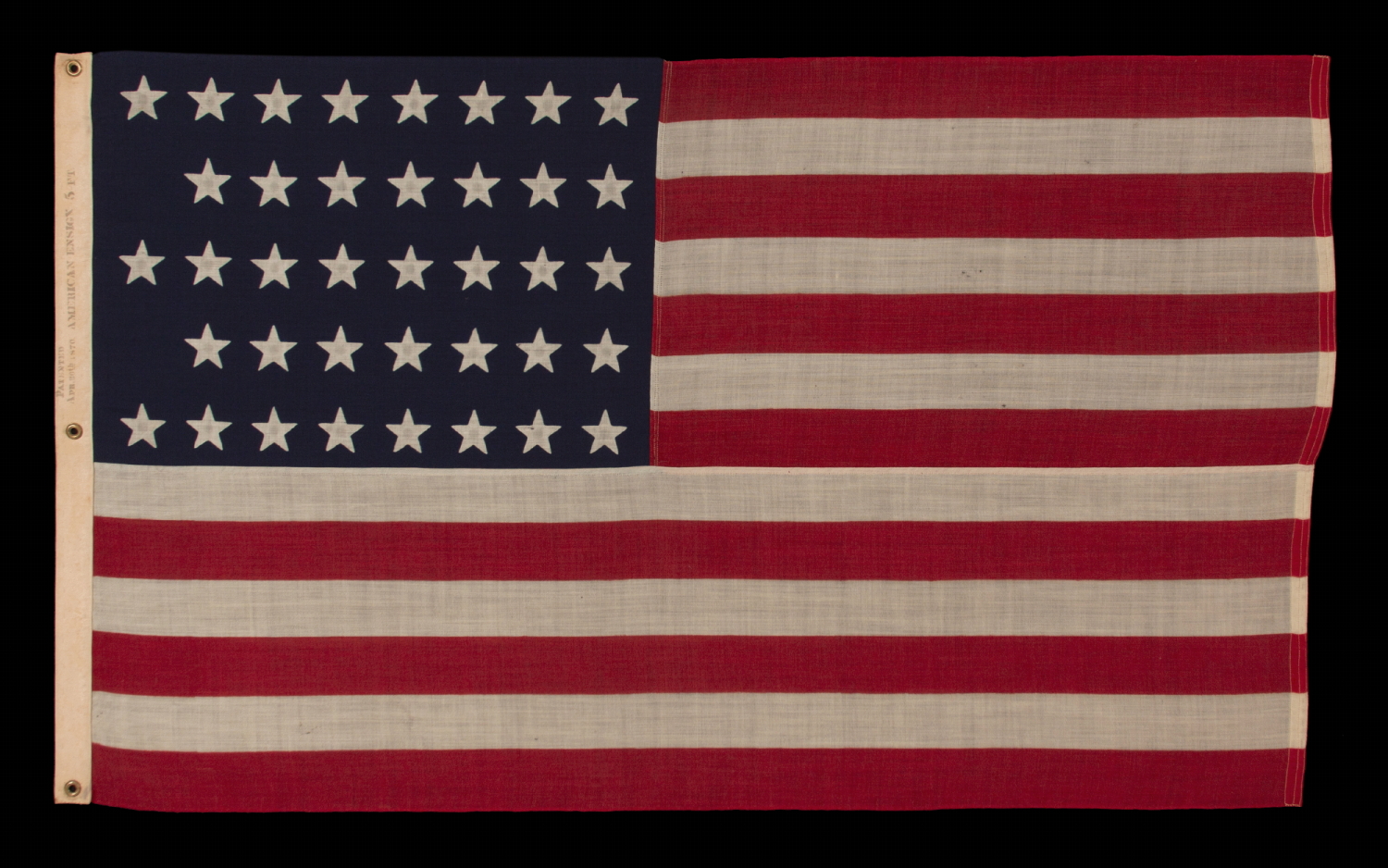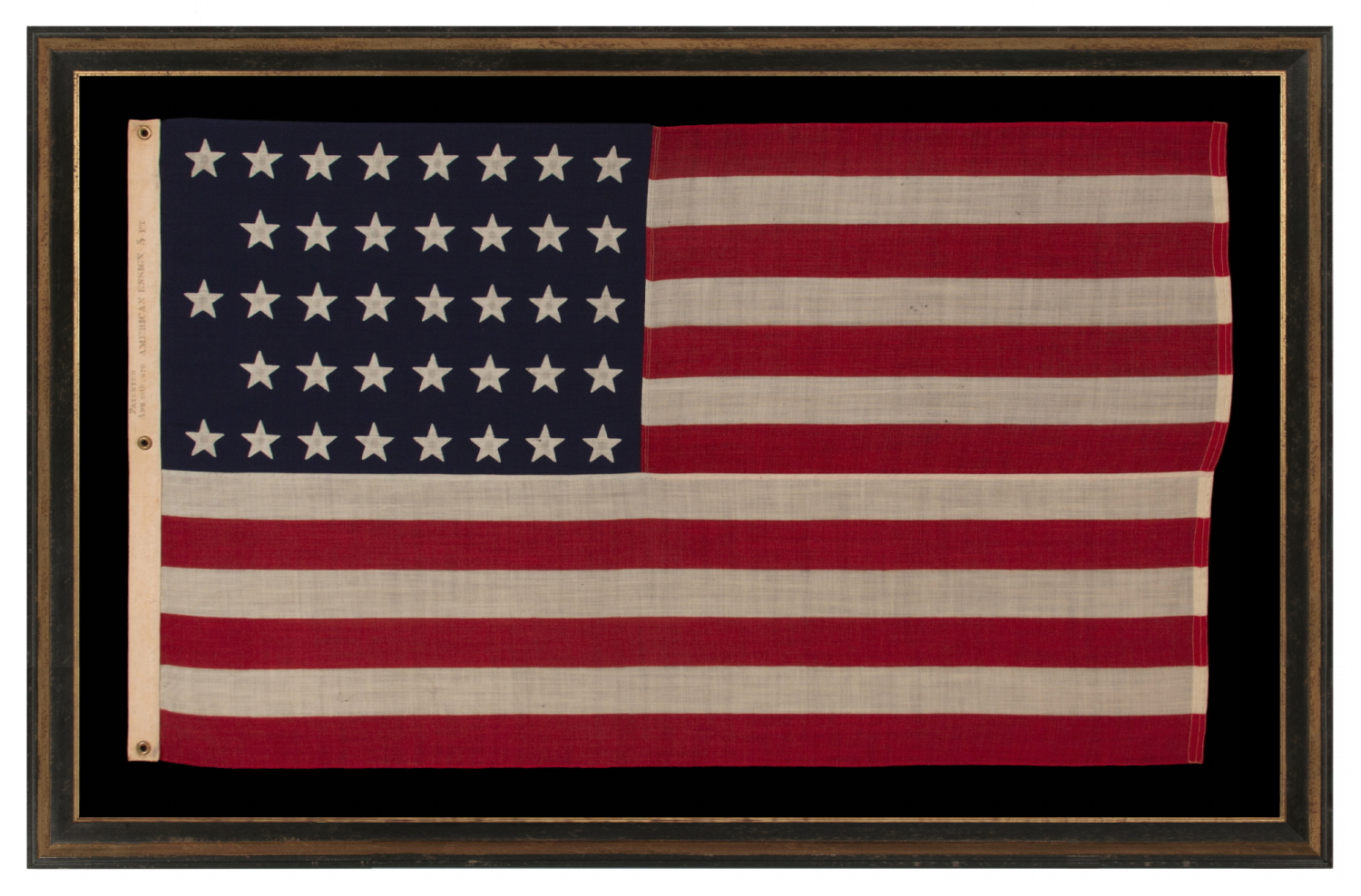
| 38 STAR ANTIQUE AMERICAN FLAG WITH A NOTCHED CONFIGURATION, MADE BY THE U.S. BUNTING COMPANY IN LOWELL, MASSACHUSETTS, REFLECTS THE ERA OF COLORADO STATEHOOD, circa 1876-1889 |
|
| Web ID: | 38j-1185 |
| Available: | In Stock |
| Frame Size (H x L): | Approx. 51" x 76.5" |
| Flag Size (H x L): | 38.75" x 64.5" |
| Description: | |
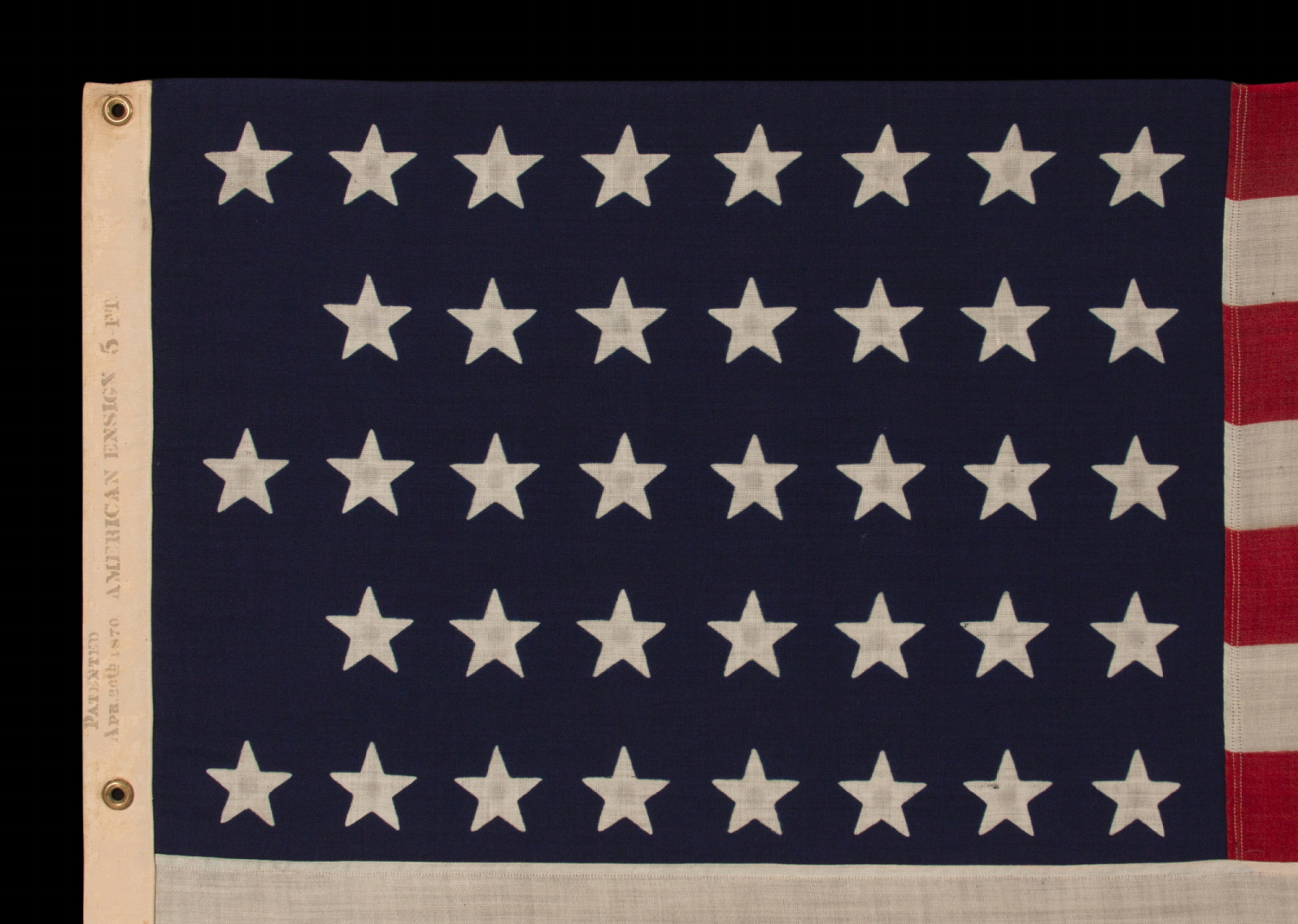
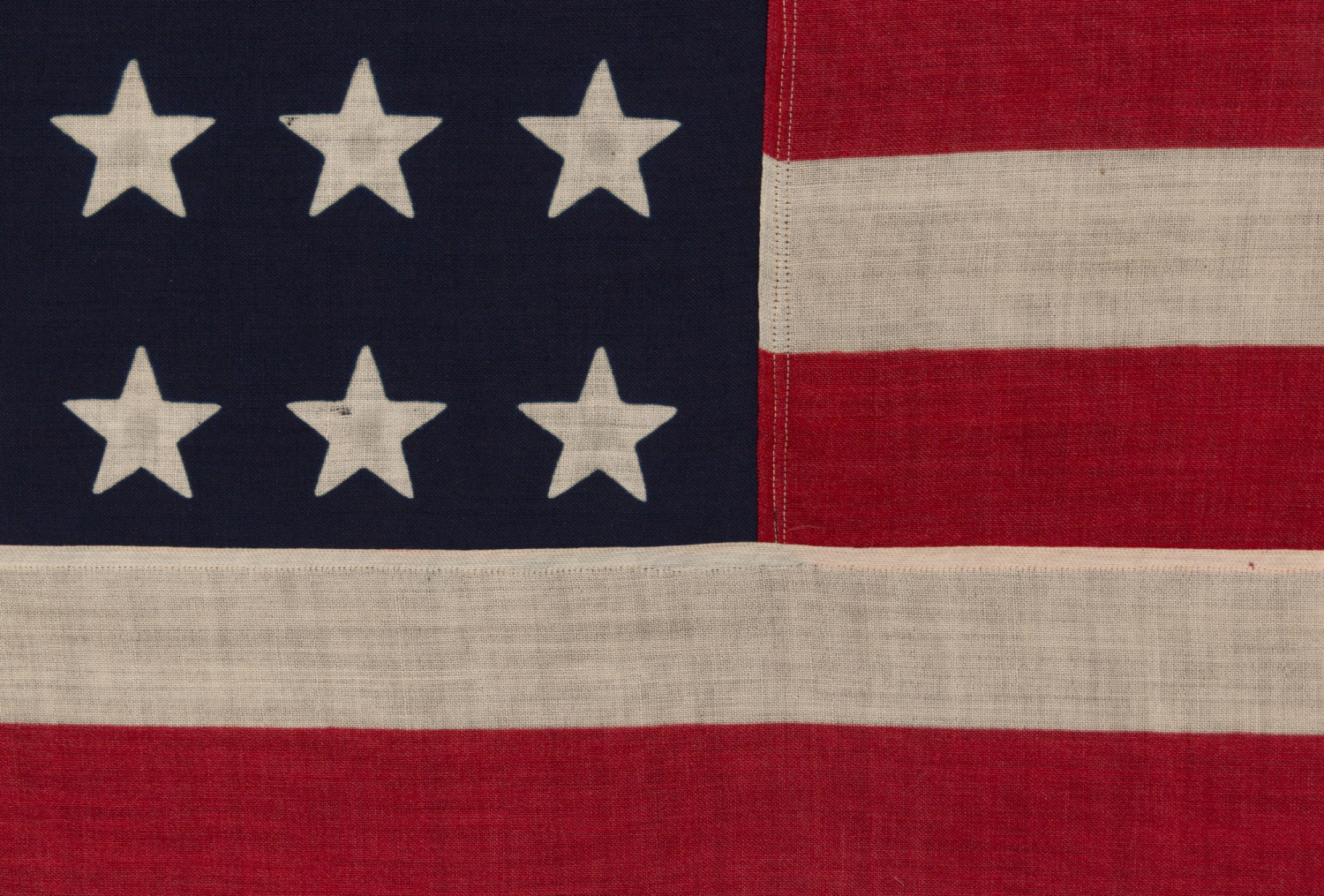
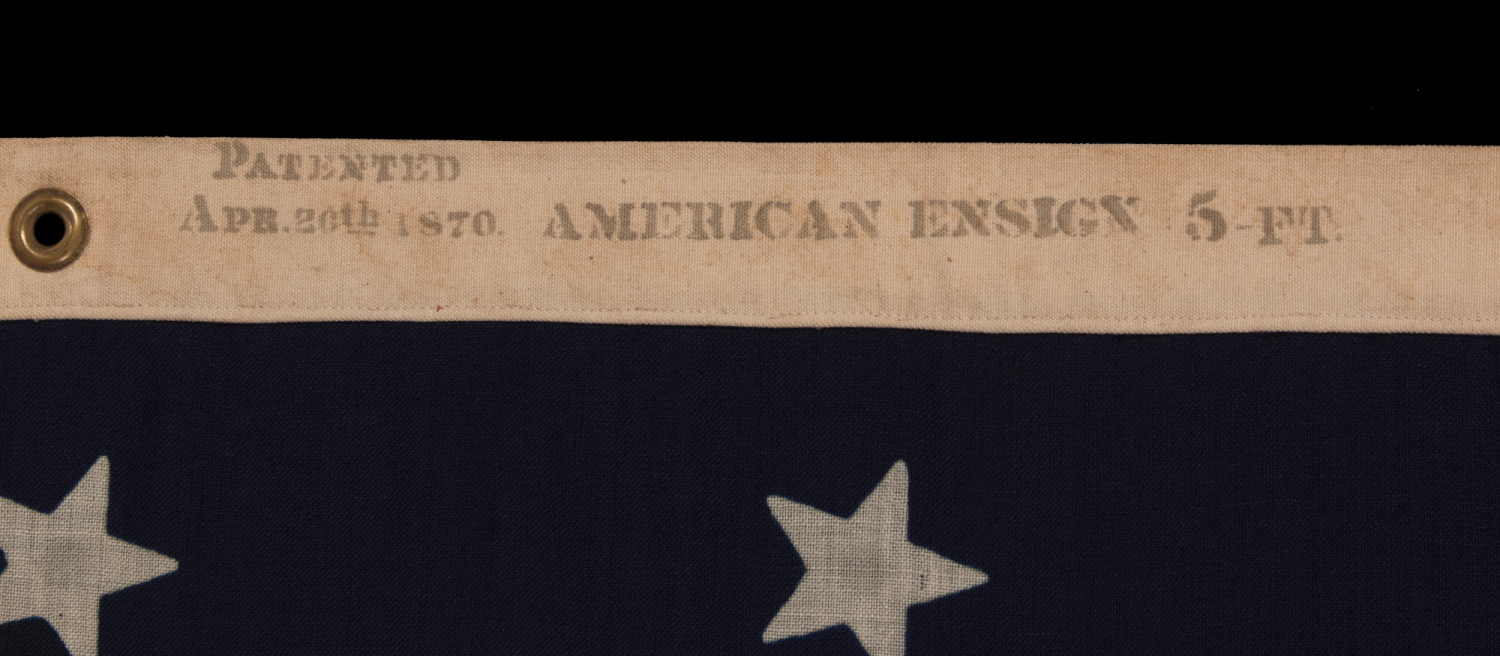
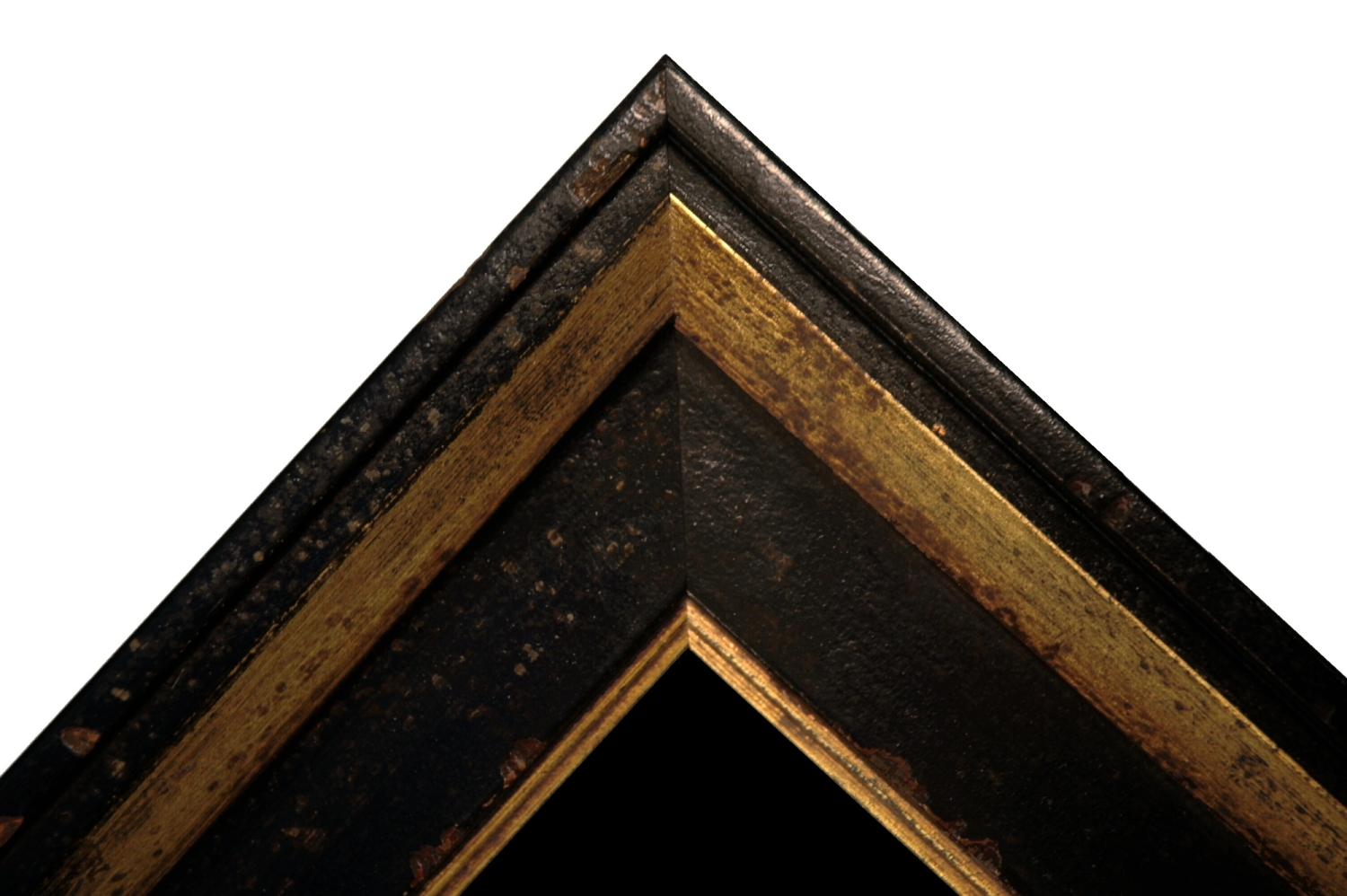
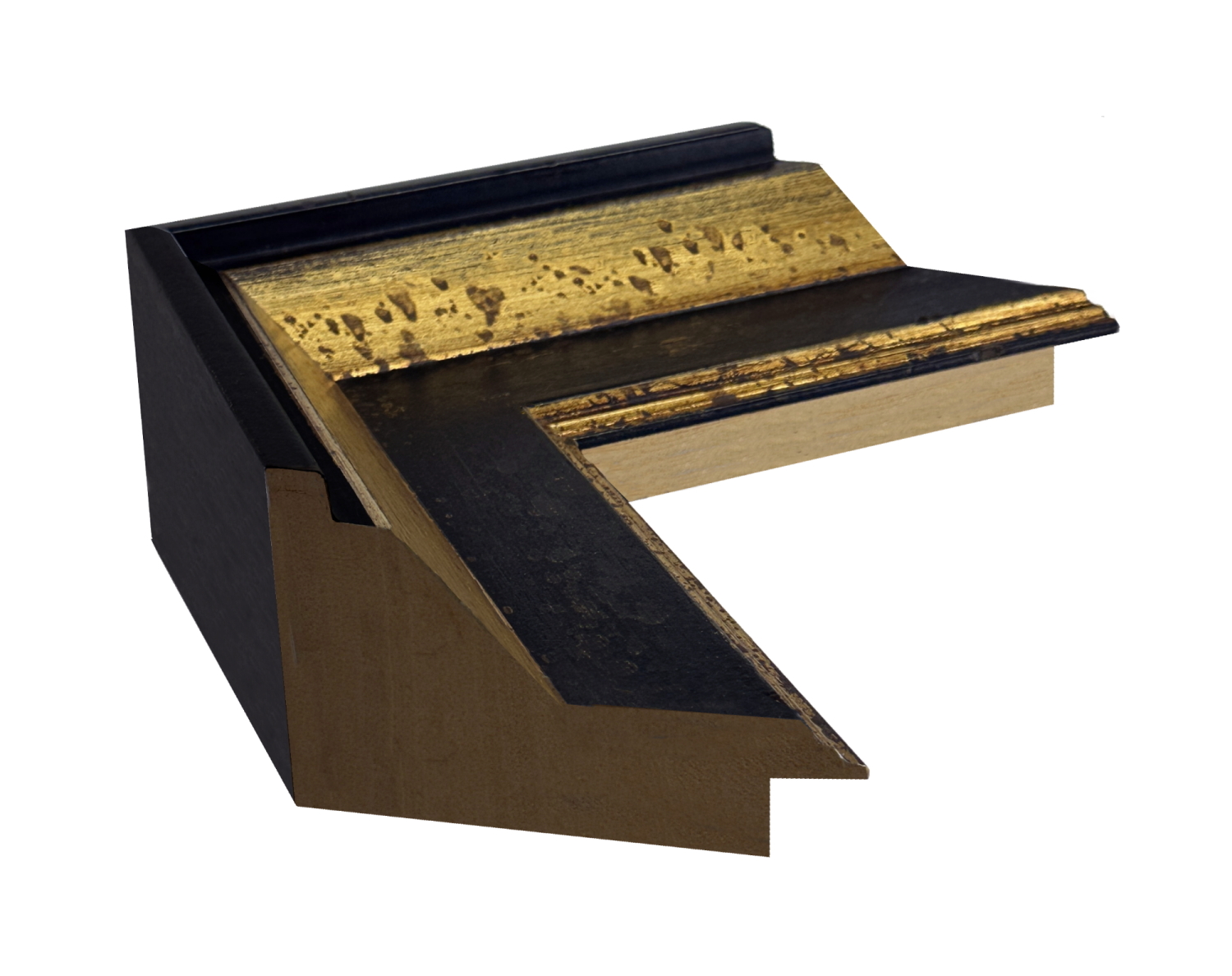
| 38 star American national flag, made in Lowell, Massachusetts with the intent of nautical use. Both the stars and the stripes are press-dyed on three panels wool bunting, joined by lineal, treadle stitching. There is a treadle-sewn, sailcloth canvas binding along the hoist with three brass grommets. Near the top, on the obverse, the following text is stenciled in black: “Patented Apr. 26th 1870.” Followed by “AMERICAN ENSIGN. 5 FT." “Ensign” is merely a term for a flag used aboard a ship. This particular example was made by the U.S. Bunting Co. of Lowell, Massachusetts. Versions of this stencil are present on other known U.S. Bunting Co. examples. The patent protected the firm’s owner, John Holt, with regards to his use of the clamp-dying process as a means to produce American flags. Colorado became the 38th state on August 1st, 1876. This was the year of our nation’s 100-year anniversary of independence. Per the Third Flag Act of 1818, stars were not officially added until the 4th of July following a state's addition. For this reason, 37 remained the official star count for the American flag throughout 1876. Flag-making was a competitive venture, however, and few flag-makers remained interested in producing 37 star flags when their competitors were making 38’s. It is for this reason that 38 and 13 stars (to represent the original 13 colonies) are the counts most often encountered at the Centennial International Exposition, our nation’s first World’s Fair, a six-month-long event, held in Philadelphia, which served as the nucleus of the national celebration. The stars of the flag are configured in what is known as a "notched" pattern, in which two spaces were left open, in anticipation that more Western Territories would soon be added. Evidence of the eagerness to do so was present beyond the early addition of the 38th star. Some flag-makers, especially those of printed parade flags (a.k.a., hand-wavers), actually began to produce 39 star flags in 1876, in hopeful anticipation of the addition of two more Western Territories instead of just one. The 39th state would not join the Union for another 13 years, however, when the Dakota Territory—thought to be coming as a single state—entered as two separate states on November 2nd, 1889. The 38 star flag generally fell out of production at that time, though it technically remained official until July 3rd, 1890. During the period during which this flag was made, lengths of 8 feet and longer, on the fly, were common in American flags. At just under 5.5 feet in length, the scale of this example is actually very small among its counterparts of the time, made from multiple pieces of fabric, for long-term, outdoor use. Although the U.S. Navy was in the habit of using 13 star flags on small craft, during the second half of the 19th century, as opposed to national flags with the full star count, like this one, there were probably exceptions to that rule. The U.S. Bunting Company was owned, in part, by Civil War General Benjamin Butler, who had a great deal of both political and military clout and is known to have sought and obtained Naval contracts on behalf of his business interests. At approximately 5.5 feet, the length of the flag would have matched 1882 U.S. Navy Regulations for a No. 7 small boat ensign. Though the height of the flag is inaccurate, at approximately 3.2 feet—an odd measurement—it does happen to match 1870-1882 regulations for a No. 13 small boat flag. Regulations do not seem to have been adhered to very strictly. Probably the hoist requirement was ignored by the firm, or by the quartermaster, in the interest of favorable pricing. This was outside wartime, and it is likely that pre-dyed fabric that was on hand, and/or the apparatus to make it, dictated one of these two measurements, or perhaps both. Unlike the hoist measurement, which was determined by the width of the stripes, the fly specifications could be easily achieved by clipping the striped fabric at the appropriate length. In addition, when a ship sailed into a foreign port, it would hoist a small, national flag of whatever nation the port belonged to. U.S. Bunting Co., a for-profit and opportunistic maker, would have sold to anyone in need of a flag, including an international audience. The reason for the inclusion of the word “American” on the stencil would have been for quick identification of the flag, among others, within the stores of foreign ships, sailing into American ports. The size of this flag would have served well for that purpose, in addition to others. I have owned examples of U.S. Bunting Co. flags, in this scale, with rows of tack holes along the hoist, likely from having been tacked to a staff and hand-carried. All-in-all, this is a great example within the 38 star count, with relationships to both Colorado and Massachusetts, with manufacture by an identified maker, with an interesting star pattern, and in a bold, yet manageable scale to frame and display. Some Notes on the Press-Dying Process: First patented in 1849, the press-dying process was thought to be a novel idea that would improve flag-making efficiency. In this case, for example, it could potentially alleviate the chore of hand-appliquéing 76 stars (38 on each side). In reality, however, the result must have been less efficient than sewing. To achieve white stars, for example, metal plates in the shape of stars had to be clamped to either side of a length of woolen fabric, in the desired configuration, so they were back-to-back. These may have been lightly brushed beforehand with a solution that would resist dye, or perhaps with a thin coat of wax. The stars were clamped together tightly, the bunting was dyed blue, and the areas where the metal stars were positioned would be left white. For flags with press-dyed stripes, the same task was repeated with different clamps. A form of resist-dyeing, this method often resulted in crude characteristics, such as stripes with irregular lines, in various widths, and stars with inconsistent shapes, in slightly varying sizes. It is likely that this resulted in some lost product and wasted time, from flags that had bleeding or misprint issues and were of too poor quality to sell. Within those flags that survived, today’s collectors today find the irregularities interesting, not only because they demonstrate early production methods, but also because they lend the sort of folk qualities that make early flags more interesting to look at. Wool was preferred because it sheds water, making it the fabric of choice for all maritime flags and, in fact, most flags produced by professional flag-makers for long-term outdoor use. Whatever the case may be, printing on wool is costly and difficult. Even today, only about 1% of wool fabric is printed*, because it generally needs to be washed afterward and wool cannot easily be treated with water. Press-dying was primarily used during the Centennial-era by the U.S. Bunting Company of Lowell, Massachusetts, which began making press-dyed flags for the U.S. military in 1869, and by Horstmann Brothers. The U.S. Bunting Co. was one of the first flag-makers to successfully produce high quality wool bunting fabric in the States, and while its owners worked diligently to master the press-dyeing process, it seems quite obvious today that it was actually more costly than anticipated. This would explain why it never became a popular method of flag production. * Chen, W., Wang, G., & Bai, Y., “Best for Wool Fabric Printing…,” (Textile Asia, 2002, v.33 (12)), pp. 37-39. Mounting: The flag was mounted and framed within our own conservation department, led by expert trained staff. We take great care in the mounting and preservation of flags and have framed thousands of examples. The background is 100% cotton twill, black in color, that has been washed and treated for colorfastness. The black-painted, hand-gilded and distressed molding is Italian. The glazing is U.V. protective acrylic (Plexiglas). Feel free to contact us for more details. Condition: Exceptional for a wool flag of the period. There is extremely minor mothing throughout, accompanied by extremely minor soiling along the hoist. |
|
| Video: | |
| Collector Level: | Intermediate-Level Collectors and Special Gifts |
| Flag Type: | Sewn flag |
| Star Count: | 38 |
| Earliest Date of Origin: | 1876 |
| Latest Date of Origin: | 1889 |
| State/Affiliation: | Colorado |
| War Association: | 1866-1890 Indian Wars |
| Price: | Please call (717) 676-0545 or (717) 502-1281 |
| E-mail: | info@jeffbridgman.com |
 |
|