| |
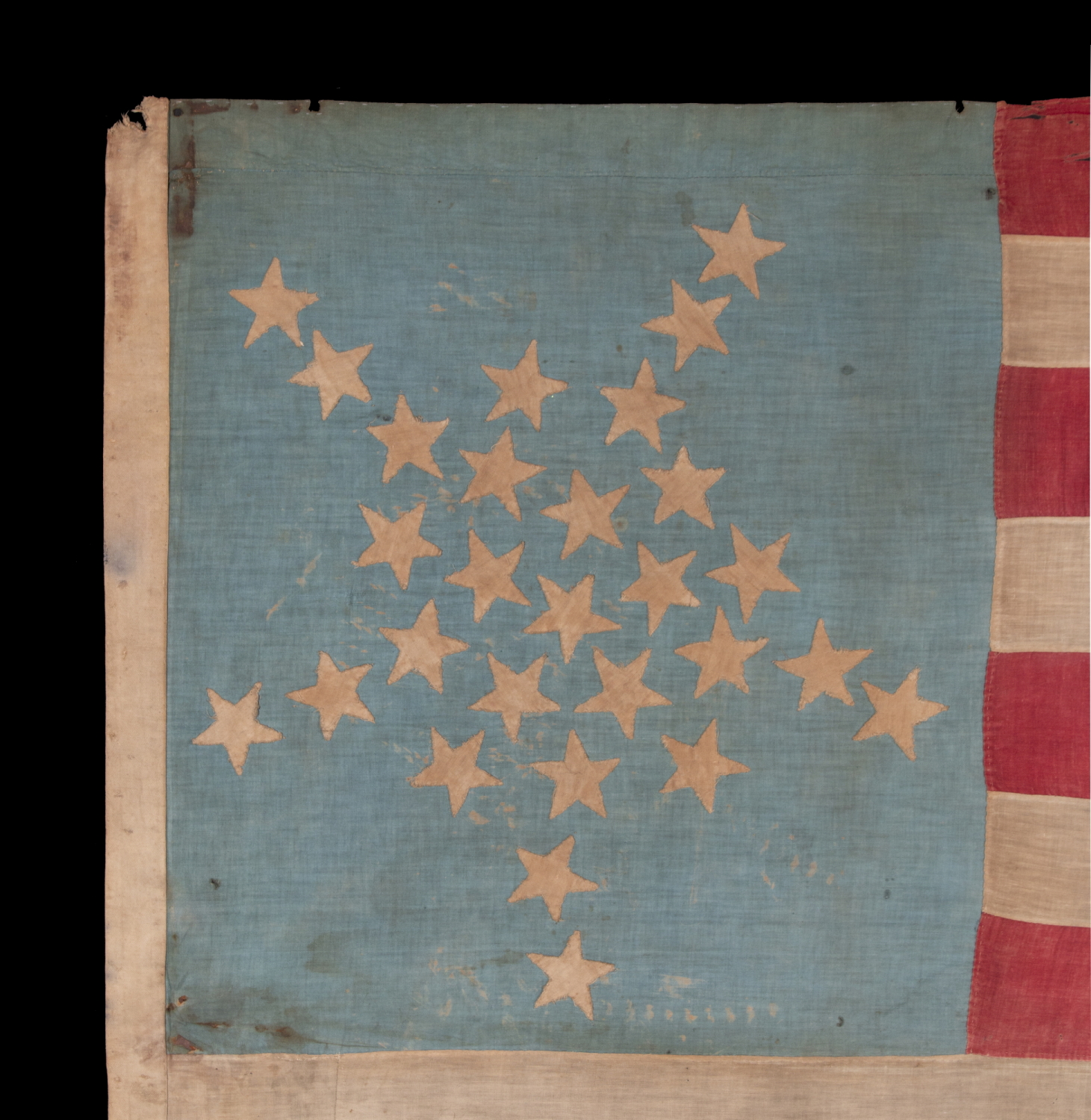
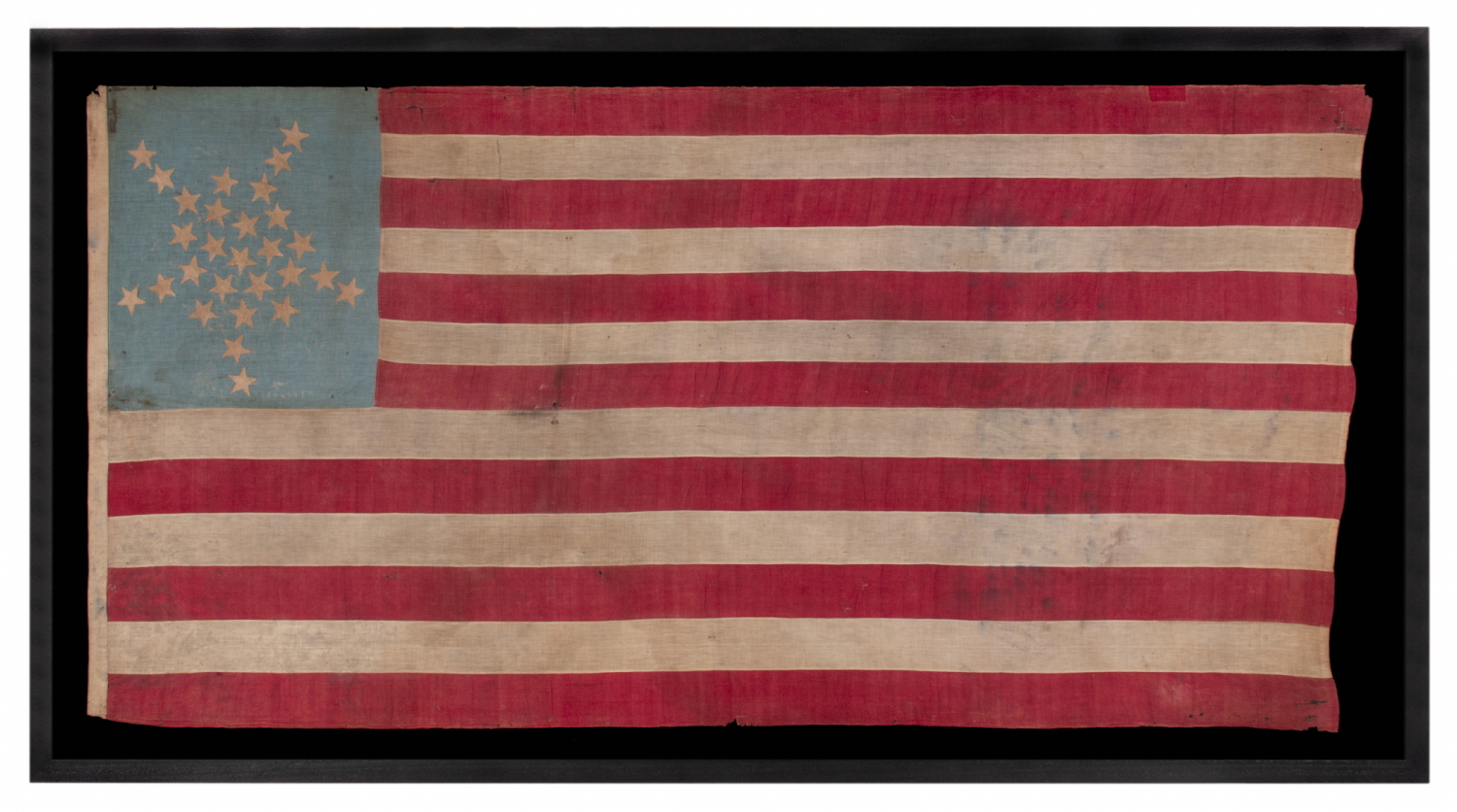
28 STAR ANTIQUE AMERICAN FLAG, REFLECTS THE ADDITION OF TEXAS TO THE UNION AS THE 28TH STATE IN 1845, WITH ITS STARS ARRANGED IN A GREAT STAR PATTERN – AN ESPECIALLY FITTING CONFIGURATION FOR THE ‘LONE STAR’ STATE – ON A CORNFLOWER BLUE CANTON; OFFICIAL FOR JUST ONE YEAR (1846-1847), AND THE BEST OF ALL EXAMPLES PRESENTLY KNOWN IN BOTH PUBLIC AND PRIVATE COLLECTIONS |
|
| Available: |
Sold |
| Frame Size (H x L): |
Approx. 65.5" x 120.5" |
| Flag Size (H x L): |
53" x 108.5" |
|
| Description....: |
|
| American national flags with 28 stars, made at the time when Texas gained statehood, are among the most rare and desirable of the 19th century. Very few period examples exist in any form and most major collections of early flags that have been assembled over the years have not included one.
Part of the reason why 28 star flags are so rare is the early date. Another is the manner of use of the Stars & Stripes in this early period. And of equal importance is the fact that the star count was official for only one year.
Became the 28th state on December 29th, 1845. After the Third Flag Act (1818), stars were officially added to the American flag on the 4th of July following a state's addition. This meant that the 28th star would theoretically have been added on July 4th, 1846. Because the makers of flags both private and public cared little for the acts of Congress, however, the 28th star would have been added by most makers at the time of the addition of the state. The star may perhaps have been added even shortly before, in anticipation of the event. The practice of making anticipatory flags was popular in early America, when the nation was eager for expansion.
Iowa became the 29th state just one day shy of a year following Texas' addition, on December 28th, 1846. While the 29th star was not officially added until July 4th, 1847, most flag-makers would have once again added it on or before Iowa's addition. So the production of 28 star flags had a window of approximately one year in length, which meant that it was one of the shortest lasting star counts in American history.
Another reason that 28 star flags are so scarce is that they were produced during a time before the Stars & Stripes was in widespread use. Flags made prior to the Civil War are extremely rare, comprising less than one percent of 19th century flags that exist in the 21st century. Prior to the Confederate attack on Fort Sumter in 1861, the Stars & Stripes was simply not used for most of the same purposes we employ it in today. Private individuals did not typically display the flag in their yards and on their porches. Parade flags didn't often fly from carriages and horses. Places of business rarely hung flags in their windows. The only consistent private use prior to 1861 seems to have accompanied political campaigning.
Even the military did not use the national flag in a manner that most people might think. Most people are surprised to learn that the infantry wasn't authorized to carry the Stars & Stripes until well into the 19th century. The foremost purpose before the Civil War (1861-65) was to identify ships on the open seas. While the flag was used to mark garrisons and government buildings, the flags of ground forces were limited to the those of their own regiment and a perhaps a federal standard (a blue or buff yellow flag bearing the arms of the United States). Artillery units were the first to be afforded the privilege in 1834. Infantry followed in 1841, but cavalry not until 1862. The first actual war in which the Stars & Stripes was officially carried was thus the Mexican War (1846-48). In more than 20 years of aggressive buying and research, I have encountered almost no American national flags produced in an obvious military style that are of the Mexican War period.
If rarity is one driver of desirability, relevance to a significant population of capable, patriotic collectors is another. Before 1836, Mexico considered Texas part of its own territory. In that year a revolution was launched that resulted in independence. For the next nine years the Republic of Texas was a nation unto itself and selected its own president.
Texas statehood, in 1845, was immediately followed by war with Mexico, which contested its ownership. The war was short, beginning in 1846, concluding in 1847, and consummated by the Treaty of Guadalupe Hidalgo on February 2nd, 1848.
In addition to being the largest body of land among the contiguous 48 states, the circumstance of Texas having been an independent entity was unique (until Hawaii joined the Union 114 years later) and is undoubtedly one reason why Texas patriotism has remained so keen. It is also a state where great wealth was amassed from American capitalism in land-driven enterprises such as ranching and oil. Success in these businesses and others played its own role in the development of independent-minded men and women, a significant portion of whom are proud to be Texans first and Americans second. Many are fascinated with the history of the Republic, its role as part of the American South, and the combined heritage of Texas and America together. All of the above plays a role in the desirability of Texas-related material.
The number of surviving 28 star flags is tiny, certainly fewer than 10. While the first, small, printed parade flags surfaced during the period when we had 26 states (1837-1844), just one printed flag is presently known in the 28 star count that may, in fact, date to the 1845-46 period. All other known examples made during this very brief time frame are of pieced-and-sewn construction.
The stars are arranged in what is known as the “Great Star” or “Great Luminary” pattern—one large star, made out of smaller ones. Great Star patterns vary widely in the way that they are assembled. In this case the configuration is comprised of a central star, surrounded by a pentagon of stars, followed by what would be another pentagon save that an additional star was included in the top, hoist end (somewhat difficult to see). Beyond this lopsided formation are groups of 2 stars extending outward at 5 roughly equivalent points around the perimeter. This results in an especially whimsical Great Star with especially pointy arms and wonderful graphic impact.
Some Notes About the Great Star Pattern:
Among early American flags there are nearly countless star patterns, but most have lineal rows or columns. Circular designs are the next step up the rarity scale. The Great Star is a hefty step beyond, far more scarce and highly coveted, due to both its rarity and strong visual qualities. The concept of arranging the stars in this fashion seems to have come about shortly after the War of 1812, when Congressman Peter Wendover of New York requested that Captain Samuel Reid, a War of 1812 naval hero, create a new design that would become the third official format of the Stars & Stripes. A recipient of the Congressional Medal of Honor, Reid became harbor master of New York following the war. During his lifetime, he created many innovations in signal use, including a system that could actually send messages from New York to New Orleans by sea in just two hours.
Use as a Naval signal had been the primary reason for the initial creation of an American national flag in 1777, but since there was no official star design, the appearance of our flag varied greatly. Reid’s primary concern centered on both consistency and ease of recognition. His hope was as more and more states joined the Union and more and more stars were added to the flag, that this important signal would remain easily identified on the open seas. In 1818, Reid suggested to Congress that the number of stripes permanently return to 13 (reduced from 15) and that the stars be grouped into the shape of one large star.
Reid’s proposal would have kept the star constellation in roughly the same format, in a pattern that could be quickly identified at a distance as the number of states grew. His concept for the stripes was ultimately accepted, but his advice on the star pattern was rejected by President James Monroe, due to the increased cost of arranging the stars in the fashion. Monroe suggested a simple pattern of justified rows, but did not issue an official deign, so the Great Star was produced by anyone willing to make it. Its rarity today, along with its beauty, has driven the desirability of American flags with this configuration.
In concise summary, this is one of the rarest 19th century flags that one may encounter, with one of the most desirable star patterns, great color, and reflecting the addition of a wealthy, large, and seriously patriotic state. The flag presently exists as the best of its kind.
Provenance: Exhibited for approximately 15 years at the The Bullock Texas State History Museum, Austin; Illustrated in “A Grand Old Flag: A History of the United States Through its Flags” by Keim, Peter (2007, DK Adult, New York).
Mounting: The flag was mounted and framed within our own conservation department, which is led by expert staff. We take great care in the mounting and preservation of flags and have framed thousands of examples.
The flag has been hand-stitched to 100% cotton twill, black in color, which was washed and treated to set the dye. The substantial, black-painted molding, with mahogany grain, is Italian. The glazing is U.V. protective acrylic.
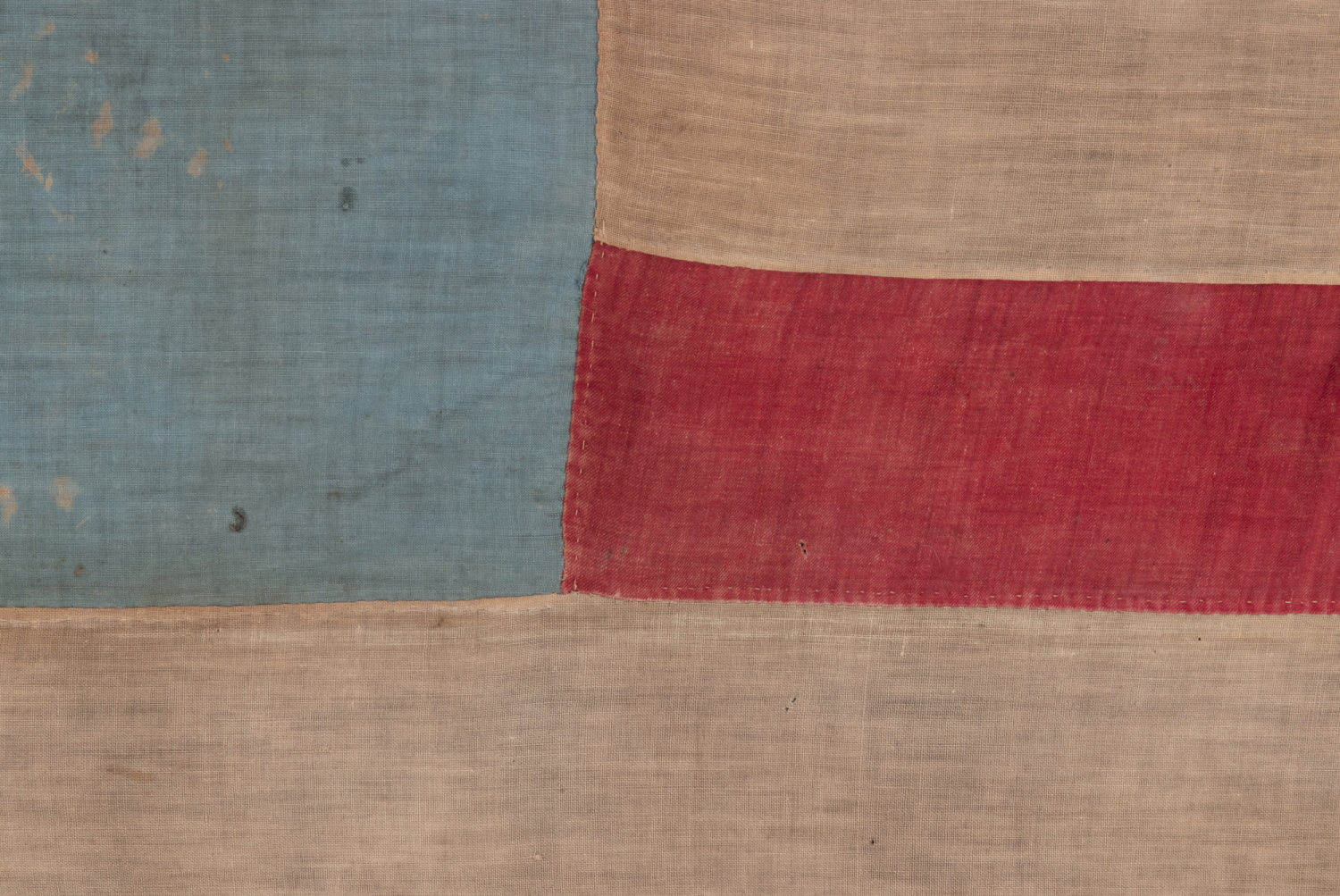
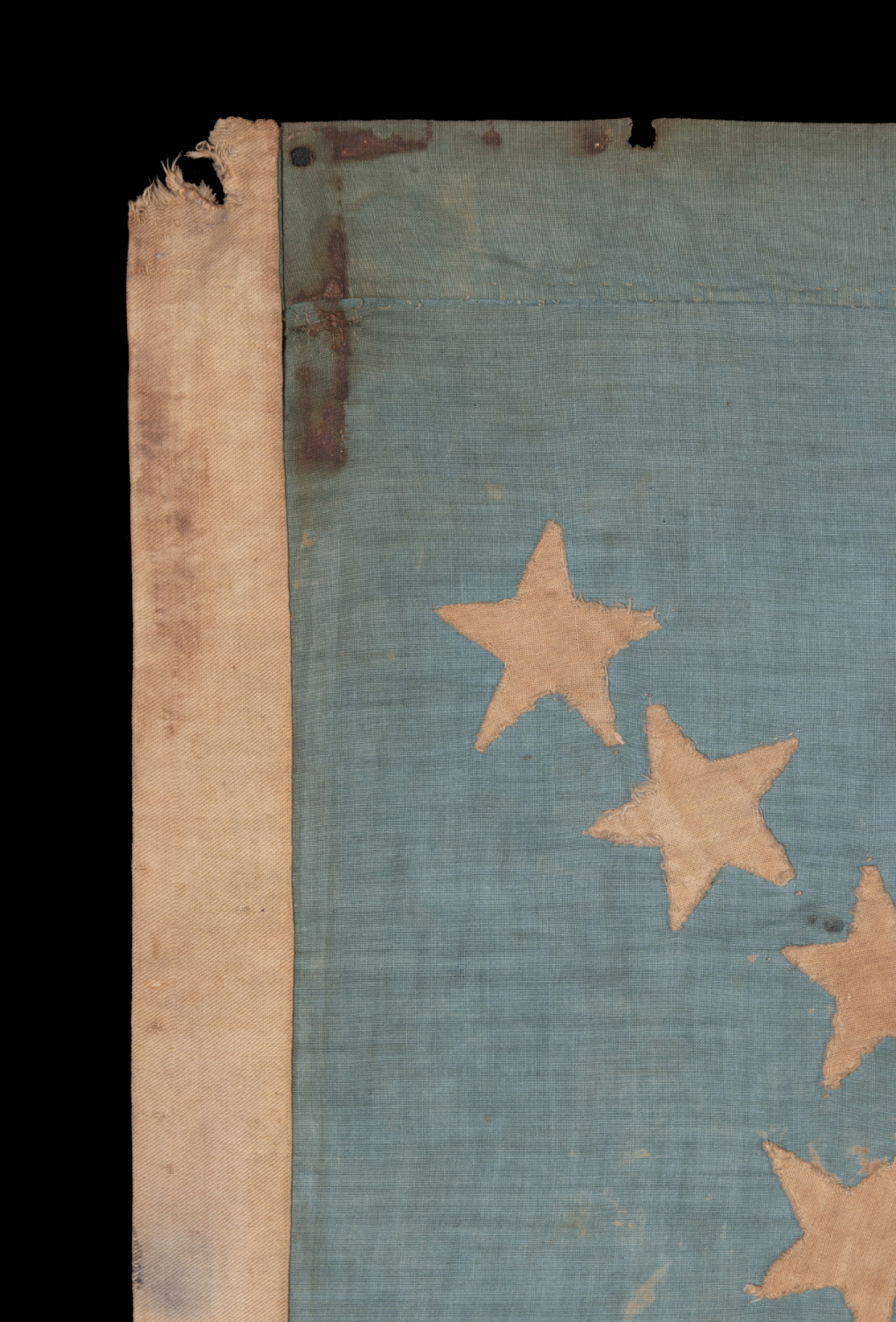
Condition: There is some soiling throughout and some rust staining in the upper and lower corners of the canton on the hoist end. There is some more significant soiling and some small holes between the 6th and 7th stripes, beyond the canton. There are various other tiny holes and small tears throughout, with very minor losses, some with stitched repairs. The most significant of these are at the fly end, in the upper and lower corners, save for the following: There is a rectangular area of loss measuring about 1.5” x 3” along the top edge of the 1st stripe, fairly close to the fly end. We placed early fabric of similar coloration behind this area during the mounting process. There is a 2” x 2” L-shaped tear in the same stripe, near the canton and a vertical mend about 15 inches beyond this. There is a large, vertical repaired tear in the 2nd stripe, near the canton, and a much smaller one near the fly end. There is a stitched repair in the middle of the 7th stripe. There is fabric loss at both the top and bottom of the sleeve. The great rarity of this flag warrants practically any condition. |
|
|
|
| Collector Level: |
Flags for the truest Patriots. My best offerings |
|
| Flag Type: |
Sewn flag |
|
| Star Count: |
28 |
|
| Earliest Date of Origin: |
1845 |
|
| Latest Date of Origin: |
1846 |
|
| State/Affiliation: |
Texas |
|
| War Association: |
1777-1860 Pre-Civil War |
|
| Price: |
SOLD |
|
| |
Views: 13 |
|
|
|