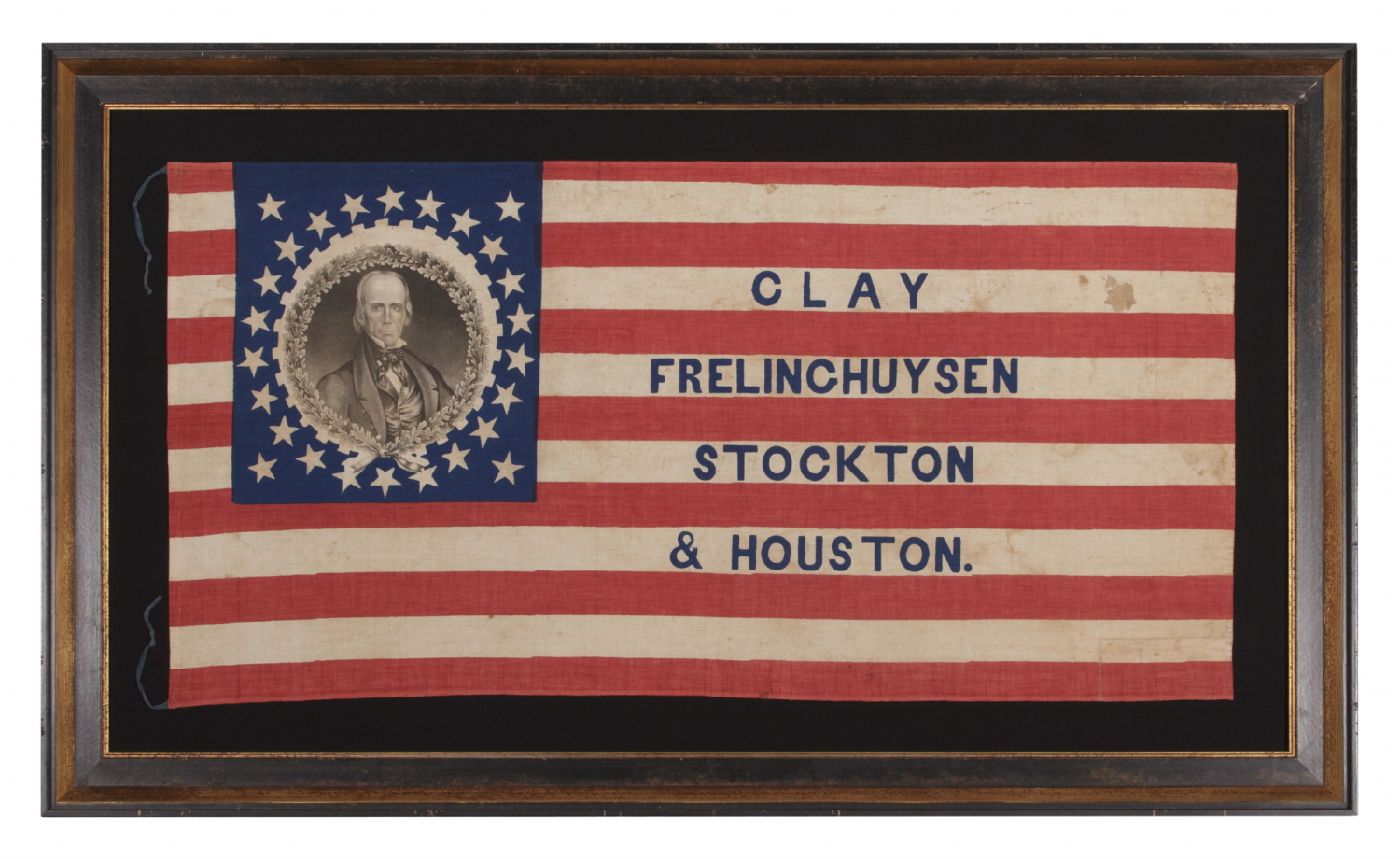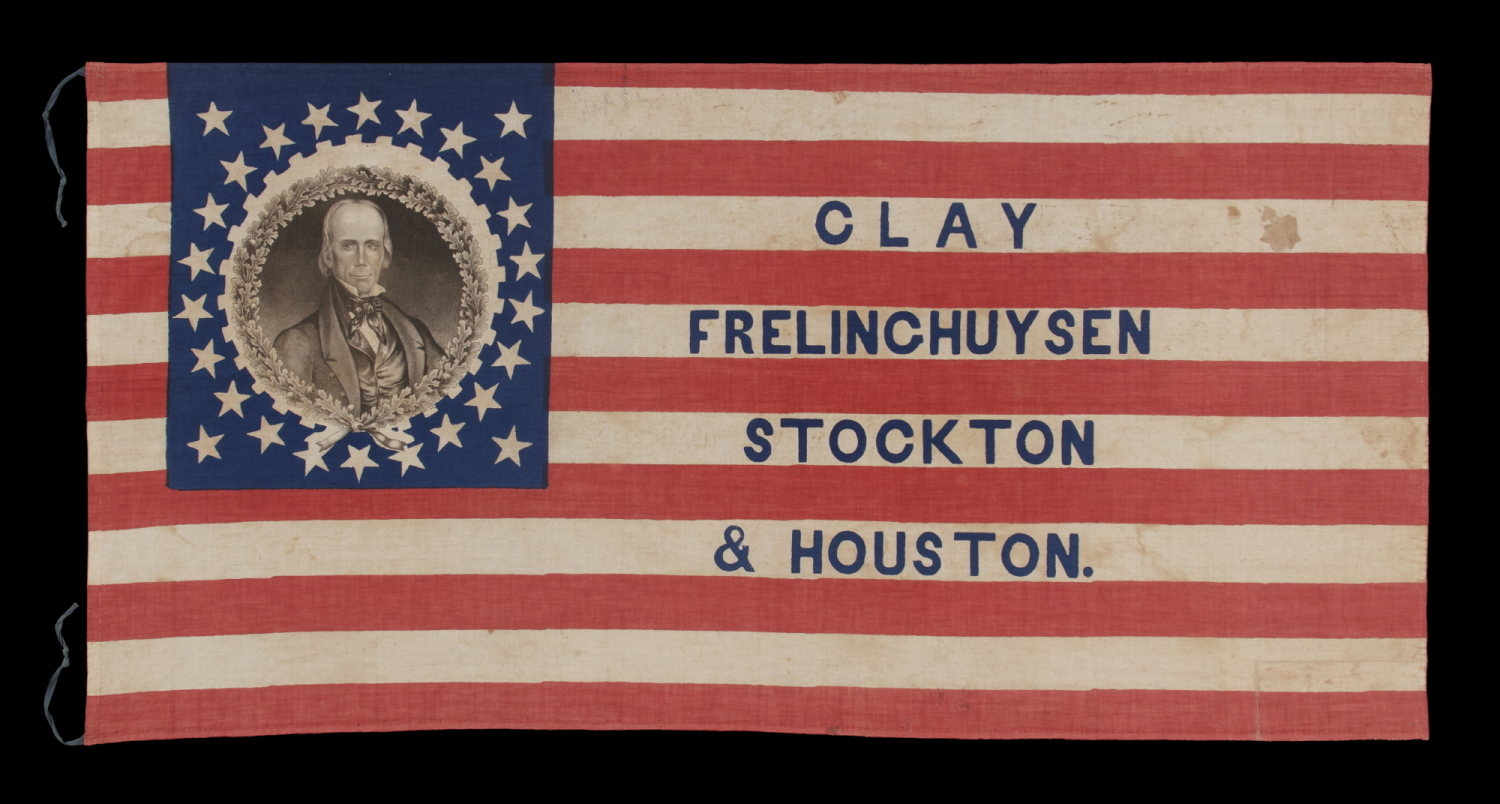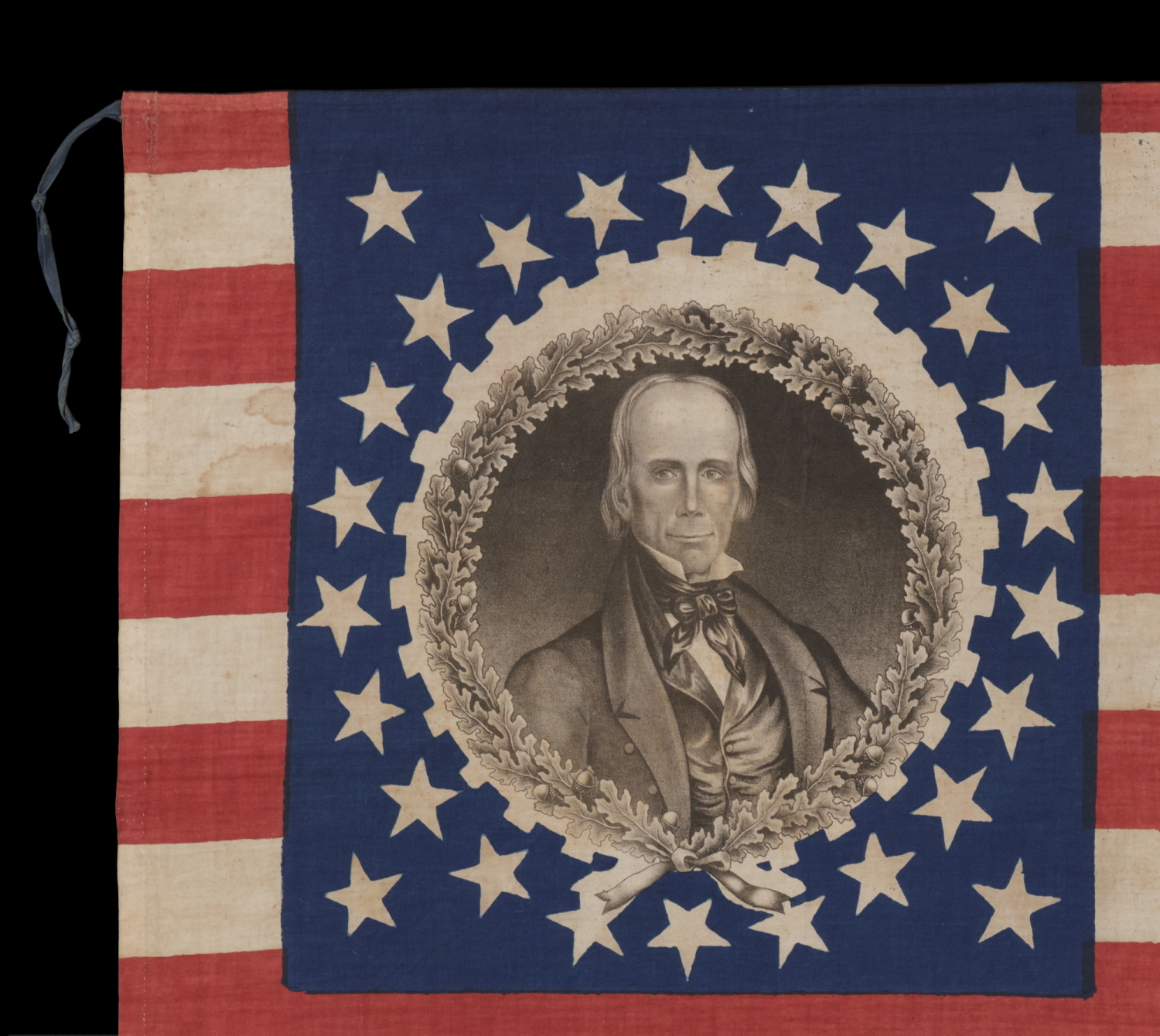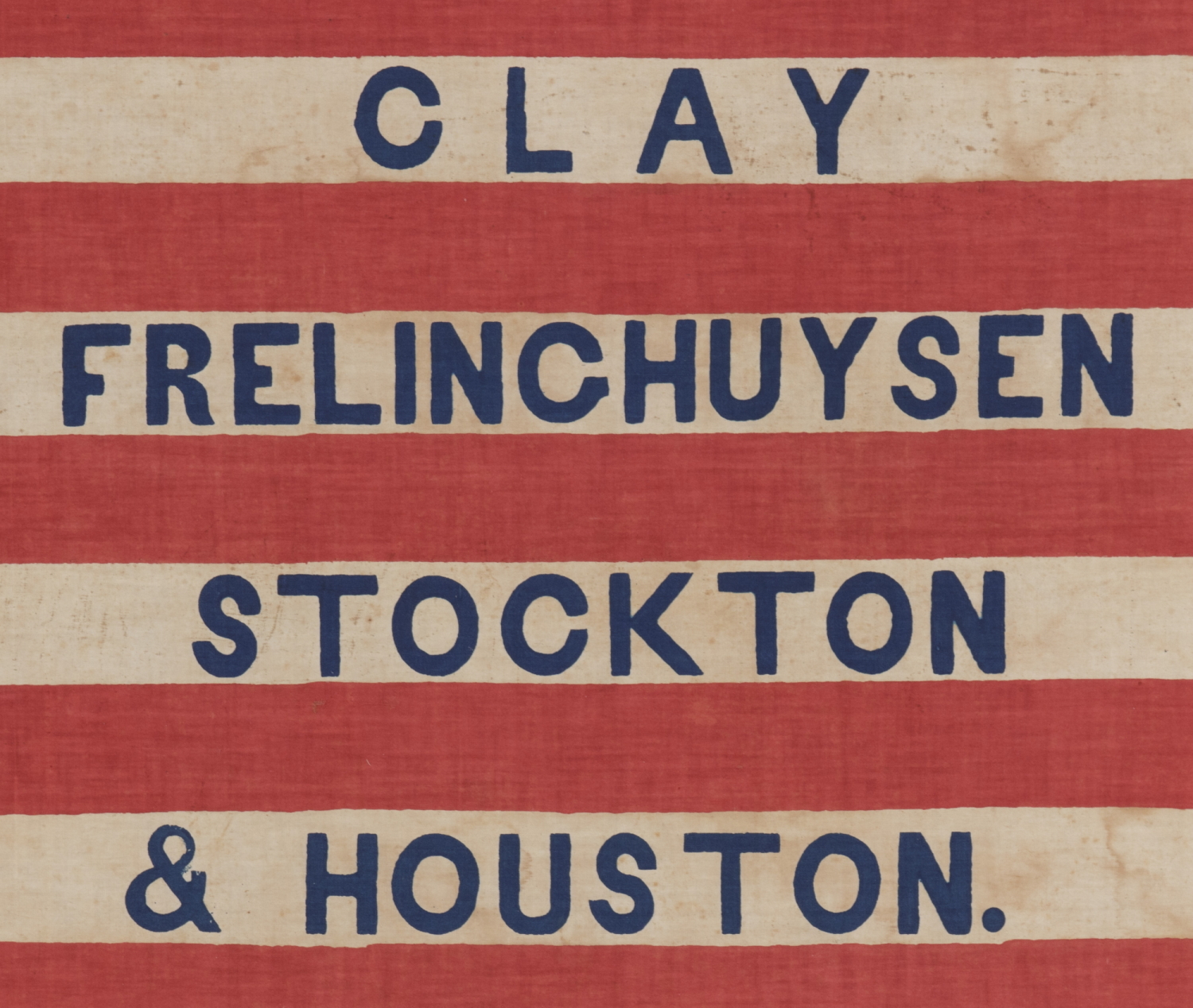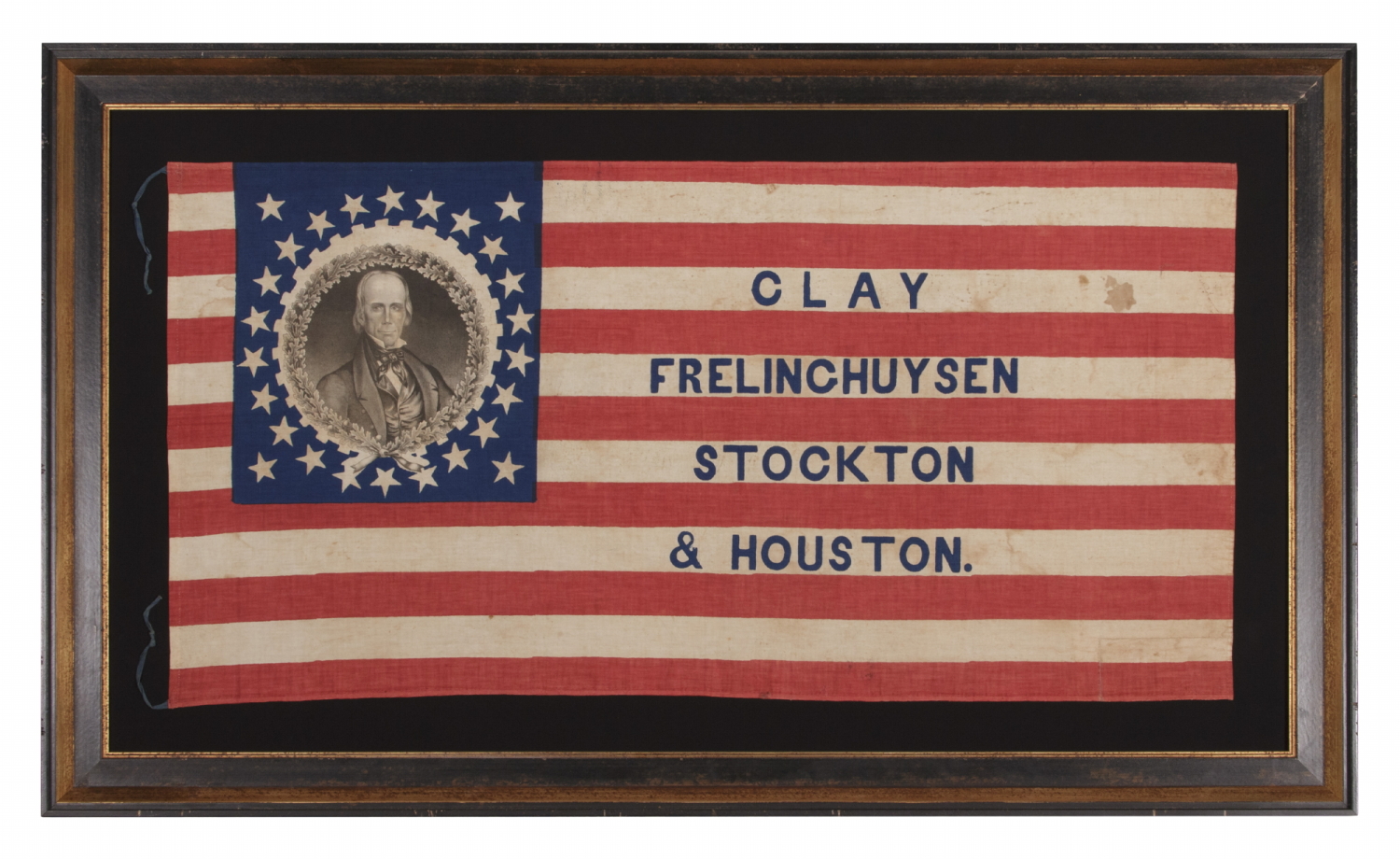
| 26 STAR AMERICAN PARADE FLAG, MADE FOR THE 1844 PRESIDENTIAL CAMPAIGN OF HENRY CLAY AND THEODORE FRELINGHUYSEN, WITH CLAY’S PORTRAIT SET WITHIN AN OAK LEAF & GEAR COG MEDALLION AND THE RARE PRESENCE OF SUCCESSFUL DELAWARE COATTAIL CANDIDATES STOCKTON & HOUSTON |
|
| Web ID: | 26j-827 |
| Available: | Sold |
| Frame Size (H x L): | 39" x 66.5" |
| Flag Size (H x L): | 27.25" x 54.5" |
| Description: | |
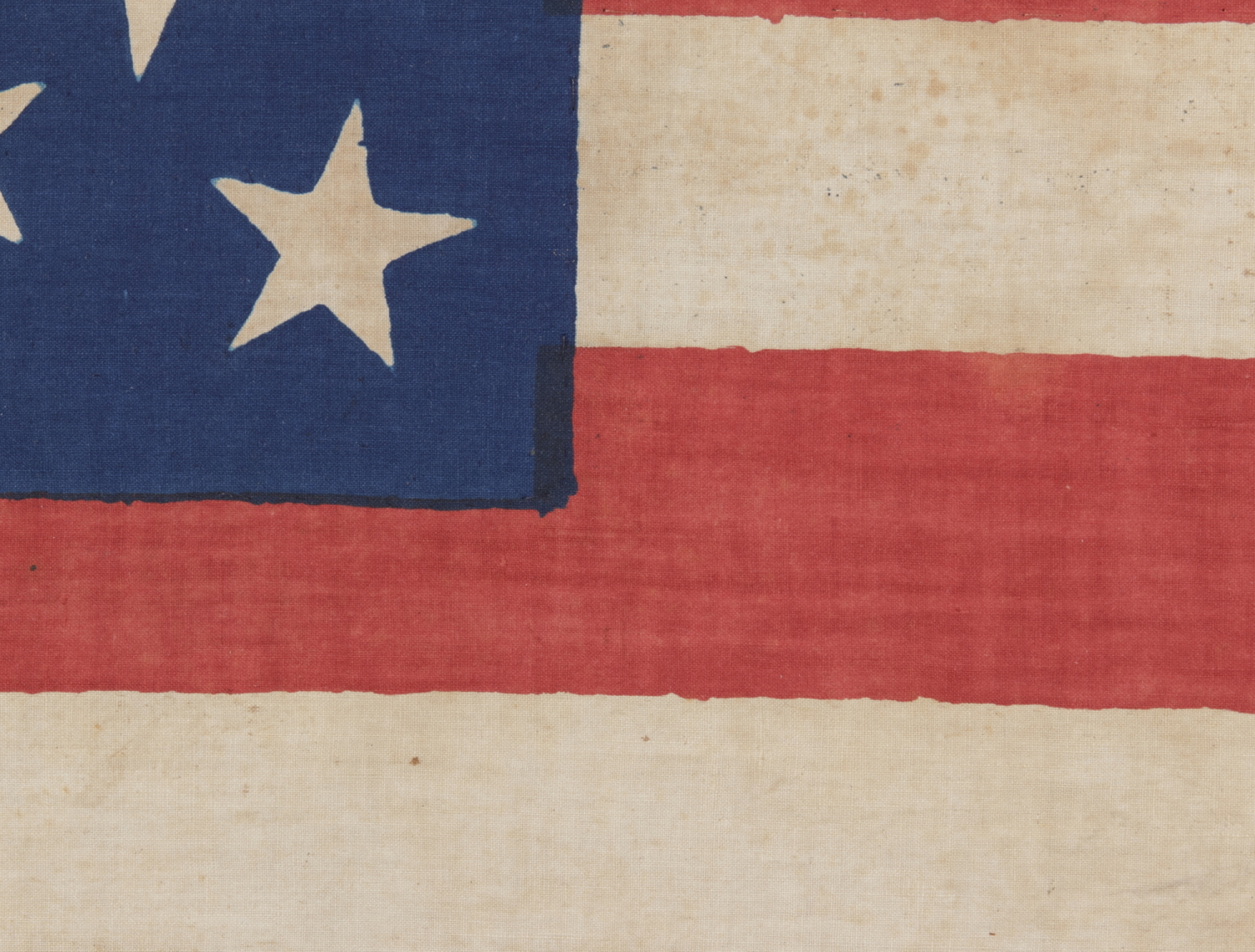
| This bold and whimsical textile can easily be argued to be the most graphic of all known American flags made during the 19th century for political campaign use. In fact, this assertion could be expanded to include all versions of the Stars & Stripes. Produced for the 1844 presidential aspirations of Whig Party candidates Henry Clay, with running mate Theodore Frelinghuysen, this is a parade flag, made to be tacked to a staff, to be waved at parades or political events. Printed on plain weave cotton, the flag is extremely large among its known counterparts. The design was conceived at the very beginning of the era of printed flags, with its 26 stars representing the earliest known star count on printed designs.* The first known parade flags that can be dated to a specific year can be traced to 1840, just 4 years prior, made to advertise the presidential campaign of Whig candidate William Henry Harrison. Many people don’t realize that in early America, campaigning for public office was generally considered to be unbecoming of a gentleman. The most dramatic change to this concept took place that year, when the Whigs and Harrison became the first to actively pursue the venture. Both flags and kerchiefs were commercially produced promote the 1840 Whig ticket, though Democrats were slow to respond. None exist for Democrat incumbent, Martin Van Buren, who lost the White House to Harrison, as the Whigs discovered campaigning to be a worthwhile endeavor. On this particular flag, Clay’s imposing portrait appears in the center of beautiful, royal blue canton, friendly but with an almost haunting, maniacal overtone. Achieved with a copper plate, this and the surrounding border of oak leaves and acorns are extremely detailed. The wreath and portrait image make this unusually fanciful among portrait style flags, as does the wheel clog border. Beyond this is a wreath of 22 stars, with a flanking star in each corner that completes the fantastic medallion device. The surnames of the candidates are printed in the same, brilliant blue within the 4th and 6th stripes. Several flags are known in this style, but what makes this particular example far more unusual are the additional names that follow in the 8th and 10th stripes. These represent successful Delaware Whig Party candidates Thomas Stockton (gubernatorial) and John Wallace Houston (congressional). Presidential campaign flags that feature coattail candidates are extraordinarily rare. Their presence here is not only desirable for its scarcity, but the associated graphic impact. Note how the combination of the names, and the field of stripes, with their notedly exaggerated length, add substantial visual effect. Among surviving flags of 1844, presentation of this flag is only matched by a variant of the same design, produced for a political faction called the Native American Party, which didn’t put forth a presidential candidate and generally supported Clay’s candidacy. It is of interest to note that a very similar flag was produced for Clay’s Democrat opponents, James Polk & George Dallas. Though their basic elements are very similar, the form of the Polk is neither as elongated, nor as striking. Possibly produced by a competing flag-maker, a Clay variant exists, as well, the profile of which matches the Polk. Both exhibit different shades of red and blue, and with a different engraved portrait that displays slight differences. Born in Virginia on April 12th, 1777, about 2 months before the Stars & Stripes was adopted as the American national flag (June 14th), Henry Clay was both a founding Whig Party member, and organizer, who studied law at the College of William & Mary, in Richmond, before setting up a practice in Kentucky, in 1797, just 5 years after the territory had become the 15th state. Clay’s most famous client was Aaron Burr, whom he successfully defended from a charge of treason in 1807. Elected to the Kentucky House of Representatives in 1803, the state legislature elected him to the United States Senate just 3 years later, in 1806. Sworn in at age 29, a year younger than required by law, no one opposed when Clay took his seat. Deciding that he didn’t like the rules of the Senate, Clay ran, unopposed, for a seat in the U.S. House of Representatives in 1810, soon after becoming the youngest person to thus far be selected as Speaker. Known as "The Great Compromiser" and "The Great Pacificator,” he played a significant role in the negotiated Treaty of Ghent, that brought an official close to the War of 1812. Returning to the Senate twice, in 1831 and 1849, he served that institution for a total of 16 years, and the House for 10. From 1825-1829 he served as Secretary of State under John Quincy Adams. Until his death, in 1853, Clay was heavily involved with mitigating matters between the Free & Slave States, spearheading both the Missouri Compromise of 1820, and the subsequent Compromise of 1850, that restored some semblance of order when it expired. Represented by 15 states in each faction, the addition of California as the 16th Free State, on September 9th of that year, permanently tipped the balance of power in favor of the North. Clay’s platform focused on the creation of a national currency, promotion of agriculture, and protection of American industry through such devices as protective tariffs. The gear in the canton represents the importance of the advancement of America into the industrial age and less reliance on foreign goods. As it turned out, this issue was not as important to Americans as westward expansion, which was the platform of the successful presidential candidate, James Polk. When he ran in 1844, Clay had sought the White House two times previously, in both 1824 (Democratic Republican ticket) and 1832 (National Republican). “Always a bride’s maid, never a bride” is a phrase often uttered, for one of the most loved and longest-serving public servants in American history. Clay’s platform focused on the creation of a national currency, promotion of agriculture, and protection of American industry through such devices as protective tariffs. The gear in the canton represents the importance of the advancement of America into the industrial age and less reliance on foreign goods. As it turned out, this issue was not as important to Americans as westward expansion, which was the platform of the successful presidential candidate, James Polk. It is of interest to note that the 1844 election was the first in which an incumbent president, John Tyler, sought nomination and didn’t get it, which made Polk a dark horse nominee. Joseph Smith, who soon after founded the Mormon Church, in 1847, ran as a third party candidate. No flags or textiles survive from the Smith campaign. Michigan joined the Union as the 26th state on January 26th, 1837. The 26 star flag became official on July 4th of that year and remained so until July 3rd, 1845, following the addition of Florida as the 27th state. The earliest known parade flags, made within that 8-year period, have either 26 or 13 stars, the latter paying homage to the original 13 colonies. More About Clay’s Presidential Campaigns & His 1844 Running Mate, Theodore Frelinghuysen: Henry Clay ran for president as a Democratic Republican in 1824, then as a National Republican in 1832, and as a Whig in 1844. The first of these may arguably have been the most interesting historically. In 1824 there were 4 candidates, all from one party (Democrat-Republican), including John Quincy Adams, Andrew Jackson, William H. Crawford, and Clay. None garnered a large enough majority of the electoral vote to win. Adams won New England, while Jackson and Adams split the mid-Atlantic states, Jackson and Clay split the Western states, and Jackson and Crawford split the South. Jackson finished with a plurality of the popular vote (though there was none in six states, including New York, the most populous of these), and also of the electoral vote, while the other three candidates each finished with a significant share. Clay, who finished fourth, was eliminated. Lack of the required majority caused a contingent election to be held by the House of Representatives, of which Clay was the Speaker. Adams won and offered Clay an appointment to Secretary of State, which he had badly wanted in 1820, when President James Monroe had instead selected Adams. Following his 1825-1829 term of service, Clay returned to the Senate, where he served from 1831-1842, and then again from 1849-1852. Clay’s running mate, Theodore Frelinghuysen was born in Franklin, NJ in 1787. Before he ran for vice president, he was an attorney, served as New Jersey’s Attorney General (1817-1829), then a U.S. Senator (1829-1835), then Mayor of Newark (1837-38), then Chancellor of NYU (1839-1850), then President of Rutgers College (1850 until his death in 1862). His grandson was Henry Cabot Lodge, Jr. The Frelinghuysen family represents a political dynasty in New Jersey, including a member of the Provincial Congress of New Jersey, a delegate to Continental Congress, a delegate to the U.S. Constitutional Convention, a U.S. Secretary of State, 3 United States Senators, and 2 members of the United States House of Representatives. * Although we no longer had 13 states, the 13 star count was also used on printed flags during the same period. Mounting: The textile has been mounted and framed within our own conservation department, which is led by expert staff. We take great care in the mounting and preservation of flags and have framed thousands of examples. The textile has been hand-stitched to 100% cotton, black in color, that was washed and treated for colorfastness. The mount was then placed in a black-painted, hand-gilded and distressed Italian molding. The glazing is Optimum Museum Acrylic (Plexiglas), U.V. protective, anti-reflective (crystal clear), and scratch-resistant. Condition: In the bottom, fly end corner it would appear that a rectangular piece of the last red stripe and a portion of the white stripe above was intentionally clipped. This was placed back in position and stabilized during the mounting process. There is minor to soiling, with a couple of areas of modest to moderate staining towards the fly end, beyond and adjacent to the text. There is minor fading in the red stripes. Many of my clients prefer early flags to show their age and history of use. The flag is in an exceptional state of preservation for the period and presents beautifully. |
|
| Video: | |
| Collector Level: | Flags for the truest Patriots. My best offerings |
| Flag Type: | Parade flag |
| Star Count: | 26 |
| Earliest Date of Origin: | 1844 |
| Latest Date of Origin: | 1844 |
| State/Affiliation: | Kentucky |
| War Association: | |
| Price: | SOLD |
| E-mail: | info@jeffbridgman.com |
 |
|