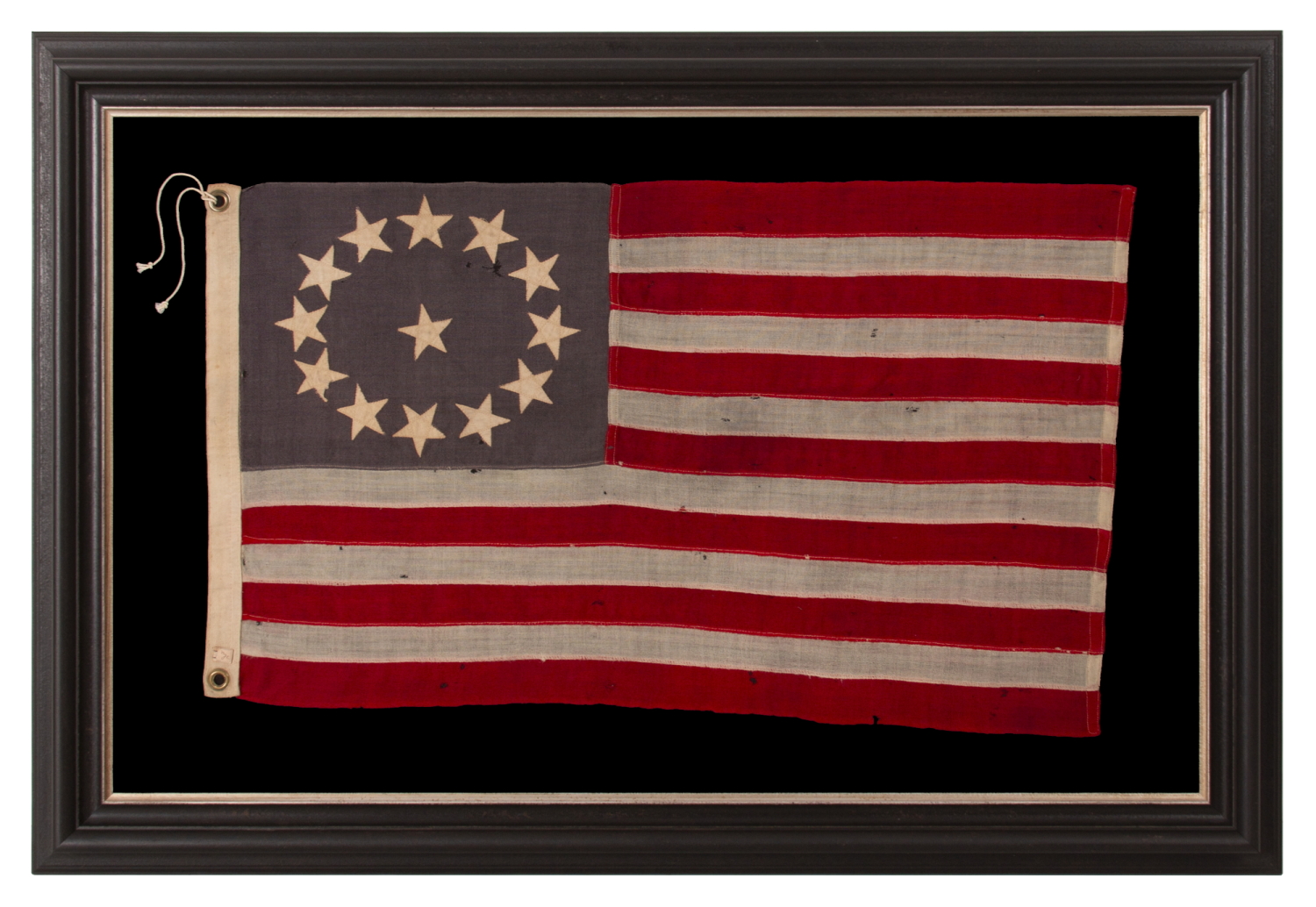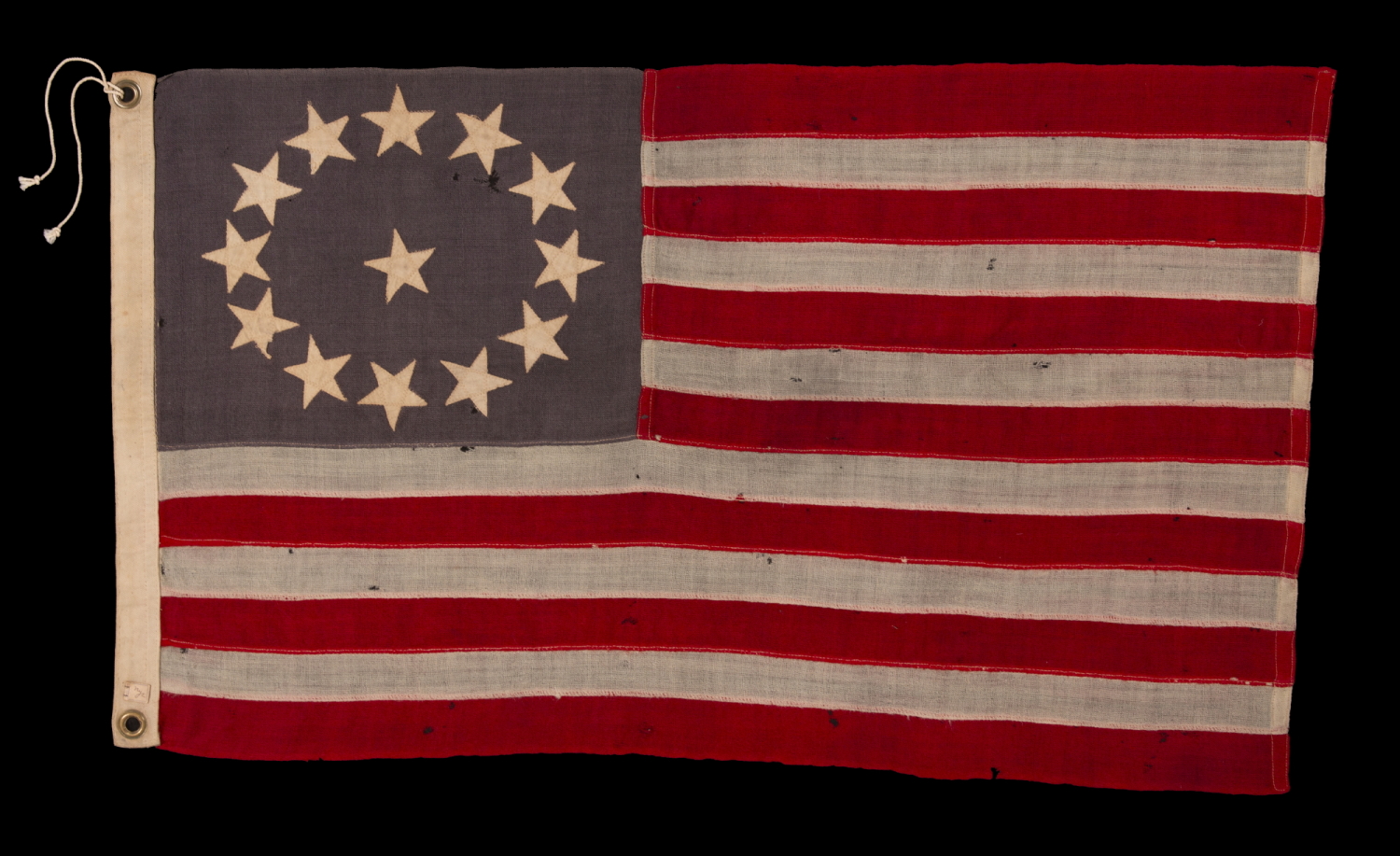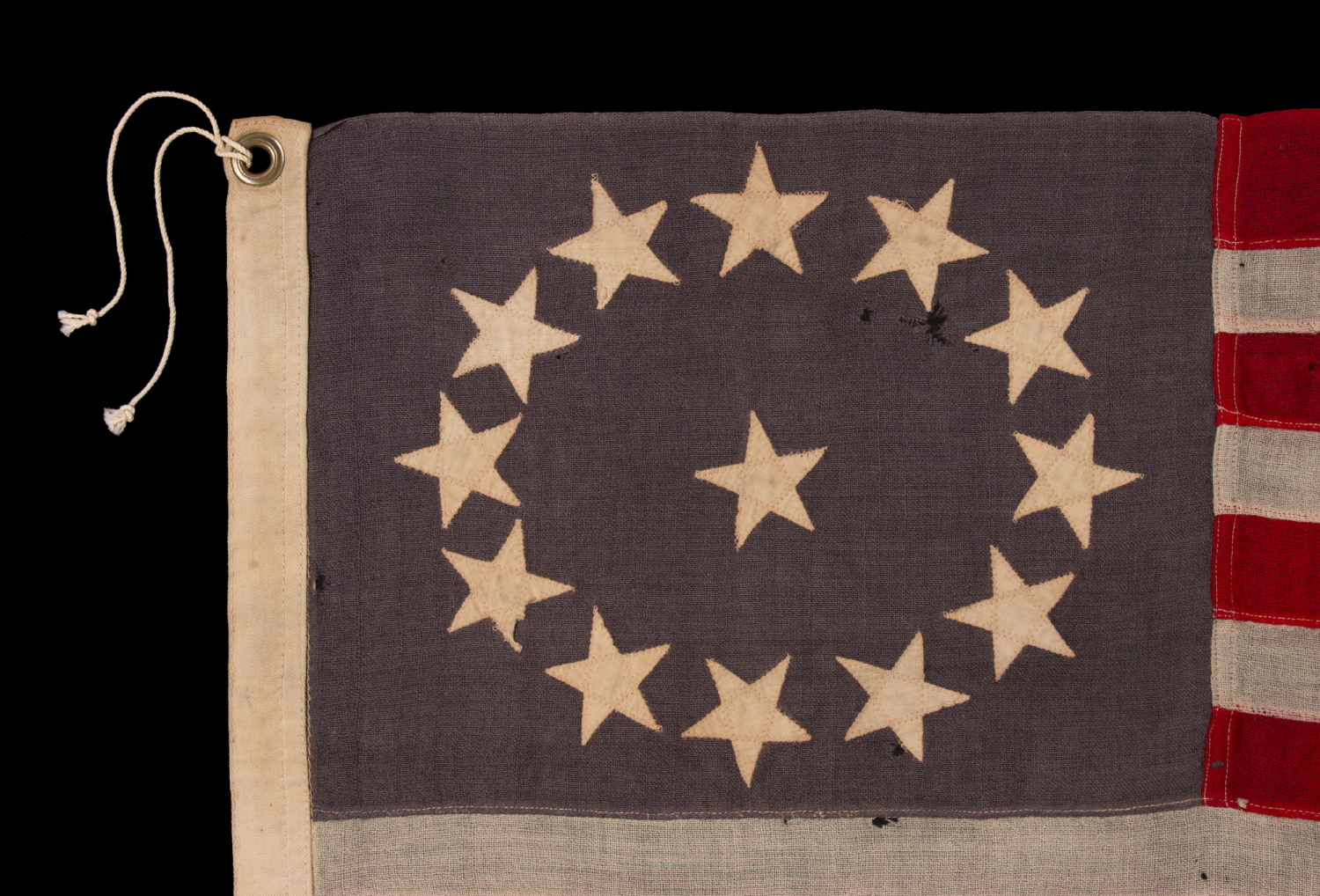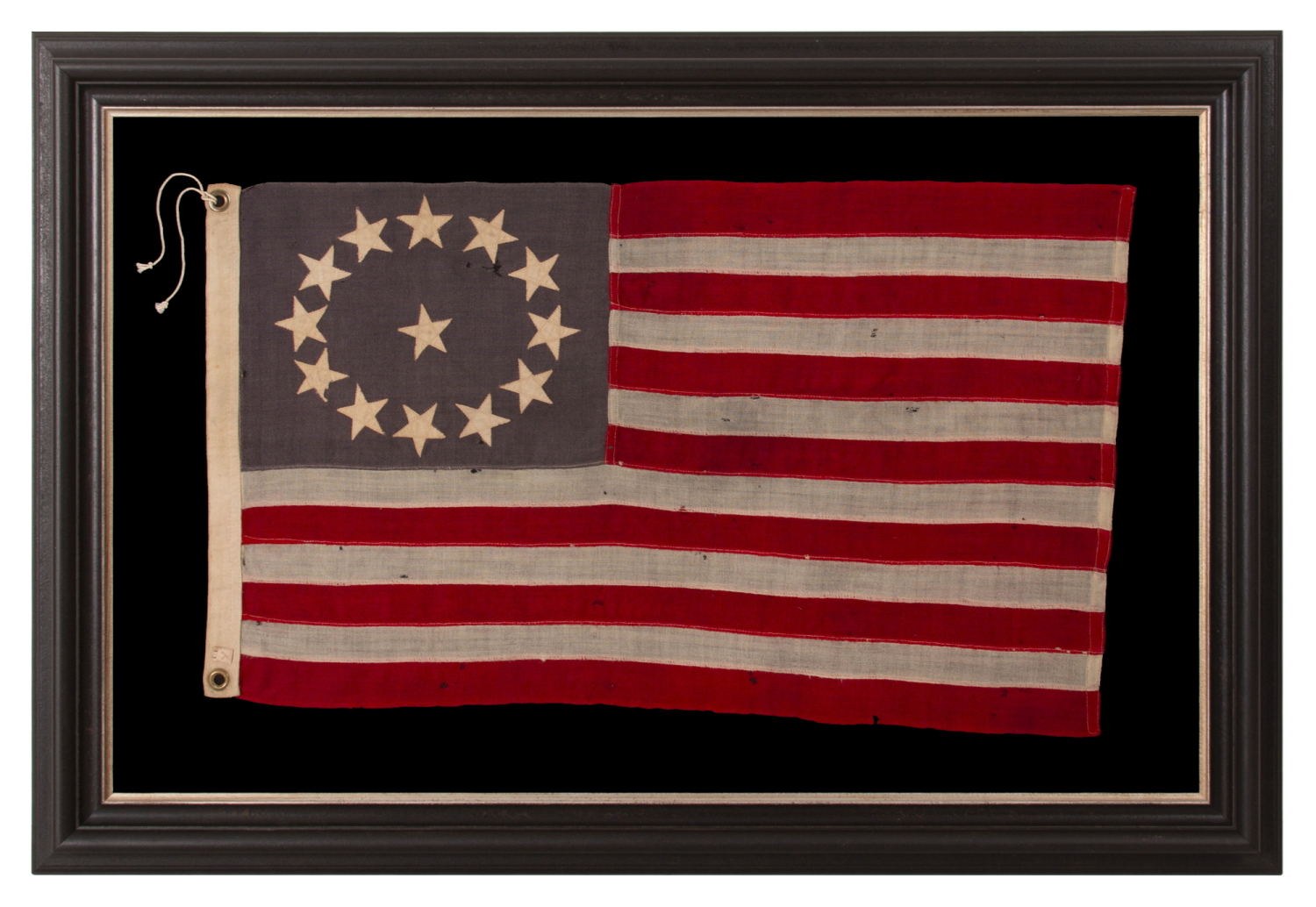
| 13 STARS ON A DUSTY BLUE CANTON, IN AN OVAL VERSION OF WHAT IS KNOWN AS THE 3RD MARYLAND PATTERN, MADE DURING THE LAST DECADE OF THE 19TH CENTURY, MARKED WITH THE SURNAME “NYE” |
|
| Web ID: | 13j-1737 |
| Available: | In Stock |
| Frame Size (H x L): | 31.75" x 46.5" |
| Flag Size (H x L): | 20" x 34" |
| Description: | |
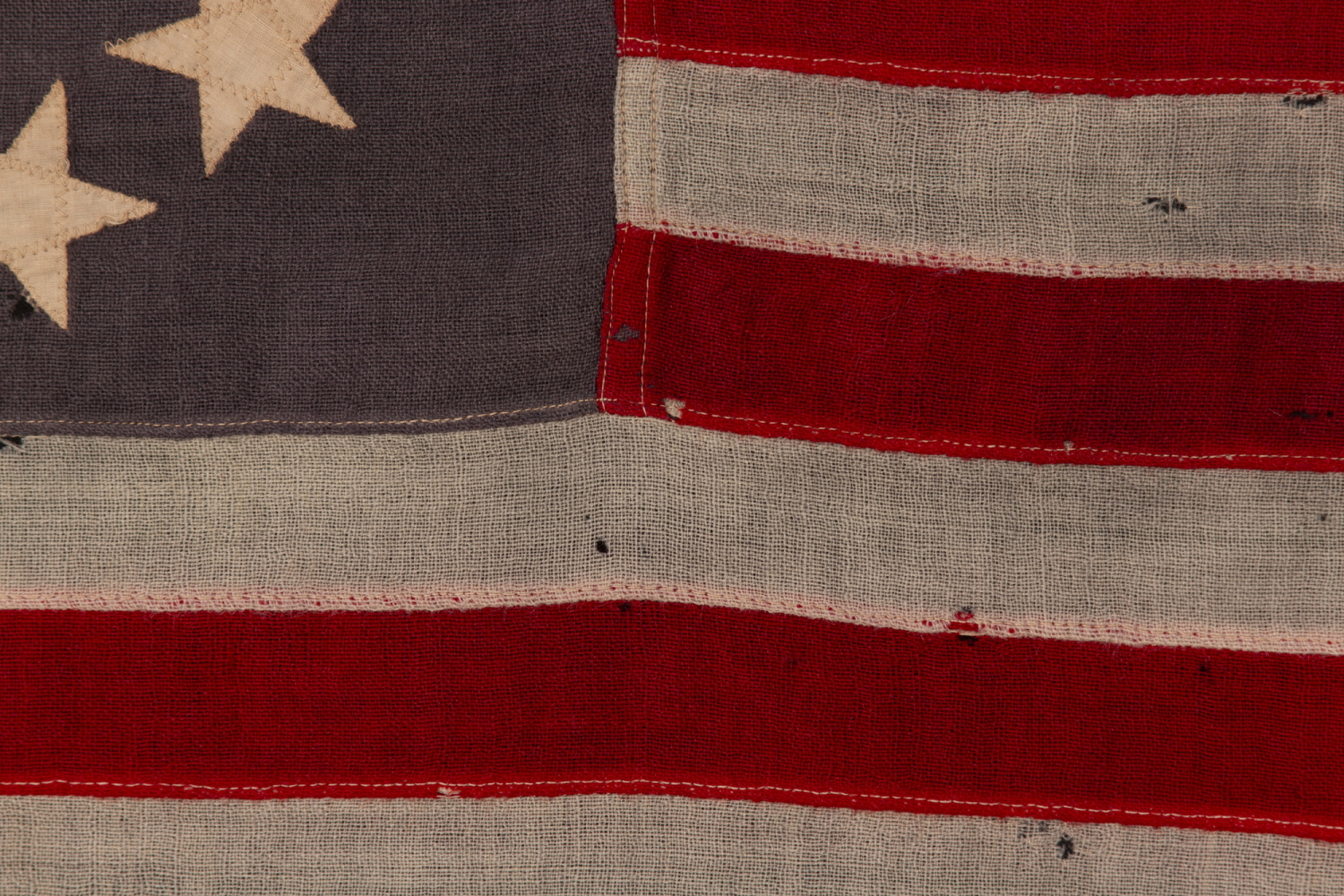
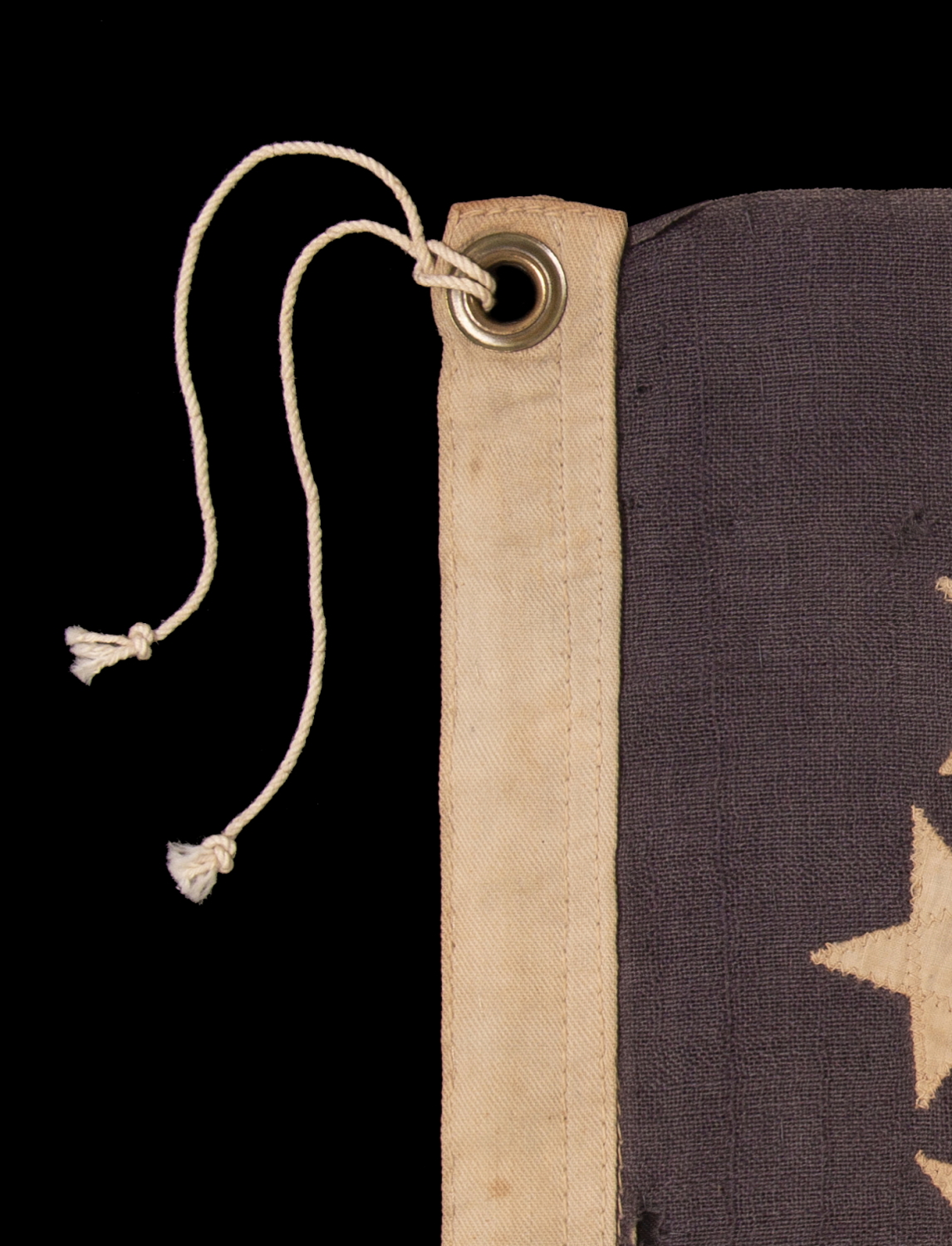
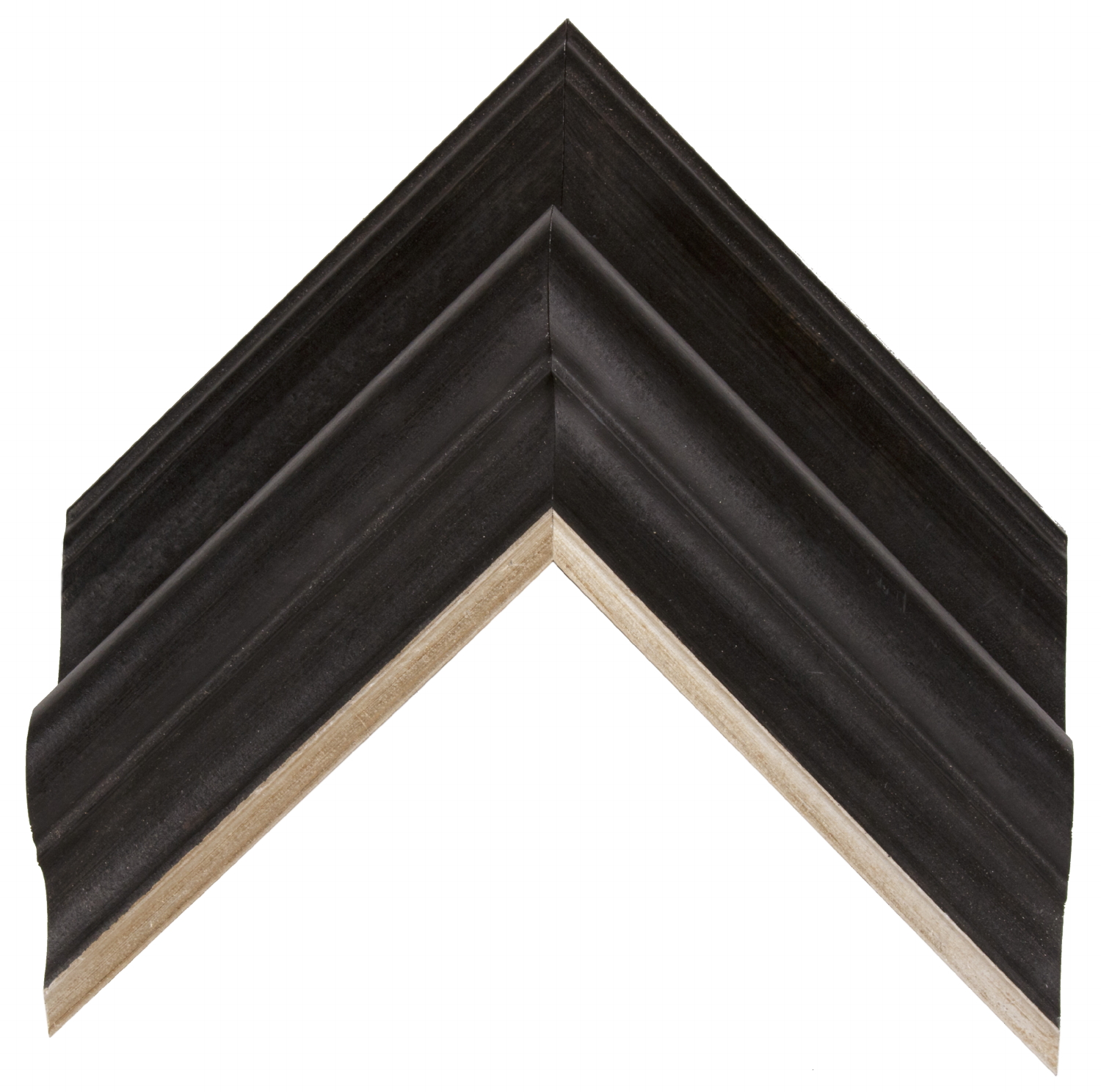
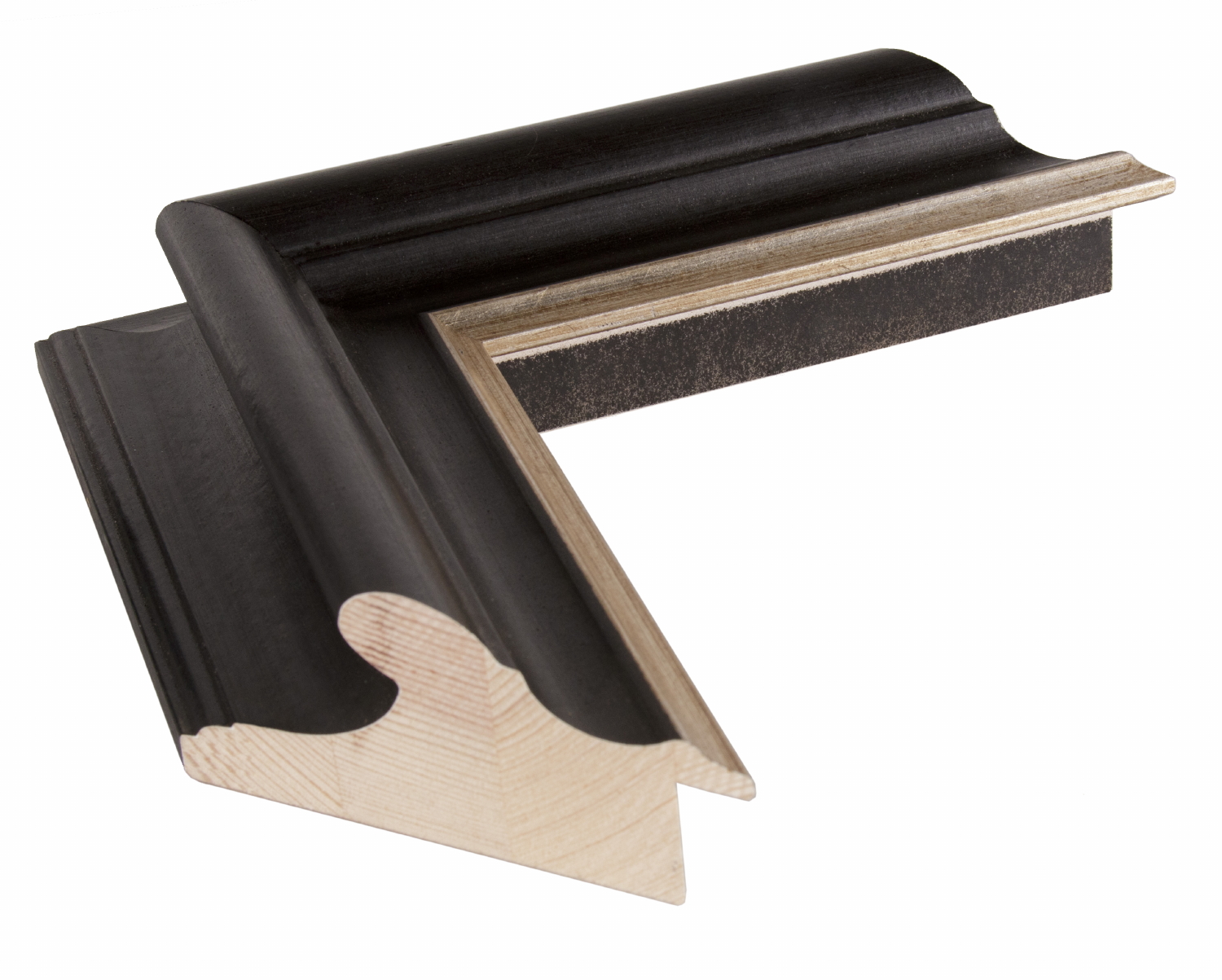
| 13 star American national flag, made during the last decade of the 19th century, which some unusual and attractive features. The stars are arranged in an oval version of what is known as the 3rd Maryland pattern. This consists of a wreath of 12 stars, more often encountered in a circular arrangement, with a single star in the very center. Note how the stars that comprise the wreath are individually positioned, in such a way that each has one point directed outward, so that the arms below it, to either side, line up with those of the stars to either side. The canton and stripes of the flag are made of wool bunting that has been pieced by machine stitching. The stars are made of cotton and are double-appliquéd (applied to both sides) with a zigzag, machine stitch. There is a twill cotton binding along the hoist, with two zinc-plated, brass grommets. A length of braided cotton twine, knotted at each end, is tied in the upper grommet. The name “Nye” is hand-written on a tiny paper tag, affixed to the binding, on the obverse, near the lower grommet. This would reflect the name of a former owner. It was common to mark flags for ownership, in some fashion, during the 18th – early 20th centuries. Note how the coloration of the canton has faded to a dusty, stone blue. This is both an attractive feature and indicative of the flag’s date of manufacture. When this trait is present, it is most often encountered in flags that date between 1885 and 1895, and more often in the second half of that ten-year date bracket. The color is a result of what is known as a "fugitive" dye, which is one that breaks down chemically, of its own right, whether or not it has been exposed for prolonged periods to light. After 1895, either flag manufacturers caught on to the fugitive dye and ordered different wool, or the textile company that was producing it changed its dying process. In any event, flags that were made with this particular fabric and have survived to the present day, have an interesting presentation that many collectors find pleasing to the eye. Why 13 Stars? As the number of stars grew with the addition of new states, it became increasingly difficult to fit their full complement on a small flag. The stars would, by necessity, have to become smaller, which made it more difficult to view them from a distance as individual objects. The fear was that too many stars would become one white mass and distort the ability to identify American ships on the open seas. The U.S. Navy flew 13 stars on its small-scale flags for precisely this reason. This was, of course, the original number of stars on the first American national flag, by way of the First Flag Act of 1777, and equal to the number of original colonies that became states. For all practical purposes, commercial flag-makers simply didn't produce flags with pieced-and-sewn construction, that were 4 feet in length or less, before the 1890's. There are exceptions to this rule, but until this time, the smallest sewn flags were generally around 6 feet on the fly. Because the primary use of flags had long been more utilitarian than decorative, flags needed to be large in order to serve effectively in their function as signals. Lengths of 8-10 feet and larger were common. During the same period, garrison flags were, by U.S. Army regulations, 35 feet on the fly. The largest employed by the U.S. Navy were of equivalent length. Even those flags with sewn construction, made for general display of patriotism, were often extremely large by modern standards. Beginning around 1890, commercial makers began to produce small flags for the first time in significant quantity, namely with measurements of either 2x3 feet or 2.5 x 4 feet. When they did, they chose the 13 star count, mirroring Navy practice. This continued until at least the 1920’s. At just 20 x 34 inches, this particular example does not conform to expected measurements, and is unusually small among its counterparts. Because most 19th century flags with sewn construction are so large, the small size of this example is not only rare, but desirable, far easier for a collector to frame and display. Because there was no official star pattern until 1912, prior to that time, the design was left to the liberties of the maker. I have identified more than 80 star patterns for the 13 star flag alone. The 3rd Maryland pattern is desirable due to both its visual attractiveness and the scarcity of its use, especially in an oval variant, like is displayed here. The name comes from a flag that resides at the Maryland State Capitol in Annapolis, long thought to have been present with General Daniel Morgan at the Battle of Cowpens in 1781 with the 3rd Maryland Regiment. According to legend, the flag was supposed to have been carried by Color Sergeant William Batchelor of the Maryland Light Infantry and was donated to the State of Maryland by Batchelor's descendants. The story was disproved in the 1970's, however, following an examination by the late flag expert Grace Rogers Cooper of the Smithsonian, who proved that the flag was no earlier than the 1840’s. Despite the lack of direct association with the reputed regiment, many flag collectors and enthusiasts embraced the name "3rd Maryland" and it stuck to the design. The term actually received some legitimacy through the existence of a similar flag, in the collection of the Smithsonian’s National Museum of History & Technology, with verified Maryland provenance. This was carried by the Maryland and District of Columbia Battalion of Volunteers during the Mexican War. While the configuration is known to be an early one, as evidenced by 18th century illustrations, this star pattern is most often encountered, among actual, surviving flags, among those that date to the mid-19th century, between the Mexican War and Civil War eras (1846-1865). In the 1890’s, when this flag particular flags was made, approximately 75% of those being seem to have born the 3-2-3-2-3 arrangement. Medallion patterns, with a wreath of 8 stars, a star in the center, and a star in each corner, were significantly scarcer, representing approximately 20%, with the remainder in some other design. 13 star flags have been flown throughout our nation’s history for a variety of purposes, both patriotic and utilitarian. In addition to their use by the U.S. Navy and by commercial makers on small flags post-1890, some private ships flew 13 star examples throughout the 19th century. 13 star flags were hoisted at all manner of patriotic events, including Lafayette’s return visit and tour of America in 1824-25, the 1876 centennial of American independence, and annual celebrations of Independence Day. 13 star flags were displayed during the Civil War, to reference past struggles for American liberty, and were used by 19th century politicians while campaigning, for the same reason. The use of yachting ensigns with a wreath of 13 stars, surrounding a fouled anchor, which allowed pleasure boats to bypass customs between 1848 and 1980, persists today without an official purpose. Any American flag that has previously been official remains so according to the flag acts, so it remains perfectly acceptable to fly 13 star flags today by way of congressional law. Throughout history, and even today, they are boldly displayed at every presidential inauguration. Mounting: For 25 years we have maintained our own textile conservation department, led by expert staff. We take great care in the mounting and preservation of flags and related textiles and have preserved thousands of examples. The flag has been hand-stitched to 100% cotton twill, black in color, that was washed and treated for colorfastness. The black-painted and gilded molding, with its wide, shaped profile, is Italian. The glazing is U.V. protective acrylic (Plexiglas). Condition: In addition to the fading of the canton, described above, there is a scattering of minor mothing throughout. There is minor soiling in limited areas, and there is modest overall oxidation of the white cotton fabrics. One of the cotton stars displays minor losses along one edge. Many of my clients prefer early flags to show their age and history of use. |
|
| Video: | |
| Collector Level: | Intermediate-Level Collectors and Special Gifts |
| Flag Type: | Sewn flag |
| Star Count: | 13 |
| Earliest Date of Origin: | 1890 |
| Latest Date of Origin: | 1895 |
| State/Affiliation: | 13 Original Colonies |
| War Association: | |
| Price: | Please call (717) 676-0545 or (717) 502-1281 |
| E-mail: | info@jeffbridgman.com |
 |
|