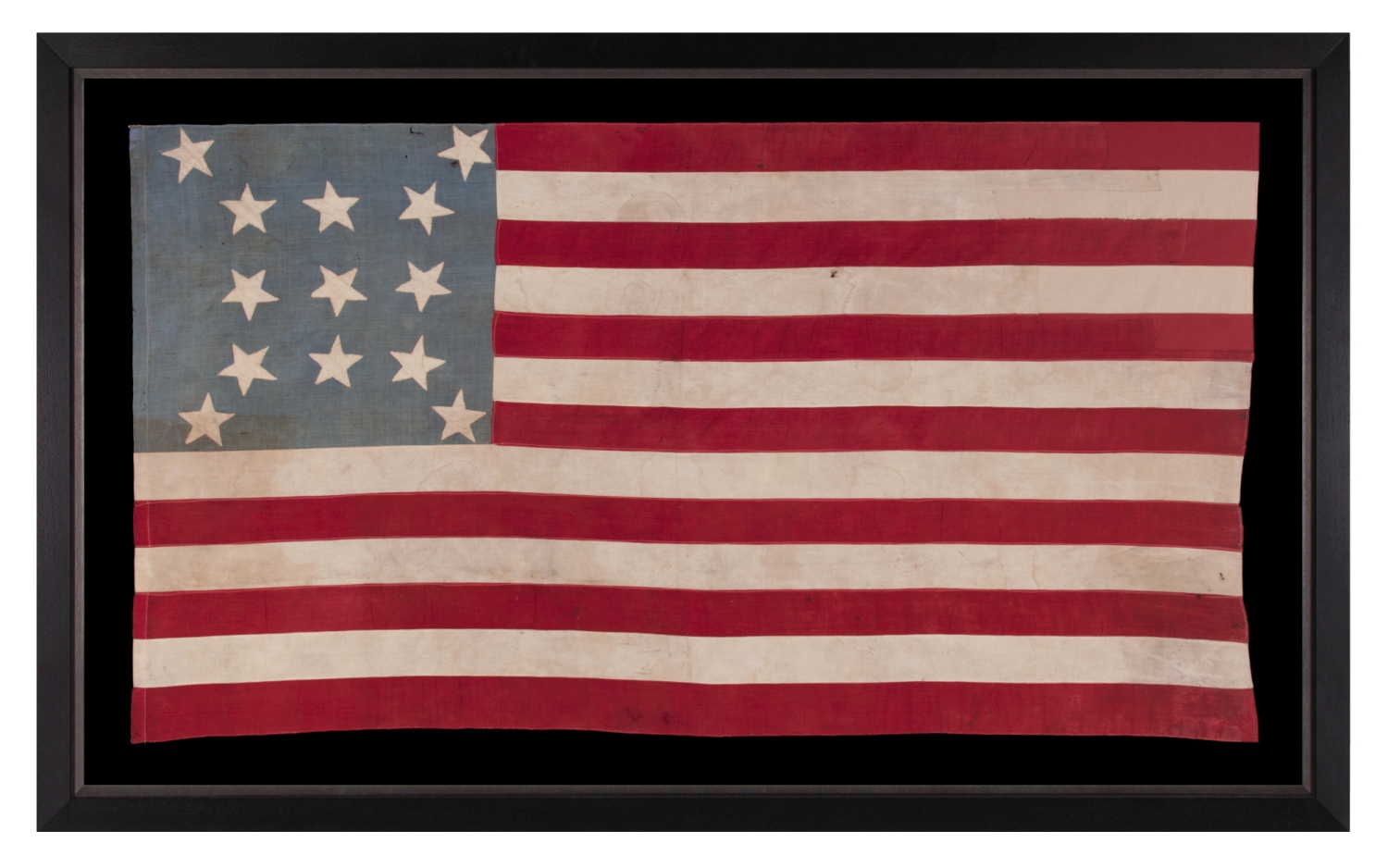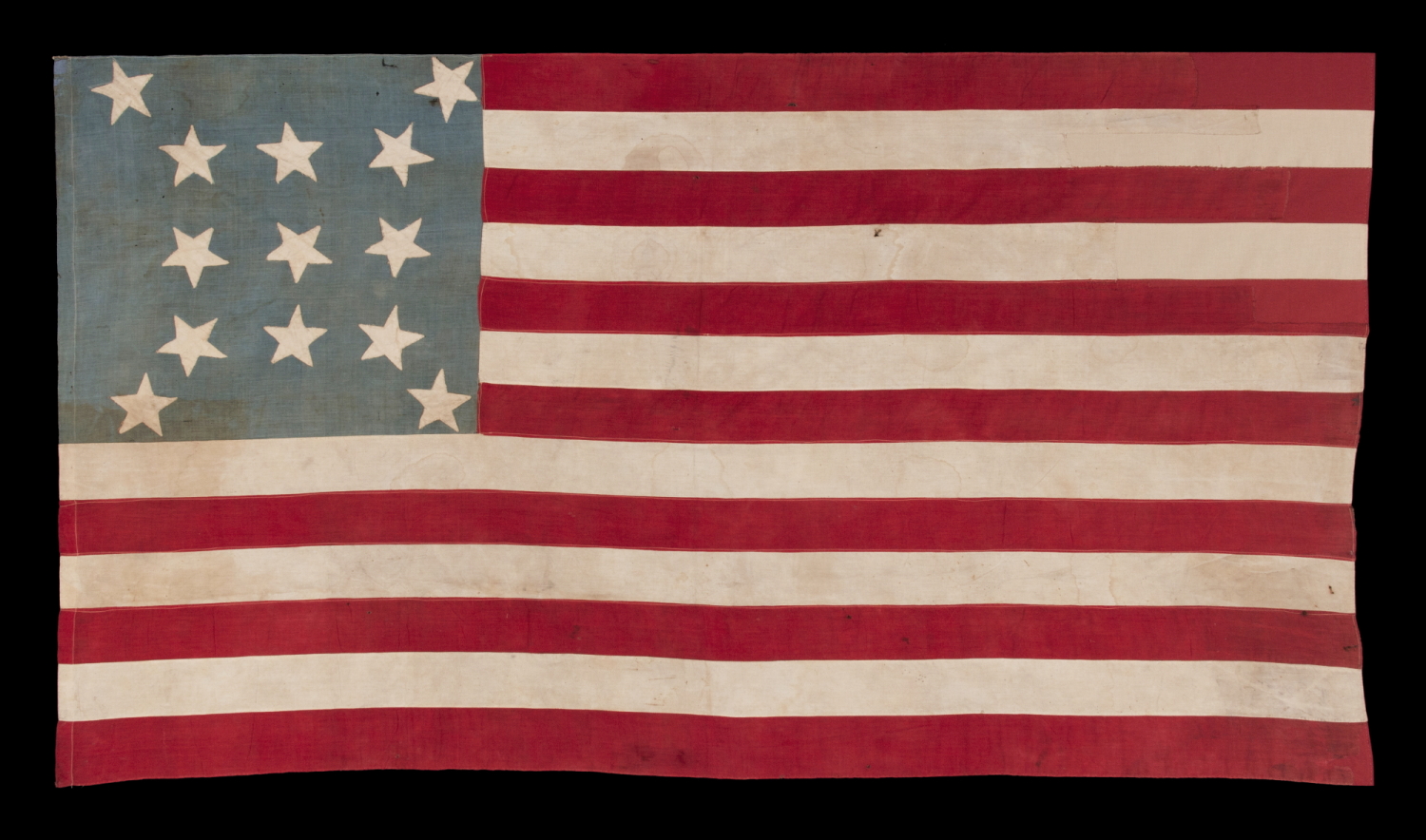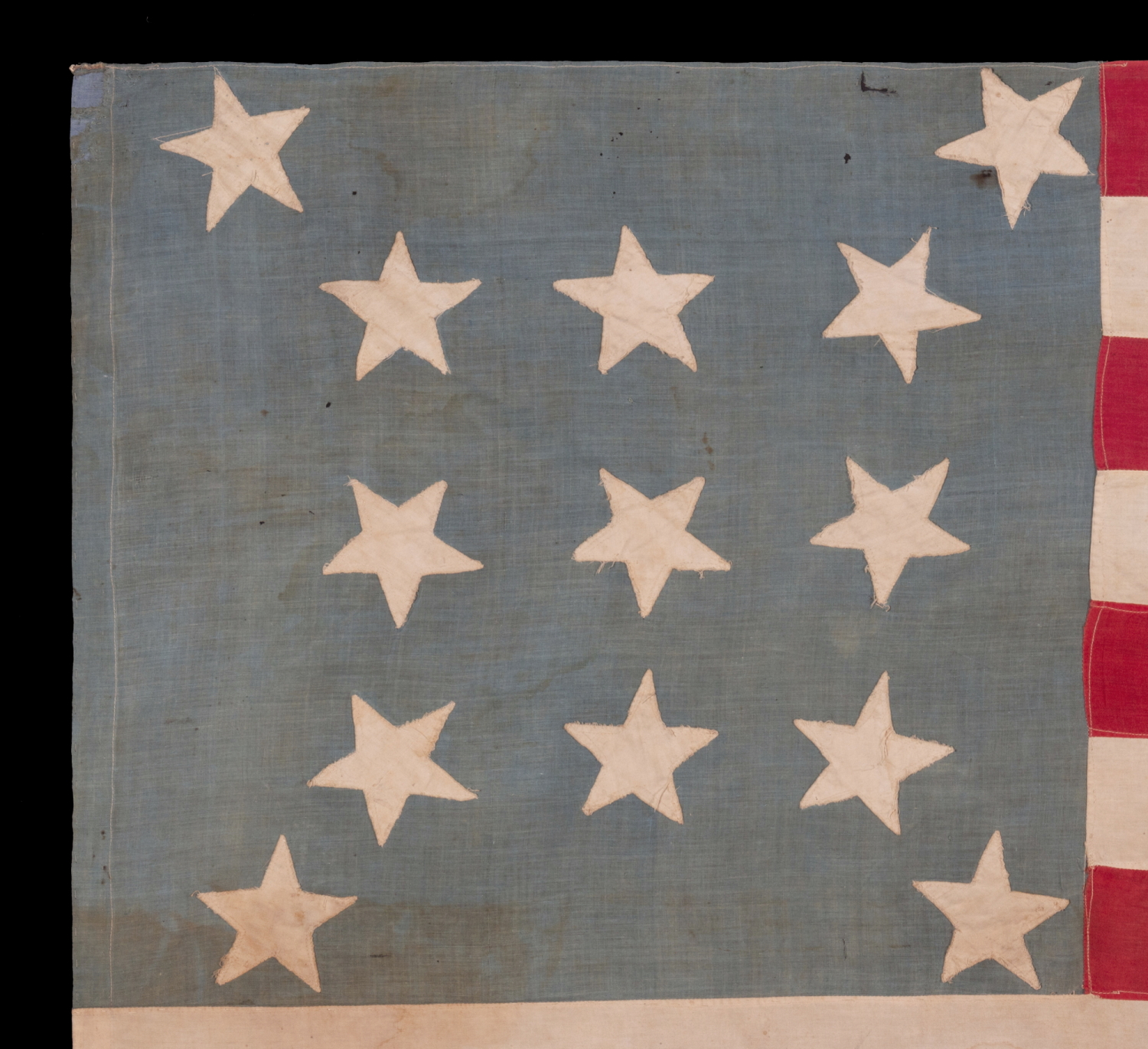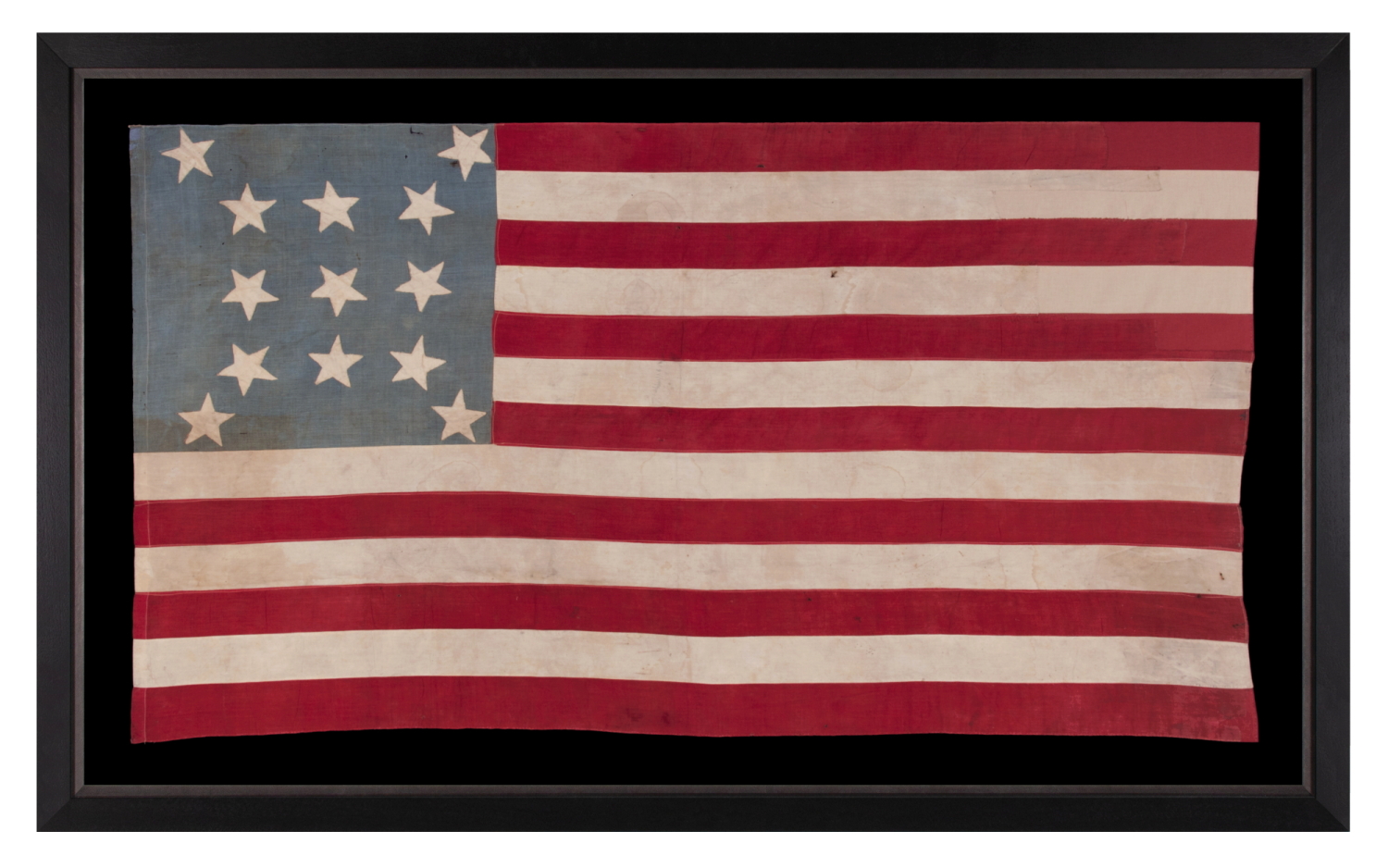
| 13 STAR ANTIQUE AMERICAN FLAG, A HOMEMADE EXAMPLE WITH AN INCREDIBLY RARE CONFIGURATION OF STARS THAT CONSISTS OF A BOX OF 9 WITH 4 OUTLIERS, SET AGAINST A LIGHT BLUE CANTON; LIKELY MADE IN CELEBRATION OF THE 1876 CENTENNIAL OF AMERICAN INDEPENDENCE; EXHIBITED AT THE MUSEUM OF THE AMERICAN REVOLUTION, JUNE-JULY 2019 |
|
| Web ID: | 13j-1527 |
| Available: | In Stock |
| Frame Size (H x L): | 51.25" x 83.5" |
| Flag Size (H x L): | 40.25" x 73.25" |
| Description: | |
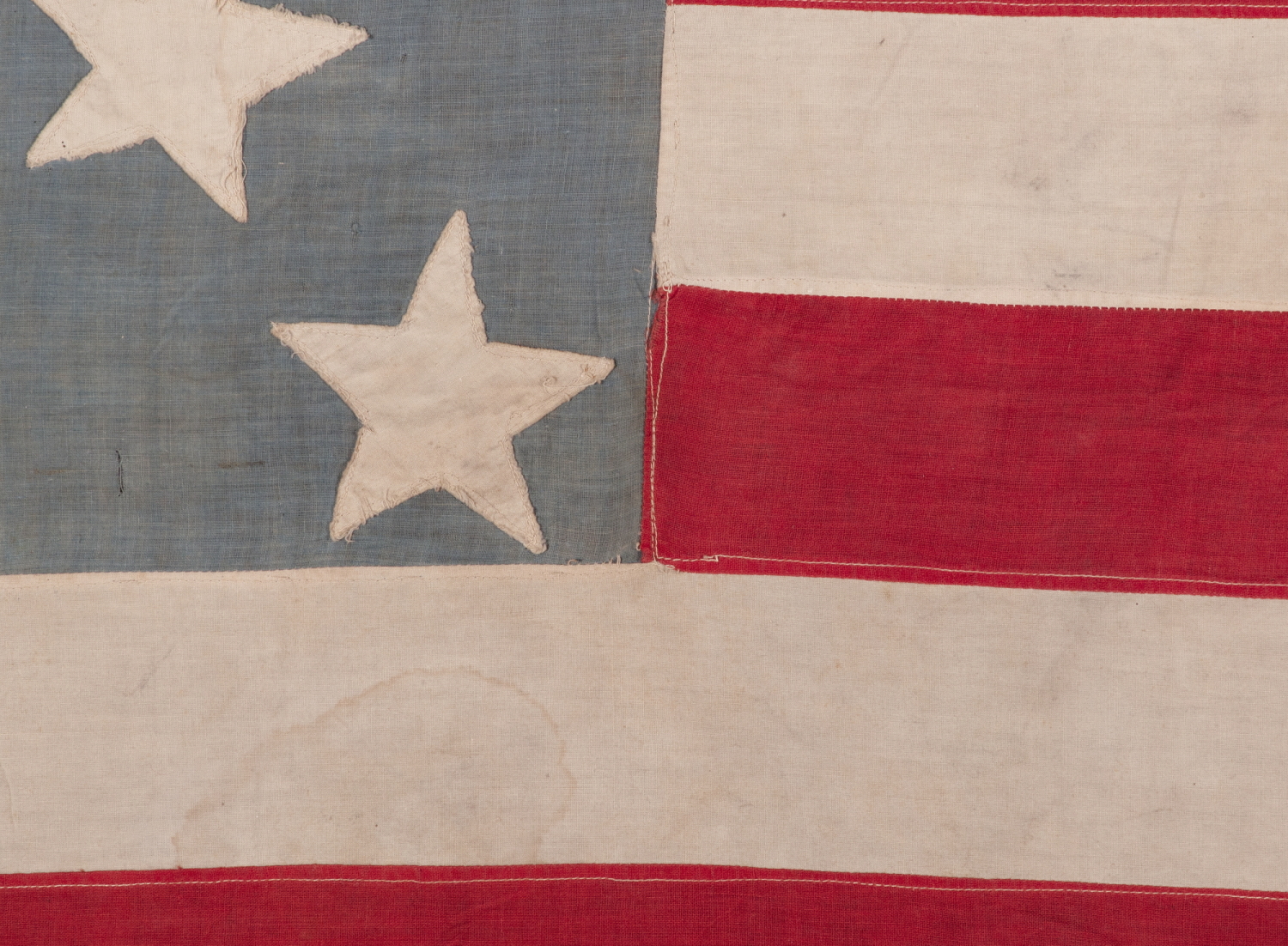
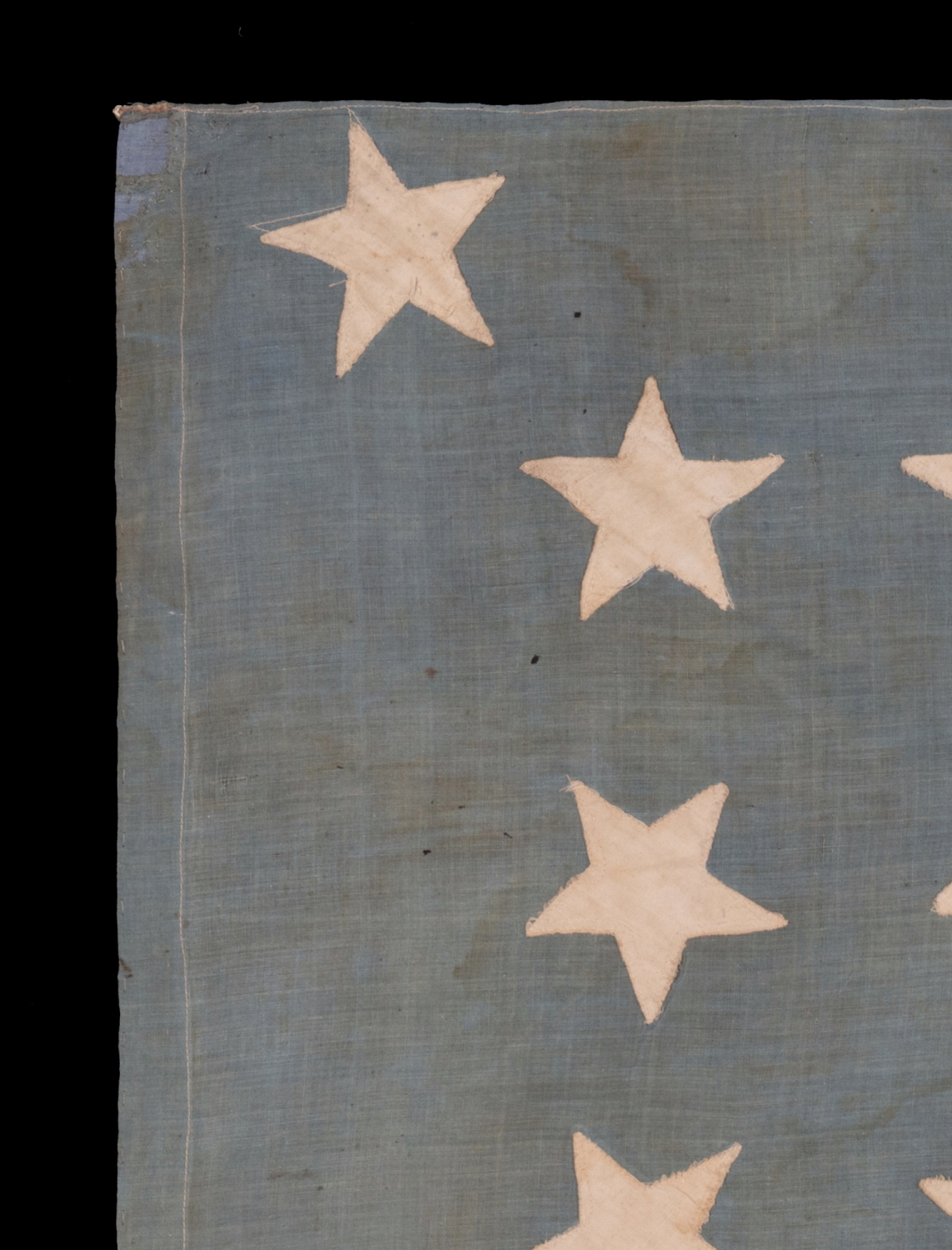
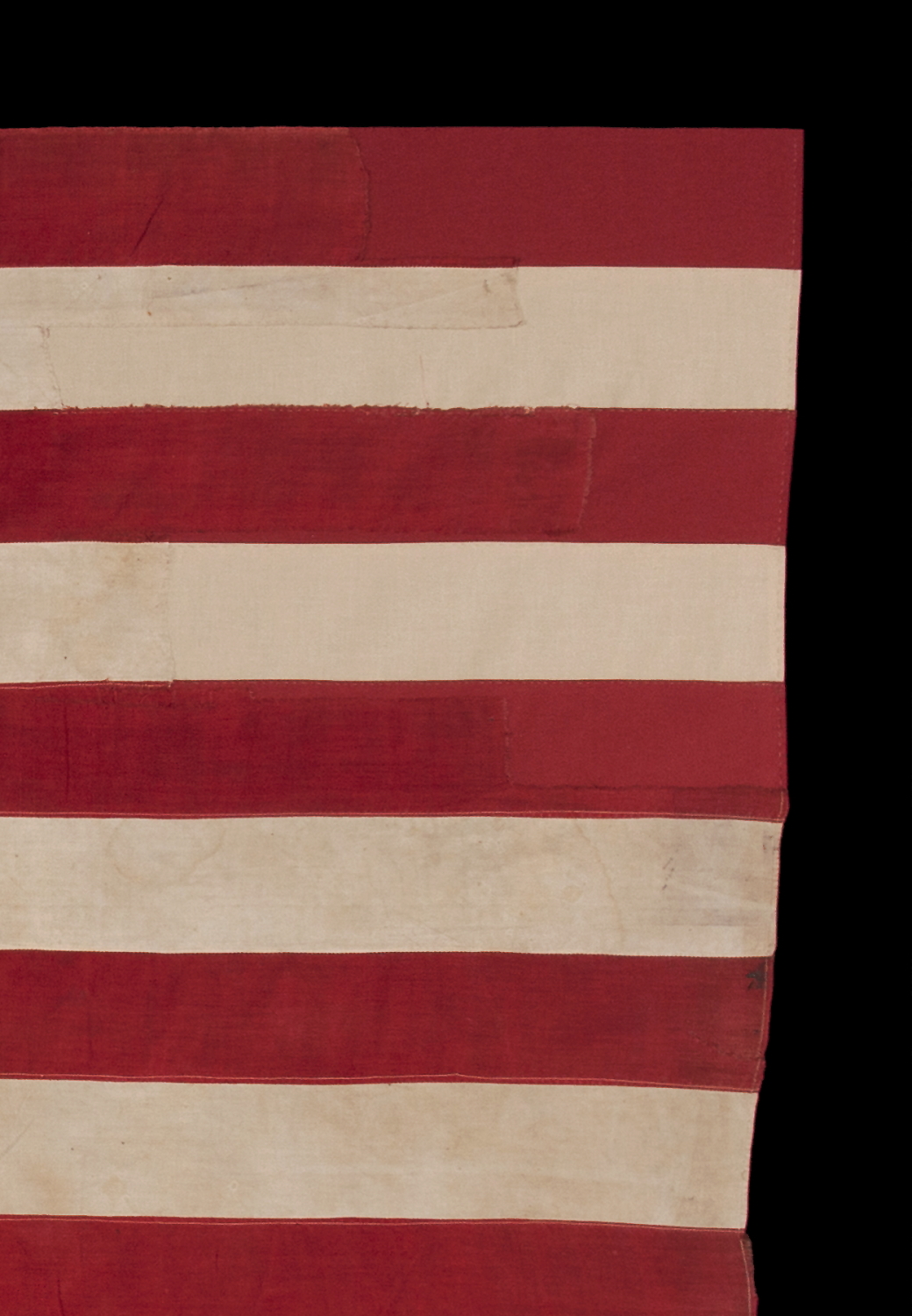
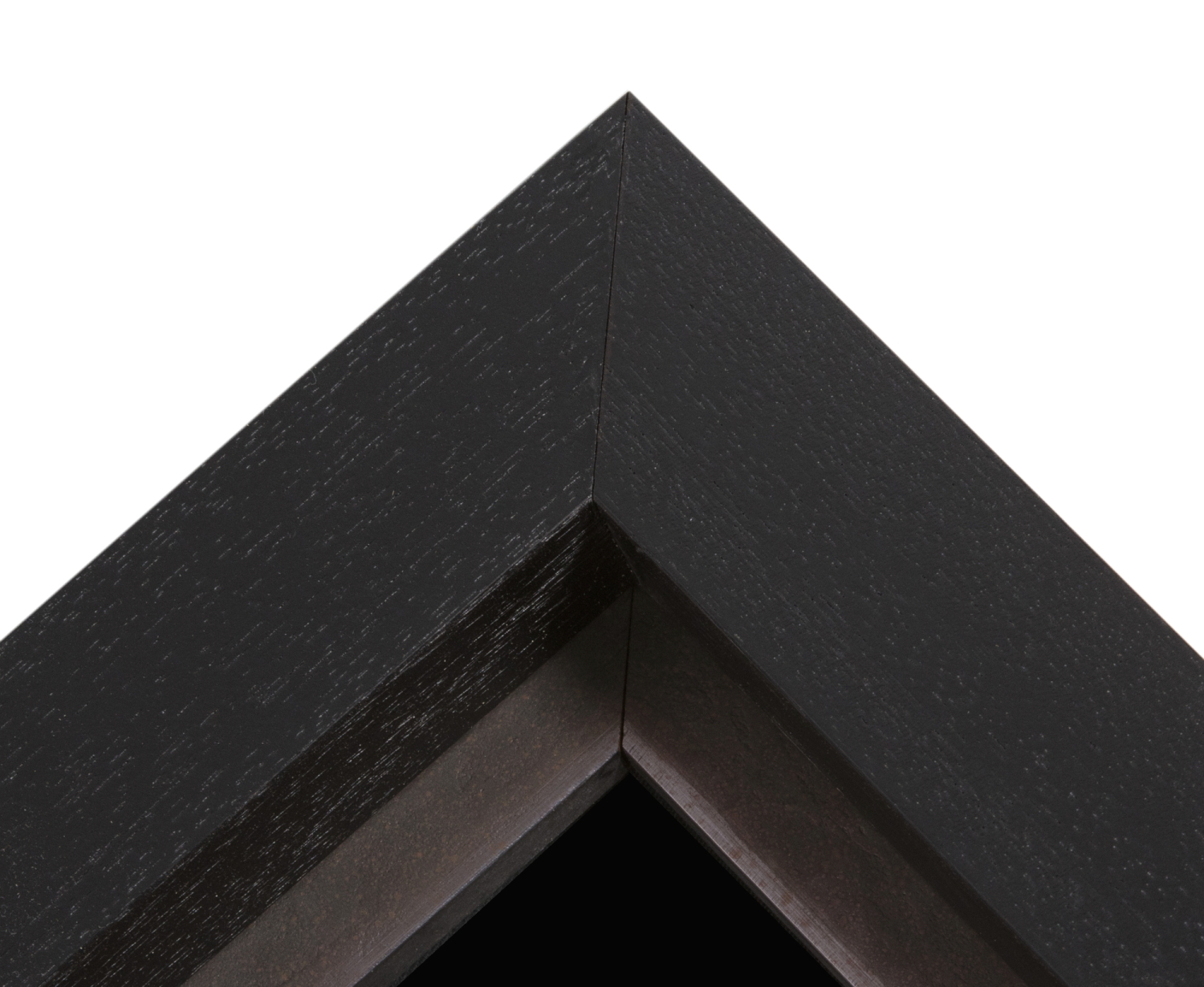
| 13 star American national flag, made around the time of the 1876 centennial of American independence. The stars are configured in a particularly rare and unusual manner, in which 9 of their total is arranged in a justified box, in the center of the canton, flanked by a single star in each corner. Though assemblages of circular and star-shaped formations are well known in 19th century Stars & Stripes, when embedded as merely a part of some larger, more complex configuration, far less-so is the presence of distinct squares or rectangles, such as this one. In terms of 13 star flags, specifically, the most recognizable variant within the category I have termed “boxed medallions,” is known as the Trumbull pattern. This displays a rectangle of 12 stars, surrounding a single, center star. Among early, surviving flags in this pattern, with sewn construction, that date to the 19th century,* perhaps 10-12 examples are known, all of which are in private hands.* I have had the great privilege of having owned most of these. 13 star “Box of 9” medallions are represented by just two surviving flags. Just one other is known. Both date to approximately the same time frame. Likely made for our nation’s 100th birthday, the flag that is the subject of this narrative was homemade. Constructed of plain weave cotton, the canton and stripes were pieced and joined by treadle stitching. The stars, likewise cotton, were double-appliqued (applied to both sides) and are sewn by the same method. The narrow seams and accurate stitching indicative that the maker was someone with significant skill as a seamstress. Because the edges of the stars were not turned under, it’s logical to presume that she/he was either not accomplished at applique work—it being far more difficult than hemming straight seams—or that short term use was expected, and/or time to complete the task was of the essence. The fabrics used to construct the canton and stripes were rolled back onto themselves, and hemmed in such a way as to form an open sleeve. Prior to 1912, there were no official shades of red and blue, nor an official star configuration, nor an official number of points that the stars needed to have, nor official proportions. On this particular flag, note how the faded, cornflower blue color of the near-to-square proportioned canton, draws interest to this example when compared not only to modern flags, but even to those of the same, 1876 era. In spite of there being no official color, the cantons of most flags were navy blue. Note also how the position of each star, on its vertical axis, varies throughout, and how the individual placement of the stars within the pattern, is not especially accurate, as well as how the entire configuration is offset against the canton, justified toward the fly end. In addition to the bold star and nearly unique star pattern, this collection of elements, many of them inherent to human error and personal choice, play a significant role in its visual presentation. Though this particular flag has no known specific history, it is of interest to note that the other flag in this star pattern, was discovered in the town of Redbank, New Jersey, where a major battle of the Revolution occurred. Though very little is known about its origin, the name “Hoeffner” was inscribed on one of four flags found there in a group, in addition to the address of “59 N. Front St.”** Two of the others bore the typical, circular medallion configuration of stars, with a ring of 8, plus one in the center, with a single star in each corner, often encountered in centennial parade flags. All three of these flags were of centennial era origin. [Sadly, I cannot recall the pattern present in the fourth example.] While the materials used to construct the three flags I described was typical of commercially-made examples, and the applique work was indicative of the same, and while the other used a combination of three different sizes of stars (intentionally though not dramatically different), the star pattern of the two “Box-of-9” examples is so similar that whomever made each, more likely than not, had probably viewed the same source image, perhaps in a newspaper, or a painting of some sort, or a sketch, if not in an actual flag. The use of the 9 star arrangement, in the middle of this star pattern, could bear two possible meanings. Made in the wake of the Civil War, the use of a group of 9 stars, to represent 9 states, may reflect the exclusion of North & South Carolina, Georgia, and Virginia, the 4 Slave States, from among the original 13, that formally seceded from the Union, regulating them to positions outside the central pattern. I have recently made the independent conclusion that this exact reason provides a perfect explanation for the circular medallion described above, which I have never encountered in a surviving, pre-Civil War flag. Circular medallions, also with 4 stars exiled to positions outside a central group of 9, begin to appear during the Civil War. Use of this pattern explodes at the time of the 1876 centennial, when Civil War veterans predominated the American market for flags of all sorts. This remained true until the 1920’s when reunions fade and the pattern effectively disappears all-together. It may be the first Blue & Gray reunion, at Gettysburg, in 1913, at the time of the 50th anniversary of the battle, and the increasing age and passing of the men who fought, led to a star pattern – the Betsy Ross design – that reunited the stars. Post-1920’s, almost all 13 star flags, unless reproducing some particular historic example, were almost exclusively made with a single, circular wreath. An alternative explanation for the square medallion, specifically, may be rooted in an 18th century image, with some relevance to the Sons of Liberty, some of the flags of which are believed to have displayed 9 vertical stripes, to reflect the 9 colonies that opposed the 1865 Stamp Act, that imposed taxes on imported English goods, with no corresponding representation of America in British Parliament. Whatever the case may be, this 13 star flag, with its rare, “Box of 9” star pattern, cornflower blue color, centennial era date, and wonderful visual qualities, survives as a wonderful example for any collector, or one-time buyer alike. Provenance: Exhibited from June 14th – July 21st, 2019, at the Museum of the American Revolution in Philadelphia, in an exhibit entitled “A New Constellation,” curated by Jeff Bridgman. This was the first ever, large scale exhibit of 13 star examples at a major museum. Exhibited from May – present in the office of Secretary of Health Robert F. Kennedy, Jr., in the Hubert Humphrey Bldg., Washington DC, as part of a large lend, curated by Jeff R. Bridgman Antiques, Inc. * No 18th century examples are known. ** It was reported that an ancestor of the family, and its last reported surviving member, served as U.S. Ambassador to Lebanon in the 1950’s. Born in Kansas, Georgetown University graduate, Harold Minor (1891 – 1984), indeed lived in Redbank in the 1950’s, shortly after his 1952-1953 stint as U.S. Ambassador to Lebanon. Prior to this, during WWII, he had served in the State Department as U.S. Consul in Terran (Iran). Please note that the flag has absolutely nothing to do with the Middle East, and that I am merely including this information—perhaps of no relevance whatsoever—so that Minor’s possible relationship to the flags, if any, can in any way lend to further research of this scarce 13 star design. Mounting: The flag was mounted and framed in-house. For 25 years we have maintained our own specialized department for this purpose, with expert staff. We take great care in the mounting and preservation of flags and related textiles and have preserved thousands of examples. The two-part frame consists of a black-painted molding, of shadow box depth, with a wood grained surface, to which a a flat profile molding, made of wood, but with a finish that presents like old gun metal, was added as a liner. The background is 100% cotton twill, black in color, that has been washed and treated for colorfastness. A shadowbox was created to accommodate the tassel. The glazing is U.V. protective acrylic (Plexiglas). Feel free to contact us for more details. Condition: The flag was obviously flown for an extended period. There are significant losses at the fly end, particularly in the 1st – 5th stripes. Fabric of similar coloration was placed behind this region during the mounting process. There are more minor losses at the fly end of the last stripe, and in the upper, hoist end corner of the canton. These were likewise underlain. There is modest soiling throughout, accompanied by modest to moderate of the same in limited areas, including within the striped field, below the canton, extending slightly upwards into it, and with the field, just beyond the canton, and in the lower, fly end corner. A few tiny tears and minor losses, in both the canton and stripes, were left as-is. Many of my clients prefer early flags to show their age and history of use. |
|
| Video: | |
| Collector Level: | Flags for the truest Patriots. My best offerings |
| Flag Type: | Sewn flag |
| Star Count: | 13 |
| Earliest Date of Origin: | 1870 |
| Latest Date of Origin: | 1880 |
| State/Affiliation: | 13 Original Colonies |
| War Association: | 1866-1890 Indian Wars |
| Price: | Please call (717) 676-0545 or (717) 502-1281 |
| E-mail: | info@jeffbridgman.com |
 |
|