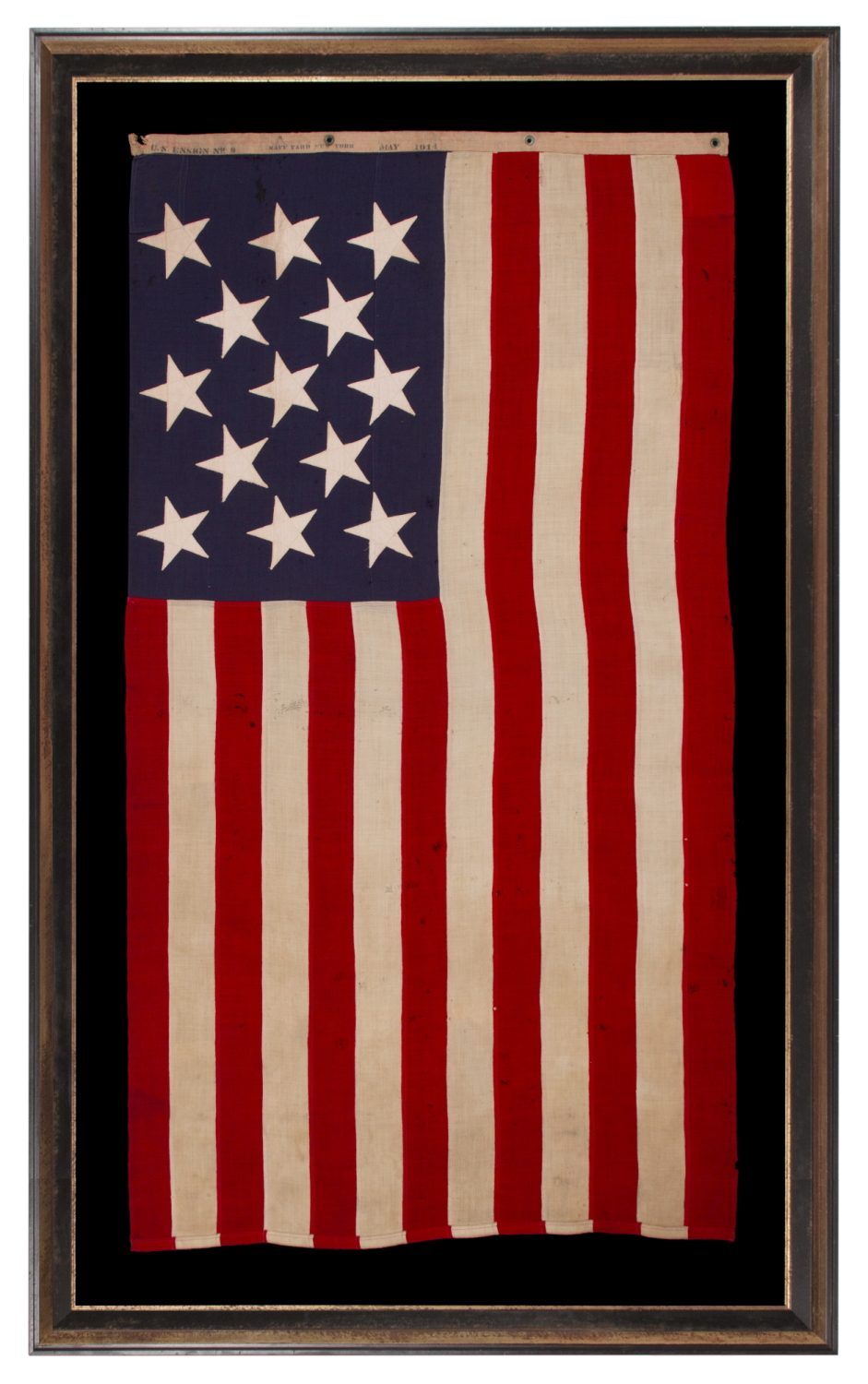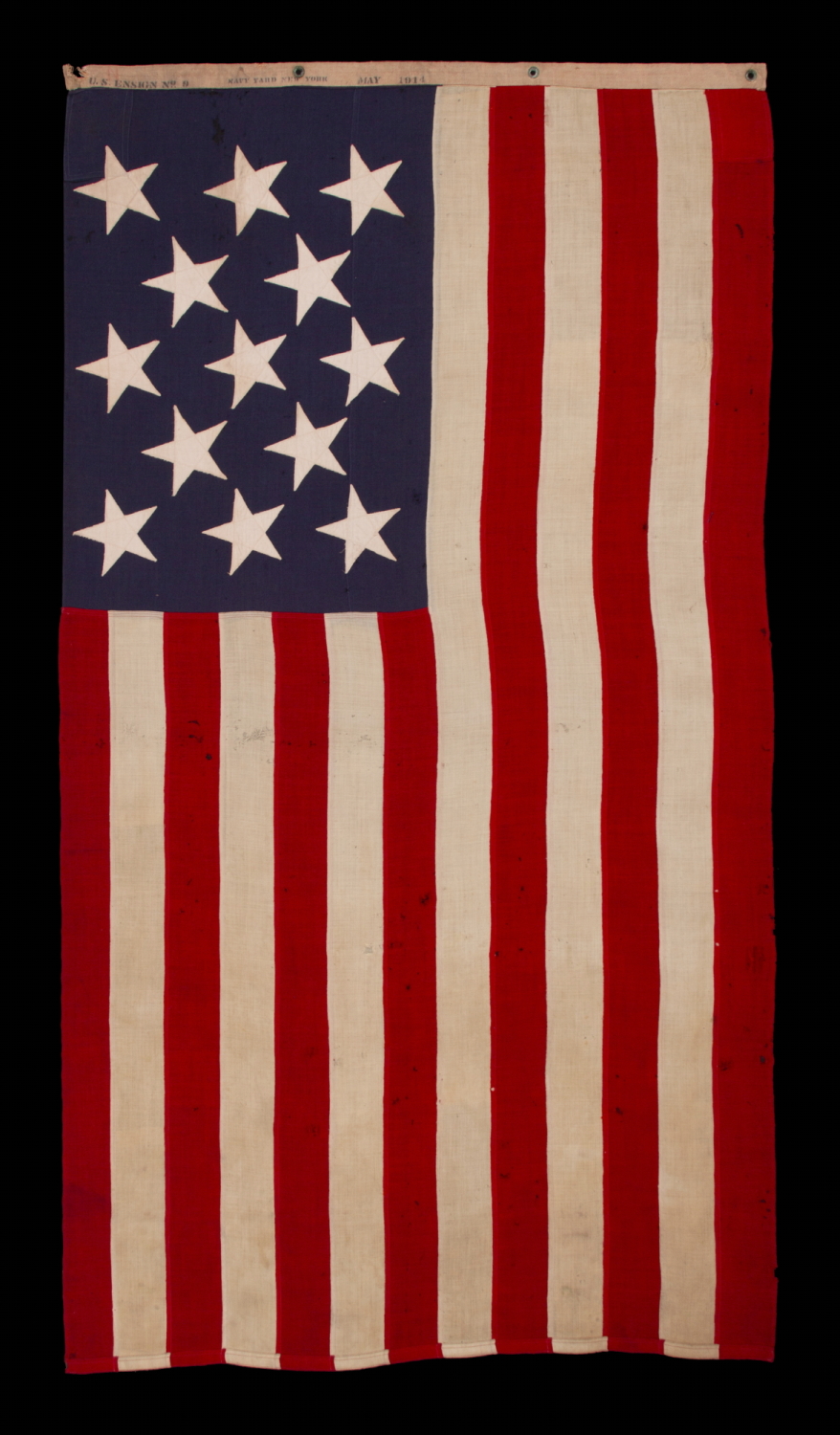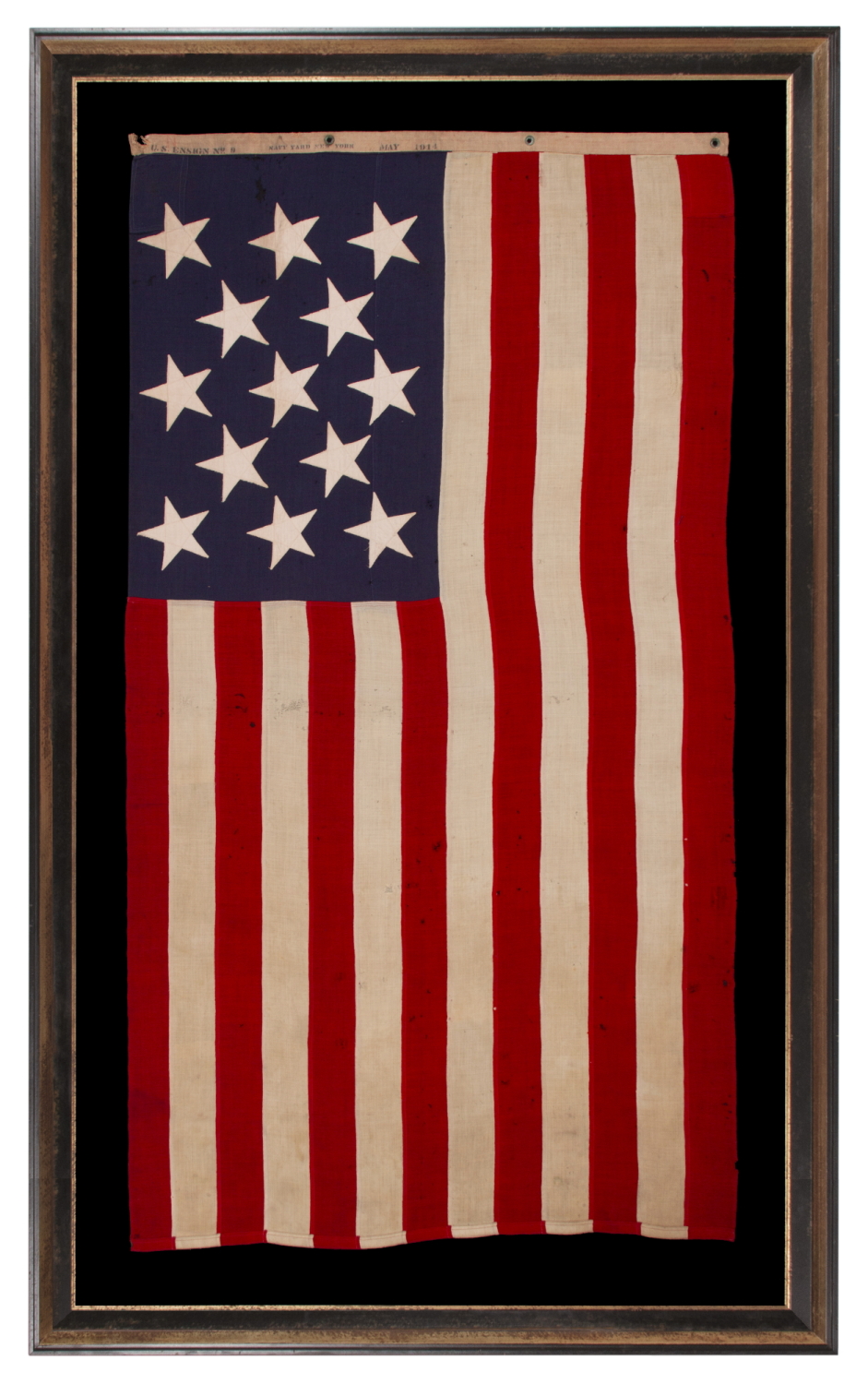
| 13 STAR ANTIQUE AMERICAN FLAG WITH A 3-2-3-2-3 PATTERN OF ESPECIALLY LARGE STARS; A U.S. NAVY SMALL BOAT ENSIGN, SIGNED & DATED 1914, MADE AT THE BROOKLYN NAVY YARD IN NEW YORK CITY |
|
| Web ID: | 13j-1722 |
| Available: | In Stock |
| Frame Size (H x L): | Approx. 92" x 54" |
| Flag Size (H x L): | 80" x 42" |
| Description: | |
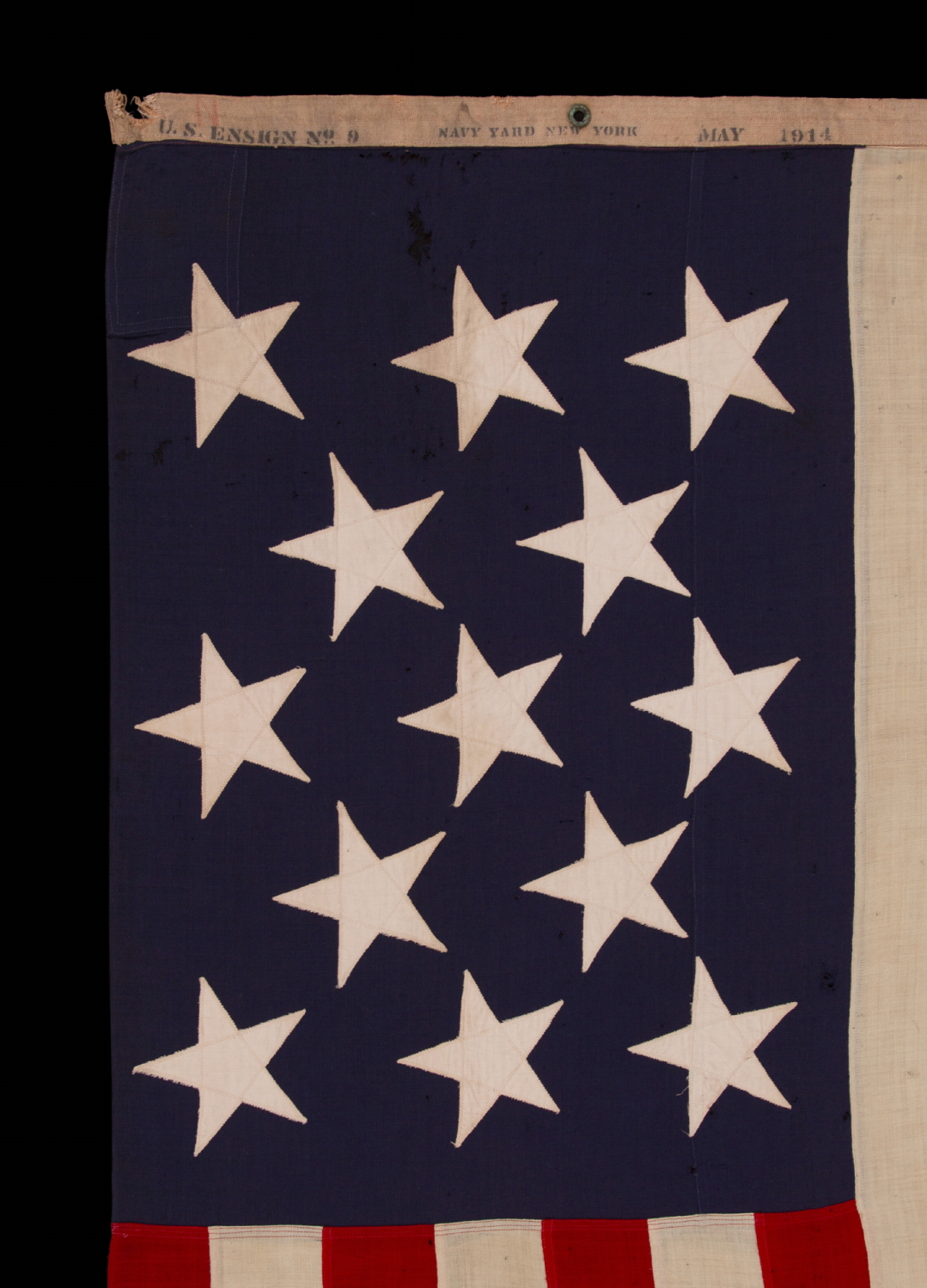
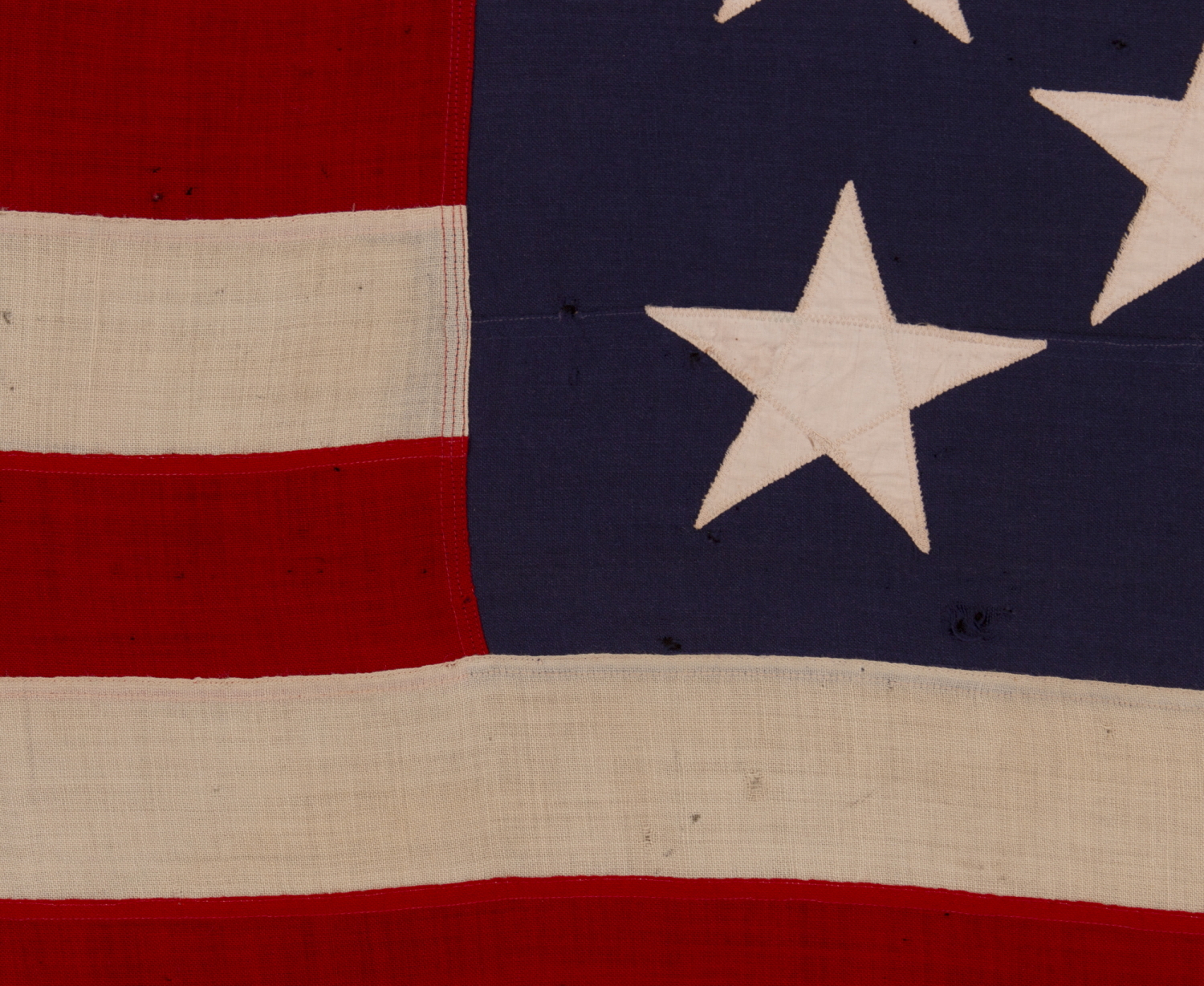
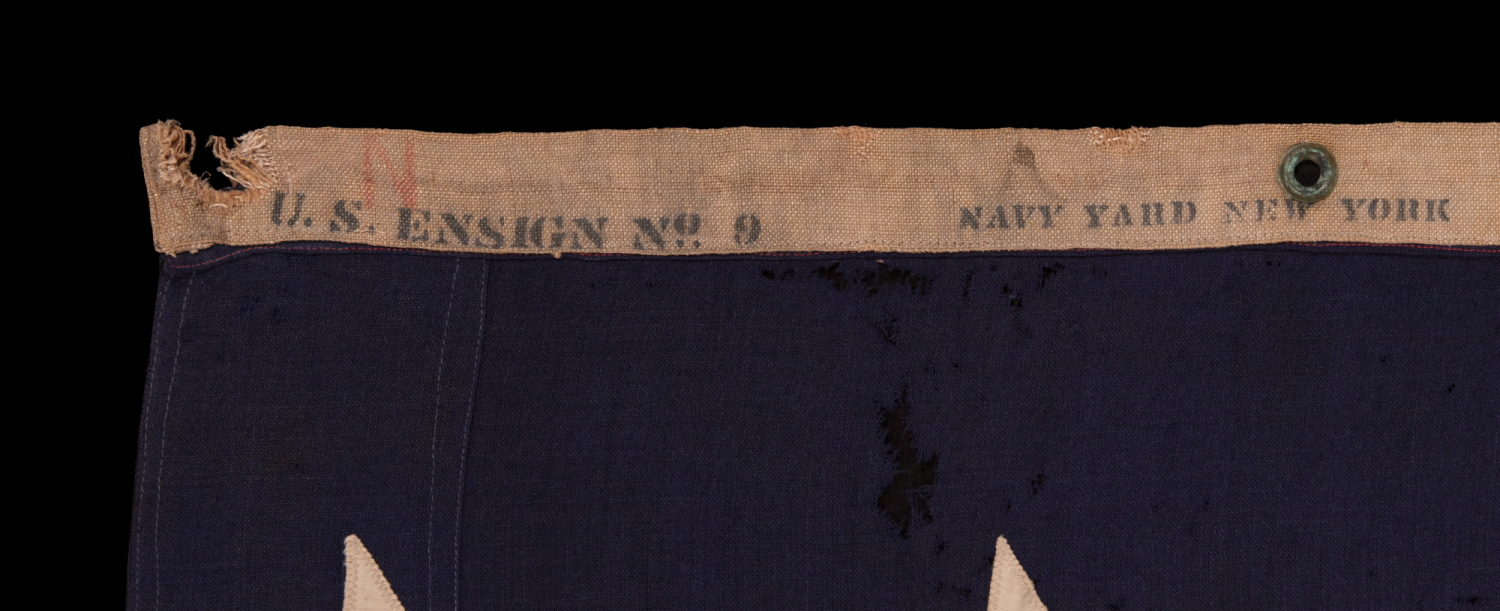
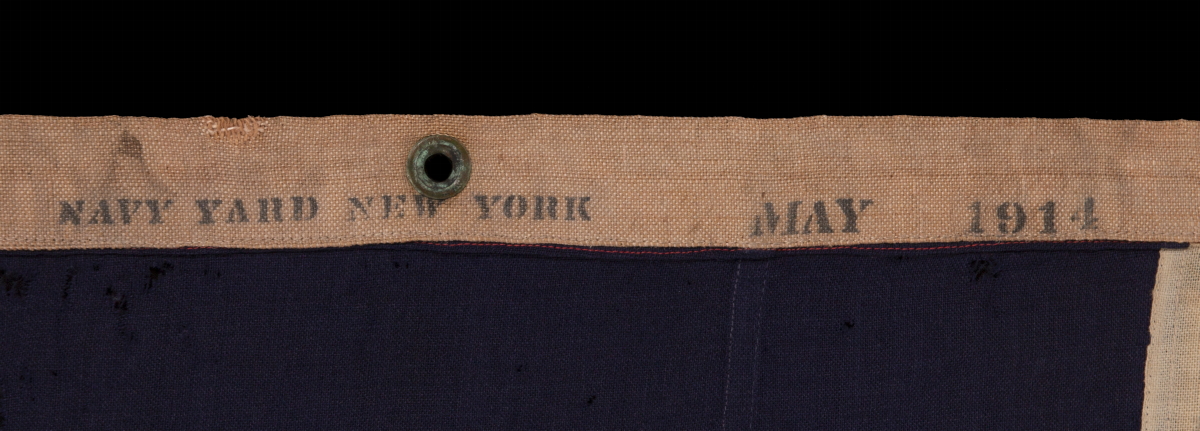
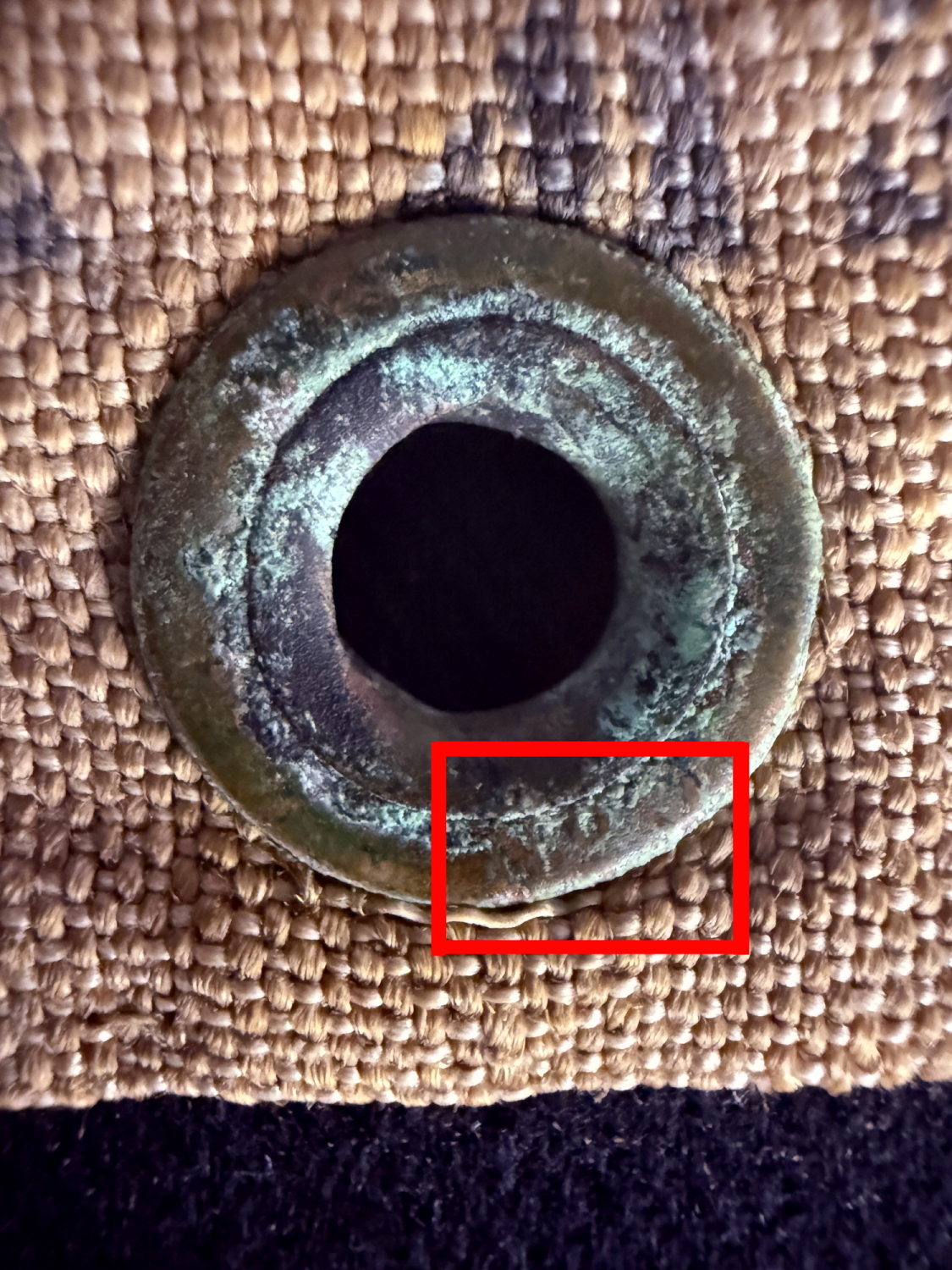
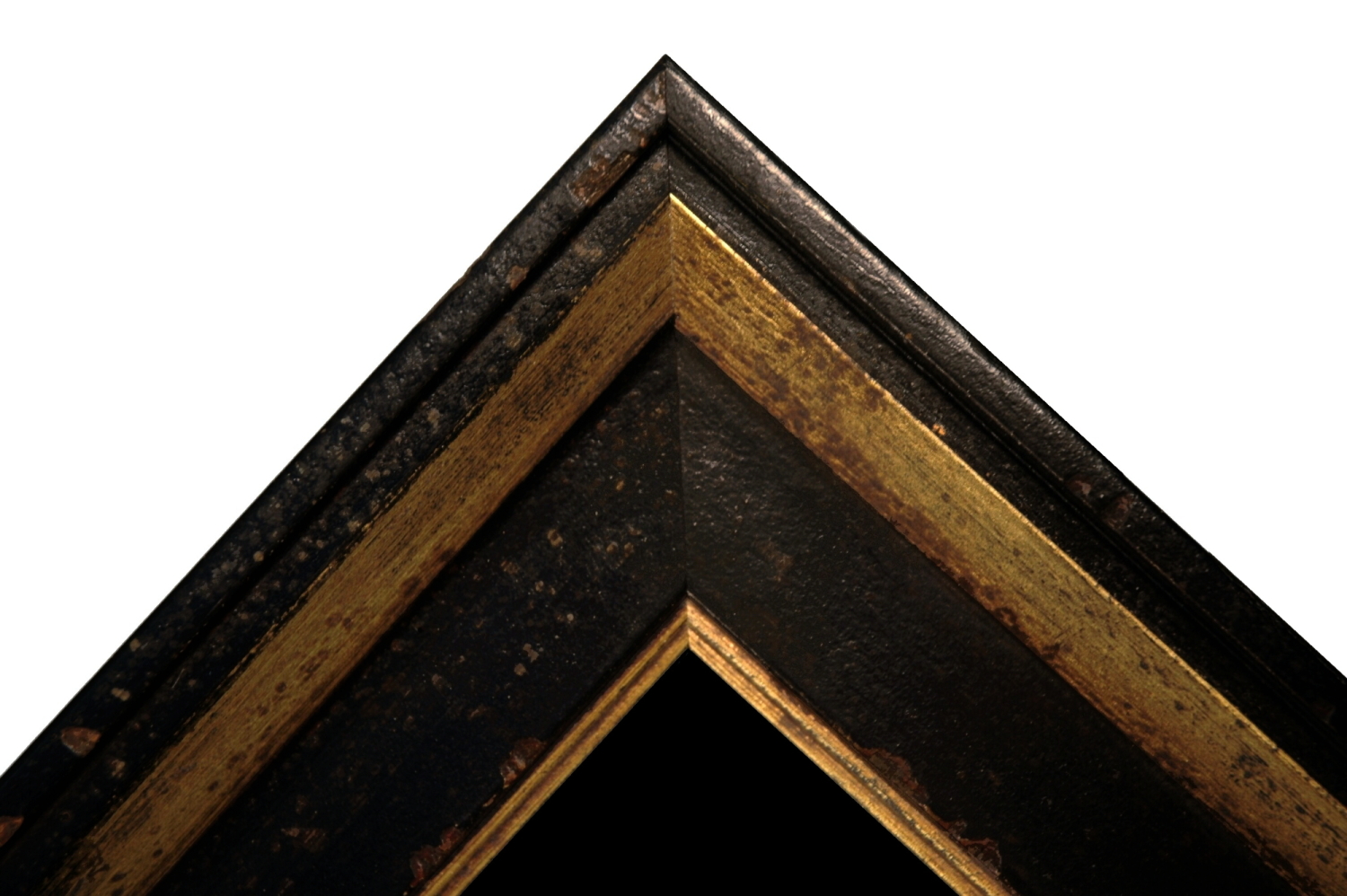
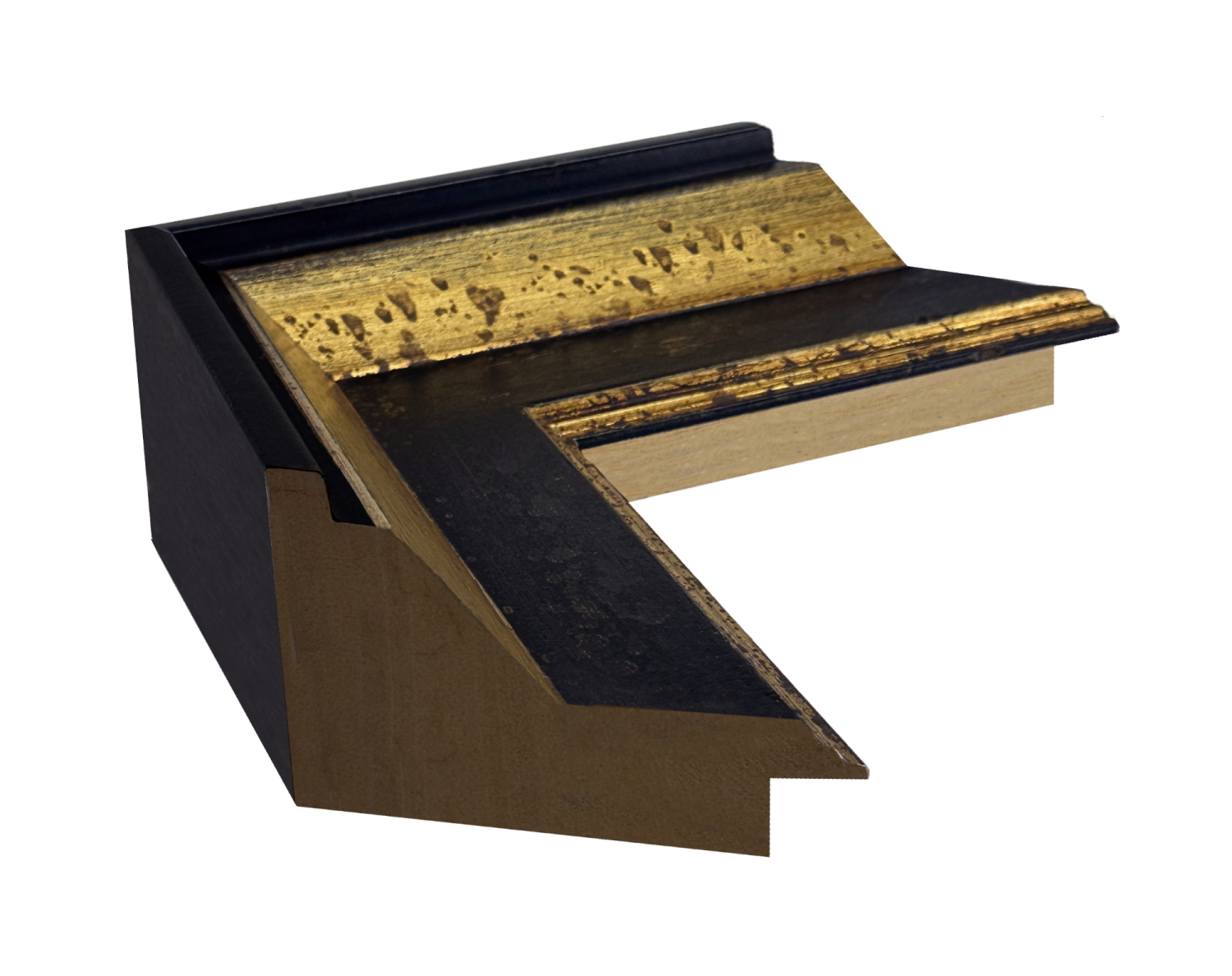
| 13 star American national flag of the type used by the U.S. Navy on small boats around the turn-of-the 19th century to the beginning of the 20th. These were flown at the stern, from a gaff, or from the yard-arm on a larger vessel, or as the primary flag on a skiff, or other small craft, that ushered sailors back and forth to shore. The U.S. Navy flew 13 star flags not only in the Revolutionary and early Federal periods, following the First Flag Act of June 14th, 1777, but throughout much or all of the 19th century, particularly the second half. As the total number of states increased, and subsequently the number of stars on our nation’s flag, the Navy often elected to use star counts lower than what was official at the time, on smaller flags, in order that the stars could be more easily discerned at a distance, as individual objects. Primarily these “boat flags” or “small boat ensigns” displayed 13 stars, to reflect the original 13 colonies. Flag experts disagree about precisely when the Navy began to employ this practice. Some feel that the use of 13 star flags basically never stopped, which seems to be supported by depictions of ships in period artwork. Less consistent prior to the Civil War, but more-so afterwards, the tradition of displaying 13 star boat flags continued until 1916, when President Woodrow Wilson wrote an Executive Order that—at least in theory—ended the practice, in favor of flags with the full star count. Some military traditions die hard, however, and according to flag expert Grace Rogers Cooper of the Smithsonian, Wilson’s order did not completely dispel the presence of 13 star flags on small Navy craft. While I don’t doubt the sincerity of this, I practically never encount evidence of them being displayed post-1916. This particular boat flag is signed along the hoist on the reverse by way of a black-inked stencil that reads: “U.S. Ensign No. 9; Navy Yard New York; May 1914.” Established in 1801, the Brooklyn Navy Yard remained a key seat of Naval operations until 1966, at which point it was decommissioned and sold to the city. As a rule, the Navy made its own flags at various locations. During the 19-teens, principal sites of Navy manufacture, beyond New York, included the Charlestown Navy Yard, Boston, the Norfolk Navy Yard, Virginia, and Mare Island, California, Headquarters of the Pacific Fleet, as well as Cavite in the Philippine Islands. With but a tiny handful of identified exceptions, most Navy flags seem to have gone unmarked until the 1880's and after, and even then were scantly and inconsistently signed. During the 19th century, the word “small,” as it relates to flags, meant something different to the Navy than most people would expect. Through much of this period, the largest flags specified by Navy regulations were to measure 36 feet on the fly. This was equivalent to the largest flags flown by the Army, to mark military garrisons. Until 1882, the classification of small boat flags included all national flags 10 feet long and smaller on the fly. The “No. 9” designation, stenciled on this flag, identifies it as the largest of those in use (3.52 x 6.69 feet), per U.S. Navy Regulations of 1914, adopted in the same year in which this flag was made.* The stars of the flag are made of cotton and are double-appliquéd (applied to both sides) with a zigzag machine stitch. Note how these are especially large relative to the size of the canton, when compared to most other flags throughout American history. The canton and stripes are made of wool bunting that has been joined with a lineal machine stitch. The patches in the upper and lower, hoist-end corners are called gussets. These are original to the flag's construction and were added for reinforcement at the points where it was subject to the most wear. There is a coarse linen binding along the hoist, with what would have originally been 4 brass grommets—one of which is absent, having been torn away. Each of these would have been stamped with the following info. at one time: “Pat’d Aug. 26, 1884” (present on the grommets of these flags from 1884 until this time), along with a size designation. Though heavily corroded and worn, on one of these “No. 0” is visible. The presence of this dating is a very nice feature. Grommets on other types of flags are never so specifically marked. In addition to the NY markings, a large letter “N” is inscribed in red/orange grease pencil or crayon. The intended purpose of this is not known. In most cases the 3-2-3-2-3 design can also be viewed as a diamond of stars, with a star in each corner and a star in the very center. It is of interest to note that the pattern can also be interpreted as a combination of the crosses of St. Andrew and St. George, which some feel could have been the design of the very first American flag and may identify a link between this star configuration and the British Union Jack. The pattern is often attributed--albeit erroneously in my opinion--to New Jersey Senator Francis Hopkinson, a member of the Second Continental Congress and signer of the Declaration of Independence, who is credited with having played the most significant role in the original design of the American national flag. Hopkinson's original drawings for the design of the flag have not survived and his other depictions of 13 star arrangements for other devices are inconsistent. 13 star flags have been made throughout American history, from at least June 14th, 1777, when the first Flag Act was passed by Congress, until the present. They have been continuously produced for reasons both patriotic and utilitarian. In addition to their use on U.S. Navy ships, some private ships flew 13 star examples throughout the 19th century. Because this was the original number of stars on the American flag, representing the 13 colonies, it was appropriate for any device made in conjunction with celebrations or notions of American independence. 13 star flags were thus displayed at patriotic events, including, but certainly not limited to, such occasions as Lafayette’s final visit to America and grand tour in 1824-25, the nation’s centennial in 1876, and longstanding celebrations of Independence Day. From at least 1840 onward, 13 star flags were produced for presidential campaigns, drawing a parallel between the past and present struggles for freedom, and were carried by soldiers during the Mexican and Civil Wars for the same purpose. Throughout history, and even today, they are boldly displayed at every presidential inauguration. * It is of interest to note that from 1899 until that year, the numeric identification for a flag of the same basic size was instead listed as a number “6”, the dimensions of which were nearly identical, at 3.52 x 6.67 feet. In reality, human error and shrinkage would not allow anyone to distinguish between these. Mounting: The flag was mounted and framed in-house. For 25 years we have maintained our own specialized department for this purpose and our lead conservator holds a master's degree in textile conservation from one of the nation’s top programs. We take great care in the mounting and preservation of flags and related textiles and have preserved thousands of examples. The mount was placed in a black-painted, hand-gilded and distressed Italian molding. The background is 100% cotton twill, black in color, that has been washed and treated for colorfastness. The glazing is U.V. protective acrylic (Plexiglas). Feel free to contact us for more details. Condition: There is extremely minor mothing in limited areas. There is minor to moderate soiling in some of the stars, accompanied by a couple of small, modest to moderate stains below the canton, near the hoist end, and scattered minor staining elsewhere. The colors are especially strong and the overall condition is excellent for the period among surviving examples. Many of my clients prefer early flags to show their age and history of use. |
|
| Video: | |
| Collector Level: | Intermediate-Level Collectors and Special Gifts |
| Flag Type: | Sewn flag |
| Star Count: | 13 |
| Earliest Date of Origin: | 1914 |
| Latest Date of Origin: | 1914 |
| State/Affiliation: | New York |
| War Association: | |
| Price: | Please call (717) 676-0545 |
| E-mail: | info@jeffbridgman.com |
 |
|