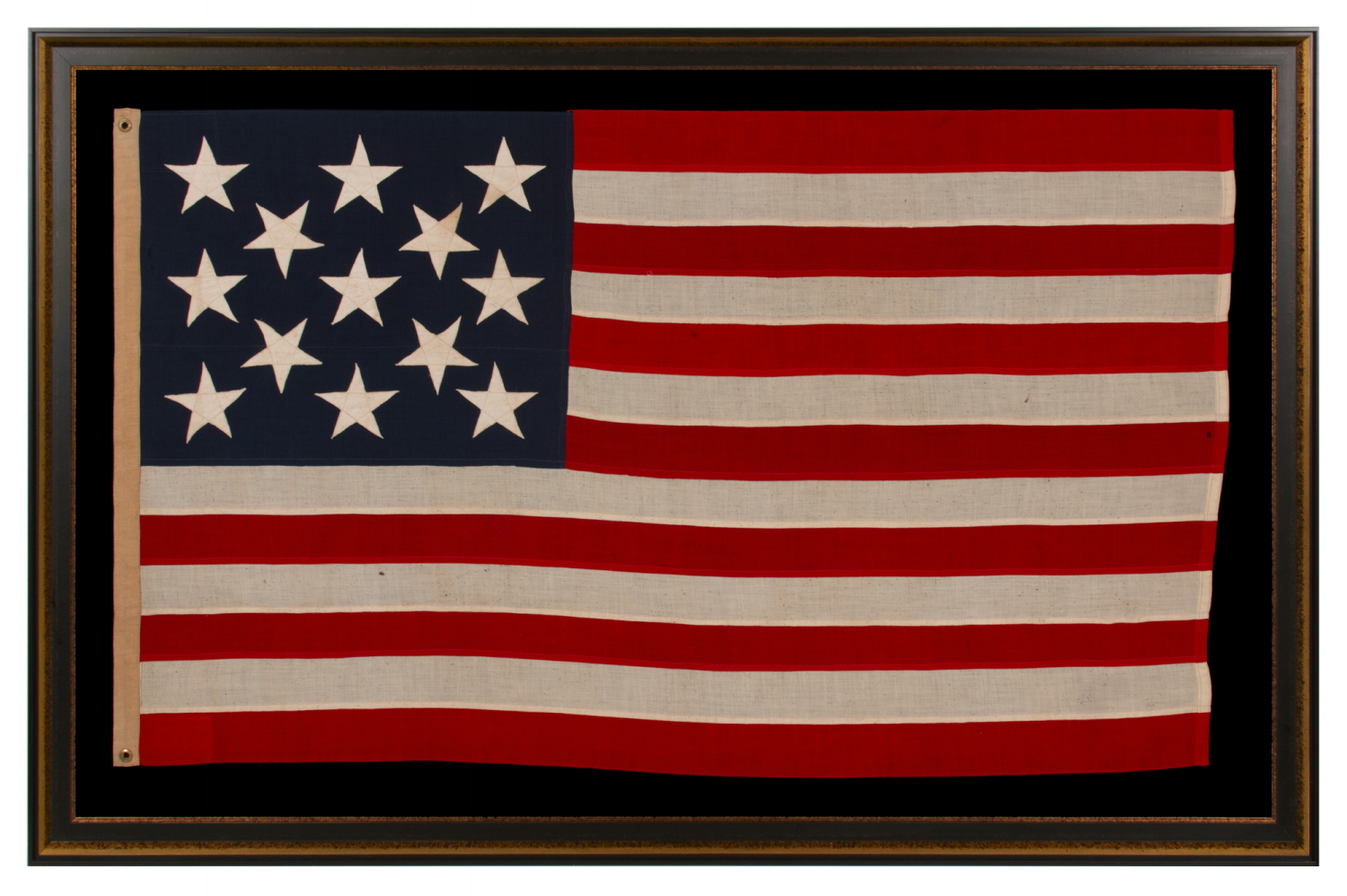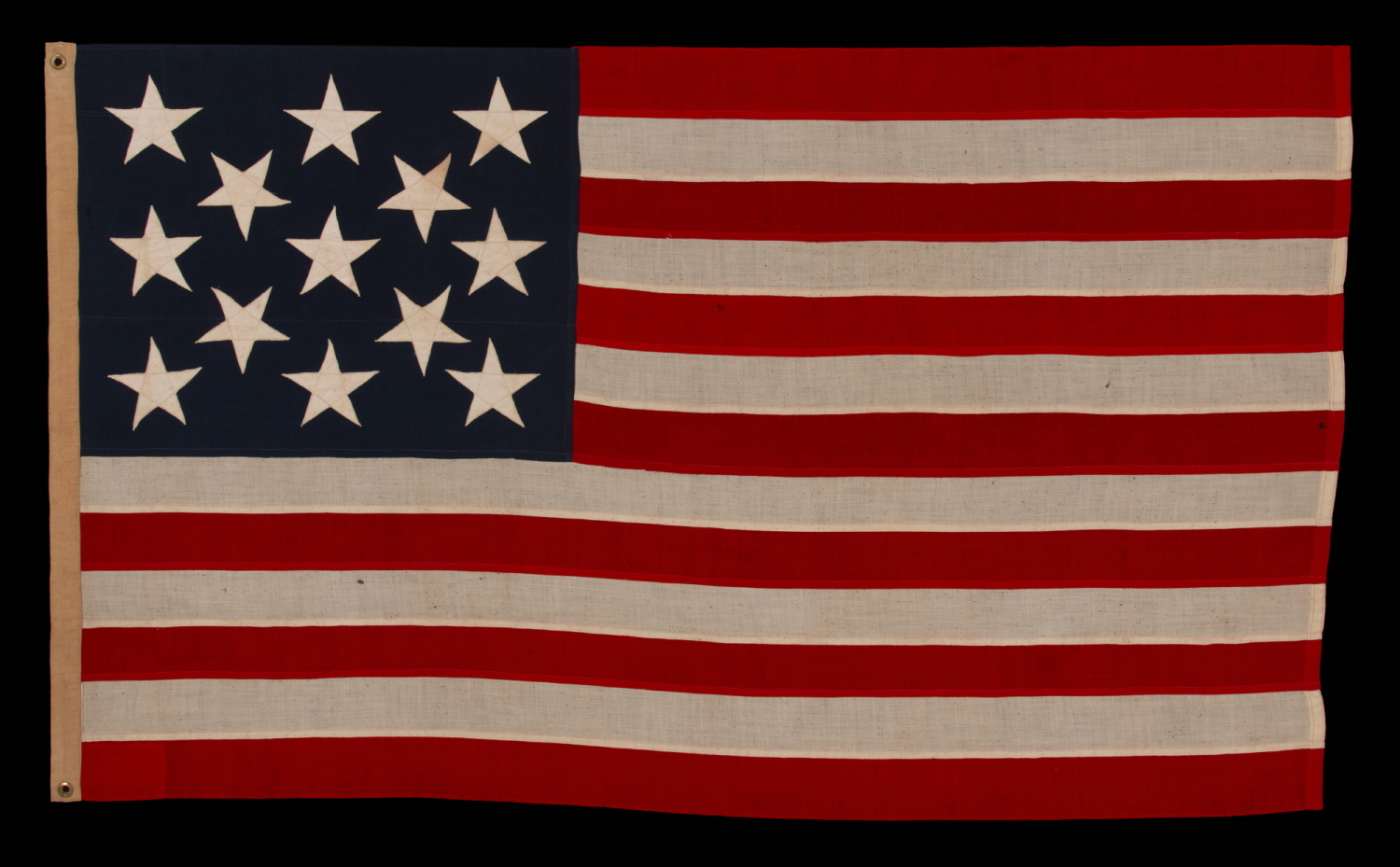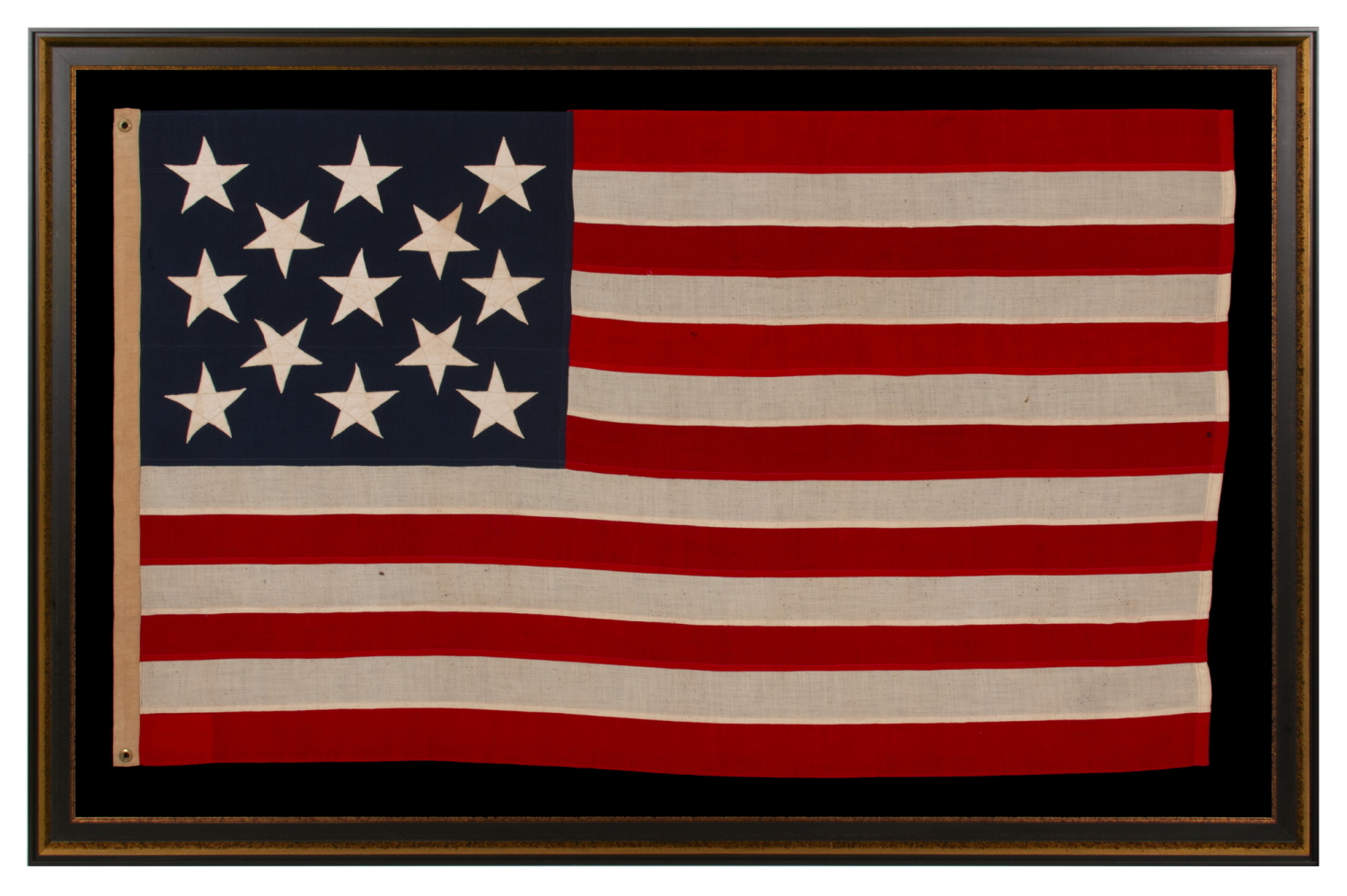
| 13 STAR ANTIQUE AMERICAN FLAG WITH A 3-2-3-2-3 PATTERN OF ESPECIALLY LARGE STARS; A U.S. NAVY SMALL BOAT ENSIGN, ALMOST CERTAINLY MADE AT MARE ISLAND, CALIFORNIA, circa 1906-1912, LARGER THAN THE SPECIFIED DIMENSIONS & UNCHARACTERISTICALLY UNSIGNED; EXTREMELY RARE |
|
| Web ID: | 13j-1710 |
| Available: | In Stock |
| Frame Size (H x L): | 61" x 93.75" |
| Flag Size (H x L): | 49.5 " x 82.5" |
| Description: | |
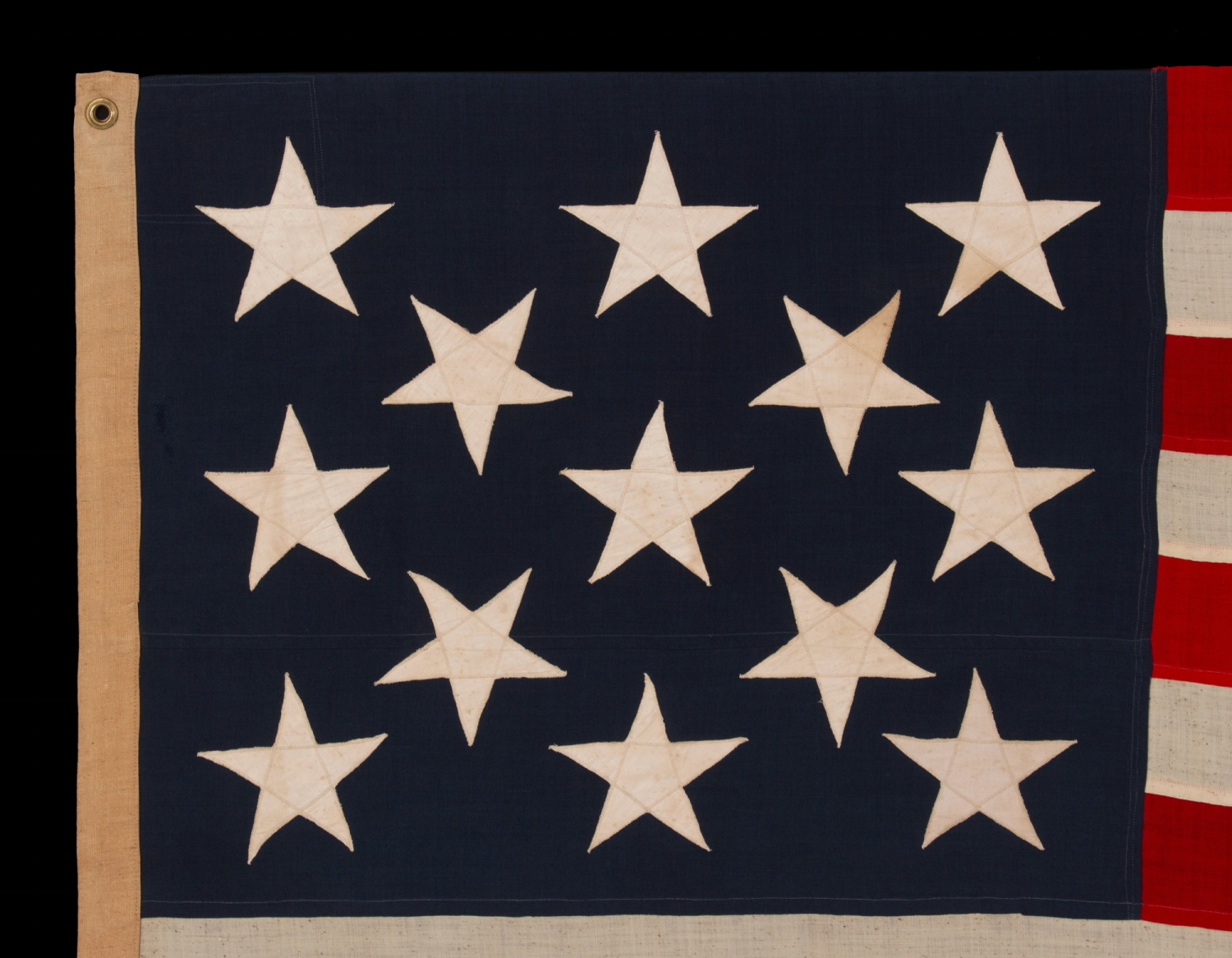
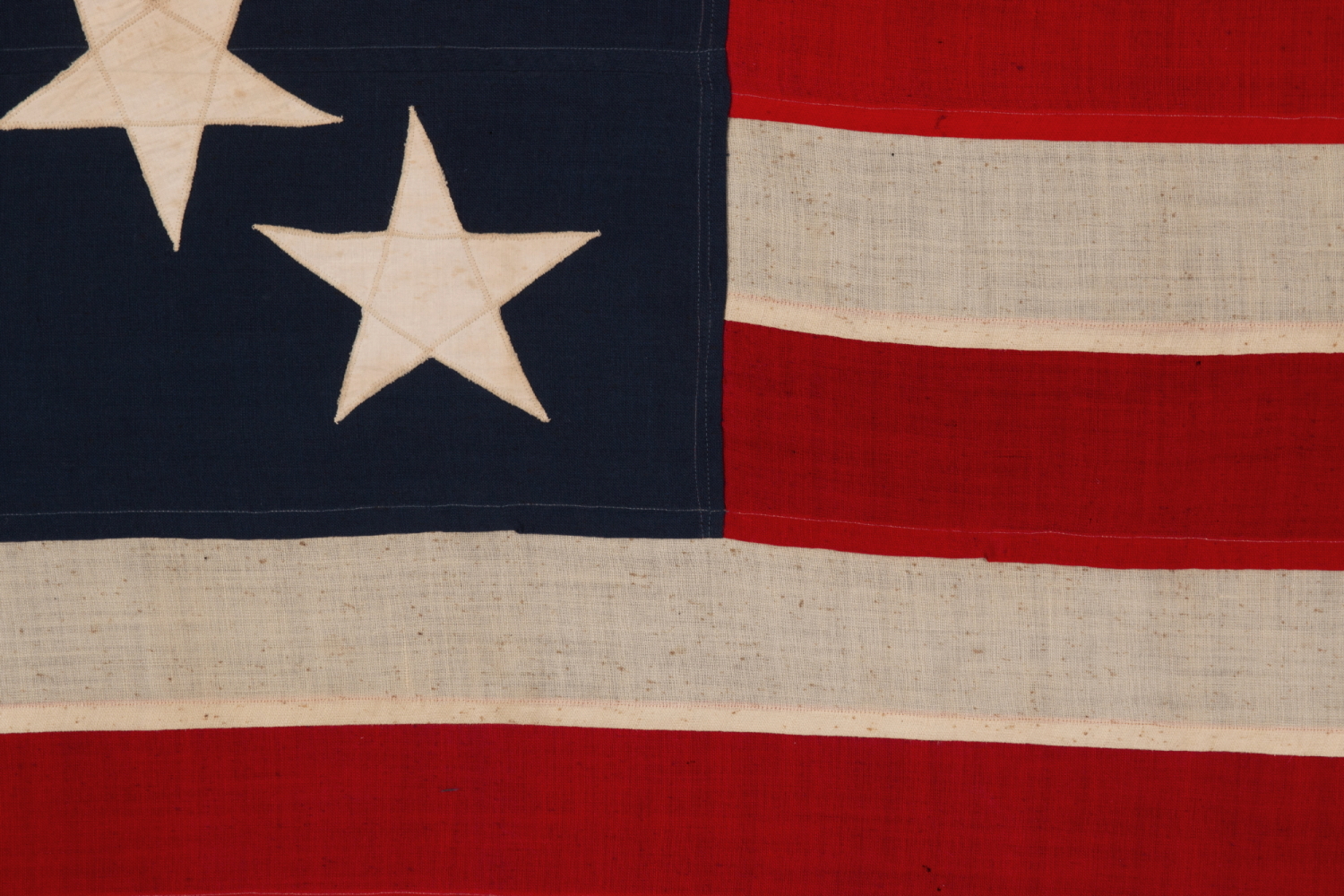
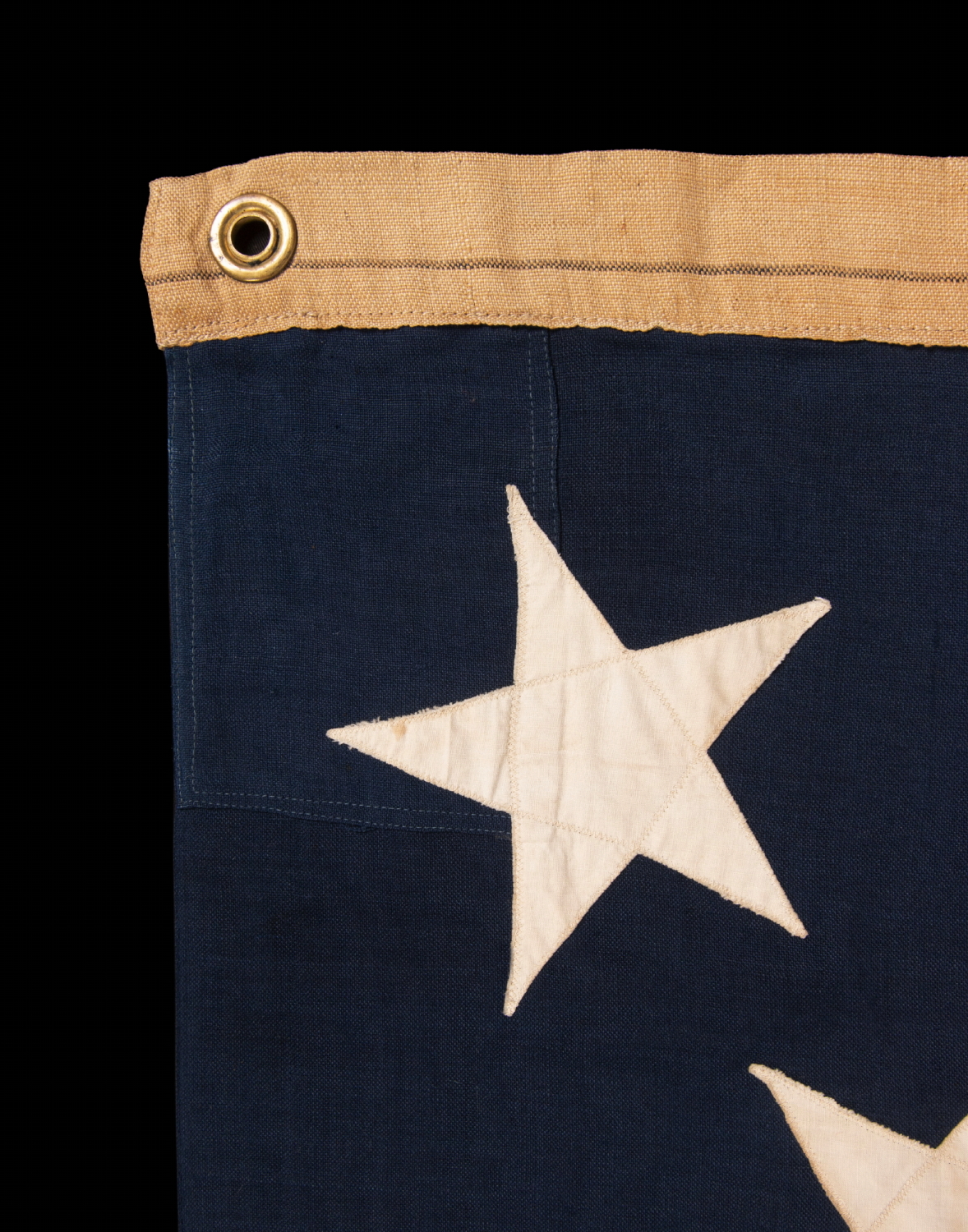
| 13 star American national flag of the type used by the U.S. Navy on small boats around the turn-of-the 19th to the beginning of the 20th century. These flags were flown at the stern, from a gaff, or from the yard-arm on a larger vessel, or as the primary flag on a skiff, or other small craft, that ushered sailors back and forth to shore. The U.S. Navy flew 13 star flags not only in the Revolutionary and early Federal periods, following the First Flag Act of June 14th, 1777, but throughout much or all of the 19th century, particularly the second half. As the total number of states increased, and subsequently the number of stars on our nation’s flag, the Navy often elected to use star counts lower than the official number at the corresponding time, on its smaller flags, in order that the stars themselves might be easier to discern at a distance. Primarily these “small boat ensigns” or “boat flags,” displayed 13 stars to reflect the original 13 colonies. Flag experts disagree about precisely when the Navy began to employ this practice. Some feel that the use of 13 star flags never stopped, which seems to be supported by depictions of ships in period artwork. Less consistent prior to the Civil War, but more-so afterwards, the tradition continued until 1916, when President Woodrow Wilson wrote an Executive Order that, in theory, ended the Navy’s use of 13 stars in favor of the full star count. Some military traditions die hard, however, and according to flag expert Grace Rogers Cooper of the Smithsonian, Wilson’s order did not completely dispel the presence of 13 star flags on small Navy craft. While I don’t doubt the sincerity of this, I have thus far discovered just one documented exception, displayed post-1916. The U.S. Navy largely produced its own flags, with but few exceptions. The vast majority of small boat flags with reduced star counts—some survive with counts other than 13—went undated until the 1890’s. During that decade, stenciled marks start to appear with more frequency on flags produced at the Brooklyn Navy Yard in New York City. Following the turn of the 20th century (1900), marks begin appear from two other locations, including Cavite, in the Philippines, and Mare Island, California, a massive base that served as Headquarters of the Pacific Fleet. For going on 3 decades, I have been aggressively acquiring high end examples of antique American national flags and related textiles. During that time I have had the great privilege to acquire most of the Navy-produced ‘boat flags,’ with 13 stars, that have been offered, both publicly and privately, through every avenue by which antiques are sold. This includes those dating at least as early as the 1830’s-1840’s era, through the issue of Wilson’s 1916 order. This unusual circumstance has permitted me the rare opportunity to actually hold these in my hands, compare and contrast them, while assembling an excellent baseline data to compare and cross-reference the various traits and eccentricities present across time and, when such knowledge is obtainable, various points of origin. Although the U.S. Navy signed most of its flag made during the 1890-1916 era, the flag that is the subject of this narrative is unmarked; nonetheless, enough facts are present to allow me to ascertain both date and location of manufacture with some degree of certainty. During the 19th century, the word “small” when it came to flags, meant something different to the Navy than most people might expect. Through much of that 100-year time span, the largest flags specified in Navy regulations were 36 feet on the fly, a size that was equivalent to the Garrison flags of the army, flown on forts. Until 1882, “small boat flags,” as flag aficionados often call them today, could be as long as 10 feet on the fly. Because framing, the way that we do it, typically adds about a foot, a framed flag measuring 11 feet in length is not something one would generally describe as being small. From 1882 onward, through 1914, the largest boat flags measured 3.52 x 6.67 feet, designated a “No. 6” on the regulations of both 1882 and 1899. At approximately 49.5 x 82.5 inches, or 4.13 x 6.88 feet, the example that is the subject of this narrative is therefore larger than anything listed in official specs. I have sometimes uttered, in jest, that that “the most accurate thing one can say about the consistency of measurements in early boat flags of the U.S. Navy, is their complete lack thereof.” In that light, the circumstance is unsurprising. While there is little doubt that Navy regulations were properly distributed and well-known, especially in locations such as New York and Mare Island, decisions regarding the size of flags was probably determined more by the width of suitable fabrics, available to the corresponding navy yard, and the optimal efficiency of their use. For example, the width of blue wool bunting was typically 18”. If the canton was taller, it needed to be pieced from two lengths of fabric, one of which may be left in its full width, and a narrow piece hemmed along the lower edge. The width of what was left over might be most efficiently used with another 18” section, to produce a larger flag of a certain size, given the desired or the most efficient proportions. Width of the stripes, per available fabrics, might play a similar role. Certain types of ships, such as tugs, might require flags of differing lengths, given obstacles that might interfere. Without going into too much more detail, one can see how various factors might affect flag sizes, especially on opposite sides of America, with different supply chains and different ship builders, let alone different quartermasters and other officers who concerned themselves with the specifications of signals. The stars of the flag are made of cotton and are double-appliquéd (applied to both sides) with a zigzag machine stitch. Note how these are especially large relative to the size of the canton, when compared to most other flags throughout American history. Arranged in a 3-2-3-2-3 configuration of staggered rows, note how the stars in the 1st, 3rd, and 5th rows are oriented so that one point is directed upward, in the 12:00 position, while those in the second and 4th rows are mirror image opposites, being what one might describe as “upside-down,” with one arm directed toward 6:00. In most cases the 3-2-3-2-3 design can also be viewed as a diamond of stars, with a star in each corner and a star in the very center. It is of interest to note that the pattern can also be interpreted as a combination of the crosses of St. Andrew and St. George, which some feel could have been the design of the very first American flag and may identify a link between this star configuration and the British Union Jack. The pattern is often attributed--albeit erroneously in my opinion--to New Jersey Senator Francis Hopkinson, a member of the Second Continental Congress and signer of the Declaration of Independence, who is credited with having played the most significant role in the original design of the American national flag. Hopkinson's original drawings for the design of the flag have not survived and his other depictions of 13 star arrangements for other devices are inconsistent. Use of this pattern by the U.S. Navy began sometime during the late Civil War, between roughly 1864-1865. Prior to that time, its presence on surviving flags with 13 stars is extremely rare. The canton and stripes are made of wool bunting that has been joined with a lineal machine stitch. The patches in the upper and lower, hoist-end corners are called gussets. These are original to the flag's construction and were added for reinforcement at the points where it was subject to the most wear. There is a coarse linen binding along the hoist, with 2 brass grommets. Note the vertical stripe that results from 3 black fibers, woven into the fabric, that served as a visual reference for trimming bindings to whatever width was required. Though the grommets of this era on U.S. Navy-produced flags are typically encountered with stamped patent dates, and a sequentially numbered size designation, these bear only the latter, which reads: “No. 3.” In the unusual absence of dating, a peculiar size can be one way to predict place of manufacture. The huge stars are an identifier, as is their opposing vertical positions. More than 20 years ago, in 2002 or 2023, I obtained a flag of nearly identical proportions, with like measurements, the same large stars and opposing pattern, made of the same, expected fabrics peculiar to Navy production. All of the applique work and hemming was accomplished with the same types of stitching. Though no trim line was present in the binding, the presence of this feature varies in all instances, across all commercial makers, as well as in Navy examples. With 3, smaller, 1884 patent-dated grommets, instead of 2 without the additional markings, on the reverse of the binding, “No. 6 U.S. E Mare Island July 06” was stenciled in the expected manner. The canton, in that instance, was assembled from three narrow lengths of fabric. Though measurements were not taken, one can easily asses that 3 of the narrow lengths of the blue wool bunting, used to complete the lower portion of the canton of the unsigned flag, could be easily joined together to make a canton of equivalent size. This is the precise manner by which United States Navy Yards carefully planned and utilized available cloth. A quick glance at flags produced in New York, in the same era, revealed use of large stars in opposing positions, in the 3-2-3-2-3 pattern, on “No. 6” marked flags of similar length, in both 1908 and 1912, but with consistently narrower hoist measurements, between 40 – 43 inches, instead of 49 – 50. Flags being produced at Mare Island in 1902 I can say with some assuredness that the flag that is the subject of this narrative was sewn at Mare Island, sometime between roughly 1906 and 1912. Brief History of Mare Island: Located about 23 miles northeast of San Francisco, Mare Island (actually a peninsula) became a seat of U.S. Navy defense in 1852, in the wake of California’s admission as the 31st state (1850). The site was proposed by Commodore John Drake Sloat, a prominent U.S. Navy officer who, in 1848, had embarked at Monterey and claimed the former Mexican ‘Alta California’ Territory for the United States, with the support of explorer and former U.S. Army Engineer, John Fremont, who arrived on the same day, in the employment of one America’s most powerful senators, Railroad Thomas Hart Benton of Missouri. Two years later, Sloat received orders to lead a survey party in search of a logical site for the nation's first Pacific naval installation. The result was his recommendation that it be situated on the ‘island’ that lay beyond the Napa River, on the western edge of the settlement of Vallejo, which at that time served as the state’s principle seat of government. Sloat selected the location, being "free from ocean gales and from floods and freshets." On November 6th 1852, two years after California gained statehood, President Fillmore reserved Mare Island for government use by Executive Order. Acting favorably on Sloat’s report, U.S. Navy purchased Mare Island, in July of 1853, for the sum of $83,410, for use as a naval shipyard.** Two years later, on September 16th of 1854, it became the first permanent U.S. naval installation on the West Coast, with Commodore David G. Farragut serving as its first commander. The base became home to what was known as the Pacific Fleet, and remained so until the threat of Japanese expansionism caused the shift to a more advanced position at Pearl Harbor. Very active in WWII, Korea, and Vietnam, it closed in 1993, following congressional approval of recommendations contained in the Base Realignment and Closure Report. In addition to their use on U.S. Navy ships, some private ships flew 13 star examples throughout the 19th century. Beginning around 1890, commercial makers began to produce small flags for the first time in significant quantity. When they did, they chose the 13 star count, mirroring Navy practice. This continued into at least the first two decades of the 20th century. The use of yachting ensigns with a wreath of 13 stars, surrounding a fouled anchor, allowed pleasure boats to bypass customs between 1848-1980. Though they no longer serve this function, their use persists widely today in the boating community, without an official purpose. * It is of interest to note that from 1899 until that year, the numeric identification for a flag of the same basic size was instead listed as a number “6”, the dimensions of which were nearly identical, at 3.52 x 6.67 feet. In reality, human error and shrinkage would not allow anyone to distinguish between these. ** When the Navy bought Mare Island, it belonged to one of its own, Lieutenant Commander William Pope McArthur, a U.S. Navy hydrographer, who had previously surveyed the island, and, in 1850, bought it from its Mexican owner, with a consortium of private investors. Per the 1848 Treaty of Guadalupe Hidalgo, that ended the Mexican War, legal owners of private land, in areas seized by or otherwise transferred to the United States, retained their original ownership. |
|
| Video: | |
| Collector Level: | Advanced Collectors and the Person with Everything |
| Flag Type: | Sewn flag |
| Star Count: | 13 |
| Earliest Date of Origin: | 1906 |
| Latest Date of Origin: | 1912 |
| State/Affiliation: | California |
| War Association: | |
| Price: | Please call (717) 676-0545 or (717) 502-1281 |
| E-mail: | info@jeffbridgman.com |
 |
|