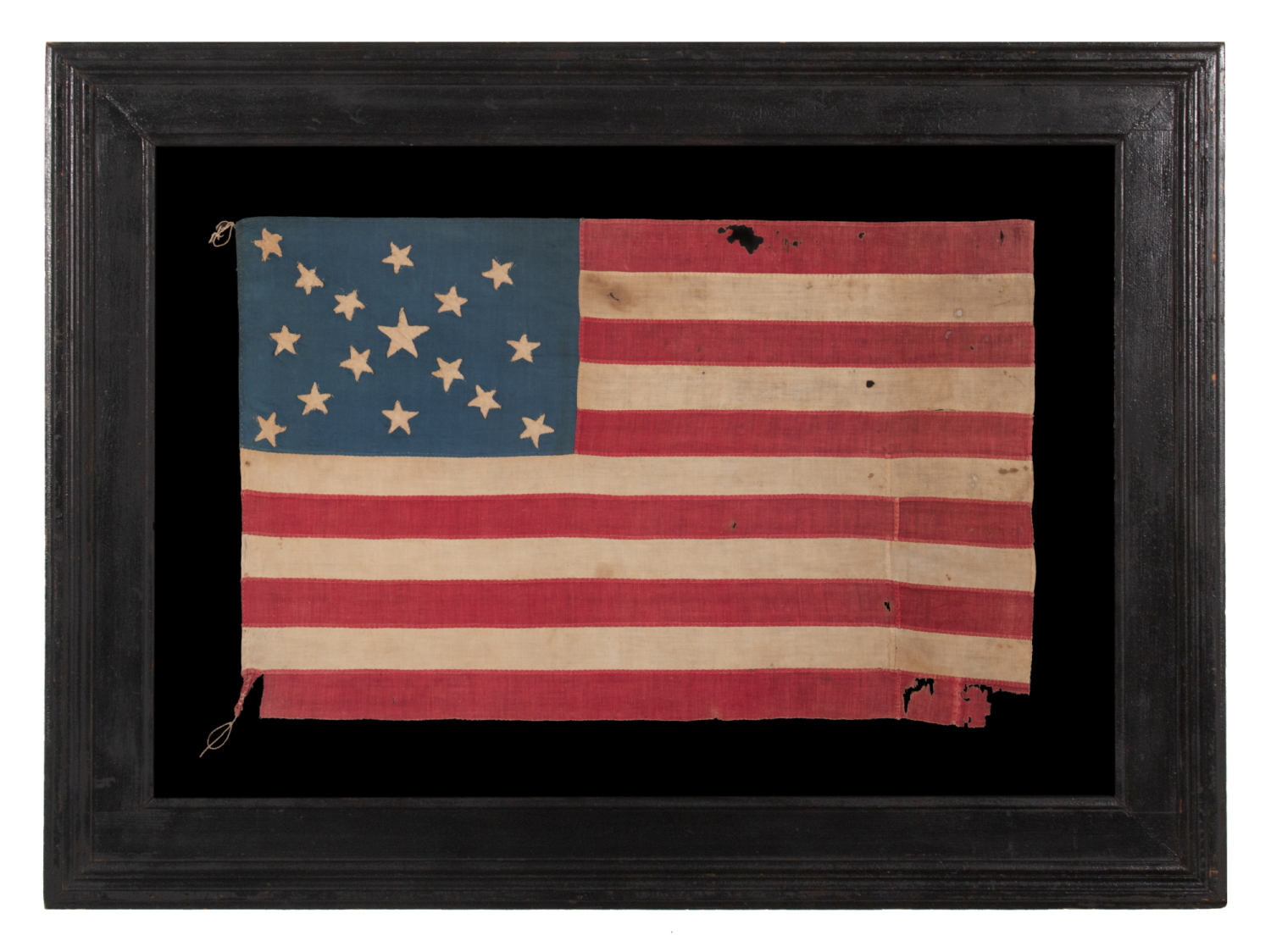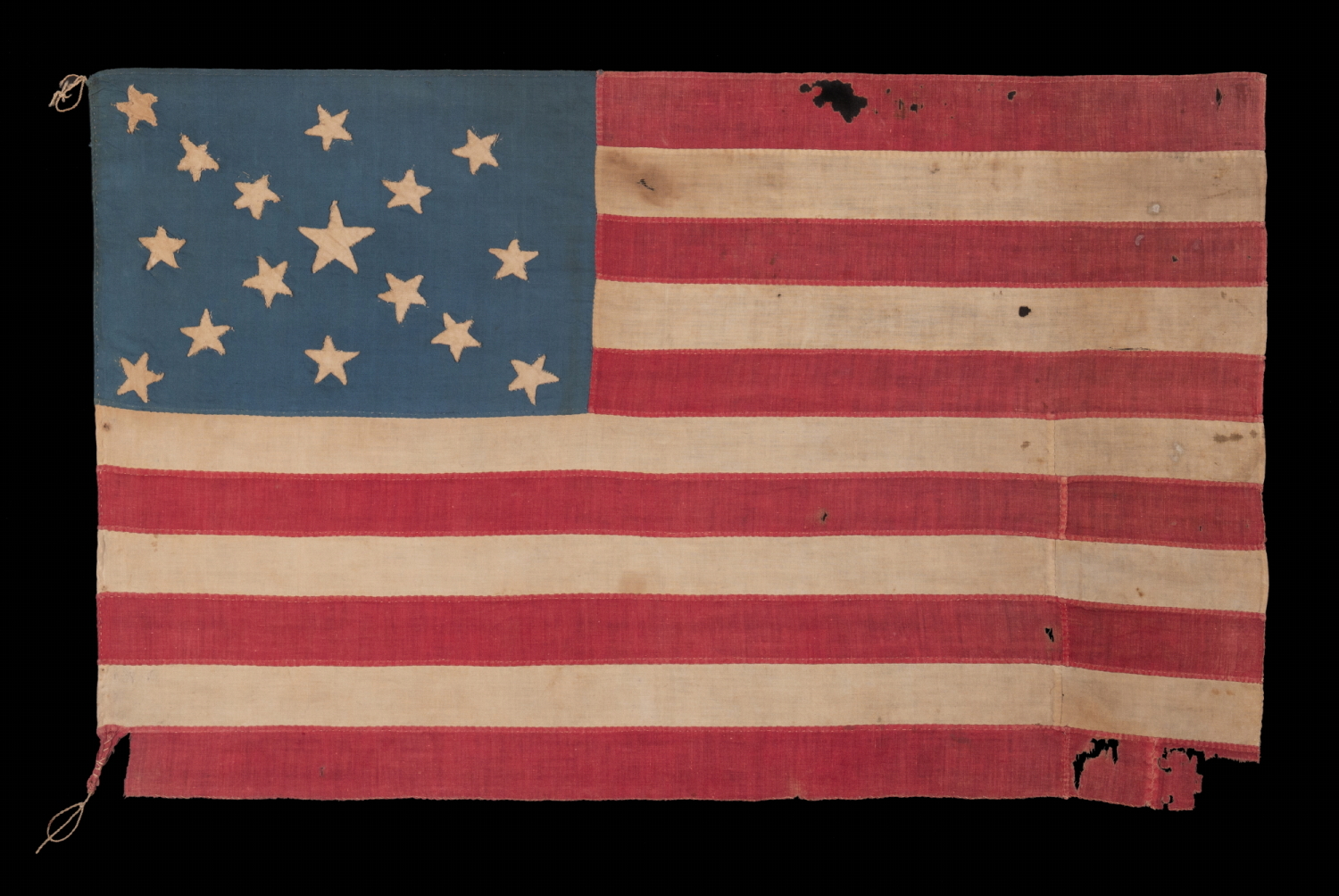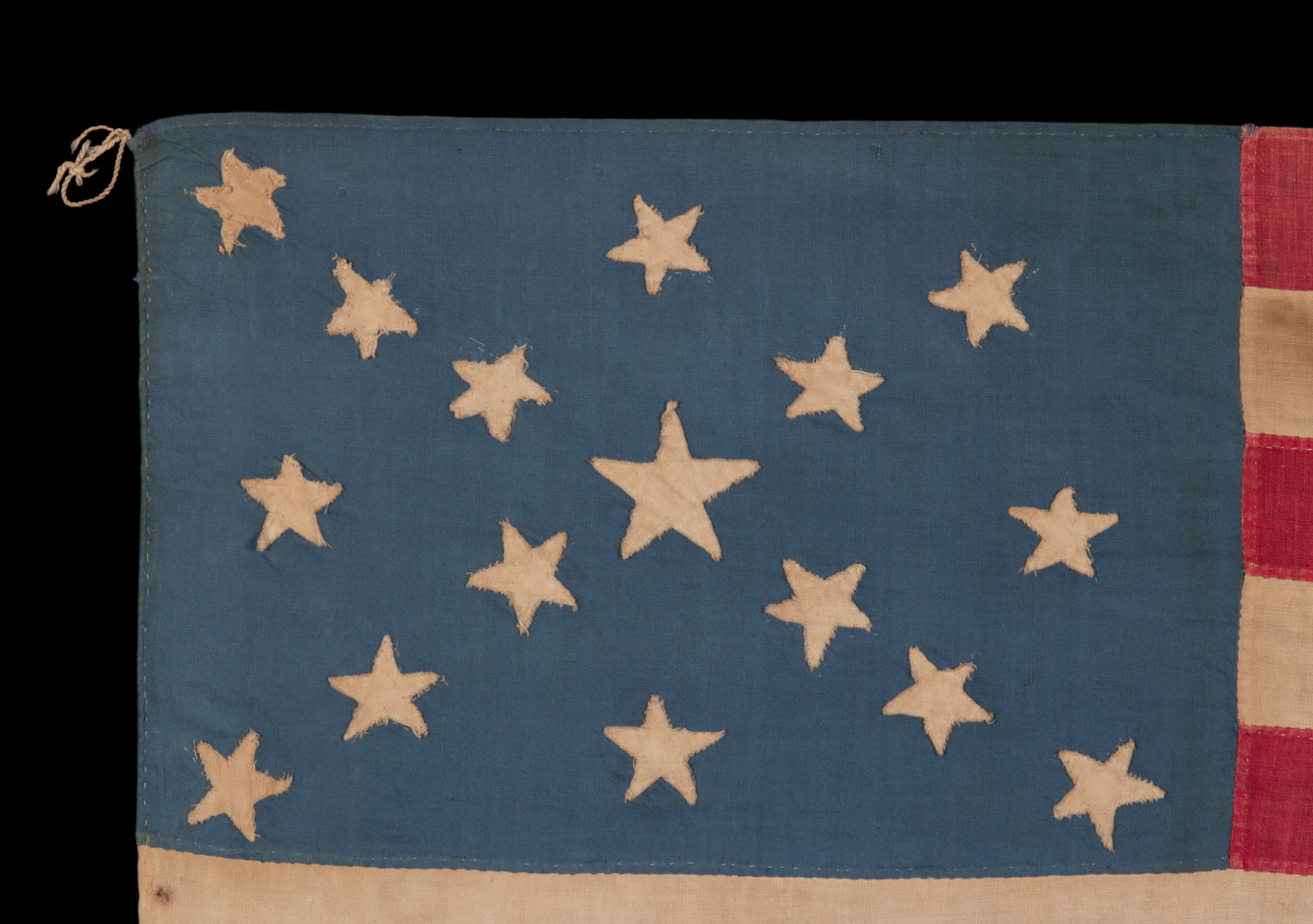
| 16 STARS IN A RARE AND BEAUTIFUL STARBURST MEDALLION, ON A HOMEMADE & ENTIRELY HAND-SEWN, ANTIQUE ANTIQUE FLAG, MADE WITH AN ABOLITIONIST MESSAGE, circa 1850-1858, REMOVING THE SLAVE STATES FROM THE STAR COUNT, YET WITH A COMBINATION OF TRAITS THAT CURIOUSLY REFLECT TENNESSEE AS THE 16th STATE TO JOIN THE UNION, AND THE 11th TO LEAVE IT; ARGUABLY THE BEST TO EXIST IN THIS STAR COUNT |
|
| Web ID: | 16j-807 |
| Available: | In Stock |
| Frame Size (H x L): | 31.25" x 42.25" |
| Flag Size (H x L): | 17.5" x 28" |
| Description: | |
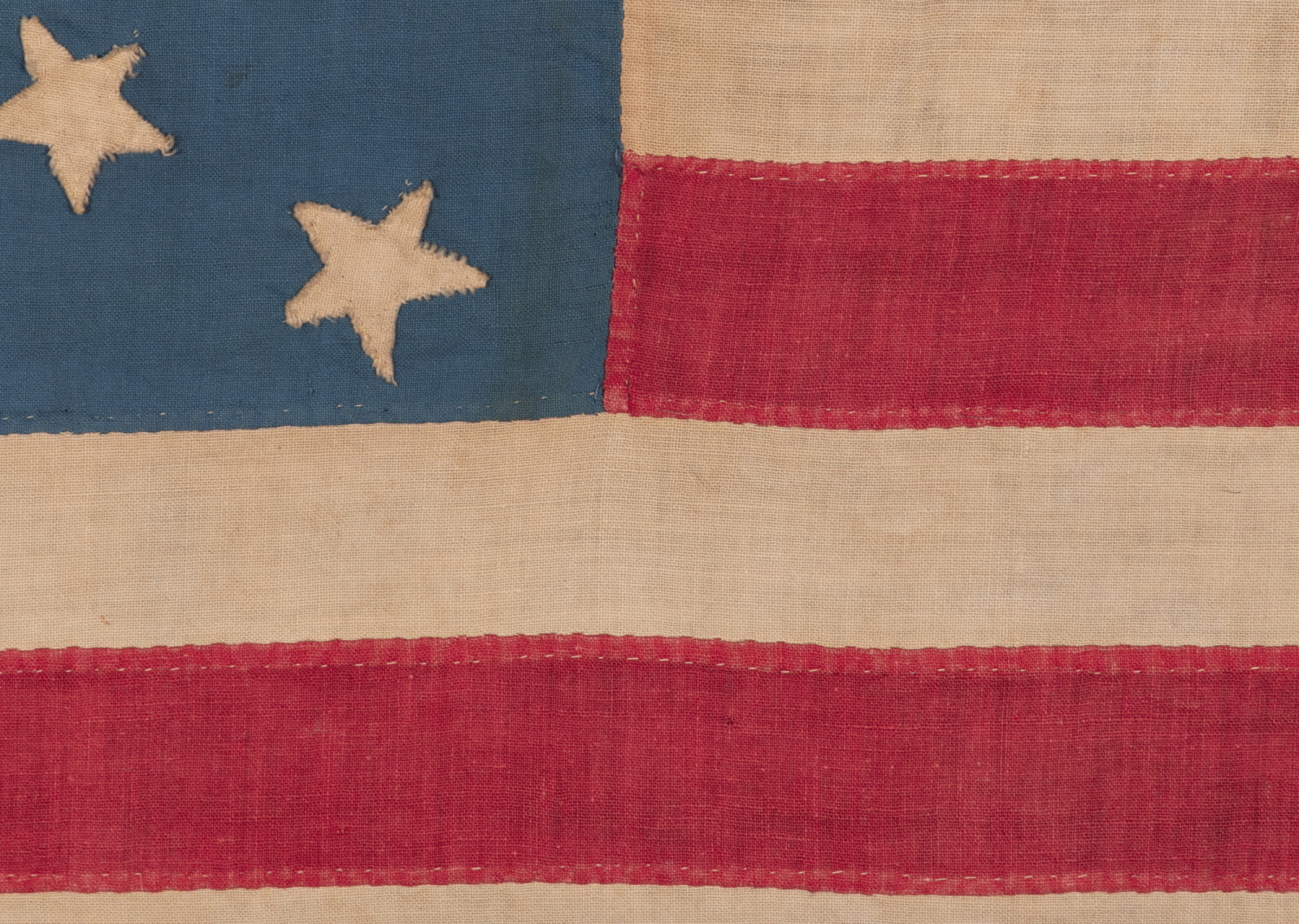
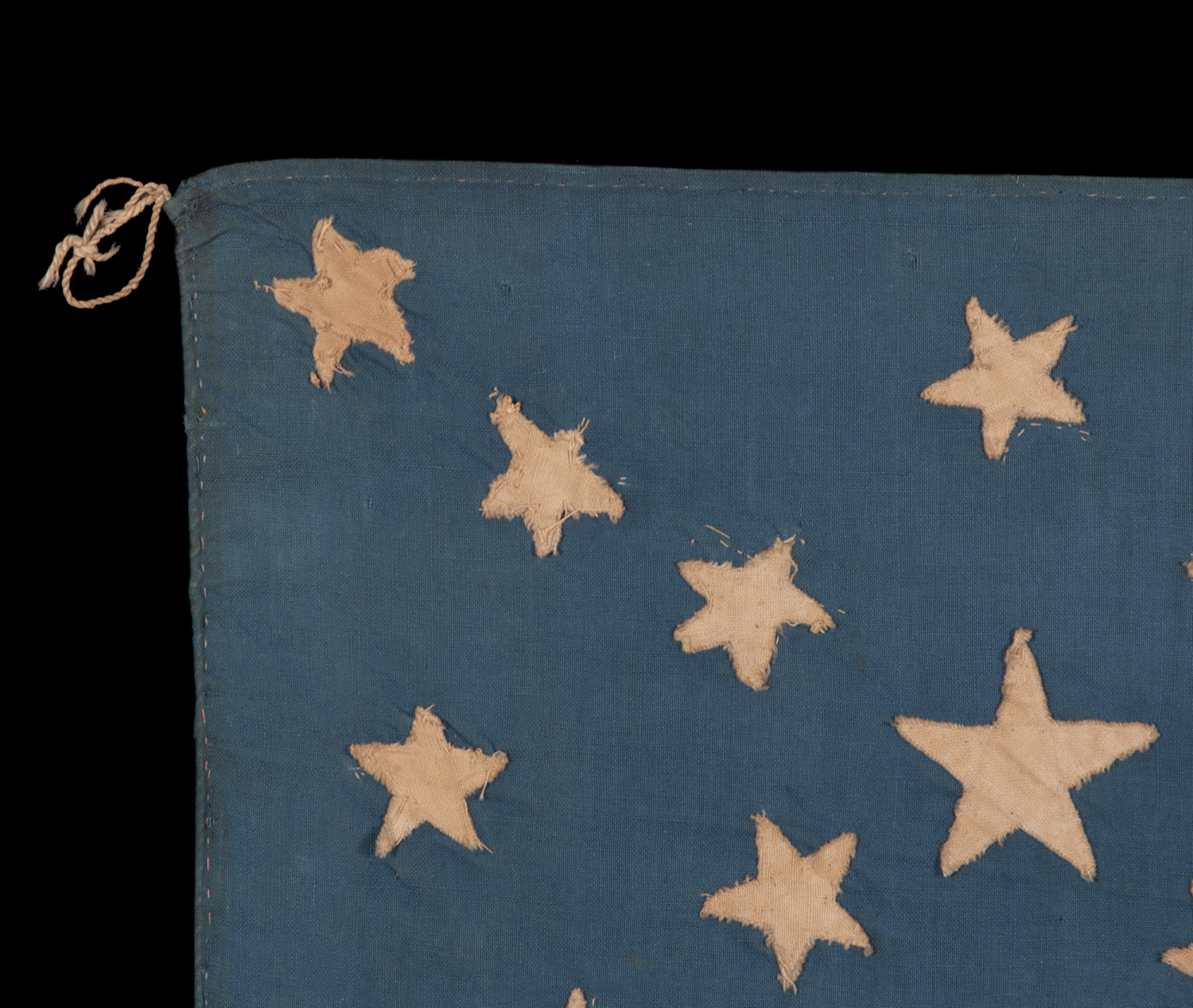
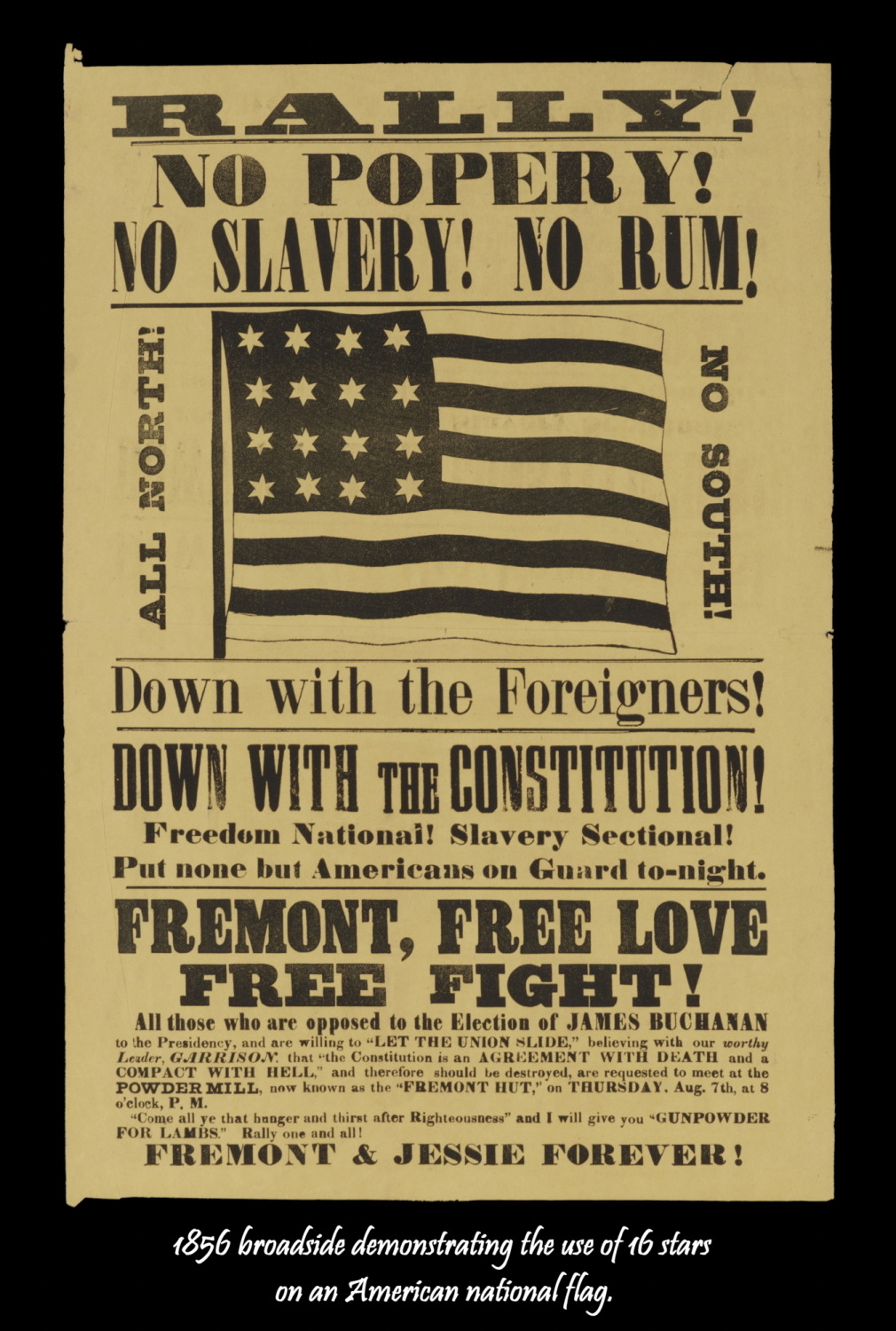
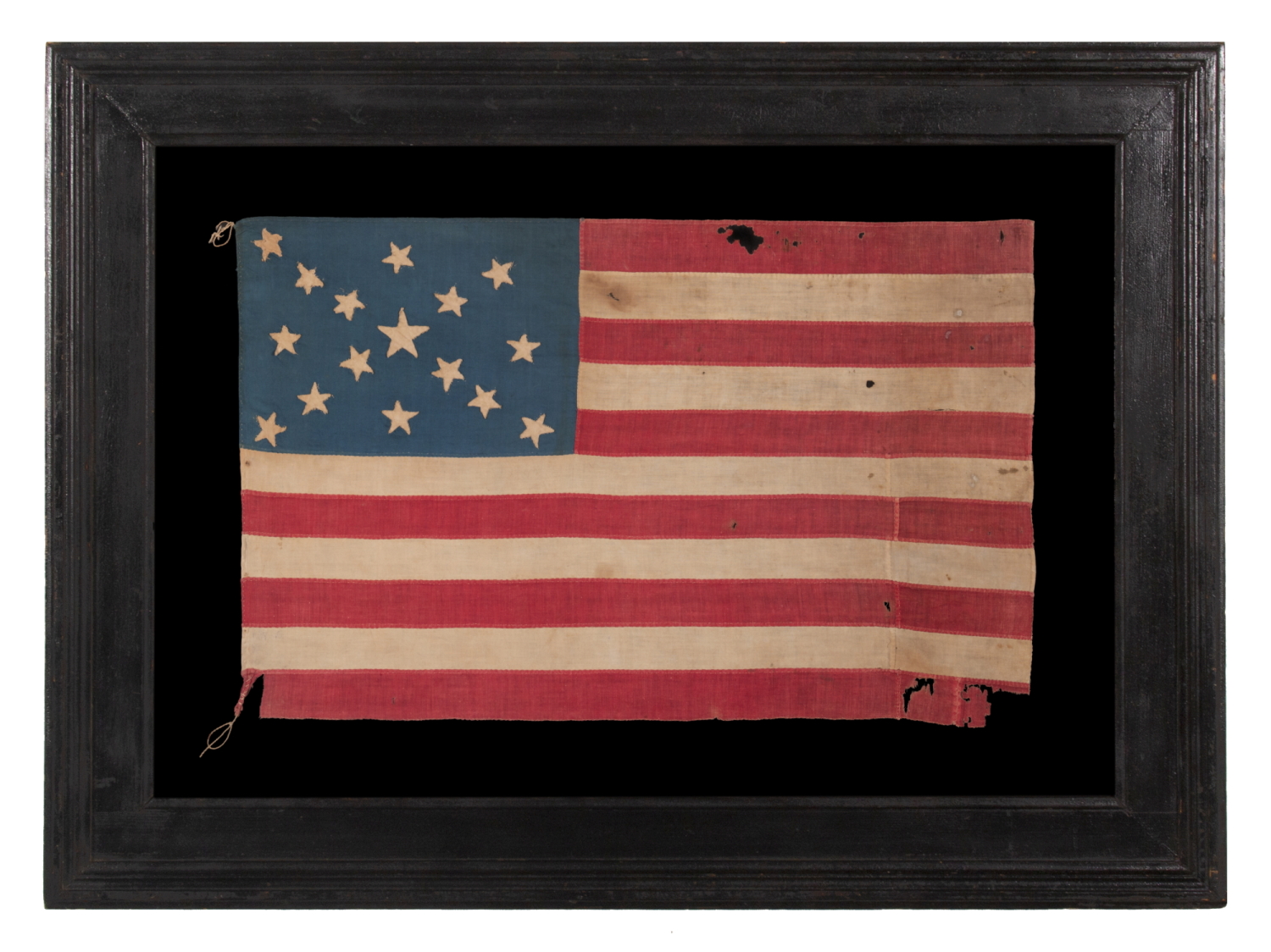
| Homemade and entirely hand-sewn, antique American with 16 stars and a shortened complement of 11 stripes. Constructed during the mid-19th century, in the approximate period between 1850 and 1858, the stars, the canton, stripes, and stars are all made of plain weave cotton. The latter are configured in a dynamic manner that places them among a very rare group of geometric designs that I have termed “starburst cross medallions”. Note the rather interesting inclusion of a saltire, with diagonal rows extending outward from a large center star. Three of these are comprised of 3 stars each, but one is intentionally incomplete, with an open space in the upper, fly end position. The above arrangement of 12, in a pattern like the Cross of St. Andrew, is accompanied by 4 additional stars placed one between each arm. Together with the large center star, these can be viewed as a superimposed Roman cross / Cross of St. George. If made following the late fall of 1861, when the Confederate, Southern Cross battle flag design was introduced, the inclusion of the saltire might illustrate the maker’s solidarity with the South. The 16 star count, however, illustrates just the opposite. Made just prior, between approximately 1850-1858, the stars of the flag don’t glorify the South, but instead exclude it, removing the Slave States from the prescribed total of the time. During the Gold Rush, growing tension came to a head as the long-maintained 50-50 split of Free & Slave States, guaranteed by the Missouri Compromise of 1820, was about to evaporate. Balance between the North and South ended with California’s admission as a Free State in 1850, forever tipping the scales in Congress to Free States, now 16 in total, versus the Slave States’ 15. Measures hoped to mitigate damage, including the Compromise of 1850, the Fugitive Slave Act (also 1850), and the Kansas-Nebraska Act (1854), followed by the Dred Scott Decision (1857), with accompanying negotiations and rhetoric, spewed more controversy and anger than had thus-far been present at almost any other point in American history. The most infamous physical brawl that took place on the floor of Congress occurred in 1858, over the proposed constitution for the Kansas Territory, that would have legalized slavery. The Republican Party formed in 1854, in response to the related issues, running its first Presidential candidate, John Frémont, in 1856, on an anti-slavery platform. As tempers flared, hidden messages appeared in early flags. Examples with 15 stars, made in the period between 1848-1850, then 16 stars, are reported by newspapers as having been raised in support of either an abolitionist message, or of Frémont specifically. Instances of the use of what the press reported as “Disunion Flags” were published throughout America, from Maine to California. A rare broadside, made for the presidential campaign of Democrat opponent James Buchanan, displayed a prominent 16 star flag, flanked by the words “All North” and “No South,” professing that Frémont cared only for the North. In addition to homemade flags, and the incorporation of 16 stars in political campaigning, Federal use of the 16 star count is likewise known. From at least the mid-19th century onward, if not well beforehand, the U.S. Navy maintained a practice of using lower star counts on what it would term “boat flags,” more commonly referred to today in vexillology as “small boat ensigns.” Typically 10 feet long or smaller, these were the Navy’s smallest national flags (Stars & Stripes). Used to identify small craft, they often displayed a star count lower than actual, with the intent of making the stars more discernable at a distance, and so less likely to become one big white mass. Though most of these displayed 13 stars, with respect to the original 13 colonies, other low counts were utilized that served similar function, yet simultaneously conveyed an anti-slavery message. Evidence of the Navy’s use of 16 star flags survives not only in actual signed examples of the corresponding era, but in newspaper articles that report sightings of vessels with them unfurled. Because protecting merchant ships from pirates and policing trade consumed much of the Navy’s focus outside wartime, Navy ships spent a significant amount of their time at sea chasing slave traders, faring as far as the African coast. The "Act Prohibiting the Importation of Slaves," passed in 1807, which took effect in 1808, made it illegal for Americans to engage in the slave trade between nations, while granting U.S. authorities the right to both seize ships caught in the transporting of slaves, and confiscate their cargo. In 1850, the U.S.S. Perry, as part of the African Squadron, under the command of Lt. Andrew Foote, captured the slave ship Martha off the African coast of Ambriz. In 1853, the U.S.S. Constitution, the flagship of the same group, under command of Commodore Isaac Mayo, went up the mouth of the Congo River to capture the slave trader H.M. Gambrill. These are just two instances that demonstrate the efforts of the U.S. Navy, far from home, in pursuit of abolitionist goals. Use of 16 star flags theoretically continued until 1858, when Minnesota joined the Union as the 32nd state (the 17th Free State). During this era, and from this point forward, flag makers did various things with both star counts and configurations to facilitate the inclusion of more states. In the case of the 16 star flag that is the subject of this narrative, the open space in the upper, fly-end corner of the saltire is equivalent to something that I would term a “notched” pattern, if this were a flag with linear rows or columns. Notched designs leave obvious, blank spaces for additional stars, yet to be added. In this instance, the maker left room for a 17th star that would complete the configuration. When Abraham Lincoln gained the White House, in 1860, he urged the nation not to remove stars for Southern States as they seceded, this being in direct conflict with his goal to keep the Union together. The concept of altering the flag in this fashion having already become popular, however, it persisted throughout the war. One of the things that makes 16 star flags so interesting to collectors is the lack of examples of any period. Tennessee became the 16th state on June 1st, 1796. It is of interest to note that while there were 16 states for a period of roughly 8 years, the 16-star count was never official. The number of stars had been officially increased from 13 to 15 in 1795, by way of the Second Flag Act (passed 1794), which added stars for Vermont (entered 1791) and Kentucky (entered 1792), and increased the stripe count by the same number. It would be 23 more years before the flag would receive another official update from Congress. In 1818, by way of the Third Flag Act, the star count was increased to 20, to reflect the 5 additional states that had joined the Union by that time, and the stripe count was returned to 13, with the notion that they might soon transform into pinstripes with continued Westward Expansion. In spite of 16 not having been accepted as an official star count, flags were produced in the 1796-1803 era, as evidenced by surviving illustrations and at least one actual flag. Among the holdings of the Stonington Historical Society, in Stonington, Connecticut, the “Stonington flag” is the only, surviving, 1796-1803 example presently known to exist, with the proper compliment of 16 stripes. Early depictions of 16 star flags reflect that the prevailing logic, pre-1818, was to add a stripe for every star. Because most individuals were unaware of this information, other flags with 16 stars, made outside the 1796-1803 period, even if to commemorate it, typically display 13 stripes. A stripe count of 11 normally sends a distinct, Confederate message, conveying the total number of states that seceded from the Union in an official manner, through a vote of the respective state legislatures, followed by some sort of ratification (if required). Here, however, this is not the case. Though this particular flag happens to have that count, the manner by which the last stripe is finished, accompanied by the nature of the extension of the last 6 stripes, near the fly end, provides evidence of a repair that required removal of the 12th and 13th stripes. Removing stripes, to provide fabric for the restoration of those above them, was common practice in the 18th and 19th centuries, and particularly so in the period pre-dating the Civil War. Most consider Tennessee to be the 11th Confederate State.* Because Tennessee was thus both the 16th state to join the Union, and the 11th to secede from it, the combination of 11 stripes and 16 stars, especially on a flag with a saltire embedded in the configuration, is an incredible curiosity. Because so few 16 star flags exist, they are usually loved by people with a connection to Tennessee, regardless of the intent of the maker. Here, the fact that both the star and stripe counts of this particular flag point to that state, makes it even more interesting with respect to its tumultuous and interesting history. Among the rare examples of antique American flags that have been identified with 16 stars, this one is tied for the most rare, as well as the most interesting. Curiously, it is not the only one. Another 16 star example is known that displays the same odd star configuration. Flipped horizontally, in mirror image, made of different cotton fabrics, and with a different count of stripes, the flag dates to the same general era.** Certainly made by a different hand, one has to presume that the maker of one was either aware of the other, or saw the design produced somewhere, perhaps in an engraved illustration. Note the wonderful, cornflower blue color of the canton. Just as there was no official star configuration until 1912, there were likewise no official shades of red and blue. In addition to its many other assets, one of the best characteristics of this flag is its tiny scale among its pieced-and-sewn counterparts. Prior to 1890, most flags with sewn construction were 8 feet long and larger. The smaller they get, the more unusual they are. Because smaller flags are not only more rare, but easier to frame and display in an indoor setting, they are generally far more sought after, especially by advanced collectors. This is especially true of flags with strong folk attributes, such this one. The combination of all of the above leads to an exceptional example. Among known 16 star flags of the mid-19th century, this can easily be argued to be the best of its kind. Construction: Made of plain weave cotton throughout, the stripes and canton of the flag are joined by hand-stitching, with flat fell seams. The top stripe of the flag has been finished with a neat hem. The last stripe was trimmed to scale and left unhemmed along the lower edge, then bound with a carefully applied whip stitch, to lend support and in hopes to deter fraying. The stars, clipped and left raw about the edges, were double-appliquéd (applied to both sides) by hand-stitching. The hoist end was rolled over a length of braided cotton cord and hand-stitched into position, with knotted loops at the top and bottom. These would have been used to affix the flag to a wooden staff. * Although the Tennessee legislature voted for secession on May 6th, 1861 (the same as Arkansas, but later in the day), and North Carolina’s legislature voted in favor 14 days later, on May 20th, there was no ratification needed in NC, which was accepted by Jefferson Davis and the Confederate Congress on same day. This was untrue in TN, where a popular vote of the people, on June 8th, followed the legislative one. Tennessee secession didn’t become effective until that day, when it became the 11th and last to do so in a formal, legislative manner. Tennessee would not be officially accepted into the Confederacy until almost a month later, on July 2nd, 1861. The most significant reason for the state’s hesitation lay in the fact that even today it claims the greatest number of borders of any other state in the nation, except Missouri, with which it is tied. ** Misdated in some sources. Mounting: The flag was mounted and framed within our own conservation department, which is led by expert staff. We take great care in the mounting and preservation of flags and have framed thousands of examples. The black-painted portrait frame is American, dates to the 1st half of the 19th century, and retains a crude, early, varnished surface. The flag was hand-stitched to a supportive fabric first, throughout, then hand-stitched to a background of 100% cotton twill, black in color, that was washed and treated for colorfastness. The glazing is U.V. protective acrylic (Plexiglas). Feel free to contact us for more details. Condition: The flag was definitely flow for a significant period. There is a significant hole in the top stripe and significant loss at the fly end of the last stripe, accompanied by much smaller losses in the 1st, 2nd, 3rd, 4th, 7th, and 9th stripes. A vertical tear near the hoist end, in the last stripe, was wound around the rope hoist and stitched as a means of support. There appear to be some stitched repairs in some of the stars, particularly in the top, hoist-end quadrant. There is minor soiling within the white cotton fabric, accompanied by modest stains in limited areas. As noted above, the bottom 6 stripes, adjacent to the fly end, have been repaired with fabric original to the flag, that appears to have been obtained by removing the 12th and 13th stripes. This actually brought the flag into more typical proportions than it would have previously possessed. Where raw edges were present, such as at the ends of the 3rd, 4th, and last red stripes, and along the lower edge of the last red stripe, a delicate whip stitch was employed to help keep the fabric from fraying. Many of my clients prefer early flags to show their age and history of use. |
|
| Video: | |
| Collector Level: | Flags for the truest Patriots. My best offerings |
| Flag Type: | Sewn flag |
| Star Count: | 16 |
| Earliest Date of Origin: | 1850 |
| Latest Date of Origin: | 1858 |
| State/Affiliation: | Tennessee |
| War Association: | 1777-1860 Pre-Civil War |
| Price: | Please call (717) 676-0545 or (717) 502-1281 |
| E-mail: | info@jeffbridgman.com |
 |
|